Demonstrating Scholarly
Impact: Metrics, Tools and
Trends
Jane Strudwick, Director of Scholarly Communication
June 23, 2017
Topics Covered
• Why assess scholarly impact of research
• Overview of metrics and tools
• Journal Metrics
• Article Metrics
• Author Metrics
• What are altmetrics
• Current issues and future considerations
What are we talking about when
we talk about impact? (Typically)
Extent to which research is:
• Read
• Discussed
• Used
….And
• Disseminated
Inside and outside academe
Why we measure
• For Promotion and Tenure
• Determine research Quality
• Assess potential for grant funding
• Job Market
• Prove productivity
• Why else?
What are we measuring?
• Journal Quality
• Article reach
• Article impact/Influence
• Dissemination
• Researcher Impact
How are we measuring?
• Journal-Level Metrics
• Measure quality of Journal using citation formulas
• Article-Level Metrics
• Citation Based or altmetrics
• Author-Level Metrics
• Measure bibliographic impact of individual authors
• Altmetrics
• Measures and monitors reach and impact of research
through online interactions
Journal-Level Metrics
• Most journal-level metrics are calculated from the
pool of journals indexed in two citation indexing
databases
• Web of Science(WOS) (Clarivate Analytics)
Over 11,549 journals from the Science Citation Index Expanded
(SCIE) and Social Science Citation Index (SSCI). The Library has a
subscription to Web of Science, does not include access to
Journal Citation Reports (JCR)
• SCOPUS (Elsevier)
Covers nearly 22,000 titles in the scientific, technical, medical and
social sciences (including arts and humanities. The Library does
not have a subscription to SCOPUS. Journal Metrics are freely
available.
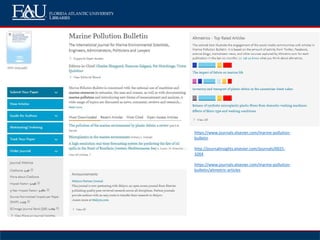
https://www.journals.elsevier.com/marine-pollution-
bulletin
http://journalinsights.elsevier.com/journals/0025-
326X
https://www.journals.elsevier.com/marine-pollution-
bulletin/altmetric-articles
Journal Impact Factor (JIF)
• Most well known and especially influential in STEM
disciplines
• JIF is a measure of the frequency with which the
"average article" published in a given scholarly
journal has been cited in a particular year or period
• JIF is not normalized for discipline. Can use Quartile
position of title in category: Q1, Q2, Q3, Q4
• 5-year indicators are also available
• The JIF can be found independently of Journal
Citation Reports, usually on the journal home page
Eigenfactor Scores® and Article
Influence ®
• The Eigenfactor Project is sponsored by the West
Lab at the Information School and the Bergstrom
Lab in the Department of Biology at the University
of Washington
• It uses information from the entire citation network
to measure the importance of each journal, much
as Google's PageRank algorithm measures the
importance of websites on the world wide web
• Find Eigenfactor metrics at Eigenfactor.Org
Scopus-Based Metrics
• CiteScore (Elsevier)
• Calculates the average number of citations received in a
calendar year by all items published in that journal in
the preceding three years
• CiteScore counts all documents since they all have the
potential to attract citations, and the Impact Factor
counts the documents considered most likely to attract
citations. CiteScore is independent of the document-
type classification
• See About CiteScore and its derivative metrics
• Find CiteScore at https://journalmetrics.scopus.com/
Scopus-Based Metrics
• SNIP (Source Normalized Impact per paper)
• Defined as the ratio of the raw Impact per Publication divided
by the Relative Database Citation Potential
• Corrects for subject-specific characteristics of the field
someone is publishing in so any two journal can be compared
• Find at CWTS Journal Indicators
http://www.journalindicators.com/
• SJR Indictor (SciMago)
• Citations are weighted, depending on the rank of the citing
journal
• A citation from an important journal will count as more than
one citation; a citation coming from a less important journal
will count as less than one citation.
• Find at www.scimagojr.com
Article-Level Metrics
Citation-based and altmetric measures can show
impact of individual research publication
• How many times was an article cited
• How is it tracking in social media
• What is the geographic distribution of citing papers
• What is the disciplinary distribution of citing papers
• What is the impact outside of the scholarly
Community
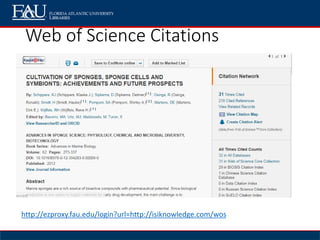
Web of Science Citations
http://ezproxy.fau.edu/login?url=http://isiknowledge.com/wos
Google Scholar
• Useful for authors and publications in disciplines
less well covered by the commercial services
• Author search in Google Scholar will produce a list
of publications with citation and a link to Google
Scholar Profile
• Indexes varied content
• Pro – Includes useful cited by literature such as policies
• Con – Can inflate citation counts
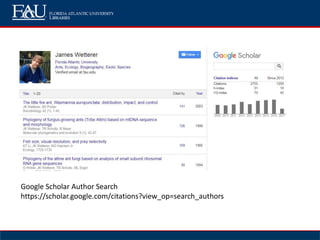
Google Scholar Author Search
https://scholar.google.com/citations?view_op=search_authors
Author Metrics
• H-Index is the best known. Attempts to measure
both productivity and impact of the published
work.
• A scientist has an index h if h of his/her Np papers
has at least h citations each, and the other (Np h)
papers have no more than h citations each
• To have an h-index of 5, an author has to have
5 publications, each receiving at least 5 citations
• Variants include g-index and m-index
• Account for highly cited papers or author career span
Where to Find H-Index
Value of the index may vary depending on the source of
information (number of indexed publications, time span, etc.)
• Web of Science
• To identify all publications by an author you can use Author Analyze
search function or enter author's ORCID or ResearcherID identifier
(if known)
• Google Scholar
• Requires creation of Google Scholar profile before providing metrics
• H-index tends to be higher than what is calculated by Web of
Science
• Publish or Perish http://www.harzing.com/pop.htm
• Freely accessible software program
• Uses Google Scholar data and includes h-index, g-index, m-index
and other metrics
Altmetrics
“Altmetrics expand our view of what impact looks
like, but also of what’s making the impact. This
matters because expressions of scholarship are
becoming more diverse.”
From http://altmetrics.org/manifesto/
Simply, altmetrics are metrics beyond traditional
citations.
What altmetrics address
• How many times something is downloaded
• Who is reading the work
• Has is it been covered by news outlets
• Who is commenting on the work
• How is it being shared
• Which countries are looking at my work
http://pitt.libguides.com/altmetrics/introduction
From University of Pittsburgh Library System
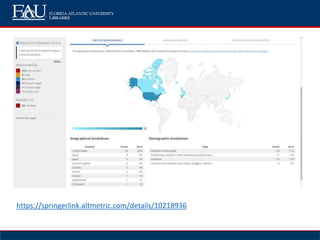
https://springerlink.altmetric.com/details/10218936
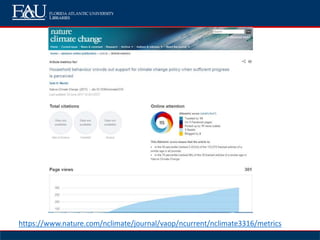
https://www.nature.com/nclimate/journal/vaop/ncurrent/nclimate3316/metrics
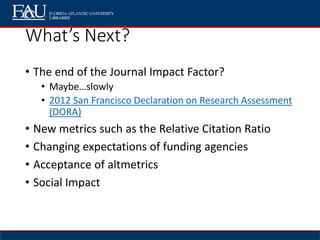
What’s Next?
• The end of the Journal Impact Factor?
• Maybe…slowly
• 2012 San Francisco Declaration on Research Assessment
(DORA)
• New metrics such as the Relative Citation Ratio
• Changing expectations of funding agencies
• Acceptance of altmetrics
• Social Impact
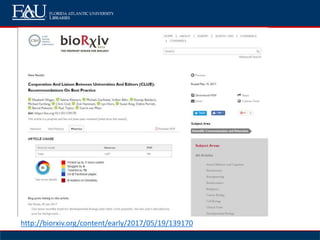
http://biorxiv.org/content/early/2017/05/19/139170

ImpactPresentation_HBOI_(1).pptx

  • 1.
    Demonstrating Scholarly Impact: Metrics,Tools and Trends Jane Strudwick, Director of Scholarly Communication June 23, 2017
  • 2.
    Topics Covered • Whyassess scholarly impact of research • Overview of metrics and tools • Journal Metrics • Article Metrics • Author Metrics • What are altmetrics • Current issues and future considerations
  • 3.
    What are wetalking about when we talk about impact? (Typically) Extent to which research is: • Read • Discussed • Used ….And • Disseminated Inside and outside academe
  • 4.
    Why we measure •For Promotion and Tenure • Determine research Quality • Assess potential for grant funding • Job Market • Prove productivity • Why else?
  • 5.
    What are wemeasuring? • Journal Quality • Article reach • Article impact/Influence • Dissemination • Researcher Impact
  • 6.
    How are wemeasuring? • Journal-Level Metrics • Measure quality of Journal using citation formulas • Article-Level Metrics • Citation Based or altmetrics • Author-Level Metrics • Measure bibliographic impact of individual authors • Altmetrics • Measures and monitors reach and impact of research through online interactions
  • 7.
    Journal-Level Metrics • Mostjournal-level metrics are calculated from the pool of journals indexed in two citation indexing databases • Web of Science(WOS) (Clarivate Analytics) Over 11,549 journals from the Science Citation Index Expanded (SCIE) and Social Science Citation Index (SSCI). The Library has a subscription to Web of Science, does not include access to Journal Citation Reports (JCR) • SCOPUS (Elsevier) Covers nearly 22,000 titles in the scientific, technical, medical and social sciences (including arts and humanities. The Library does not have a subscription to SCOPUS. Journal Metrics are freely available.
  • 8.
  • 9.
    Journal Impact Factor(JIF) • Most well known and especially influential in STEM disciplines • JIF is a measure of the frequency with which the "average article" published in a given scholarly journal has been cited in a particular year or period • JIF is not normalized for discipline. Can use Quartile position of title in category: Q1, Q2, Q3, Q4 • 5-year indicators are also available • The JIF can be found independently of Journal Citation Reports, usually on the journal home page
  • 10.
    Eigenfactor Scores® andArticle Influence ® • The Eigenfactor Project is sponsored by the West Lab at the Information School and the Bergstrom Lab in the Department of Biology at the University of Washington • It uses information from the entire citation network to measure the importance of each journal, much as Google's PageRank algorithm measures the importance of websites on the world wide web • Find Eigenfactor metrics at Eigenfactor.Org
  • 11.
    Scopus-Based Metrics • CiteScore(Elsevier) • Calculates the average number of citations received in a calendar year by all items published in that journal in the preceding three years • CiteScore counts all documents since they all have the potential to attract citations, and the Impact Factor counts the documents considered most likely to attract citations. CiteScore is independent of the document- type classification • See About CiteScore and its derivative metrics • Find CiteScore at https://journalmetrics.scopus.com/
  • 12.
    Scopus-Based Metrics • SNIP(Source Normalized Impact per paper) • Defined as the ratio of the raw Impact per Publication divided by the Relative Database Citation Potential • Corrects for subject-specific characteristics of the field someone is publishing in so any two journal can be compared • Find at CWTS Journal Indicators http://www.journalindicators.com/ • SJR Indictor (SciMago) • Citations are weighted, depending on the rank of the citing journal • A citation from an important journal will count as more than one citation; a citation coming from a less important journal will count as less than one citation. • Find at www.scimagojr.com
  • 13.
    Article-Level Metrics Citation-based andaltmetric measures can show impact of individual research publication • How many times was an article cited • How is it tracking in social media • What is the geographic distribution of citing papers • What is the disciplinary distribution of citing papers • What is the impact outside of the scholarly Community
  • 14.
    Web of ScienceCitations http://ezproxy.fau.edu/login?url=http://isiknowledge.com/wos
  • 15.
    Google Scholar • Usefulfor authors and publications in disciplines less well covered by the commercial services • Author search in Google Scholar will produce a list of publications with citation and a link to Google Scholar Profile • Indexes varied content • Pro – Includes useful cited by literature such as policies • Con – Can inflate citation counts
  • 16.
    Google Scholar AuthorSearch https://scholar.google.com/citations?view_op=search_authors
  • 17.
    Author Metrics • H-Indexis the best known. Attempts to measure both productivity and impact of the published work. • A scientist has an index h if h of his/her Np papers has at least h citations each, and the other (Np h) papers have no more than h citations each • To have an h-index of 5, an author has to have 5 publications, each receiving at least 5 citations • Variants include g-index and m-index • Account for highly cited papers or author career span
  • 18.
    Where to FindH-Index Value of the index may vary depending on the source of information (number of indexed publications, time span, etc.) • Web of Science • To identify all publications by an author you can use Author Analyze search function or enter author's ORCID or ResearcherID identifier (if known) • Google Scholar • Requires creation of Google Scholar profile before providing metrics • H-index tends to be higher than what is calculated by Web of Science • Publish or Perish http://www.harzing.com/pop.htm • Freely accessible software program • Uses Google Scholar data and includes h-index, g-index, m-index and other metrics
  • 19.
    Altmetrics “Altmetrics expand ourview of what impact looks like, but also of what’s making the impact. This matters because expressions of scholarship are becoming more diverse.” From http://altmetrics.org/manifesto/ Simply, altmetrics are metrics beyond traditional citations.
  • 20.
    What altmetrics address •How many times something is downloaded • Who is reading the work • Has is it been covered by news outlets • Who is commenting on the work • How is it being shared • Which countries are looking at my work http://pitt.libguides.com/altmetrics/introduction From University of Pittsburgh Library System
  • 21.
  • 22.
  • 23.
    What’s Next? • Theend of the Journal Impact Factor? • Maybe…slowly • 2012 San Francisco Declaration on Research Assessment (DORA) • New metrics such as the Relative Citation Ratio • Changing expectations of funding agencies • Acceptance of altmetrics • Social Impact
  • 24.