Operational Safety & Risk
management
Based on Bow Tie methodology

Arthur Groot
04 februari 2014
What is risk management?
Four elements in risk management:




Risk Treatment

Avoidance

Optimization

Transfer

Retention



Risk Acceptance



2

Risk Analysis

Source Identification

Risk Estimation

Risk Communication

04 februari 2014
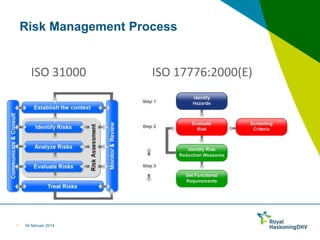
Risk Management Process

ISO 31000

3

04 februari 2014

ISO 17776:2000(E)
Why Bow Tie?



Visual overview



Clear and understandable diagram



Makes communication easy



4

The full picture

Extra focus on recovery, consequences

04 februari 2014
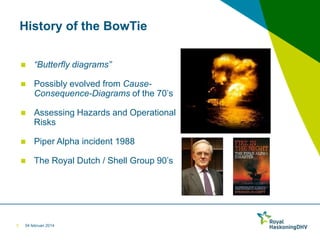
History of the BowTie



Possibly evolved from CauseConsequence-Diagrams of the 70’s



Assessing Hazards and Operational
Risks



Piper Alpha incident 1988



5

“Butterfly diagrams”

The Royal Dutch / Shell Group 90’s

04 februari 2014









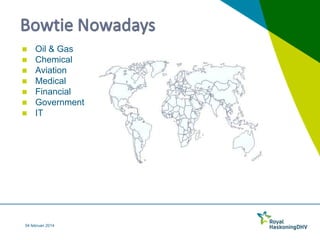
Oil & Gas
Chemical
Aviation
Medical
Financial
Government
IT

04 februari 2014


IADC HSE Case Guidelines




Demonstrate Internal Assurance
Meet Stakeholders Expectations

04 februari 2014

Global Leadership for the Drilling Industry
Why the need for BowTie






8

04 februari 2014
Quantitative vs Qualitative

9

04 februari 2014
Why qualitative risk management?



Multi causality in previous incidents



Involvement of the workforce



10

Complexity of the world

Most often the world is too complex to accurately quantify

04 februari 2014
Quantitative vs Qualitative


Quantification works best in static or linear environments
where the number of outcomes is finite or known



Qualification works best in dynamic or non-linear
environments (e.g. human factors present) where the
number of outcomes is infinite or uncertain

11

04 februari 2014
Quantitative vs. Qualitative





12

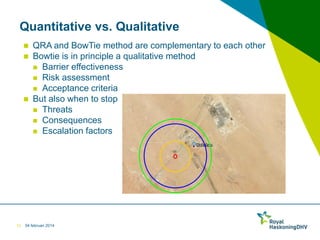
QRA and BowTie method are complementary to each other
Bowtie is in principle a qualitative method
 Barrier effectiveness
 Risk assessment
 Acceptance criteria
But also when to stop
 Threats
 Consequences
 Escalation factors

04 februari 2014
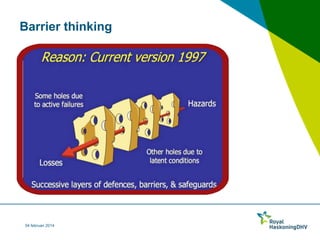
Barrier thinking

04 februari 2014
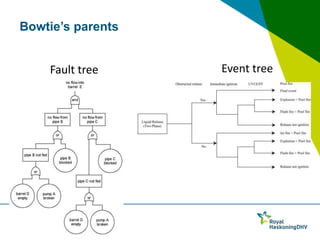
Bowtie’s parents
Fault tree

04 februari 2014

Event tree
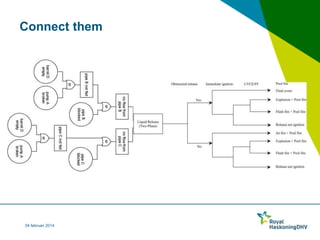
Connect them

04 februari 2014
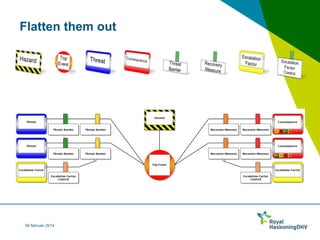
Flatten them out

04 februari 2014
The BowTie can be applied to any kind of risk!














17

Oil spill of explosive and toxic substance inside the process
plant
Tank rupture
Confined space entry with internal hazards, fall protection,
silica, falling brick hazards
Falling ice from high structure
Slip, trip and fall on ice
Welding/cutting hot work, ignition prevention
Oil spill to soil
Working with chemicals
Working near/with cranes
Working in open trenches
Fire pumps impaired
Etc.

04 februari 2014
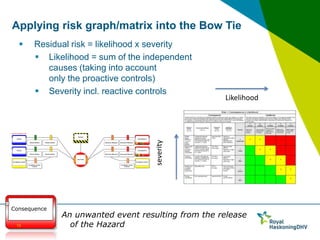
Applying risk graph/matrix into the Bow Tie
Residual risk = likelihood x severity
 Likelihood = sum of the independent
causes (taking into account
only the proactive controls)
 Severity incl. reactive controls

Likelihood

severity



Consequence
18

04 februari 2014

An unwanted event resulting from the release
of the Hazard
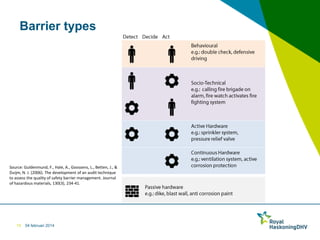
Barrier types

Source: Guldenmund, F., Hale, A., Goossens, L., Betten, J., &
Duijm, N. J. (2006). The development of an audit technique
to assess the quality of safety barrier management. Journal
of hazardous materials, 130(3), 234-41.

19

04 februari 2014
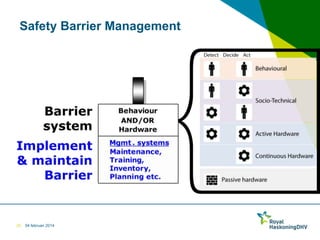
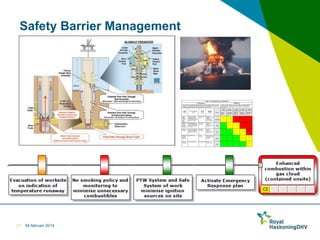
Safety Barrier Management

20

04 februari 2014
Safety Barrier Management

21

04 februari 2014
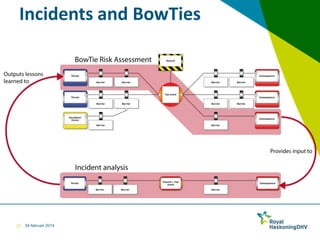
Incidents and BowTies

22

04 februari 2014
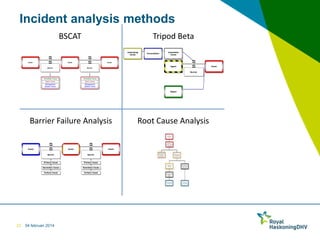
Incident analysis methods
BSCAT

Barrier Failure Analysis

23

Tripod Beta

Root Cause Analysis

04 februari 2014
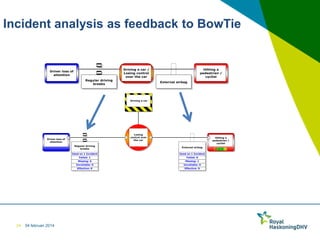
Incident analysis as feedback to BowTie

24

04 februari 2014
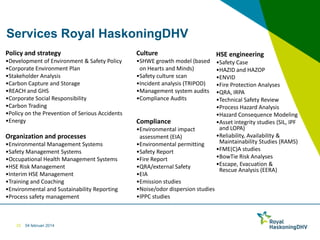
Services Royal HaskoningDHV
Policy and strategy

Culture

•Development of Environment & Safety Policy
•Corporate Environment Plan
•Stakeholder Analysis
•Carbon Capture and Storage
•REACH and GHS
•Corporate Social Responsibility
•Carbon Trading
•Policy on the Prevention of Serious Accidents
•Energy

•SHWE growth model (based
on Hearts and Minds)
•Safety culture scan
•Incident analysis (TRIPOD)
•Management system audits
•Compliance Audits

Organization and processes
•Environmental Management Systems
•Safety Management Systems
•Occupational Health Management Systems
•HSE Risk Management
•Interim HSE Management
•Training and Coaching
•Environmental and Sustainability Reporting
•Process safety management

25

04 februari 2014

Compliance
•Environmental impact
assessment (EIA)
•Environmental permitting
•Safety Report
•Fire Report
•QRA/external Safety
•EIA
•Emission studies
•Noise/odor dispersion studies
•IPPC studies

HSE engineering
•Safety Case
•HAZID and HAZOP
•ENVID
•Fire Protection Analyses
•QRA, IRPA
•Technical Safety Review
•Process Hazard Analysis
•Hazard Consequence Modeling
•Asset integrity studies (SIL, IPF
and LOPA)
•Reliability, Availability &
Maintainability Studies (RAMS)
•FME(C)A studies
•BowTie Risk Analyses
•Escape, Evacuation &
Rescue Analysis (EERA)

Bow Tie methodology for Operational Safety & Risk Management

  • 1.
    Operational Safety &Risk management Based on Bow Tie methodology Arthur Groot 04 februari 2014
  • 2.
    What is riskmanagement? Four elements in risk management:   Risk Treatment  Avoidance  Optimization  Transfer  Retention  Risk Acceptance  2 Risk Analysis  Source Identification  Risk Estimation Risk Communication 04 februari 2014
  • 3.
    Risk Management Process ISO31000 3 04 februari 2014 ISO 17776:2000(E)
  • 4.
    Why Bow Tie?   Visualoverview  Clear and understandable diagram  Makes communication easy  4 The full picture Extra focus on recovery, consequences 04 februari 2014
  • 5.
    History of theBowTie   Possibly evolved from CauseConsequence-Diagrams of the 70’s  Assessing Hazards and Operational Risks  Piper Alpha incident 1988  5 “Butterfly diagrams” The Royal Dutch / Shell Group 90’s 04 februari 2014
  • 6.
  • 7.
     IADC HSE CaseGuidelines   Demonstrate Internal Assurance Meet Stakeholders Expectations 04 februari 2014 Global Leadership for the Drilling Industry
  • 8.
    Why the needfor BowTie    8 04 februari 2014
  • 9.
  • 10.
    Why qualitative riskmanagement?   Multi causality in previous incidents  Involvement of the workforce  10 Complexity of the world Most often the world is too complex to accurately quantify 04 februari 2014
  • 11.
    Quantitative vs Qualitative  Quantificationworks best in static or linear environments where the number of outcomes is finite or known  Qualification works best in dynamic or non-linear environments (e.g. human factors present) where the number of outcomes is infinite or uncertain 11 04 februari 2014
  • 12.
    Quantitative vs. Qualitative    12 QRAand BowTie method are complementary to each other Bowtie is in principle a qualitative method  Barrier effectiveness  Risk assessment  Acceptance criteria But also when to stop  Threats  Consequences  Escalation factors 04 februari 2014
  • 13.
  • 14.
    Bowtie’s parents Fault tree 04februari 2014 Event tree
  • 15.
  • 16.
    Flatten them out 04februari 2014
  • 17.
    The BowTie canbe applied to any kind of risk!             17 Oil spill of explosive and toxic substance inside the process plant Tank rupture Confined space entry with internal hazards, fall protection, silica, falling brick hazards Falling ice from high structure Slip, trip and fall on ice Welding/cutting hot work, ignition prevention Oil spill to soil Working with chemicals Working near/with cranes Working in open trenches Fire pumps impaired Etc. 04 februari 2014
  • 18.
    Applying risk graph/matrixinto the Bow Tie Residual risk = likelihood x severity  Likelihood = sum of the independent causes (taking into account only the proactive controls)  Severity incl. reactive controls Likelihood severity  Consequence 18 04 februari 2014 An unwanted event resulting from the release of the Hazard
  • 19.
    Barrier types Source: Guldenmund,F., Hale, A., Goossens, L., Betten, J., & Duijm, N. J. (2006). The development of an audit technique to assess the quality of safety barrier management. Journal of hazardous materials, 130(3), 234-41. 19 04 februari 2014
  • 20.
  • 21.
  • 22.
  • 23.
    Incident analysis methods BSCAT BarrierFailure Analysis 23 Tripod Beta Root Cause Analysis 04 februari 2014
  • 24.
    Incident analysis asfeedback to BowTie 24 04 februari 2014
  • 25.
    Services Royal HaskoningDHV Policyand strategy Culture •Development of Environment & Safety Policy •Corporate Environment Plan •Stakeholder Analysis •Carbon Capture and Storage •REACH and GHS •Corporate Social Responsibility •Carbon Trading •Policy on the Prevention of Serious Accidents •Energy •SHWE growth model (based on Hearts and Minds) •Safety culture scan •Incident analysis (TRIPOD) •Management system audits •Compliance Audits Organization and processes •Environmental Management Systems •Safety Management Systems •Occupational Health Management Systems •HSE Risk Management •Interim HSE Management •Training and Coaching •Environmental and Sustainability Reporting •Process safety management 25 04 februari 2014 Compliance •Environmental impact assessment (EIA) •Environmental permitting •Safety Report •Fire Report •QRA/external Safety •EIA •Emission studies •Noise/odor dispersion studies •IPPC studies HSE engineering •Safety Case •HAZID and HAZOP •ENVID •Fire Protection Analyses •QRA, IRPA •Technical Safety Review •Process Hazard Analysis •Hazard Consequence Modeling •Asset integrity studies (SIL, IPF and LOPA) •Reliability, Availability & Maintainability Studies (RAMS) •FME(C)A studies •BowTie Risk Analyses •Escape, Evacuation & Rescue Analysis (EERA)

Editor's Notes

  • #3 Another thing to define as clearly as possible going on is What is Risk Management? What do we do when managing risks? What are the steps to take and inputs and outputs do we need to get a good overview of what we are doing?Risk Management is often described in several phases:First we need to analyze what out Risks are. This means indentifying the sources of risk and estimating what the potential consequences of these risks are. The second step is to decide how we can treat our risks; what are the best ways to control our business? Do we want to avoid certain risks because the potential outcomes are simply too bad? How can we optimize the controls that we have in place to avoid certain events? Can we transfer certain controls, or retain them?The next step is to accept that we are dealing with certain risks when doing business. We know the risks, we know how to treat them and we accept that they are part of our organizational environment. This leading to the next step: Risk Communication. As said in the part about Risk Perception; it is of major importance that people are aware of the risks they are dealing with and know what their role is in keeping controls and barriers working. This can only be done when Risk Communication properly.
  • #9 New systems Sil systems
  • #10 BowTieXL is the latest addition to the BowTieXP software. It adds Excel type functionality to a Bowtie, allowing you to make calculations and more.
  • #14 In 1990 psychologist James T. Reason proposed the Swiss Cheese metaphor as an accident causation model. Reason hypothesized that hazards are prevented from causing losses by a series of barriers, known as controls in the bowtie method. He states that these barriers however are never 100% effective. Each barrier has unintended (inconstant) weaknesses and when these so called ‘holes’ line up a hazard can be released. According to Reason the common causes of the weaknesses in barriers can often be found in the organization (latent failures). E.g. cost & time cutting on maintenance management can eventually lead to the deterioration of the integrity of many hardware barriers within a system. In the Bowtie method these weaknesses are defined as Escalation Factors and are important features to fight the illusion of control that organizations sometime tend to have.
  • #15 Bowtie was created by mixing two existing risk analysis tools, namely Fault trees and Event trees.Fault trees flow from bottom to top and show all the ways in which the Top Event, the event at the top, can happen. Fault trees have AND/OR gauges to model whether controls are parallel or sequential.Event trees work the other way around. They start with a single event, and model what consequences can result from that. They do that by having combinations of conditions, and based on a particular combination, a certain consequence occurs. Often Event trees also have calculated frequencies for their consequences.
  • #16 Bowtie adds the two together, and forms one diagram.
  • #17 Bowtie also takes out the complexity of both the Fault tree and Event tree, making it an excellent tool for communication of risk at all levels of the organisation, not only for the experts at the HSE department. Taking out the complexity has some consequences, which we will discuss later on.Important to note is that the Bowtie method is meant for a higher abstraction level. Whereas Fault trees and Event trees are focused sometimes on the level of a single valve, Bowtie tends to focus on a higher level, and thus provides an excellent overview. It also means that Fault trees and Event trees are not obsolete, they can still be used for a more detailed picture.
  • #19 Residual! After implementing everything, all tasks, accountabilities etc
  • #20 Guldenmund, F., Hale, A., Goossens, L., Betten, J., & Duijm, N. J. (2006). The development of an audit technique to assess the quality of safety barrier management. Journal of hazardous materials, 130(3), 234-41.