Meta-analysis Techniques in
Epidemiology
Collate, analyze and conclude using results of several
related studies.
Dr Sakshi Dubey, M.V.Sc. Scholar, Division of Epidemiology
&
Dr. BR Singh, Head Division of Epidemiology Indian Veterinary Research
Institute, Izatnagar & Director CCS NIAH, Baghpat
 Analysis of analyses
 Collate, analyze and conclude using results of several related studies
 The statistical analysis of a collection of analytic results for the purpose of
integrating their findings (DerSimonian and Laird,
1986)
 Published studies from literature are combined (Berman and Parker,
2002)
 Weighted analysis of summary statistics (Bravata and Olkin,
2001)
 Frequently used for clinical trials
 Benefits of Meta-analysis
 Offers more reliable information
 Increases precision in estimating effects
Meta-analysis
Meta-analysis ???
 Single study
 Deliver reliable information for only specific place or period
 Diverse results due to varying places or periods or both
 Incapable in providing final conclusions
 Interest
 How far results of individual studies are stable under varying
situations
 Provide valid results for wider population
 Combined statistical analysis is necessary
 To produce overall summary of result
 To determine consistency among different studies
 Meta-analysis
Overcomes the limits of size or scope in single studies.
History
 The 12th century in China, Chu Hsi (1130~1200)
formulated 'Theory of Systematic Rule’
 In Western World (17th century) studies of astronomy
 In 1904 Karl Pearson in the British Medical Journal,
published a paper on multiple clinical studies
 In the 1970s, meta analysis was introduced in
educational research, starting with the work of Gene V.
Glass, Frank L. Schmidt and John E. Hunter.
Function of Meta-Analysis
 Identifies heterogeneity
 Increases statistical power and precision of the study
 Develop ,refine, and tests hypothesis
 Calculates sample size for future studies
 Identifies data gaps
 Reduces the subjectivity of study comparisons
Advantages
 Focuses attention on trials as an evaluation tool to
increase the impact of trials on clinical practice.
 Encourages designing of good trial and increases
strength of conclusions.
 Make the results fit for generalising to a larger
population.
 Improves precision and accuracy of estimates
through use of more data sets.
 May increase the statistical power to detect an
effect.
Advantages
 Inconsistency of results across studies can be
quantified, analyzed and corrected.
 Hypothesis testing can be applied on summary
estimates.
 Moderators can be included to explain variation
between studies.
 The presence of publication bias can be
investigated.
Disadvantages
 Meta-analysis may discourage large definitive trials.
 Increases tendency to unwittingly mix different trials
and ignore differences.
 Potential for tension between meta-analyst and
conductors of original trials may introduce biasness.
 Meta-analysis of several small studies may not
predict the results of a single large study.
 Sources of bias are not controlled by the method
 A good meta-analysis of badly designed studies will
still result in bad statistics.
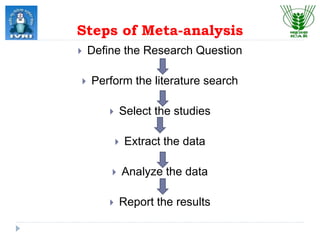
Steps of Meta-analysis
 Define the Research Question
 Perform the literature search
 Select the studies
 Extract the data
 Analyze the data
 Report the results
Study Sources
 Published literature
 citation indexes
 abstract databases
 reference lists
 contact with authors
 Unpublished literature
 Uncompleted research reports
 Work in progress
Quality Assessment
Study components
 Study design
 Outcome measurement
 Exposure measurement
 Response rate/follow-up rate
Analytic strategy
 Adjustment for confounding
Quality of reporting
Data Extraction
 Publication year
 Performing year
 Study design
 Characteristics of study population (n, age,
sex)
 Geographical setting
 Assessment procedures
 Risk estimate and variance
 Covariates
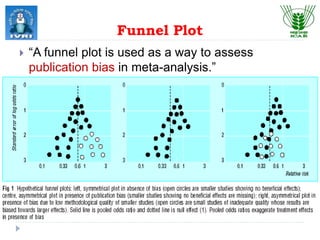
Funnel Plot
 “A funnel plot is used as a way to assess
publication bias in meta-analysis.”
Comparability of sources
 Key feature of component trial is the variability
(heterogeneity)
 Heterogeneity is variation between the studies’
results
Statistical measures of heterogeneity
 The Chi2 test measures the amount of variation in a
set of trials, and tells us if it is more than would be
expected by chance.
 I squared quantifies heterogeneity.
where Q = heterogeneity c2
statistic
Higgins and Thompson
(2002)
Q
dfQ
I

1002
Types of models are used to
produce summary effect measures
1
• Fixed Effect Model
2
• Random Effects Model
3
• Meta-Regression
Fixed effect model
 Inference is based on the studies actually done.
 The variance component of the summary effect is
only composed of terms for the within study variance
of each study.
 Confidence intervals too narrow.
Random Effect Model
 Inference is based on the assumption that studies
used in the analysis are a random sample of a
hypothetical population of studies.
 Variance component includes a between study
component as well as a within study component.
 Confidence interval is wide or wider than in fixed
effect model.
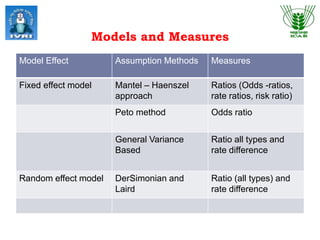
Models and Measures
Model Effect Assumption Methods Measures
Fixed effect model Mantel – Haenszel
approach
Ratios (Odds -ratios,
rate ratios, risk ratio)
Peto method Odds ratio
General Variance
Based
Ratio all types and
rate difference
Random effect model DerSimonian and
Laird
Ratio (all types) and
rate difference
^
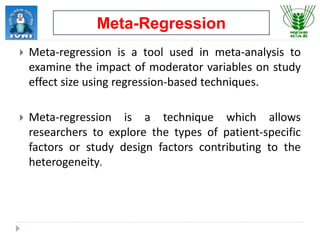
 Meta-regression is a tool used in meta-analysis to
examine the impact of moderator variables on study
effect size using regression-based techniques.
 Meta-regression is a technique which allows
researchers to explore the types of patient-specific
factors or study design factors contributing to the
heterogeneity.
Meta-Regression
Forest plot
The graphical display of results from individual
studies on a common scale is a “Forest plot”
 Useful tool for epidemiological studies which investigates the
relationships between certain risk factors and disease. (Dutton, 2010)
 Useful tool to improve animal well-being and productivity
 Despite of a wealth of suitable studies it is relatively underutilized in
animal and veterinary science. Lean et al. (2009)
 Meta-analysis can provide reliable results about diseases occurrence,
pattern and impact in livestock.
 It is utmost essential to take benefit of this statistical tool for produce.
more reliable estimates of concern effects in animal and veterinary
science data.
Meta-analysis for animal and
veterinary science
Conclusion
 Prior to conducting a meta-analysis, it is necessary to
determine if the purpose is to explore sources of
heterogeneity or to calculate a summary effect size.
 Each Steps of Meta-analysis is very important.
 Source of data should be free from publication biasness.
 Follows GIGO principle of ‘garbage in, garbage out’.
 Like large epidemiologic studies, meta-analysis run the risk of
appearing to give results more precise and conclusive that are
warranted.

Meta analysis techniques in epidemiology

  • 1.
    Meta-analysis Techniques in Epidemiology Collate,analyze and conclude using results of several related studies. Dr Sakshi Dubey, M.V.Sc. Scholar, Division of Epidemiology & Dr. BR Singh, Head Division of Epidemiology Indian Veterinary Research Institute, Izatnagar & Director CCS NIAH, Baghpat
  • 2.
     Analysis ofanalyses  Collate, analyze and conclude using results of several related studies  The statistical analysis of a collection of analytic results for the purpose of integrating their findings (DerSimonian and Laird, 1986)  Published studies from literature are combined (Berman and Parker, 2002)  Weighted analysis of summary statistics (Bravata and Olkin, 2001)  Frequently used for clinical trials  Benefits of Meta-analysis  Offers more reliable information  Increases precision in estimating effects Meta-analysis
  • 3.
    Meta-analysis ???  Singlestudy  Deliver reliable information for only specific place or period  Diverse results due to varying places or periods or both  Incapable in providing final conclusions  Interest  How far results of individual studies are stable under varying situations  Provide valid results for wider population  Combined statistical analysis is necessary  To produce overall summary of result  To determine consistency among different studies  Meta-analysis Overcomes the limits of size or scope in single studies.
  • 4.
    History  The 12thcentury in China, Chu Hsi (1130~1200) formulated 'Theory of Systematic Rule’  In Western World (17th century) studies of astronomy  In 1904 Karl Pearson in the British Medical Journal, published a paper on multiple clinical studies  In the 1970s, meta analysis was introduced in educational research, starting with the work of Gene V. Glass, Frank L. Schmidt and John E. Hunter.
  • 5.
    Function of Meta-Analysis Identifies heterogeneity  Increases statistical power and precision of the study  Develop ,refine, and tests hypothesis  Calculates sample size for future studies  Identifies data gaps  Reduces the subjectivity of study comparisons
  • 6.
    Advantages  Focuses attentionon trials as an evaluation tool to increase the impact of trials on clinical practice.  Encourages designing of good trial and increases strength of conclusions.  Make the results fit for generalising to a larger population.  Improves precision and accuracy of estimates through use of more data sets.  May increase the statistical power to detect an effect.
  • 7.
    Advantages  Inconsistency ofresults across studies can be quantified, analyzed and corrected.  Hypothesis testing can be applied on summary estimates.  Moderators can be included to explain variation between studies.  The presence of publication bias can be investigated.
  • 8.
    Disadvantages  Meta-analysis maydiscourage large definitive trials.  Increases tendency to unwittingly mix different trials and ignore differences.  Potential for tension between meta-analyst and conductors of original trials may introduce biasness.  Meta-analysis of several small studies may not predict the results of a single large study.  Sources of bias are not controlled by the method  A good meta-analysis of badly designed studies will still result in bad statistics.
  • 9.
    Steps of Meta-analysis Define the Research Question  Perform the literature search  Select the studies  Extract the data  Analyze the data  Report the results
  • 10.
    Study Sources  Publishedliterature  citation indexes  abstract databases  reference lists  contact with authors  Unpublished literature  Uncompleted research reports  Work in progress
  • 11.
    Quality Assessment Study components Study design  Outcome measurement  Exposure measurement  Response rate/follow-up rate Analytic strategy  Adjustment for confounding Quality of reporting
  • 12.
    Data Extraction  Publicationyear  Performing year  Study design  Characteristics of study population (n, age, sex)  Geographical setting  Assessment procedures  Risk estimate and variance  Covariates
  • 13.
    Funnel Plot  “Afunnel plot is used as a way to assess publication bias in meta-analysis.”
  • 14.
    Comparability of sources Key feature of component trial is the variability (heterogeneity)  Heterogeneity is variation between the studies’ results
  • 15.
    Statistical measures ofheterogeneity  The Chi2 test measures the amount of variation in a set of trials, and tells us if it is more than would be expected by chance.  I squared quantifies heterogeneity. where Q = heterogeneity c2 statistic Higgins and Thompson (2002) Q dfQ I  1002
  • 16.
    Types of modelsare used to produce summary effect measures 1 • Fixed Effect Model 2 • Random Effects Model 3 • Meta-Regression
  • 17.
    Fixed effect model Inference is based on the studies actually done.  The variance component of the summary effect is only composed of terms for the within study variance of each study.  Confidence intervals too narrow.
  • 18.
    Random Effect Model Inference is based on the assumption that studies used in the analysis are a random sample of a hypothetical population of studies.  Variance component includes a between study component as well as a within study component.  Confidence interval is wide or wider than in fixed effect model.
  • 19.
    Models and Measures ModelEffect Assumption Methods Measures Fixed effect model Mantel – Haenszel approach Ratios (Odds -ratios, rate ratios, risk ratio) Peto method Odds ratio General Variance Based Ratio all types and rate difference Random effect model DerSimonian and Laird Ratio (all types) and rate difference
  • 20.
    ^  Meta-regression isa tool used in meta-analysis to examine the impact of moderator variables on study effect size using regression-based techniques.  Meta-regression is a technique which allows researchers to explore the types of patient-specific factors or study design factors contributing to the heterogeneity. Meta-Regression
  • 21.
    Forest plot The graphicaldisplay of results from individual studies on a common scale is a “Forest plot”
  • 22.
     Useful toolfor epidemiological studies which investigates the relationships between certain risk factors and disease. (Dutton, 2010)  Useful tool to improve animal well-being and productivity  Despite of a wealth of suitable studies it is relatively underutilized in animal and veterinary science. Lean et al. (2009)  Meta-analysis can provide reliable results about diseases occurrence, pattern and impact in livestock.  It is utmost essential to take benefit of this statistical tool for produce. more reliable estimates of concern effects in animal and veterinary science data. Meta-analysis for animal and veterinary science
  • 23.
    Conclusion  Prior toconducting a meta-analysis, it is necessary to determine if the purpose is to explore sources of heterogeneity or to calculate a summary effect size.  Each Steps of Meta-analysis is very important.  Source of data should be free from publication biasness.  Follows GIGO principle of ‘garbage in, garbage out’.  Like large epidemiologic studies, meta-analysis run the risk of appearing to give results more precise and conclusive that are warranted.