Que.1 What is an economy?
Ans.1 An economy is the area of the production,
distribution, or trade, and consumption of goods
and services by different agents.
Que.2 India has which type of economy?
Que.1 What is an economy?
Ans.1 An economy is the area of the production,
distribution, or trade, and consumption of goods
and services by different agents
Que.2 India has which type of economy?
Ans.2 India has Mixed Economy.
Que.3 Why Indian economy is known as mixed
economy?
Que.2 India has which type of economy?
Ans.2 India has Mixed Economy.
Que.3 Why Indian economy is known as
mixed economy?
Ans. 3 Because it consist both public and
private enterprises.
Que.4 What is Private enterprises?
Que.3 Why Indian economy is known as
mixed economy?
Ans. 3 Because it consist both public and
private enterprises.
Que.4 What is Private enterprises?
Ans.4 ( Problematic question)
Private enterprises
Developmentary questions
Que.1 Who Owns the Reliance company?
Ans.1________________
Que.2 Who control the working of Indian
railway?
Ans.2________________
• There are all kinds of business organizations-
Small or large, industrial or trading, private
owned or government owned existing in our
country.
• These organizations affect our economic life
therefore become the part of Indian economy.
• Since Indian Economy consist both private
owned and government owned enterprises, it
is known as mixed economy.
Introduction
The private sector consist of
business owned by individuals.
The various form of organizations in
private sectors are sole
proprietorship, partnership, joint
Hindu family, cooperative society
and company.
PRIVATE Enterprises
Sole
Proprietorship
Partnership
Joint Hindu Family
Business
Cooperative society
Company
Evaluative question
Que.1 What do you understand by Private
enterprise?
Ans.1__________________________________
____________________________________
Que.2 The various forms of organizations in
private sectors are :-
(a) Sole proprietorship
(b) joint Hindu family
(c) company
(d)All the above.
Developmentary Question
Que.1 How many persons are required to start
a stationary?
Ans.1______________.
Sole proprietorship
 Sole proprietorship refers to a form of business
organization which is owned , managed and
controlled by an individual who is the recipient of
all profit and bearer of all risks.
 The word “sole” implies “only” and “proprietor”
refers to “owner”. Hence, a sole proprietor is the
one who is the only owner of a business.
Features of Sole- Proprietorship
Single
ownership
Unlimited
Liability
Profits and
Losses
Common
identity
Capital
Choose the correct option:-
Que. 1 Which of the following is not the feature
of sole proprietorship?
(a) Single ownership.
(b) Separate Identity of business.
(c) Risk are to be borne alone.
(d) Unlimited Liability.
Que.2 Write any two Demerits of Sole
Proprietorship.
JOINT HINDU
FAMILY BUSINESS
• Joint Hindu family business is a specific form
of business organization found only in India.
• It refers to a form of organization wherein the
business is owned and carried on by the
members of the Hindu undivided family .
• The business is controlled by the head of the
family who is the eldest member & is called as
KARTA
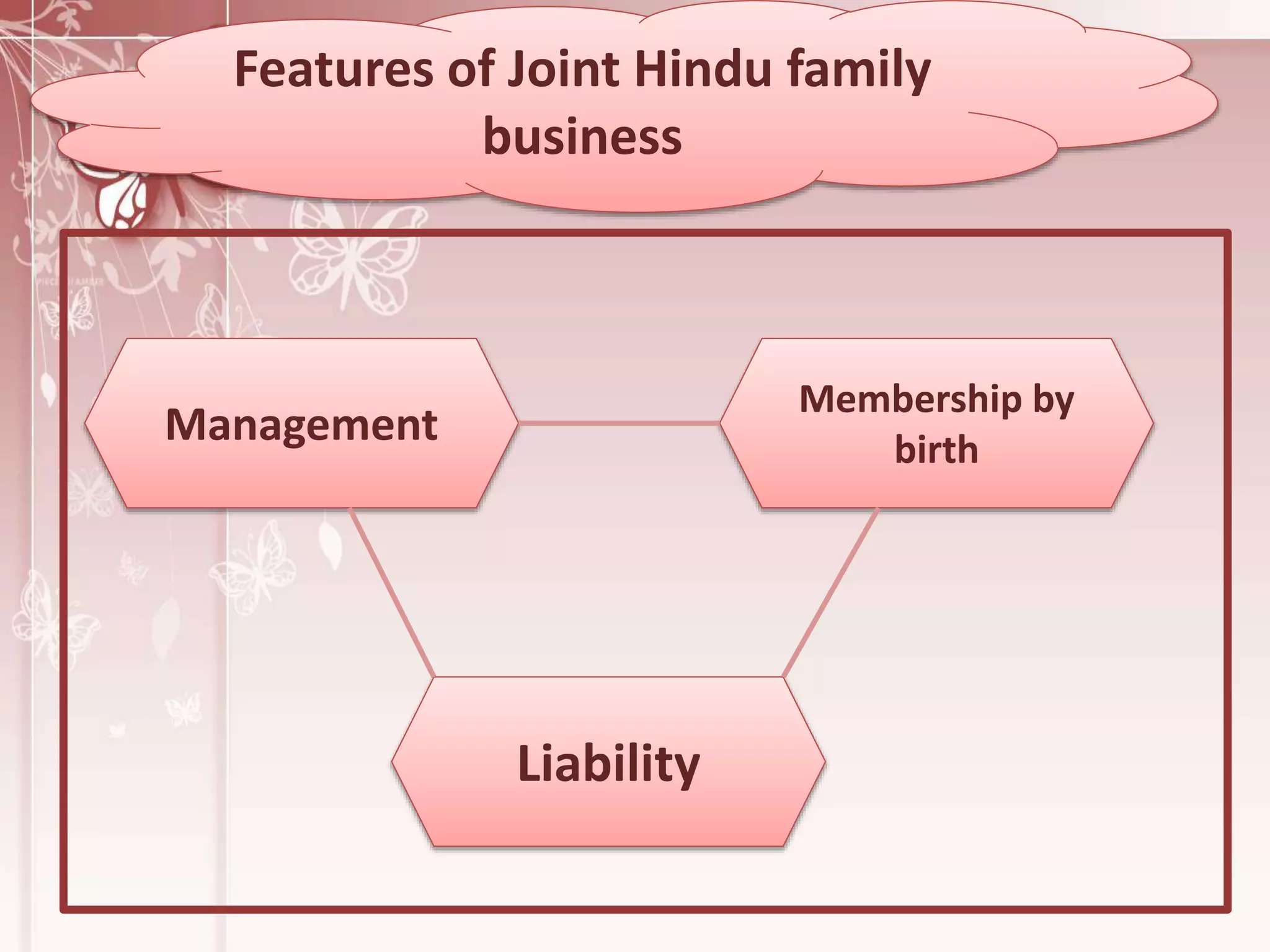
Features of Joint Hindu family
business
Management
Membership by
birth
Liability
• Easy formation
• Quick decisions and prompt action
• Flexibility in operation
• Business Secrecy
• Continuity of business
• Limited liability of co- parceners
• Limited Capital
• Unlimited liability of Karta
• Lack of stability
• Less motivation
• Limited Growth and Expansion
• No entry for non family members
• No Legal Status
Que.1 How does a family member become the
member of Joint Hindu Family Business?
Que.2 What are the merits of Joint Hindu Family
business?
Whiteboard work
PARTNERSHIP
More Persons
Profit and loss
sharing
Unlimited
Liability
Restrictions on
Transfer of
Share
Contractual
Relationship
Features of Partnership
Que.1 What is the minimum numbers
of partners in partnership?
(a) 2 (b)4
(c)10 (d)5
Que.2 Partners of a partnership
firms have-
(a) Limited Liability
(b) Unlimited Liability
Summary…
 The private sector consist of business
owned by individuals.
The various form of organizations in
private sectors are sole proprietorship,
partnership, joint Hindu family,
cooperative society and company.
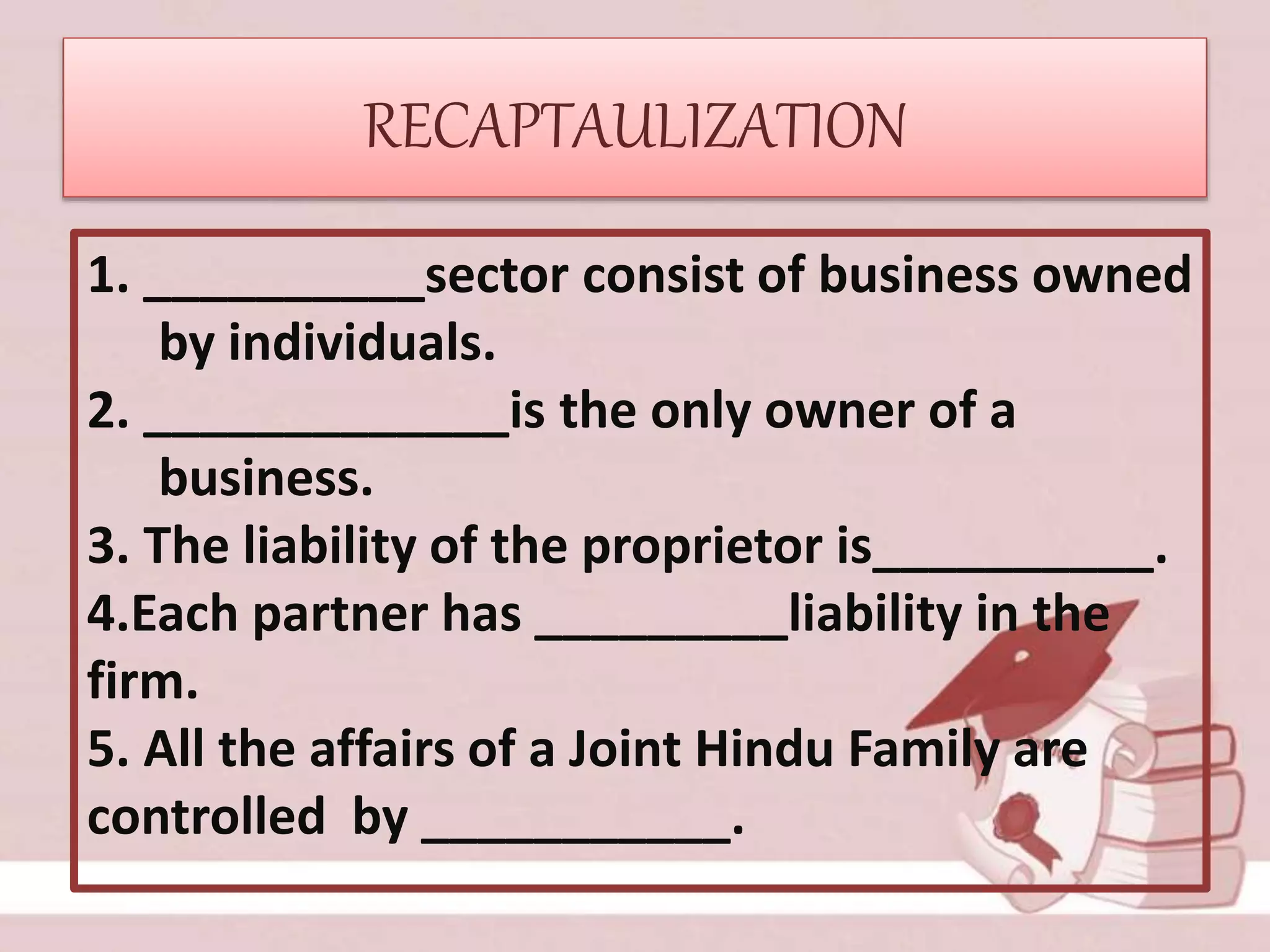
RECAPTAULIZATION
1. __________sector consist of business owned
by individuals.
2. _____________is the only owner of a
business.
3. The liability of the proprietor is__________.
4.Each partner has _________liability in the
firm.
5. All the affairs of a Joint Hindu Family are
controlled by ___________.
Home Assignment
Que.1 Write the merits and demerits of
joint Hindu family business?

ppt of online teaching of commerce

  • 1.
    Que.1 What isan economy?
  • 2.
    Que.1 What isan economy? Ans.1 An economy is the area of the production, distribution, or trade, and consumption of goods and services by different agents. Que.2 India has which type of economy?
  • 3.
    Que.1 What isan economy? Ans.1 An economy is the area of the production, distribution, or trade, and consumption of goods and services by different agents Que.2 India has which type of economy? Ans.2 India has Mixed Economy. Que.3 Why Indian economy is known as mixed economy?
  • 4.
    Que.2 India haswhich type of economy? Ans.2 India has Mixed Economy. Que.3 Why Indian economy is known as mixed economy? Ans. 3 Because it consist both public and private enterprises. Que.4 What is Private enterprises?
  • 5.
    Que.3 Why Indianeconomy is known as mixed economy? Ans. 3 Because it consist both public and private enterprises. Que.4 What is Private enterprises? Ans.4 ( Problematic question)
  • 6.
  • 7.
    Developmentary questions Que.1 WhoOwns the Reliance company? Ans.1________________ Que.2 Who control the working of Indian railway? Ans.2________________
  • 8.
    • There areall kinds of business organizations- Small or large, industrial or trading, private owned or government owned existing in our country. • These organizations affect our economic life therefore become the part of Indian economy. • Since Indian Economy consist both private owned and government owned enterprises, it is known as mixed economy. Introduction
  • 9.
    The private sectorconsist of business owned by individuals. The various form of organizations in private sectors are sole proprietorship, partnership, joint Hindu family, cooperative society and company.
  • 10.
    PRIVATE Enterprises Sole Proprietorship Partnership Joint HinduFamily Business Cooperative society Company
  • 11.
    Evaluative question Que.1 Whatdo you understand by Private enterprise? Ans.1__________________________________ ____________________________________
  • 12.
    Que.2 The variousforms of organizations in private sectors are :- (a) Sole proprietorship (b) joint Hindu family (c) company (d)All the above.
  • 13.
    Developmentary Question Que.1 Howmany persons are required to start a stationary? Ans.1______________.
  • 14.
    Sole proprietorship  Soleproprietorship refers to a form of business organization which is owned , managed and controlled by an individual who is the recipient of all profit and bearer of all risks.  The word “sole” implies “only” and “proprietor” refers to “owner”. Hence, a sole proprietor is the one who is the only owner of a business.
  • 15.
    Features of Sole-Proprietorship Single ownership Unlimited Liability Profits and Losses Common identity Capital
  • 17.
    Choose the correctoption:- Que. 1 Which of the following is not the feature of sole proprietorship? (a) Single ownership. (b) Separate Identity of business. (c) Risk are to be borne alone. (d) Unlimited Liability.
  • 18.
    Que.2 Write anytwo Demerits of Sole Proprietorship.
  • 19.
  • 21.
    • Joint Hindufamily business is a specific form of business organization found only in India. • It refers to a form of organization wherein the business is owned and carried on by the members of the Hindu undivided family . • The business is controlled by the head of the family who is the eldest member & is called as KARTA
  • 22.
    Features of JointHindu family business Management Membership by birth Liability
  • 23.
    • Easy formation •Quick decisions and prompt action • Flexibility in operation • Business Secrecy • Continuity of business • Limited liability of co- parceners
  • 24.
    • Limited Capital •Unlimited liability of Karta • Lack of stability • Less motivation • Limited Growth and Expansion • No entry for non family members • No Legal Status
  • 25.
    Que.1 How doesa family member become the member of Joint Hindu Family Business?
  • 26.
    Que.2 What arethe merits of Joint Hindu Family business? Whiteboard work
  • 27.
  • 29.
    More Persons Profit andloss sharing Unlimited Liability Restrictions on Transfer of Share Contractual Relationship Features of Partnership
  • 30.
    Que.1 What isthe minimum numbers of partners in partnership? (a) 2 (b)4 (c)10 (d)5
  • 31.
    Que.2 Partners ofa partnership firms have- (a) Limited Liability (b) Unlimited Liability
  • 32.
    Summary…  The privatesector consist of business owned by individuals. The various form of organizations in private sectors are sole proprietorship, partnership, joint Hindu family, cooperative society and company.
  • 33.
    RECAPTAULIZATION 1. __________sector consistof business owned by individuals. 2. _____________is the only owner of a business. 3. The liability of the proprietor is__________. 4.Each partner has _________liability in the firm. 5. All the affairs of a Joint Hindu Family are controlled by ___________.
  • 34.
    Home Assignment Que.1 Writethe merits and demerits of joint Hindu family business?