Introductory Questions
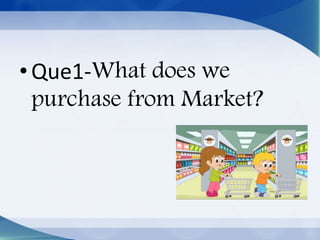
•Que1-What does we
purchase from Market?
Que.1-What does we purchase from Market?
Ans.1- We purchase commodities or things of
our needs.
Que.2- How does we purchase the commodity?
Que.1-What does we purchase from Market?
Ans.1- We purchase commodities or things of our
needs.
Que.2- How does we purchase the commodity?
Ans.2- By paying the money.
Que.3-How the price of the commodity is decided?
Que.1-What does we purchase from Market?
Ans.1- We purchase commodities or things of our
needs.
Que.2- How does we purchase the commodity?
Ans.2- By paying the money.
Que.3-How the price of the commodity is decided?
Ans.3- On the basis or expenditure incurred by
producer.
Que.1-What does we purchase from Market?
Ans.1- We purchase commodities or things of our
needs.
Que.2- How does we purchase the commodity?
Ans.2- By paying the money.
Que.3-How the price of the commodity is decided?
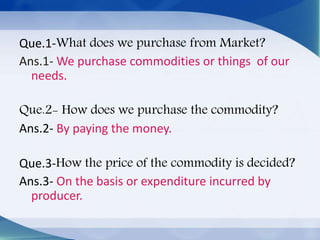
Ans.3- On the basis or expenditure incurred by
producer.
Que.4- What does we called that expenditure from
producers point of view?
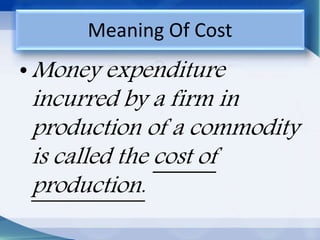
•Money expenditure
incurred by a firm in
production of a commodity
is called the cost of
production.
Meaning Of Cost
“COST is the sum of explicit costs
and implicit costs constitute cost
of production of a commodity”
Definition Of Cost
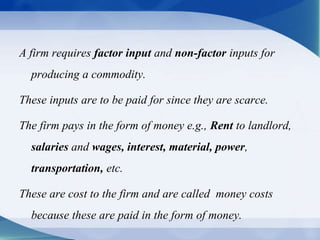
A firm requires factor input and non-factor inputs for
producing a commodity.
These inputs are to be paid for since they are scarce.
The firm pays in the form of money e.g., Rent to landlord,
salaries and wages, interest, material, power,
transportation, etc.
These are cost to the firm and are called money costs
because these are paid in the form of money.
Que.1- What do you understand by
Cost of Production?
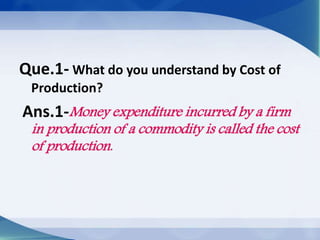
Que.1- What do you understand by Cost of
Production?
Ans.1-Money expenditure incurred by a firm
in production of a commodity is called the cost
of production.
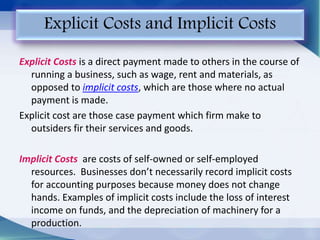
Explicit Costs is a direct payment made to others in the course of
running a business, such as wage, rent and materials, as
opposed to implicit costs, which are those where no actual
payment is made.
Explicit cost are those case payment which firm make to
outsiders fir their services and goods.
Implicit Costs are costs of self-owned or self-employed
resources. Businesses don’t necessarily record implicit costs
for accounting purposes because money does not change
hands. Examples of implicit costs include the loss of interest
income on funds, and the depreciation of machinery for a
production.
Explicit Costs and Implicit Costs
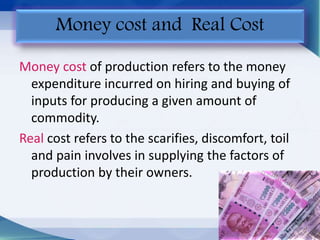
Money cost of production refers to the money
expenditure incurred on hiring and buying of
inputs for producing a given amount of
commodity.
Real cost refers to the scarifies, discomfort, toil
and pain involves in supplying the factors of
production by their owners.
Money cost and Real Cost
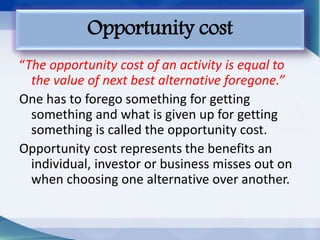
“The opportunity cost of an activity is equal to
the value of next best alternative foregone.”
One has to forego something for getting
something and what is given up for getting
something is called the opportunity cost.
Opportunity cost represents the benefits an
individual, investor or business misses out on
when choosing one alternative over another.
Opportunity cost
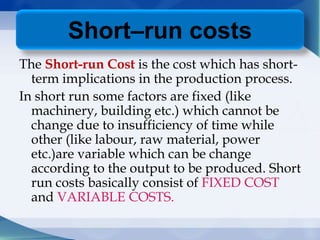
The Short-run Cost is the cost which has short-
term implications in the production process.
In short run some factors are fixed (like
machinery, building etc.) which cannot be
change due to insufficiency of time while
other (like labour, raw material, power
etc.)are variable which can be change
according to the output to be produced. Short
run costs basically consist of FIXED COST
and VARIABLE COSTS.
Short–run costs
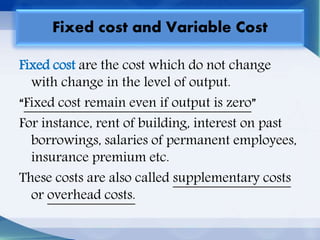
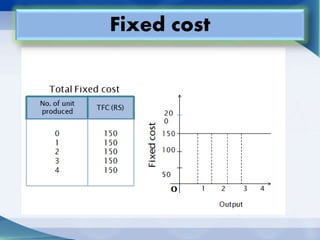
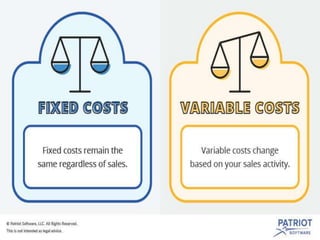
Fixed cost are the cost which do not change
with change in the level of output.
“Fixed cost remain even if output is zero”
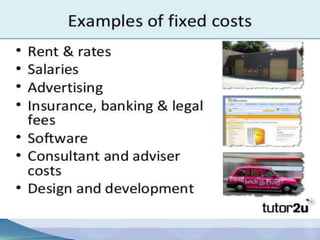
For instance, rent of building, interest on past
borrowings, salaries of permanent employees,
insurance premium etc.
These costs are also called supplementary costs
or overhead costs.
Fixed cost and Variable Cost
Fixed cost
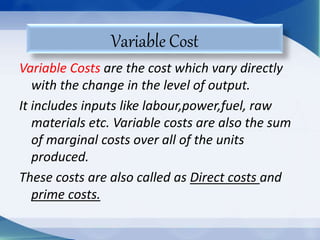
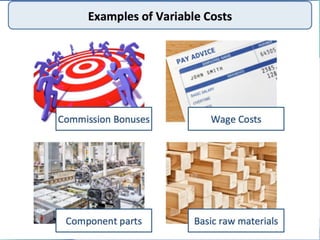
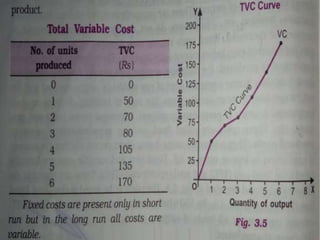
Variable Costs are the cost which vary directly
with the change in the level of output.
It includes inputs like labour,power,fuel, raw
materials etc. Variable costs are also the sum
of marginal costs over all of the units
produced.
These costs are also called as Direct costs and
prime costs.
Variable Cost
Recapitualization
Que.-1 Give 2 examples of Explicit Cost.
Que.-2 What do you understand by
Money Cost?
Que. 1- Write the Definition of Cost?
Que. 2- write 2 difference between
fixed cost and variable cost.
HOME ASSIGNMENT

ppt for online teaching for commerce students

  • 1.
  • 2.
  • 3.
    Que.1-What does wepurchase from Market? Ans.1- We purchase commodities or things of our needs. Que.2- How does we purchase the commodity?
  • 4.
    Que.1-What does wepurchase from Market? Ans.1- We purchase commodities or things of our needs. Que.2- How does we purchase the commodity? Ans.2- By paying the money. Que.3-How the price of the commodity is decided?
  • 5.
    Que.1-What does wepurchase from Market? Ans.1- We purchase commodities or things of our needs. Que.2- How does we purchase the commodity? Ans.2- By paying the money. Que.3-How the price of the commodity is decided? Ans.3- On the basis or expenditure incurred by producer.
  • 6.
    Que.1-What does wepurchase from Market? Ans.1- We purchase commodities or things of our needs. Que.2- How does we purchase the commodity? Ans.2- By paying the money. Que.3-How the price of the commodity is decided? Ans.3- On the basis or expenditure incurred by producer. Que.4- What does we called that expenditure from producers point of view?
  • 8.
    •Money expenditure incurred bya firm in production of a commodity is called the cost of production. Meaning Of Cost
  • 9.
    “COST is thesum of explicit costs and implicit costs constitute cost of production of a commodity” Definition Of Cost
  • 10.
    A firm requiresfactor input and non-factor inputs for producing a commodity. These inputs are to be paid for since they are scarce. The firm pays in the form of money e.g., Rent to landlord, salaries and wages, interest, material, power, transportation, etc. These are cost to the firm and are called money costs because these are paid in the form of money.
  • 11.
    Que.1- What doyou understand by Cost of Production?
  • 12.
    Que.1- What doyou understand by Cost of Production? Ans.1-Money expenditure incurred by a firm in production of a commodity is called the cost of production.
  • 14.
    Explicit Costs isa direct payment made to others in the course of running a business, such as wage, rent and materials, as opposed to implicit costs, which are those where no actual payment is made. Explicit cost are those case payment which firm make to outsiders fir their services and goods. Implicit Costs are costs of self-owned or self-employed resources. Businesses don’t necessarily record implicit costs for accounting purposes because money does not change hands. Examples of implicit costs include the loss of interest income on funds, and the depreciation of machinery for a production. Explicit Costs and Implicit Costs
  • 15.
    Money cost ofproduction refers to the money expenditure incurred on hiring and buying of inputs for producing a given amount of commodity. Real cost refers to the scarifies, discomfort, toil and pain involves in supplying the factors of production by their owners. Money cost and Real Cost
  • 16.
    “The opportunity costof an activity is equal to the value of next best alternative foregone.” One has to forego something for getting something and what is given up for getting something is called the opportunity cost. Opportunity cost represents the benefits an individual, investor or business misses out on when choosing one alternative over another. Opportunity cost
  • 17.
    The Short-run Costis the cost which has short- term implications in the production process. In short run some factors are fixed (like machinery, building etc.) which cannot be change due to insufficiency of time while other (like labour, raw material, power etc.)are variable which can be change according to the output to be produced. Short run costs basically consist of FIXED COST and VARIABLE COSTS. Short–run costs
  • 19.
    Fixed cost arethe cost which do not change with change in the level of output. “Fixed cost remain even if output is zero” For instance, rent of building, interest on past borrowings, salaries of permanent employees, insurance premium etc. These costs are also called supplementary costs or overhead costs. Fixed cost and Variable Cost
  • 20.
  • 23.
    Variable Costs arethe cost which vary directly with the change in the level of output. It includes inputs like labour,power,fuel, raw materials etc. Variable costs are also the sum of marginal costs over all of the units produced. These costs are also called as Direct costs and prime costs. Variable Cost
  • 27.
    Recapitualization Que.-1 Give 2examples of Explicit Cost. Que.-2 What do you understand by Money Cost?
  • 28.
    Que. 1- Writethe Definition of Cost? Que. 2- write 2 difference between fixed cost and variable cost. HOME ASSIGNMENT