Understand Case Study
Nan Yang
Doctoral School of Psychological Science and Education
Nan.yang@unitn.it
09/08/2013
1PRIN 09 - prot.20094E7SMX_004
Outline
• What is case study
• How to conduct case study
• How to validate case study
• Comparison
• Discussion
09/08/2013 PRIN 09 - prot.20094E7SMX_004 2
What is case study
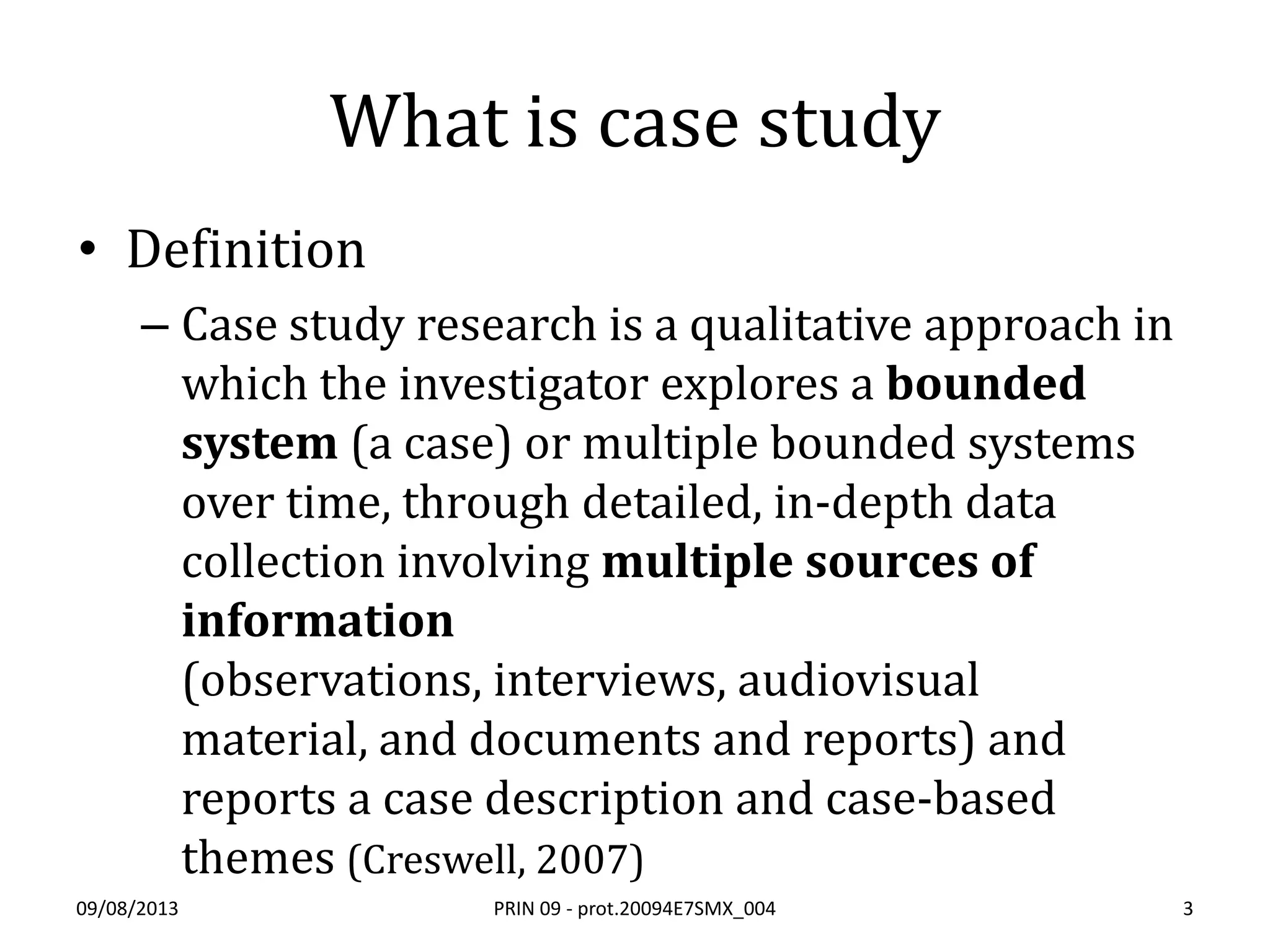
• Definition
– Case study research is a qualitative approach in
which the investigator explores a bounded
system (a case) or multiple bounded systems
over time, through detailed, in-depth data
collection involving multiple sources of
information
(observations, interviews, audiovisual
material, and documents and reports) and
reports a case description and case-based
themes (Creswell, 2007)
09/08/2013 PRIN 09 - prot.20094E7SMX_004 3
What is case study
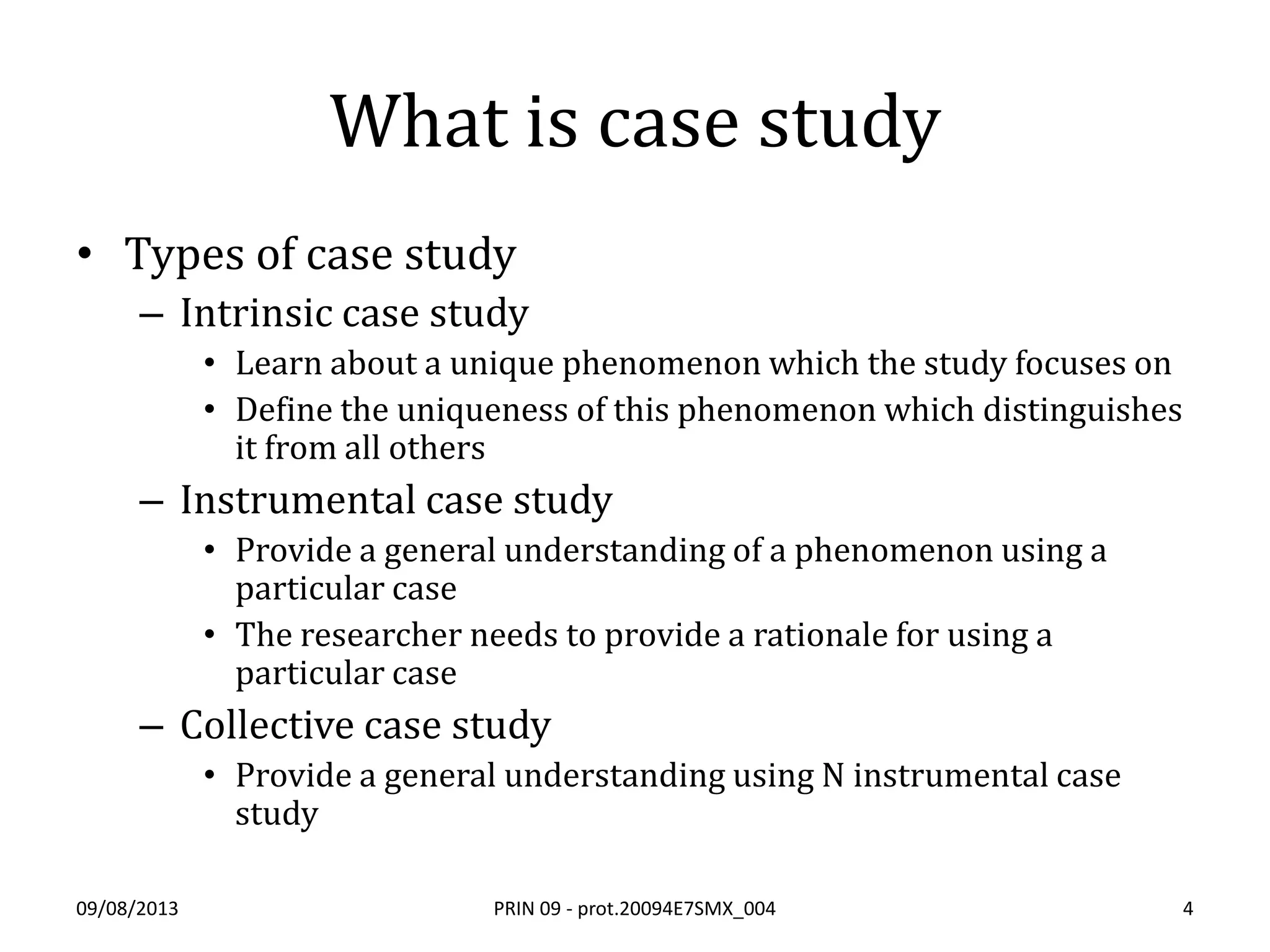
• Types of case study
– Intrinsic case study
• Learn about a unique phenomenon which the study focuses on
• Define the uniqueness of this phenomenon which distinguishes
it from all others
– Instrumental case study
• Provide a general understanding of a phenomenon using a
particular case
• The researcher needs to provide a rationale for using a
particular case
– Collective case study
• Provide a general understanding using N instrumental case
study
09/08/2013 PRIN 09 - prot.20094E7SMX_004 4
How to conduct case study
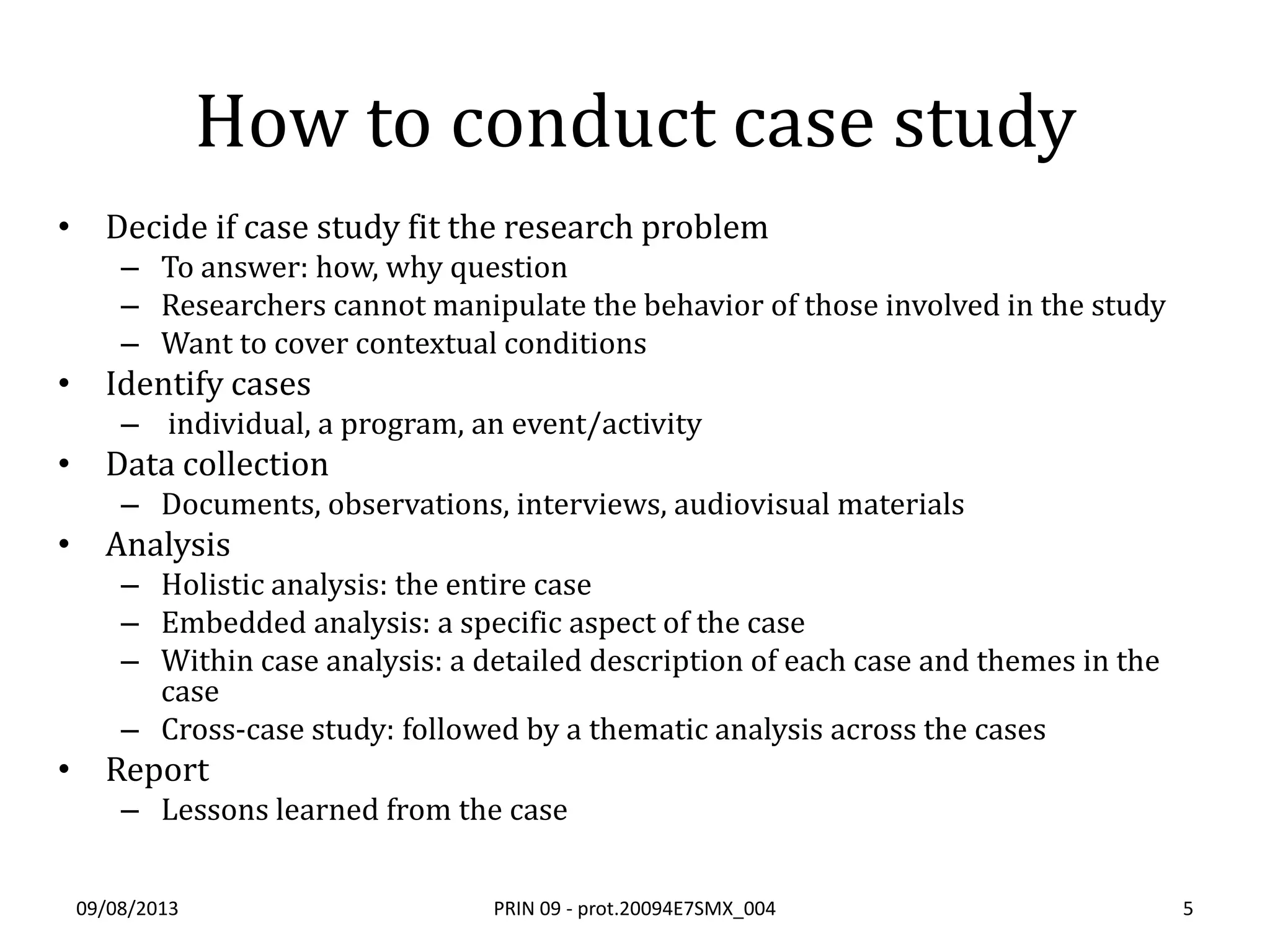
• Decide if case study fit the research problem
– To answer: how, why question
– Researchers cannot manipulate the behavior of those involved in the study
– Want to cover contextual conditions
• Identify cases
– individual, a program, an event/activity
• Data collection
– Documents, observations, interviews, audiovisual materials
• Analysis
– Holistic analysis: the entire case
– Embedded analysis: a specific aspect of the case
– Within case analysis: a detailed description of each case and themes in the
case
– Cross-case study: followed by a thematic analysis across the cases
• Report
– Lessons learned from the case
09/08/2013 PRIN 09 - prot.20094E7SMX_004 5
How to validate case study
• Stake: critique checklist for a case study report (part of)
– Easy to read
– Fit together, each sentence contributing to the whole
– Have a conceptual structure (themes or issues)
– Issues are developed in a serious and scholarly way
– Adequately defined case
– A sense of story to the presentation
– The reader is provided vicarious experience
– Effective quotations
– Effective headings, figures, artifacts, appendixes, indexes
– Make sound assertions, neither over- or under interpreting
– Pay adequate attention to various contexts
– Present sufficient raw data
– Well chosen data source, in sufficient number
– Triangulated observations and interpretations
09/08/2013 PRIN 09 - prot.20094E7SMX_004 6
How to validate case study
• Creswell
– Clear identification of the case
– The case used to understand a research issue or
used because intrinsic merit
– Clear description of the case
– Assertions or generalizations are made from the
case analysis
– Researchers reflexive or self-disclosing about
their own position in the study
09/08/2013 PRIN 09 - prot.20094E7SMX_004 7
Comparison
• With narrative and ethnographical study
– When the unit of analysis is a single individual
09/08/2013 PRIN 09 - prot.20094E7SMX_004 8
Case Study Narrative Study Ethnographical Study
Illustrate an issue,
compiles a detailed
description of the setting
for the case
Focus on the stories told
from the individual and
arrange these stories in
chronological order
Set individuals’ stories
within the context of
their culture and culture-
sharing group
Discussion
• Do we need a theory in case study?
• How to balance the generalizability and
depth of case
09/08/2013 PRIN 09 - prot.20094E7SMX_004 9
Thank you
09/08/2013 PRIN 09 - prot.20094E7SMX_004 10

Understand Case Study

  • 1.
    Understand Case Study NanYang Doctoral School of Psychological Science and Education Nan.yang@unitn.it 09/08/2013 1PRIN 09 - prot.20094E7SMX_004
  • 2.
    Outline • What iscase study • How to conduct case study • How to validate case study • Comparison • Discussion 09/08/2013 PRIN 09 - prot.20094E7SMX_004 2
  • 3.
    What is casestudy • Definition – Case study research is a qualitative approach in which the investigator explores a bounded system (a case) or multiple bounded systems over time, through detailed, in-depth data collection involving multiple sources of information (observations, interviews, audiovisual material, and documents and reports) and reports a case description and case-based themes (Creswell, 2007) 09/08/2013 PRIN 09 - prot.20094E7SMX_004 3
  • 4.
    What is casestudy • Types of case study – Intrinsic case study • Learn about a unique phenomenon which the study focuses on • Define the uniqueness of this phenomenon which distinguishes it from all others – Instrumental case study • Provide a general understanding of a phenomenon using a particular case • The researcher needs to provide a rationale for using a particular case – Collective case study • Provide a general understanding using N instrumental case study 09/08/2013 PRIN 09 - prot.20094E7SMX_004 4
  • 5.
    How to conductcase study • Decide if case study fit the research problem – To answer: how, why question – Researchers cannot manipulate the behavior of those involved in the study – Want to cover contextual conditions • Identify cases – individual, a program, an event/activity • Data collection – Documents, observations, interviews, audiovisual materials • Analysis – Holistic analysis: the entire case – Embedded analysis: a specific aspect of the case – Within case analysis: a detailed description of each case and themes in the case – Cross-case study: followed by a thematic analysis across the cases • Report – Lessons learned from the case 09/08/2013 PRIN 09 - prot.20094E7SMX_004 5
  • 6.
    How to validatecase study • Stake: critique checklist for a case study report (part of) – Easy to read – Fit together, each sentence contributing to the whole – Have a conceptual structure (themes or issues) – Issues are developed in a serious and scholarly way – Adequately defined case – A sense of story to the presentation – The reader is provided vicarious experience – Effective quotations – Effective headings, figures, artifacts, appendixes, indexes – Make sound assertions, neither over- or under interpreting – Pay adequate attention to various contexts – Present sufficient raw data – Well chosen data source, in sufficient number – Triangulated observations and interpretations 09/08/2013 PRIN 09 - prot.20094E7SMX_004 6
  • 7.
    How to validatecase study • Creswell – Clear identification of the case – The case used to understand a research issue or used because intrinsic merit – Clear description of the case – Assertions or generalizations are made from the case analysis – Researchers reflexive or self-disclosing about their own position in the study 09/08/2013 PRIN 09 - prot.20094E7SMX_004 7
  • 8.
    Comparison • With narrativeand ethnographical study – When the unit of analysis is a single individual 09/08/2013 PRIN 09 - prot.20094E7SMX_004 8 Case Study Narrative Study Ethnographical Study Illustrate an issue, compiles a detailed description of the setting for the case Focus on the stories told from the individual and arrange these stories in chronological order Set individuals’ stories within the context of their culture and culture- sharing group
  • 9.
    Discussion • Do weneed a theory in case study? • How to balance the generalizability and depth of case 09/08/2013 PRIN 09 - prot.20094E7SMX_004 9
  • 10.
    Thank you 09/08/2013 PRIN09 - prot.20094E7SMX_004 10