Elevating the scope of Nursing Practice
Prof. (Mr.) Asokan R
HOD of MSN Dept. & I/C of R&D
Kalinga Institute of Nursing Sciences,
KIIT Deemed to be University, Bhubaneswar, Odisha, India.
Introduction
What is Nursing Practice?
Nursing practice is underpinned by values that guide the way
in which nursing care is provided.
The American Nurses Association (ANA) provides leadership in
determining the goals, objectives, and professional practice of nursing.
ANA defines nursing as " … a caring-based practice in which
processes of diagnosis and treatment are applied to human experiences
of health and illness" (ANA, 1994).
Nursing practice may be work experience that is direct and/or
indirect patient care in clinical practice, nursing administration, education,
research, or consultation in the specialty represented by the credential.
January 1, 2021
Oncology Nursing Certification Corporation
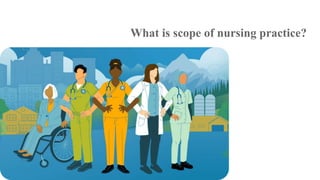
What is scope of nursing practice?
The scope of nursing practice is the range of roles, functions,
responsibilities and activities which a registered nurse is educated,
competent and has authority to perform.
Level of professionalism as demonstrated by behavior and
attitudes.
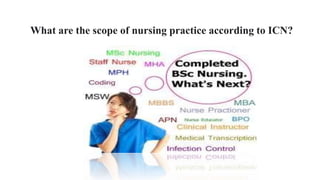
What are the scope of nursing practice according to ICN?
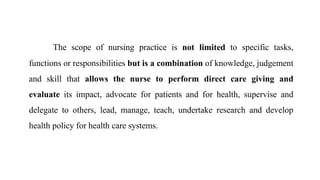
The scope of nursing practice is not limited to specific tasks,
functions or responsibilities but is a combination of knowledge, judgement
and skill that allows the nurse to perform direct care giving and
evaluate its impact, advocate for patients and for health, supervise and
delegate to others, lead, manage, teach, undertake research and develop
health policy for health care systems.
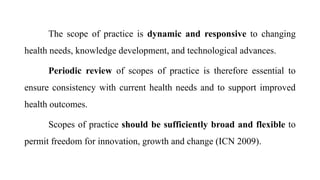
The scope of practice is dynamic and responsive to changing
health needs, knowledge development, and technological advances.
Periodic review of scopes of practice is therefore essential to
ensure consistency with current health needs and to support improved
health outcomes.
Scopes of practice should be sufficiently broad and flexible to
permit freedom for innovation, growth and change (ICN 2009).
Factors which influence scope of Nursing practice
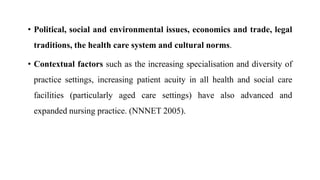
• Political, social and environmental issues, economics and trade, legal
traditions, the health care system and cultural norms.
• Contextual factors such as the increasing specialisation and diversity of
practice settings, increasing patient acuity in all health and social care
facilities (particularly aged care settings) have also advanced and
expanded nursing practice. (NNNET 2005).
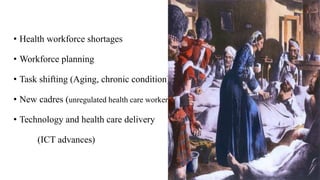
• Health workforce shortages
• Workforce planning
• Task shifting (Aging, chronic condition)
• New cadres (unregulated health care workers)
• Technology and health care delivery
(ICT advances)
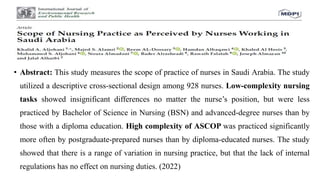
• Abstract: This study measures the scope of practice of nurses in Saudi Arabia. The study
utilized a descriptive cross-sectional design among 928 nurses. Low-complexity nursing
tasks showed insignificant differences no matter the nurse’s position, but were less
practiced by Bachelor of Science in Nursing (BSN) and advanced-degree nurses than by
those with a diploma education. High complexity of ASCOP was practiced significantly
more often by postgraduate-prepared nurses than by diploma-educated nurses. The study
showed that there is a range of variation in nursing practice, but that the lack of internal
regulations has no effect on nursing duties. (2022)
How should elevate the scope of Nursing Practice?
1. Belong to Associations
• Attending chapter meetings
• Networking (future jobs or references)
2. Continue Your Education
• Stay up to date within your specialty
• Take courses or go to seminars
• Advance your degree
• Whatever you decide, be it learning a new skill or obtaining a
new degree
• Well-rounded nurse
3. Mentor New Nurses
• On-the-job or more formally through a college
• By teaching what we know, the mentor actually learns more through
questions, explaining procedures and processes.
• Mentoring is crucial in bringing the next generation of nurses to
practice.
• Positive experiences and others
4. Write Letters
• Staffing ratios or other issues you’re facing on the job (Make the
policy makers aware.)
• Nurses are in a perfect position to speak up to help create
changes in policies that would better the profession and health
care as a whole.
5. Continue to Project a Professional Image
• Nurses must continue to uphold our reputation and our code of ethics to
keep.
• Our social media presence. Even though we may be posting personal photos or
opinions, if we list the name of our workplace and/or what we do, we are still
being linked with the nursing profession.
• Look and act like a professional person 24/7 – wherever you are you serve as
a role model of who and what a nurse is.
• Professional appearance starts with good grooming and workwear appropriate
for a professional person.
6. Consider a specialization
• Narrow your focus
• Becoming certified in your specialty area will help advance
in your practice
7. Follow nursing blogs
• Thousands of resources from other nurses or nursing organizations
are available with the simple click of a mouse.
• Keep a pulse on industry news
• Demonstrating leadership and industry-awareness begins
• Learn cutting-edge ideas in nursing practice from seasoned experts,
understand more about how healthcare systems
8. Talk about your ambitions
• Your supervisor know that you are interested in a promotion or
a different role, that will create great opportunities.”
• Placed on committees within the organization to get to know
nurses from different departments, help you learn about other
roles that might be interesting.
9. Experience different nursing units
• Soak up all of the nursing experience
• More valuable to hospitals
• Diverse experience also makes you a more attractive candidate
for management positions.
10. Look into continuing education opportunities
• Covers new advancements, techniques and practices for nurses.
• A high level of clinical expertise
• Decision-makers are looking for nurses who can transition their mindset
and are ready to hold new challenges
• “Completing some professional development around non-clinical
areas (for example, leadership, education skills, communication, conflict
management) make ready for the challenge of this new frontier.”
11. Take the next step in college education
• Bachelor of Science in Nursing (opening doors and becoming a professional
imperative)
• Master of Science in Nursing (better-qualified for leadership and managerial
positions)
• Doctor of Nursing Practice (want to influence high-level policy changes in
healthcare, want to measure outcomes in healthcare and impact change at their
institution)
• Best nurse leaders do not always have a long list of credentials behind their
name, exhibit excellence in their own work.
12. Nurses Can Raise Their Level of Nursing
Professionalism
• Professional behavior and attitudes of the nurse
13. Put caring first
• Nurse genuinely cares for each patient and accepts the patient as
unique, respects his individual rights, and meets all his physical,
psychological, social and spiritual needs.
• This includes respect for dignity irrespective of nationality, race,
creed, colour, age, sex, politics or social status.
14. Be professionally responsible and accountable
• No longer seen as subservient to the medical practitioner.
• Independent practitioner
• Use initiative and take decisions
15. Develop and maintain professional standards
• Nurses’ responsibility to continually evaluate their own practice
against the set standards.
• Because of commitment to quality patient care the nurse should
also strive to continually raise those standards.
16. Maintain professional competence
• The best quality of care for the patient is only possible if the
nurse accepts responsibility for increasing her professional
knowledge and keeping up to date with new developments.
• She should have an enquiring mind and learn all the time and
not limit learning to that required for CPD points for registration.
17. Participate in professional affairs
• Active in promoting the profession and addressing current
issues in nursing and health care.
• Professional groups, including nursing associations or societies
representing different nursing specialties, are more successful
than individuals in bringing about change through the voice of
numbers.
• Active in professional groups and sharing your expertise
can add considerably to your professional development and
18. Make a difference
• Contribute to the future of your profession – what you as
a nurse do or say does make a difference.
• Be proud to be a nurse, always look and act professionally.
19. Changing State Regulations
• Autonomous practice of nurse practitioners
• Most commonly it is nurse practitioners, but also includes certified nurse
midwives, certified registered nurse anesthetists, and clinical nurse
specialists.”
• Institutional barriers for other nurses, including registered nurses (RNs)
and licensed practical nurses (LPNs), to allow them to practice to the top of
their education and training.
• Examples include prescribing medicine, diagnosing a patient, and providing
treatment independent of a physician. Even when it is allowed, there are
administrative burdens.
20. Increasing Access to High-quality Care
• Significantly increase access to care, especially in rural and
underserved communities where physician care may be
scarce or difficult to access.
21. Reducing Administrative Burden
• Being able to move nurses to different areas to treat
patients or to cover for nurses who were called to a
different area, was essential to patient health.
22. Improving Care Access Through the Workforce
• Significant boost to primary care efforts where they are
especially needed such as in rural or low-income areas.
• “For countries that are deficient in the number of primary care
providers, meeting the needs of the population is important.
• “is that extremely empowering for nurses to do all the things
they are prepared to do.”
Clinical nurse autonomy and control over nursing practice (CONP) have been
associated with increased nurse satisfaction and improved patient outcomes - both
elements of a healthy work environment. This article outlines strategies for enhancing
autonomy as well as strategies for enhancing CONP and describes the importance of
articulating expectations for autonomous practice, enhancing competence in clinical
expertise, establishing participative decision making, and developing nurses' skills in
making decisions. In addition, the critical role of nurse leaders and the need to work
upstream to influence the social, political, and economic factors affecting nursing
practice are discussed. (2010)
The Future of Nursing: Leading Change, Advancing Health.
• Nurses have the opportunity to play a central role in transforming the
health care system to create a more accessible, high-quality, and value-
driven environment for patients.
• If the system is to capitalize on this opportunity, however, the
constraints of outdated policies, regulations, and cultural
barriers, including those related to scope of practice, will have to be
lifted, most notably for advanced practice registered nurses. (2011)
Conclusion
• Comfort Zone professionals • Super professionals
Bibliography
• 1. https://www.nmbi.ie/COVID-19/Scope-of-Practice/Nursing-Practice-Scope-
Definition
• 2.https://www.ncbi.nlm.nih.gov/books/NBK232401/#:~:text=Definition%20of%20N
ursing%20Practice&text=ANA%20defines%20nursing%20as%20"%20…%20a,"%2
0(ANA%2C%201994)
• 3. https://www.oncc.org/nursing-practice-definition
• 4. https://nurseslabs.com/8-ways-nurses-can-raise-level-nursing-professionalism/
• 5. https://www.icn.ch/sites/default/files/inline-files/B07_Scope_Nsg_Practice.pdf
• 6. https://dailynurse.com/how-can-nurses-elevate-the-profession/
• 7. https://www.rasmussen.edu/degrees/nursing/blog/nursing-career-advancement/
• 8. https://nurseslabs.com/uplifting-image-nurses-6-ways-can-help/
• 9. https://dailynurse.com/how-can-nurses-elevate-the-profession/
• 10.https://www.icn.ch/sites/default/files/inlinefiles/2010_ICN%20Scope%20of%20Nursing
%20and%20Decision%20making%20Toolkit_eng.pdf
• 11. Aljohani, K.A. Alamri, M.S. AL-Dossary, R. Albaqawi, H. Hosis, K.A. et al. Scope of
Nursing Practice as Perceived by NursesWorking in Saudi Arabia. Int. J. Environ. Res. Public
Health 2022, 19, 4220. https://doi.org/10.3390/ijerph19074220
• 12. Weston, M.J., (Jan. 31, 2010) "Strategies for Enhancing Autonomy and Control Over
Nursing Practice" OJIN: The Online Journal of Issues in Nursing Vol. 15, No. 1, Manuscript
2 DOI: 10.3912/OJIN.Vol15No01Man02 https://doi.org/10.3912/OJIN.Vol15No01Man02
• 13. https://minoritynurse.com/future-of-nursing-2020-2030-examining-scope-of-practice/
• 14. https://www.ncbi.nlm.nih.gov/books/NBK209871/
Elevating the scope of Nursing Practice.pptx

Elevating the scope of Nursing Practice.pptx

  • 1.
    Elevating the scopeof Nursing Practice Prof. (Mr.) Asokan R HOD of MSN Dept. & I/C of R&D Kalinga Institute of Nursing Sciences, KIIT Deemed to be University, Bhubaneswar, Odisha, India.
  • 2.
  • 3.
    What is NursingPractice?
  • 4.
    Nursing practice isunderpinned by values that guide the way in which nursing care is provided. The American Nurses Association (ANA) provides leadership in determining the goals, objectives, and professional practice of nursing. ANA defines nursing as " … a caring-based practice in which processes of diagnosis and treatment are applied to human experiences of health and illness" (ANA, 1994).
  • 5.
    Nursing practice maybe work experience that is direct and/or indirect patient care in clinical practice, nursing administration, education, research, or consultation in the specialty represented by the credential. January 1, 2021 Oncology Nursing Certification Corporation
  • 6.
    What is scopeof nursing practice?
  • 7.
    The scope ofnursing practice is the range of roles, functions, responsibilities and activities which a registered nurse is educated, competent and has authority to perform. Level of professionalism as demonstrated by behavior and attitudes.
  • 8.
    What are thescope of nursing practice according to ICN?
  • 9.
    The scope ofnursing practice is not limited to specific tasks, functions or responsibilities but is a combination of knowledge, judgement and skill that allows the nurse to perform direct care giving and evaluate its impact, advocate for patients and for health, supervise and delegate to others, lead, manage, teach, undertake research and develop health policy for health care systems.
  • 10.
    The scope ofpractice is dynamic and responsive to changing health needs, knowledge development, and technological advances. Periodic review of scopes of practice is therefore essential to ensure consistency with current health needs and to support improved health outcomes. Scopes of practice should be sufficiently broad and flexible to permit freedom for innovation, growth and change (ICN 2009).
  • 11.
    Factors which influencescope of Nursing practice
  • 12.
    • Political, socialand environmental issues, economics and trade, legal traditions, the health care system and cultural norms. • Contextual factors such as the increasing specialisation and diversity of practice settings, increasing patient acuity in all health and social care facilities (particularly aged care settings) have also advanced and expanded nursing practice. (NNNET 2005).
  • 13.
    • Health workforceshortages • Workforce planning • Task shifting (Aging, chronic condition) • New cadres (unregulated health care workers) • Technology and health care delivery (ICT advances)
  • 14.
    • Abstract: Thisstudy measures the scope of practice of nurses in Saudi Arabia. The study utilized a descriptive cross-sectional design among 928 nurses. Low-complexity nursing tasks showed insignificant differences no matter the nurse’s position, but were less practiced by Bachelor of Science in Nursing (BSN) and advanced-degree nurses than by those with a diploma education. High complexity of ASCOP was practiced significantly more often by postgraduate-prepared nurses than by diploma-educated nurses. The study showed that there is a range of variation in nursing practice, but that the lack of internal regulations has no effect on nursing duties. (2022)
  • 15.
    How should elevatethe scope of Nursing Practice?
  • 16.
    1. Belong toAssociations • Attending chapter meetings • Networking (future jobs or references)
  • 17.
    2. Continue YourEducation • Stay up to date within your specialty • Take courses or go to seminars • Advance your degree • Whatever you decide, be it learning a new skill or obtaining a new degree • Well-rounded nurse
  • 18.
    3. Mentor NewNurses • On-the-job or more formally through a college • By teaching what we know, the mentor actually learns more through questions, explaining procedures and processes. • Mentoring is crucial in bringing the next generation of nurses to practice. • Positive experiences and others
  • 19.
    4. Write Letters •Staffing ratios or other issues you’re facing on the job (Make the policy makers aware.) • Nurses are in a perfect position to speak up to help create changes in policies that would better the profession and health care as a whole.
  • 20.
    5. Continue toProject a Professional Image • Nurses must continue to uphold our reputation and our code of ethics to keep. • Our social media presence. Even though we may be posting personal photos or opinions, if we list the name of our workplace and/or what we do, we are still being linked with the nursing profession. • Look and act like a professional person 24/7 – wherever you are you serve as a role model of who and what a nurse is. • Professional appearance starts with good grooming and workwear appropriate for a professional person.
  • 21.
    6. Consider aspecialization • Narrow your focus • Becoming certified in your specialty area will help advance in your practice
  • 22.
    7. Follow nursingblogs • Thousands of resources from other nurses or nursing organizations are available with the simple click of a mouse. • Keep a pulse on industry news • Demonstrating leadership and industry-awareness begins • Learn cutting-edge ideas in nursing practice from seasoned experts, understand more about how healthcare systems
  • 23.
    8. Talk aboutyour ambitions • Your supervisor know that you are interested in a promotion or a different role, that will create great opportunities.” • Placed on committees within the organization to get to know nurses from different departments, help you learn about other roles that might be interesting.
  • 24.
    9. Experience differentnursing units • Soak up all of the nursing experience • More valuable to hospitals • Diverse experience also makes you a more attractive candidate for management positions.
  • 25.
    10. Look intocontinuing education opportunities • Covers new advancements, techniques and practices for nurses. • A high level of clinical expertise • Decision-makers are looking for nurses who can transition their mindset and are ready to hold new challenges • “Completing some professional development around non-clinical areas (for example, leadership, education skills, communication, conflict management) make ready for the challenge of this new frontier.”
  • 26.
    11. Take thenext step in college education • Bachelor of Science in Nursing (opening doors and becoming a professional imperative) • Master of Science in Nursing (better-qualified for leadership and managerial positions) • Doctor of Nursing Practice (want to influence high-level policy changes in healthcare, want to measure outcomes in healthcare and impact change at their institution) • Best nurse leaders do not always have a long list of credentials behind their name, exhibit excellence in their own work.
  • 27.
    12. Nurses CanRaise Their Level of Nursing Professionalism • Professional behavior and attitudes of the nurse
  • 28.
    13. Put caringfirst • Nurse genuinely cares for each patient and accepts the patient as unique, respects his individual rights, and meets all his physical, psychological, social and spiritual needs. • This includes respect for dignity irrespective of nationality, race, creed, colour, age, sex, politics or social status.
  • 29.
    14. Be professionallyresponsible and accountable • No longer seen as subservient to the medical practitioner. • Independent practitioner • Use initiative and take decisions
  • 30.
    15. Develop andmaintain professional standards • Nurses’ responsibility to continually evaluate their own practice against the set standards. • Because of commitment to quality patient care the nurse should also strive to continually raise those standards.
  • 31.
    16. Maintain professionalcompetence • The best quality of care for the patient is only possible if the nurse accepts responsibility for increasing her professional knowledge and keeping up to date with new developments. • She should have an enquiring mind and learn all the time and not limit learning to that required for CPD points for registration.
  • 32.
    17. Participate inprofessional affairs • Active in promoting the profession and addressing current issues in nursing and health care. • Professional groups, including nursing associations or societies representing different nursing specialties, are more successful than individuals in bringing about change through the voice of numbers. • Active in professional groups and sharing your expertise can add considerably to your professional development and
  • 33.
    18. Make adifference • Contribute to the future of your profession – what you as a nurse do or say does make a difference. • Be proud to be a nurse, always look and act professionally.
  • 34.
    19. Changing StateRegulations • Autonomous practice of nurse practitioners • Most commonly it is nurse practitioners, but also includes certified nurse midwives, certified registered nurse anesthetists, and clinical nurse specialists.” • Institutional barriers for other nurses, including registered nurses (RNs) and licensed practical nurses (LPNs), to allow them to practice to the top of their education and training. • Examples include prescribing medicine, diagnosing a patient, and providing treatment independent of a physician. Even when it is allowed, there are administrative burdens.
  • 35.
    20. Increasing Accessto High-quality Care • Significantly increase access to care, especially in rural and underserved communities where physician care may be scarce or difficult to access.
  • 36.
    21. Reducing AdministrativeBurden • Being able to move nurses to different areas to treat patients or to cover for nurses who were called to a different area, was essential to patient health.
  • 37.
    22. Improving CareAccess Through the Workforce • Significant boost to primary care efforts where they are especially needed such as in rural or low-income areas. • “For countries that are deficient in the number of primary care providers, meeting the needs of the population is important. • “is that extremely empowering for nurses to do all the things they are prepared to do.”
  • 38.
    Clinical nurse autonomyand control over nursing practice (CONP) have been associated with increased nurse satisfaction and improved patient outcomes - both elements of a healthy work environment. This article outlines strategies for enhancing autonomy as well as strategies for enhancing CONP and describes the importance of articulating expectations for autonomous practice, enhancing competence in clinical expertise, establishing participative decision making, and developing nurses' skills in making decisions. In addition, the critical role of nurse leaders and the need to work upstream to influence the social, political, and economic factors affecting nursing practice are discussed. (2010)
  • 39.
    The Future ofNursing: Leading Change, Advancing Health. • Nurses have the opportunity to play a central role in transforming the health care system to create a more accessible, high-quality, and value- driven environment for patients. • If the system is to capitalize on this opportunity, however, the constraints of outdated policies, regulations, and cultural barriers, including those related to scope of practice, will have to be lifted, most notably for advanced practice registered nurses. (2011)
  • 42.
    Conclusion • Comfort Zoneprofessionals • Super professionals
  • 43.
    Bibliography • 1. https://www.nmbi.ie/COVID-19/Scope-of-Practice/Nursing-Practice-Scope- Definition •2.https://www.ncbi.nlm.nih.gov/books/NBK232401/#:~:text=Definition%20of%20N ursing%20Practice&text=ANA%20defines%20nursing%20as%20"%20…%20a,"%2 0(ANA%2C%201994) • 3. https://www.oncc.org/nursing-practice-definition • 4. https://nurseslabs.com/8-ways-nurses-can-raise-level-nursing-professionalism/ • 5. https://www.icn.ch/sites/default/files/inline-files/B07_Scope_Nsg_Practice.pdf • 6. https://dailynurse.com/how-can-nurses-elevate-the-profession/ • 7. https://www.rasmussen.edu/degrees/nursing/blog/nursing-career-advancement/ • 8. https://nurseslabs.com/uplifting-image-nurses-6-ways-can-help/ • 9. https://dailynurse.com/how-can-nurses-elevate-the-profession/
  • 44.
    • 10.https://www.icn.ch/sites/default/files/inlinefiles/2010_ICN%20Scope%20of%20Nursing %20and%20Decision%20making%20Toolkit_eng.pdf • 11.Aljohani, K.A. Alamri, M.S. AL-Dossary, R. Albaqawi, H. Hosis, K.A. et al. Scope of Nursing Practice as Perceived by NursesWorking in Saudi Arabia. Int. J. Environ. Res. Public Health 2022, 19, 4220. https://doi.org/10.3390/ijerph19074220 • 12. Weston, M.J., (Jan. 31, 2010) "Strategies for Enhancing Autonomy and Control Over Nursing Practice" OJIN: The Online Journal of Issues in Nursing Vol. 15, No. 1, Manuscript 2 DOI: 10.3912/OJIN.Vol15No01Man02 https://doi.org/10.3912/OJIN.Vol15No01Man02 • 13. https://minoritynurse.com/future-of-nursing-2020-2030-examining-scope-of-practice/ • 14. https://www.ncbi.nlm.nih.gov/books/NBK209871/