Research 20.
How to Write
Data Analysis
Chapter
Dr Zafar Ullah; zafarullah76@gmail.com
Research: 20 . Code:0043 1
Data Analysis/ Results and Discussion Instructions
★ Present tense
★ Most voluminous part
★ Different analysis in every thesis
★ Analyse according to your generated data
★ Analyse according to your documents/ content
★ Change data into beautiful visuals with Datawrapper
★ Analyse according to research questions
★ Analyse with key terms of theory
2
Cont…
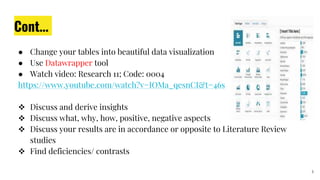
● Change your tables into beautiful data visualization
● Use Datawrapper tool
● Watch video: Research 11; Code: 0004
https://www.youtube.com/watch?v=IOMa_qesnCI&t=46s
 Discuss and derive insights
 Discuss what, why, how, positive, negative aspects
 Discuss your results are in accordance or opposite to Literature Review
studies
 Find deficiencies/ contrasts
3
Data Analysis in Experimental Research
★ Pre test, tabular data
★ Treatment phase
★ Post test, tabular data
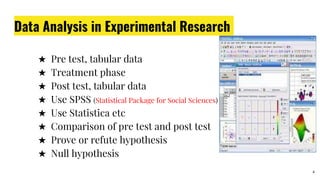
★ Use SPSS (Statistical Package for Social Sciences)
★ Use Statistica etc
★ Comparison of pre test and post test
★ Prove or refute hypothesis
★ Null hypothesis
4
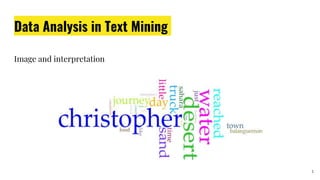
Data Analysis in Text Mining
Image and interpretation
5
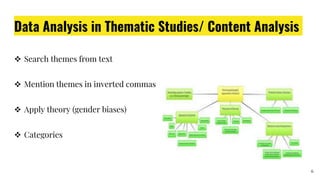
Data Analysis in Thematic Studies/ Content Analysis
 Search themes from text
 Mention themes in inverted commas
 Apply theory (gender biases)
 Categories
6
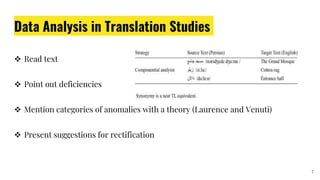
Data Analysis in Translation Studies
 Read text
 Point out deficiencies
 Mention categories of anomalies with a theory (Laurence and Venuti)
 Present suggestions for rectification
7
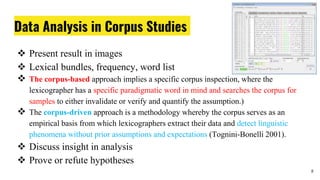
Data Analysis in Corpus Studies
 Present result in images
 Lexical bundles, frequency, word list
 The corpus-based approach implies a specific corpus inspection, where the
lexicographer has a specific paradigmatic word in mind and searches the corpus for
samples to either invalidate or verify and quantify the assumption.)
 The corpus-driven approach is a methodology whereby the corpus serves as an
empirical basis from which lexicographers extract their data and detect linguistic
phenomena without prior assumptions and expectations (Tognini-Bonelli 2001).
 Discuss insight in analysis
 Prove or refute hypotheses
8
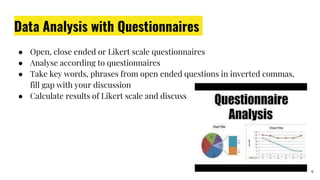
Data Analysis with Questionnaires
● Open, close ended or Likert scale questionnaires
● Analyse according to questionnaires
● Take key words, phrases from open ended questions in inverted commas,
fill gap with your discussion
● Calculate results of Likert scale and discuss
9
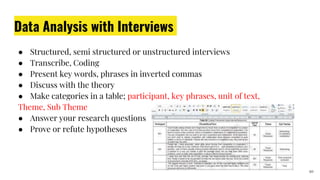
Data Analysis with Interviews
● Structured, semi structured or unstructured interviews
● Transcribe, Coding
● Present key words, phrases in inverted commas
● Discuss with the theory
● Make categories in a table; participant, key phrases, unit of text,
Theme, Sub Theme
● Answer your research questions
● Prove or refute hypotheses
10
SiriusData (Pvt Company)
Training: Linguistics, Academia,
TEFL, Technology, Research etc
Tutoring: Linguistics,
Literature, IELTS, English for
All classes and all levels
Editing: proofreading
Translation: English, Urdu
Contact:
Whatsapp: 0092-3468620004
Email: zafarullah76@gmail.com 11

Research 20. code 43. how to write data analysis chapter

  • 1.
    Research 20. How toWrite Data Analysis Chapter Dr Zafar Ullah; zafarullah76@gmail.com Research: 20 . Code:0043 1
  • 2.
    Data Analysis/ Resultsand Discussion Instructions ★ Present tense ★ Most voluminous part ★ Different analysis in every thesis ★ Analyse according to your generated data ★ Analyse according to your documents/ content ★ Change data into beautiful visuals with Datawrapper ★ Analyse according to research questions ★ Analyse with key terms of theory 2
  • 3.
    Cont… ● Change yourtables into beautiful data visualization ● Use Datawrapper tool ● Watch video: Research 11; Code: 0004 https://www.youtube.com/watch?v=IOMa_qesnCI&t=46s  Discuss and derive insights  Discuss what, why, how, positive, negative aspects  Discuss your results are in accordance or opposite to Literature Review studies  Find deficiencies/ contrasts 3
  • 4.
    Data Analysis inExperimental Research ★ Pre test, tabular data ★ Treatment phase ★ Post test, tabular data ★ Use SPSS (Statistical Package for Social Sciences) ★ Use Statistica etc ★ Comparison of pre test and post test ★ Prove or refute hypothesis ★ Null hypothesis 4
  • 5.
    Data Analysis inText Mining Image and interpretation 5
  • 6.
    Data Analysis inThematic Studies/ Content Analysis  Search themes from text  Mention themes in inverted commas  Apply theory (gender biases)  Categories 6
  • 7.
    Data Analysis inTranslation Studies  Read text  Point out deficiencies  Mention categories of anomalies with a theory (Laurence and Venuti)  Present suggestions for rectification 7
  • 8.
    Data Analysis inCorpus Studies  Present result in images  Lexical bundles, frequency, word list  The corpus-based approach implies a specific corpus inspection, where the lexicographer has a specific paradigmatic word in mind and searches the corpus for samples to either invalidate or verify and quantify the assumption.)  The corpus-driven approach is a methodology whereby the corpus serves as an empirical basis from which lexicographers extract their data and detect linguistic phenomena without prior assumptions and expectations (Tognini-Bonelli 2001).  Discuss insight in analysis  Prove or refute hypotheses 8
  • 9.
    Data Analysis withQuestionnaires ● Open, close ended or Likert scale questionnaires ● Analyse according to questionnaires ● Take key words, phrases from open ended questions in inverted commas, fill gap with your discussion ● Calculate results of Likert scale and discuss 9
  • 10.
    Data Analysis withInterviews ● Structured, semi structured or unstructured interviews ● Transcribe, Coding ● Present key words, phrases in inverted commas ● Discuss with the theory ● Make categories in a table; participant, key phrases, unit of text, Theme, Sub Theme ● Answer your research questions ● Prove or refute hypotheses 10
  • 11.
    SiriusData (Pvt Company) Training:Linguistics, Academia, TEFL, Technology, Research etc Tutoring: Linguistics, Literature, IELTS, English for All classes and all levels Editing: proofreading Translation: English, Urdu Contact: Whatsapp: 0092-3468620004 Email: zafarullah76@gmail.com 11