5th Group :
Members:
1. Aulia Novi Hapsari
2. Dewi Kumala Puspita
3. Nunu Nurhayati
4. R. Dwi Indah Yulistianingsih
5. Sri Sahara
RESEARCH METODOLOGY
OF LEARNING ENGLISH
Developing Effective Discussion of
Main Findings
Functions of Discussion chapters
Rudestam and Newton (2001) and Evans and
Gruba (2002) provide helpful advice on writing
Discussion chapters.
A good Discussion chapter, they advise, typically
contains the following:
1. An overview of the significant findings of the
study
2. A consideration of the findings in the light of
existing research studies
3. Implications of the study for current theory
(except in purely applied studies)
4. A careful examination of findings that fail to
support or only partly support the hypotheses
outlined in the study
5. Limitations of the study that may affect the
validity or the generalizability of the results
6. Recommendations for further research
7. Implications of the study for professional
practice or applied settings (optional). (Rudestam
and Newton 2001: 121)
Strategies for writing the Discussion section
Evans and Gruba (2002) suggest strategies for
writing the Discussion section.
The steps outlined above for writing a framework
for their Discussion chapter. That is:
1. Write a sentence about all the things they know
now that they didn’t know when they started
their research.
2. Sort the sentences into groups.
3. Write headings for each of the groups of
sentences.
4. Write sub-headings for each sentence in each
group.
5. Use this as a framework for planning the
Discussion chapter.
The typical shape of the Discussion section
Research in the area of academic writing has
shown that there are a number of ways in which
Discussion sections are typically written. The
Discussion chapter is often in a kind of ‘reverse’
form from the Introduction section.
They found a number of steps that often occur in
Discussion sections, as shown below.
1. background information;
2. statement of results;
3. (un)expected outcome – i.e. whether the result is
expected or not;
4. reference to previous research – comparison of
results with previous research reported in the
literature;
5. explanation of unexpected outcome – i.e. suggesting
reasons for an unexpected result (if this is the case)
or one different from those found in previous studies;
6. exemplification – providing examples to
support the explanation given in step 5;
7. deduction or claim – making a more general
claim arising from the results of the study,
e.g. drawing a conclusion, stating an
hypothesis;
8. support from previous research – quoting
previous research to support the claim/s being
made;
9. recommendation – making suggestions for
future research;
10. justification for future research – arguing why
the future research is recommended.
Samraj (2005) found the Discussion chapters she
examined typically followed the steps outlined below :
1. background information;
2. report on results;
3. commentary on results
interpretation of results
comparison with other research
explanation for results
evaluation of results
4. summary of results;
5. evaluation of the study;
 limitations significance/advantage of the
study
 evaluation of the methods
6. evaluation of the field;
7. deductions from the results;
 research deductions
 applied deductions.
Making claims and hedging in the
Discussion section
Students need to show both their stance and
engagement (Hyland 2005b) with their findings
and the work of other researchers on their topic.
Hyland describes stance as the ways in which
writers present themselves and convey their
judgments, opinions and commitments to their own,
and other people’s, research. (Hyland 2005b: 176).
Engagement is the strategies writers use to
acknowledge and recognize the presence of their
readers: ‘pulling them along with their argument,
focusing their attention, acknowledging their
uncertainties, including them as discourse
participants and guiding them to interpretations’
(Hyland 2005b: 176).
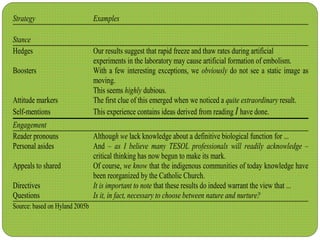
Strategy Examples
Stance
Hedges Our results suggest that rapid freeze and thaw rates during artificial
experiments in the laboratory may cause artificial formation of embolism.
Boosters With a few interesting exceptions, we obviously do not see a static image as
moving.
This seems highly dubious.
Attitude markers The first clue of this emerged when we noticed a quite extraordinary result.
Self-mentions This experience contains ideas derived from reading I have done.
Engagement
Reader pronouns Although we lack knowledge about a definitive biological function for ...
Personal asides And – as I believe many TESOL professionals will readily acknowledge –
critical thinking has now begun to make its mark.
Appeals to shared Of course, we know that the indigenous communities of today knowledge have
been reorganized by the Catholic Church.
Directives It is important to note that these results do indeed warrant the view that ...
Questions Is it, in fact, necessary to choose between nature and nurture?
Source: based on Hyland 2005b
Writing Conclusions
This part of the chapter provides a framework for
the typical structure of concluding chapters. The
language typical of concluding chapters is
discussed in this section, as is the purpose of the
Conclusions section.
Features of Conclusions
The Conclusions section is where students both
summarize and ‘wrap up’ their work. Evans and
Gruba (2002) list the following features of
Conclusions :
1. The Conclusions are what the Discussion chapter
has been arguing for.
2. The Conclusions may be a separate chapter or they
may be combined with the Discussion chapter,
labeled ‘Discussion and Conclusions’.
3. The Conclusions reached in this chapter should be
drawn from the Discussion chapter.
4. There should be no further discussion in the
Conclusions chapter.
5. The Conclusions should respond to the aims that
were stated in the first chapter.
The language of Conclusions
Hewings (1993) discusses typical language
features of Conclusions. In particular, he
describes how writers report, comment and
speculate on their findings
CONCLUSION
The Discussion and Conclusions sections of a thesis
or dissertation are, as Swales and Feak (1994) point
out, not always easy to provide students with
guidelines for. There is a lot of disciplinary variation
in these sections. It is, thus, especially important for
students to look at examples of previous theses and
dissertations to see what writers typically do in their
area of study.
One thing writers do, however, in this part of the
text, no matter what the conventions, is step back
and take a broad look at their findings, and their
study as a whole (Weissberg and Buker 1990),
saying not just what the study has done, but also
‘what does it mean’.
This ‘what does it mean?’, we feel, is the key point
that a good Discussion, and in turn Conclusions,
section needs to address. A good thesis or
dissertation should tell the reader not just ‘what I
have done’, but ‘why what I have done matters’.
T H A N K Y O U

Developing Efective Discussion of Main Findings

  • 1.
    5th Group : Members: 1.Aulia Novi Hapsari 2. Dewi Kumala Puspita 3. Nunu Nurhayati 4. R. Dwi Indah Yulistianingsih 5. Sri Sahara RESEARCH METODOLOGY OF LEARNING ENGLISH
  • 2.
  • 3.
    Functions of Discussionchapters Rudestam and Newton (2001) and Evans and Gruba (2002) provide helpful advice on writing Discussion chapters. A good Discussion chapter, they advise, typically contains the following: 1. An overview of the significant findings of the study 2. A consideration of the findings in the light of existing research studies 3. Implications of the study for current theory (except in purely applied studies)
  • 4.
    4. A carefulexamination of findings that fail to support or only partly support the hypotheses outlined in the study 5. Limitations of the study that may affect the validity or the generalizability of the results 6. Recommendations for further research 7. Implications of the study for professional practice or applied settings (optional). (Rudestam and Newton 2001: 121)
  • 5.
    Strategies for writingthe Discussion section Evans and Gruba (2002) suggest strategies for writing the Discussion section. The steps outlined above for writing a framework for their Discussion chapter. That is: 1. Write a sentence about all the things they know now that they didn’t know when they started their research. 2. Sort the sentences into groups. 3. Write headings for each of the groups of sentences.
  • 6.
    4. Write sub-headingsfor each sentence in each group. 5. Use this as a framework for planning the Discussion chapter.
  • 7.
    The typical shapeof the Discussion section Research in the area of academic writing has shown that there are a number of ways in which Discussion sections are typically written. The Discussion chapter is often in a kind of ‘reverse’ form from the Introduction section.
  • 8.
    They found anumber of steps that often occur in Discussion sections, as shown below. 1. background information; 2. statement of results; 3. (un)expected outcome – i.e. whether the result is expected or not; 4. reference to previous research – comparison of results with previous research reported in the literature; 5. explanation of unexpected outcome – i.e. suggesting reasons for an unexpected result (if this is the case) or one different from those found in previous studies;
  • 9.
    6. exemplification –providing examples to support the explanation given in step 5; 7. deduction or claim – making a more general claim arising from the results of the study, e.g. drawing a conclusion, stating an hypothesis; 8. support from previous research – quoting previous research to support the claim/s being made; 9. recommendation – making suggestions for future research; 10. justification for future research – arguing why the future research is recommended.
  • 10.
    Samraj (2005) foundthe Discussion chapters she examined typically followed the steps outlined below : 1. background information; 2. report on results; 3. commentary on results interpretation of results comparison with other research explanation for results evaluation of results 4. summary of results;
  • 11.
    5. evaluation ofthe study;  limitations significance/advantage of the study  evaluation of the methods 6. evaluation of the field; 7. deductions from the results;  research deductions  applied deductions.
  • 12.
    Making claims andhedging in the Discussion section Students need to show both their stance and engagement (Hyland 2005b) with their findings and the work of other researchers on their topic. Hyland describes stance as the ways in which writers present themselves and convey their judgments, opinions and commitments to their own, and other people’s, research. (Hyland 2005b: 176).
  • 13.
    Engagement is thestrategies writers use to acknowledge and recognize the presence of their readers: ‘pulling them along with their argument, focusing their attention, acknowledging their uncertainties, including them as discourse participants and guiding them to interpretations’ (Hyland 2005b: 176).
  • 14.
    Strategy Examples Stance Hedges Ourresults suggest that rapid freeze and thaw rates during artificial experiments in the laboratory may cause artificial formation of embolism. Boosters With a few interesting exceptions, we obviously do not see a static image as moving. This seems highly dubious. Attitude markers The first clue of this emerged when we noticed a quite extraordinary result. Self-mentions This experience contains ideas derived from reading I have done. Engagement Reader pronouns Although we lack knowledge about a definitive biological function for ... Personal asides And – as I believe many TESOL professionals will readily acknowledge – critical thinking has now begun to make its mark. Appeals to shared Of course, we know that the indigenous communities of today knowledge have been reorganized by the Catholic Church. Directives It is important to note that these results do indeed warrant the view that ... Questions Is it, in fact, necessary to choose between nature and nurture? Source: based on Hyland 2005b
  • 15.
    Writing Conclusions This partof the chapter provides a framework for the typical structure of concluding chapters. The language typical of concluding chapters is discussed in this section, as is the purpose of the Conclusions section.
  • 16.
    Features of Conclusions TheConclusions section is where students both summarize and ‘wrap up’ their work. Evans and Gruba (2002) list the following features of Conclusions : 1. The Conclusions are what the Discussion chapter has been arguing for. 2. The Conclusions may be a separate chapter or they may be combined with the Discussion chapter, labeled ‘Discussion and Conclusions’.
  • 17.
    3. The Conclusionsreached in this chapter should be drawn from the Discussion chapter. 4. There should be no further discussion in the Conclusions chapter. 5. The Conclusions should respond to the aims that were stated in the first chapter.
  • 18.
    The language ofConclusions Hewings (1993) discusses typical language features of Conclusions. In particular, he describes how writers report, comment and speculate on their findings
  • 19.
    CONCLUSION The Discussion andConclusions sections of a thesis or dissertation are, as Swales and Feak (1994) point out, not always easy to provide students with guidelines for. There is a lot of disciplinary variation in these sections. It is, thus, especially important for students to look at examples of previous theses and dissertations to see what writers typically do in their area of study.
  • 20.
    One thing writersdo, however, in this part of the text, no matter what the conventions, is step back and take a broad look at their findings, and their study as a whole (Weissberg and Buker 1990), saying not just what the study has done, but also ‘what does it mean’. This ‘what does it mean?’, we feel, is the key point that a good Discussion, and in turn Conclusions, section needs to address. A good thesis or dissertation should tell the reader not just ‘what I have done’, but ‘why what I have done matters’.
  • 21.
    T H AN K Y O U