Research Methodology
TITLE: UNDERSTANDING THE RELATIONSHIP
BETWEEN LEARNING STRATEGIES AND
LEARNER AUTONOMY TOWARDS STUDENT’S
ACADEMIC ACHIEVEMENT IN LANGUAGE
LEARNING AT KOLEJ-POLYTECH MARA KUALA
LUMPUR
SYAZALINAH BINTI WASLI
INTRODUCTION
 Learner autonomy has become a “central concern” in a way of learning
foreign language (Fumin, F. (2012). Teachers' Roles in Promoting Students' Learner Autonomy in China.
English Language Teaching, 51-56)
 It shows a positive influence to the growth of target language when learner
autonomy is executed in the learning process (Little, D. (2008). Knowledge about language
and learner autonomy. In J. C. (Eds), Encyclopedia of Language and Education (pp. 247-258). New York: Springer
Science)
 Language Learning Strategies (LLSs) have emerged not only as integral
components of various theoretical models of language proficiency (Bialystok, 1978;
Canale and Swain, 1980; Ellis, 1985; Bachman and Palmer, 1996) but also as a means of achieving
learners’ autonomy in the process of language learning (Oxford, 1990; Benson and Voller,
1997)
BACKGROUND OF THE RESEARCH
 Meaningful learning is where the learner chooses conscientiously to integrate new
knowledge to knowledge that the learner already possesses (Novak J. , 2002)
 Learner who are autonomous have locus of control in learning; an individual’s
belief system regarding the causes of his or her experience and the factors to
which that person attributes success or failure (Barzegar, 2011)
 The feasibility of helping students become more effective language learners is by
teaching them learning strategies (Chamot, A. U. Issues in Language Learning Strategy Research and
Teaching. Electronic Journal of Foreign Language Teaching. 2004, 1: 14−26)
Previous research:
 Personal Goal-setting and Autonomy in Language Learning by TOMOKO KODA-DALLOW AND MOIRA HOBBS, 2005
 Relationship Between Learner Autonomy and English Language Proficiency of Japanese Learners by Shien Sakai and Akiko
Takagi, 2009
 Learner Autonomy and the Use of Language Learning Strategies in a Taiwanese Junior High School by Hsiang-I Chen
(Corresponding author) and Hung-Hsi Pan , 2015
PROBLEM STATEMENT
 Issue: Not many research done in Malaysian context on enhancing learner
autonomy and learning strategies in language learning.
 Less effort made by the students in terms of learning the English language
autonomously
 Target Population: KPTM Kuala Lumpur Students
 Why we need to overcome this problem?
 To encourage students to learn according to their needs
 To enhance life-long learning in their life
 To nurture learner autonomy in every student
RESEARCH OBJECTIVE
The research objectives of this research are as follows:
i. To see what is the level of learner autonomy among KPTM students.
ii. To find out whether there are any individual differences in learner autonomy
between high and low achievers in language learning.
iii. To find out whether there are any correlation between student’s learning
strategies (group discussions) and the level of learner autonomy.
iv. To find out whether learner autonomy can help KPTM’s students to improve
their academic achievement in language learning.
RESEARCH QUESTION
The research questions of this study are as follows:
i. What is the level of learner autonomy among KPTM students?
ii. Are there any individual differences in learner autonomy between high and
low achievers in language learning?
iii. Is there any correlation between student’s learning strategies (group
discussions) and the level of learner autonomy?
iv. How can learner autonomy help to improve KPTM students’ academic
achievement in language learning?
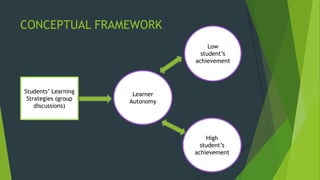
CONCEPTUAL FRAMEWORK
Learner
Autonomy
Students’ Learning
Strategies (group
discussions)
High
student’s
achievement
Low
student’s
achievement
RESEARCH DESIGN
Quantitative Research Designs
 Correlational Research (investigator use correlation statistical technique to describe and measure the
degree of association {or relationship} between two or more variables or sets of scores)  The Explanatory
Design
 To see the correlational between learning strategies and learner autonomy.
 To establish possible correlation between learner autonomy and student’s academic achievement
(high & low achiever)
 Sample: Stratified Sampling (stratify the population on some specific characteristic [high & low
achiever] )
RESEARCH INSTRUMENT
RESEARCH QUESTION INTRUMENTS
i. What is the level of learner autonomy
among KPTM students?
Questionnaire
ii. Are there any individual differences
in learner autonomy between high and
low achievers in language learning?
Questionnaire
iii. Is there any correlation between
student’s learning strategies (group
discussions) and the level of learner
autonomy?
Questionnaire
iv. How can learner autonomy help to
improve KPTM students’ academic
achievement in language learning?
Questionnaire
(open-ended questions)
There tool that will be used in this research:
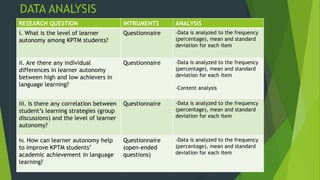
DATA ANALYSIS
RESEARCH QUESTION INTRUMENTS ANALYSIS
i. What is the level of learner
autonomy among KPTM students?
Questionnaire -Data is analyzed to the frequency
(percentage), mean and standard
deviation for each item
ii. Are there any individual
differences in learner autonomy
between high and low achievers in
language learning?
Questionnaire -Data is analyzed to the frequency
(percentage), mean and standard
deviation for each item
-Content analysis
iii. Is there any correlation between
student’s learning strategies (group
discussions) and the level of learner
autonomy?
Questionnaire -Data is analyzed to the frequency
(percentage), mean and standard
deviation for each item
iv. How can learner autonomy help
to improve KPTM students’
academic achievement in language
learning?
Questionnaire
(open-ended
questions)
-Data is analyzed to the frequency
(percentage), mean and standard
deviation for each item

Reseach proposal presentation

  • 1.
    Research Methodology TITLE: UNDERSTANDINGTHE RELATIONSHIP BETWEEN LEARNING STRATEGIES AND LEARNER AUTONOMY TOWARDS STUDENT’S ACADEMIC ACHIEVEMENT IN LANGUAGE LEARNING AT KOLEJ-POLYTECH MARA KUALA LUMPUR SYAZALINAH BINTI WASLI
  • 2.
    INTRODUCTION  Learner autonomyhas become a “central concern” in a way of learning foreign language (Fumin, F. (2012). Teachers' Roles in Promoting Students' Learner Autonomy in China. English Language Teaching, 51-56)  It shows a positive influence to the growth of target language when learner autonomy is executed in the learning process (Little, D. (2008). Knowledge about language and learner autonomy. In J. C. (Eds), Encyclopedia of Language and Education (pp. 247-258). New York: Springer Science)  Language Learning Strategies (LLSs) have emerged not only as integral components of various theoretical models of language proficiency (Bialystok, 1978; Canale and Swain, 1980; Ellis, 1985; Bachman and Palmer, 1996) but also as a means of achieving learners’ autonomy in the process of language learning (Oxford, 1990; Benson and Voller, 1997)
  • 3.
    BACKGROUND OF THERESEARCH  Meaningful learning is where the learner chooses conscientiously to integrate new knowledge to knowledge that the learner already possesses (Novak J. , 2002)  Learner who are autonomous have locus of control in learning; an individual’s belief system regarding the causes of his or her experience and the factors to which that person attributes success or failure (Barzegar, 2011)  The feasibility of helping students become more effective language learners is by teaching them learning strategies (Chamot, A. U. Issues in Language Learning Strategy Research and Teaching. Electronic Journal of Foreign Language Teaching. 2004, 1: 14−26) Previous research:  Personal Goal-setting and Autonomy in Language Learning by TOMOKO KODA-DALLOW AND MOIRA HOBBS, 2005  Relationship Between Learner Autonomy and English Language Proficiency of Japanese Learners by Shien Sakai and Akiko Takagi, 2009  Learner Autonomy and the Use of Language Learning Strategies in a Taiwanese Junior High School by Hsiang-I Chen (Corresponding author) and Hung-Hsi Pan , 2015
  • 4.
    PROBLEM STATEMENT  Issue:Not many research done in Malaysian context on enhancing learner autonomy and learning strategies in language learning.  Less effort made by the students in terms of learning the English language autonomously  Target Population: KPTM Kuala Lumpur Students  Why we need to overcome this problem?  To encourage students to learn according to their needs  To enhance life-long learning in their life  To nurture learner autonomy in every student
  • 5.
    RESEARCH OBJECTIVE The researchobjectives of this research are as follows: i. To see what is the level of learner autonomy among KPTM students. ii. To find out whether there are any individual differences in learner autonomy between high and low achievers in language learning. iii. To find out whether there are any correlation between student’s learning strategies (group discussions) and the level of learner autonomy. iv. To find out whether learner autonomy can help KPTM’s students to improve their academic achievement in language learning.
  • 6.
    RESEARCH QUESTION The researchquestions of this study are as follows: i. What is the level of learner autonomy among KPTM students? ii. Are there any individual differences in learner autonomy between high and low achievers in language learning? iii. Is there any correlation between student’s learning strategies (group discussions) and the level of learner autonomy? iv. How can learner autonomy help to improve KPTM students’ academic achievement in language learning?
  • 7.
    CONCEPTUAL FRAMEWORK Learner Autonomy Students’ Learning Strategies(group discussions) High student’s achievement Low student’s achievement
  • 8.
    RESEARCH DESIGN Quantitative ResearchDesigns  Correlational Research (investigator use correlation statistical technique to describe and measure the degree of association {or relationship} between two or more variables or sets of scores)  The Explanatory Design  To see the correlational between learning strategies and learner autonomy.  To establish possible correlation between learner autonomy and student’s academic achievement (high & low achiever)  Sample: Stratified Sampling (stratify the population on some specific characteristic [high & low achiever] )
  • 9.
    RESEARCH INSTRUMENT RESEARCH QUESTIONINTRUMENTS i. What is the level of learner autonomy among KPTM students? Questionnaire ii. Are there any individual differences in learner autonomy between high and low achievers in language learning? Questionnaire iii. Is there any correlation between student’s learning strategies (group discussions) and the level of learner autonomy? Questionnaire iv. How can learner autonomy help to improve KPTM students’ academic achievement in language learning? Questionnaire (open-ended questions) There tool that will be used in this research:
  • 10.
    DATA ANALYSIS RESEARCH QUESTIONINTRUMENTS ANALYSIS i. What is the level of learner autonomy among KPTM students? Questionnaire -Data is analyzed to the frequency (percentage), mean and standard deviation for each item ii. Are there any individual differences in learner autonomy between high and low achievers in language learning? Questionnaire -Data is analyzed to the frequency (percentage), mean and standard deviation for each item -Content analysis iii. Is there any correlation between student’s learning strategies (group discussions) and the level of learner autonomy? Questionnaire -Data is analyzed to the frequency (percentage), mean and standard deviation for each item iv. How can learner autonomy help to improve KPTM students’ academic achievement in language learning? Questionnaire (open-ended questions) -Data is analyzed to the frequency (percentage), mean and standard deviation for each item