IOWA STATE UNIVERSITY
Civil, Construction & Environmental Engineering


                            Peter Becker
                     Graduate Research Assistant

                    Master of science thesis defense
                              15 July 2011


Dream it, Design it, Build it.          www.ccee.engineering.iastate.edu
Transportation Research Board and the
 Strategic Highway Research Program 2
 (SHRP2)
Mr. Ed O’Malley and GeoStructures, Inc.
Drs. David White, Jeramy Ashlock, and Charles
 Jahren
Mr. Ed O’Malley and GeoStructures, Inc.
Earthworks engineering research center
 (EERC) and the Institute for Transportation
 (InTrans)
1 Introduction
2 Rapid impact compaction (RIC)
3 Current state of practice for commercial
  construction applications
4 Test methods
5 Materials
6 Results and analysis
7 Assessment of RIC for transportation
  applications
8 Conclusions and recommendations
Transportation agencies seldom utilize
 geoconstruction technologies due to different
 “obstacles”
Rapid impact compaction (RIC) has potential
 for transportation infrastructure projects but
 has yet to be used
•   no simple design/analysis procedure;
•   no established performance criteria;
•   no easy-to-use-tools to select technology;
•   no long-term performance data;
•   environmental impacts;
•   performance uncertainty; and
•   no accessible case histories (Berg et al., 2008)
Goal of Research:
 Evaluate RIC for civil engineering applications in
 transportation sector
Research Objectives:
  1. develop expanded RIC knowledge base from
     contractors;
  2. present detailed case history of RIC project; and
  3. assess applicability of
     design, QC/QA, specification procedures.
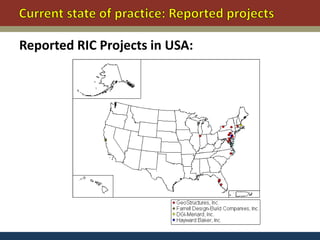
Reported RIC Projects in USA:
Design/Analysis:
  Qualitative procedure
Construction and QC/QA:
  Follows square impact point spacing
  Compaction at each impact point concludes after
   different criteria:
  QA performed by SPT
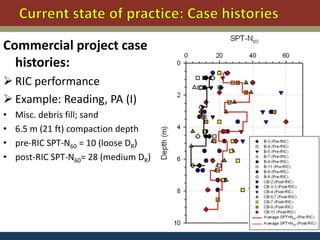
Commercial project case
  histories:
 RIC performance
 Example: Reading, PA (I)
•   Misc. debris fill; sand
•   6.5 m (21 ft) compaction depth
•   pre-RIC SPT-N60 = 10 (loose DR)
•   post-RIC SPT-N60= 28 (medium DR)
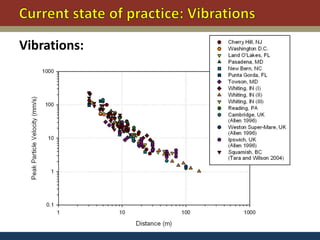
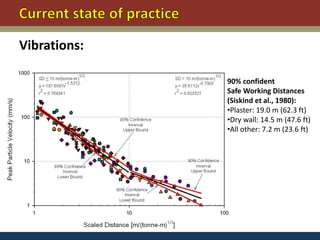
Vibrations:
Vibrations:

              90% confident
              Safe Working Distances
              (Siskind et al., 1980):
              •Plaster: 19.0 m (62.3 ft)
              •Dry wall: 14.5 m (47.6 ft)
              •All other: 7.2 m (23.6 ft)
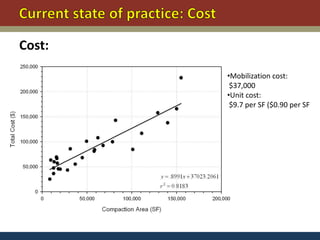
Cost:

        •Mobilization cost:
         $37,000
        •Unit cost:
         $9.7 per SF ($0.90 per SF
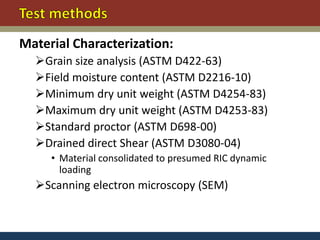
Material Characterization:
  Grain size analysis (ASTM D422-63)
  Field moisture content (ASTM D2216-10)
  Minimum dry unit weight (ASTM D4254-83)
  Maximum dry unit weight (ASTM D4253-83)
  Standard proctor (ASTM D698-00)
  Drained direct Shear (ASTM D3080-04)
     • Material consolidated to presumed RIC dynamic
       loading
  Scanning electron microscopy (SEM)
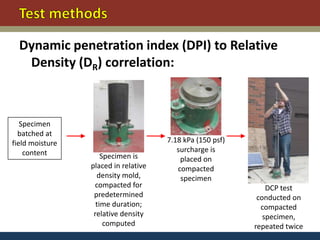
Dynamic penetration index (DPI) to Relative
   Density (DR) correlation:


   Specimen
  batched at
field moisture                        7.18 kPa (150 psf)
    content                              surcharge is
                     Specimen is          placed on
                 placed in relative      compacted
                   density mold,          specimen
                  compacted for                                DCP test
                  predetermined                             conducted on
                   time duration;                            compacted
                  relative density                            specimen,
                      computed                             repeated twice
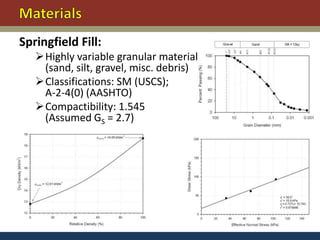
Springfield Fill:
   Highly variable granular material
    (sand, silt, gravel, misc. debris)
   Classifications: SM (USCS);
    A-2-4(0) (AASHTO)
   Compactibility: 1.545
    (Assumed GS = 2.7)
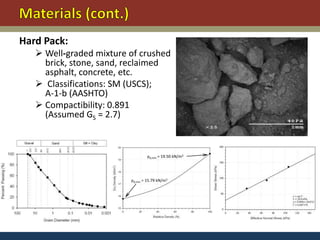
Hard Pack:
    Well-graded mixture of crushed
     brick, stone, sand, reclaimed
     asphalt, concrete, etc.
    Classifications: SM (USCS);
     A-1-b (AASHTO)
    Compactibility: 0.891
     (Assumed GS = 2.7)


                                 ρd,min = 19.50 kN/m3


                         ρd,min = 15.79 kN/m3
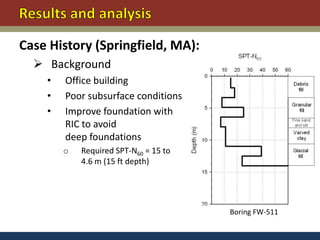
Case History (Springfield, MA):
   Background
    •   Office building
    •   Poor subsurface conditions
    •   Improve foundation with
        RIC to avoid
        deep foundations
        o   Required SPT-N60 = 15 to
            4.6 m (15 ft depth)


                                       Boring FW-511
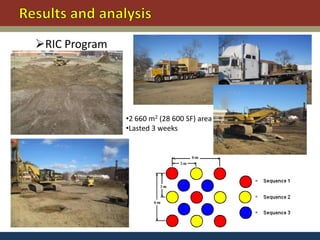
RIC Program


               •2 660 m2 (28 600 SF) area
               •Lasted 3 weeks
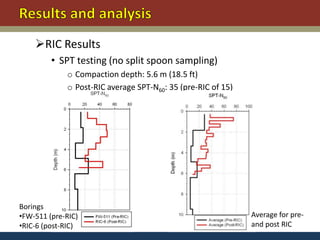
RIC Results
         • SPT testing (no split spoon sampling)
             o Compaction depth: 5.6 m (18.5 ft)
             o Post-RIC average SPT-N60: 35 (pre-RIC of 15)


Borings
•FW-511 (pre-RIC)                                             Average for pre-
•RIC-6 (post-RIC)                                             and post RIC
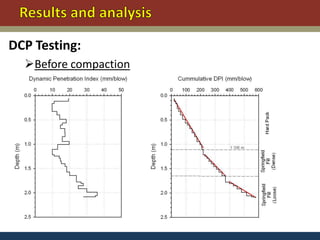
DCP Testing:
  Before compaction
   trial
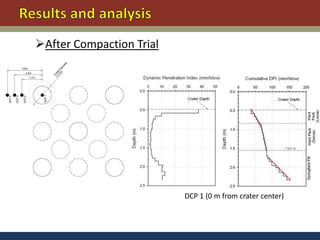
After Compaction Trial


                          DCP 1 (0 m from crater center)
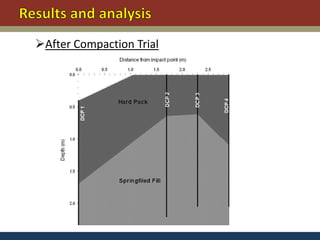
After Compaction Trial
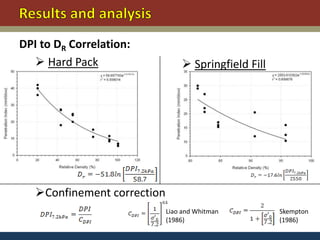
DPI to DR Correlation:
   Hard Pack                     Springfield Fill


   Confinement correction
                             Liao and Whitman         Skempton
                             (1986)                   (1986)
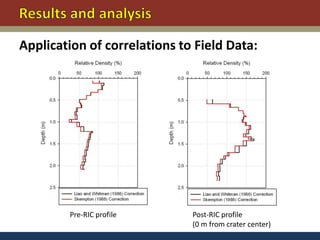
Application of correlations to Field Data:


        Pre-RIC profile       Post-RIC profile
                              (0 m from crater center)
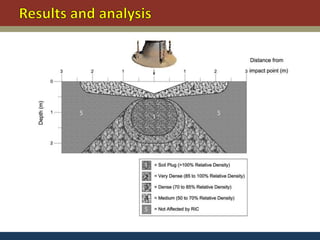
Spatially analyzed relative density profile
[Liao and Whitman (1986) correction]:
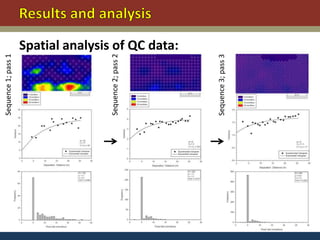
Sequence 1; pass 1


Sequence 2; pass 2
                     Spatial analysis of QC data:


Sequence 3; pass 3
SHRP2 R02
  • Phase 1
    o Identification of geoconstruction technologies
      applicable to transportation infrastructure
  • Phase 2
    o Development of selection guidance system
       o Comprehensive Technology Summary (CTS)
       o Task 10 Assessment of Design Methods and QC/QA
         Procedures
       o Task 12 Assessment of Existing Specifications
CTS
 • Summary of basic
   function, advantages, disadvantages, etc.
 • Potential transportation infrastructure
   applications
Task 10
  • Design method
    o Direct measurement of improvement depth following
      construction
  • QC/QA procedures
    o QC procedures
        Process control, equipment performance (data acquisition
         system)
    o QA procedures
        Bearing capacity, predicted settlement, liquefaction
         susceptibility (in situ penetration tests)
    o Currently flawed
Task 12
  • One specification available (commercial
    specification)
     o Performance-related specification
     o Requires improvement before application to
       transportation projects
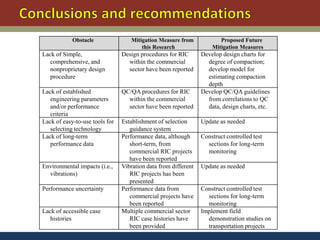
Obstacle               Mitigation Measure from             Proposed Future
                                       this Research                Mitigation Measures
Lack of Simple,                 Design procedures for RIC       Develop design charts for
   comprehensive, and             within the commercial           degree of compaction;
   nonproprietary design          sector have been reported       develop model for
   procedure                                                      estimating compaction
                                                                  depth
Lack of established             QC/QA procedures for RIC        Develop QC/QA guidelines
   engineering parameters         within the commercial           from correlations to QC
   and/or performance             sector have been reported       data, design charts, etc.
   criteria
Lack of easy-to-use tools for   Establishment of selection      Update as needed
   selecting technology            guidance system
Lack of long-term               Performance data, although      Construct controlled test
   performance data                short-term, from               sections for long-term
                                   commercial RIC projects        monitoring
                                   have been reported
Environmental impacts (i.e.,    Vibration data from different   Update as needed
  vibrations)                      RIC projects has been
                                   presented
Performance uncertainty         Performance data from           Construct controlled test
                                   commercial projects have       sections for long-term
                                   been reported                  monitoring
Lack of accessible case         Multiple commercial sector      Implement field
   histories                       RIC case histories have        demonstration studies on
                                   been provided                  transportation projects
Thank you for your attention!

  Are there any questions?

M.S. Thesis Defense

  • 1.
    IOWA STATE UNIVERSITY Civil,Construction & Environmental Engineering Peter Becker Graduate Research Assistant Master of science thesis defense 15 July 2011 Dream it, Design it, Build it. www.ccee.engineering.iastate.edu
  • 2.
    Transportation Research Boardand the Strategic Highway Research Program 2 (SHRP2) Mr. Ed O’Malley and GeoStructures, Inc. Drs. David White, Jeramy Ashlock, and Charles Jahren Mr. Ed O’Malley and GeoStructures, Inc. Earthworks engineering research center (EERC) and the Institute for Transportation (InTrans)
  • 3.
    1 Introduction 2 Rapidimpact compaction (RIC) 3 Current state of practice for commercial construction applications 4 Test methods 5 Materials 6 Results and analysis 7 Assessment of RIC for transportation applications 8 Conclusions and recommendations
  • 4.
    Transportation agencies seldomutilize geoconstruction technologies due to different “obstacles” Rapid impact compaction (RIC) has potential for transportation infrastructure projects but has yet to be used
  • 5.
    no simple design/analysis procedure; • no established performance criteria; • no easy-to-use-tools to select technology; • no long-term performance data; • environmental impacts; • performance uncertainty; and • no accessible case histories (Berg et al., 2008)
  • 6.
    Goal of Research: Evaluate RIC for civil engineering applications in transportation sector Research Objectives: 1. develop expanded RIC knowledge base from contractors; 2. present detailed case history of RIC project; and 3. assess applicability of design, QC/QA, specification procedures.
  • 8.
  • 9.
    Design/Analysis: Qualitativeprocedure Construction and QC/QA: Follows square impact point spacing Compaction at each impact point concludes after different criteria: QA performed by SPT
  • 10.
    Commercial project case histories:  RIC performance  Example: Reading, PA (I) • Misc. debris fill; sand • 6.5 m (21 ft) compaction depth • pre-RIC SPT-N60 = 10 (loose DR) • post-RIC SPT-N60= 28 (medium DR)
  • 11.
  • 12.
    Vibrations: 90% confident Safe Working Distances (Siskind et al., 1980): •Plaster: 19.0 m (62.3 ft) •Dry wall: 14.5 m (47.6 ft) •All other: 7.2 m (23.6 ft)
  • 13.
    Cost: •Mobilization cost: $37,000 •Unit cost: $9.7 per SF ($0.90 per SF
  • 14.
    Material Characterization: Grain size analysis (ASTM D422-63) Field moisture content (ASTM D2216-10) Minimum dry unit weight (ASTM D4254-83) Maximum dry unit weight (ASTM D4253-83) Standard proctor (ASTM D698-00) Drained direct Shear (ASTM D3080-04) • Material consolidated to presumed RIC dynamic loading Scanning electron microscopy (SEM)
  • 15.
    Dynamic penetration index(DPI) to Relative Density (DR) correlation: Specimen batched at field moisture 7.18 kPa (150 psf) content surcharge is Specimen is placed on placed in relative compacted density mold, specimen compacted for DCP test predetermined conducted on time duration; compacted relative density specimen, computed repeated twice
  • 16.
    Springfield Fill: Highly variable granular material (sand, silt, gravel, misc. debris) Classifications: SM (USCS); A-2-4(0) (AASHTO) Compactibility: 1.545 (Assumed GS = 2.7)
  • 17.
    Hard Pack:  Well-graded mixture of crushed brick, stone, sand, reclaimed asphalt, concrete, etc.  Classifications: SM (USCS); A-1-b (AASHTO)  Compactibility: 0.891 (Assumed GS = 2.7) ρd,min = 19.50 kN/m3 ρd,min = 15.79 kN/m3
  • 18.
    Case History (Springfield,MA):  Background • Office building • Poor subsurface conditions • Improve foundation with RIC to avoid deep foundations o Required SPT-N60 = 15 to 4.6 m (15 ft depth) Boring FW-511
  • 19.
    RIC Program •2 660 m2 (28 600 SF) area •Lasted 3 weeks
  • 20.
    RIC Results • SPT testing (no split spoon sampling) o Compaction depth: 5.6 m (18.5 ft) o Post-RIC average SPT-N60: 35 (pre-RIC of 15) Borings •FW-511 (pre-RIC) Average for pre- •RIC-6 (post-RIC) and post RIC
  • 21.
    DCP Testing: Before compaction trial
  • 22.
    After Compaction Trial DCP 1 (0 m from crater center)
  • 23.
  • 24.
    DPI to DRCorrelation:  Hard Pack  Springfield Fill Confinement correction Liao and Whitman Skempton (1986) (1986)
  • 25.
    Application of correlationsto Field Data: Pre-RIC profile Post-RIC profile (0 m from crater center)
  • 26.
    Spatially analyzed relativedensity profile [Liao and Whitman (1986) correction]:
  • 28.
    Sequence 1; pass1 Sequence 2; pass 2 Spatial analysis of QC data: Sequence 3; pass 3
  • 29.
    SHRP2 R02 • Phase 1 o Identification of geoconstruction technologies applicable to transportation infrastructure • Phase 2 o Development of selection guidance system o Comprehensive Technology Summary (CTS) o Task 10 Assessment of Design Methods and QC/QA Procedures o Task 12 Assessment of Existing Specifications
  • 30.
    CTS • Summaryof basic function, advantages, disadvantages, etc. • Potential transportation infrastructure applications
  • 31.
    Task 10 • Design method o Direct measurement of improvement depth following construction • QC/QA procedures o QC procedures  Process control, equipment performance (data acquisition system) o QA procedures  Bearing capacity, predicted settlement, liquefaction susceptibility (in situ penetration tests) o Currently flawed
  • 32.
    Task 12 • One specification available (commercial specification) o Performance-related specification o Requires improvement before application to transportation projects
  • 33.
    Obstacle Mitigation Measure from Proposed Future this Research Mitigation Measures Lack of Simple, Design procedures for RIC Develop design charts for comprehensive, and within the commercial degree of compaction; nonproprietary design sector have been reported develop model for procedure estimating compaction depth Lack of established QC/QA procedures for RIC Develop QC/QA guidelines engineering parameters within the commercial from correlations to QC and/or performance sector have been reported data, design charts, etc. criteria Lack of easy-to-use tools for Establishment of selection Update as needed selecting technology guidance system Lack of long-term Performance data, although Construct controlled test performance data short-term, from sections for long-term commercial RIC projects monitoring have been reported Environmental impacts (i.e., Vibration data from different Update as needed vibrations) RIC projects has been presented Performance uncertainty Performance data from Construct controlled test commercial projects have sections for long-term been reported monitoring Lack of accessible case Multiple commercial sector Implement field histories RIC case histories have demonstration studies on been provided transportation projects
  • 34.
    Thank you foryour attention! Are there any questions?

Editor's Notes

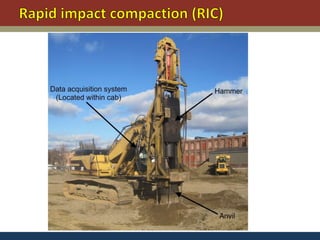
  • #8 Compaction method that uses impact forces to densify loose, granular soilsComprises hammer, anvil, and data acquisition systemCurrently limited to commercial projectsPublished materials lack sufficient information
  • #11 RIC performance (i.e., compaction depth, post-RIC SPT-N60 value)