A STUDY ON CONTRIBUTING FACTORS BEHIND
STUDENTS’ LOW LEVEL OF INTRINSIC MOTIVATION
TOWARDS ENGLISH LANGUAGE LEARNING IN KOLEJ
POLY-TECH MARA KUANTAN
Prepared by:
MOHD JURAIMI BIN OMAR
2014928935
MASTER IN TESL (ED770)
UiTM
EDU702 - RESEARCH METHODOLOGY
INTRODUCTION
• Motivating students to excel in their English
lesson might be a problem to many
teachers/lecturers.
• Motivation is very important. It is the key to
learning (Dornyei, 1998)
• There are many improvements in English
lessons although the students are still showing
minimum level of intrinsic motivation
(Vannestal & Lindquist, 2011)
EDU702 - RESEARCH METHODOLOGY
BACKGROUND OF THE RESEARCH
• Many English teachers/lecturers believe that
their students lack intrinsic motivation to excel
in English learning.
• Johansson (2010) pointed out intrinsic
motivation as a factor of influence in students’
English grammar lesson.
• Dornyei (2009) indicated that students’
success in second language learning depends
on their motivation level.
EDU702 - RESEARCH METHODOLOGY
STATEMENT OF THE PROBLEM
• According to Eide Neurolearning website,
students tend to lose their intrinsic motivation as
their age increases.
• It was recorded that students in 6th grade
possessed 3.0 points of intrinsic motivation level
compared to those in 9th grade who managed to
score only 2.5 points out of 3.5 scale.
• Ahmed (2014) singled out that learners’
motivation and desire are the main factor for
second language acquisition.
EDU702 - RESEARCH METHODOLOGY
RESEACH OBJECTIVES
The research objectives of this study are as follows:
i. To identify contributing factors behind students’
low level of intrinsic motivation in English learning
ii. To understand the relation between contributing
factors and level of intrinsic motivation
iii. To investigate how contributing factors will lead to
students’ low level of intrinsic motivation
EDU702 - RESEARCH METHODOLOGY
RESEARCH QUESTIONS
The research questions of this study are as
follows:
i. What are the contributing factors behind students’
low level of intrinsic motivation?
ii. What is the relation between contributing factors
and students’ level of intrinsic motivation?
iii. How contributing factors can lead students to have
low level of intrinsic motivation?
EDU702 - RESEARCH METHODOLOGY
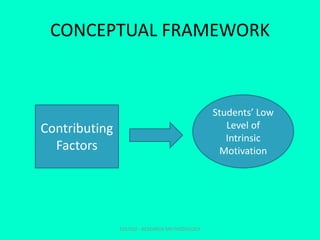
CONCEPTUAL FRAMEWORK
Contributing
Factors
Students’ Low
Level of
Intrinsic
Motivation
EDU702 - RESEARCH METHODOLOGY
RESEARCH DESIGN
• This research is a quantitative research.
• This research employs a correlational
research.
• The data will be collected using questionnaire.
EDU702 - RESEARCH METHODOLOGY
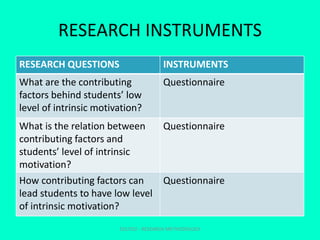
RESEARCH INSTRUMENTS
RESEARCH QUESTIONS INSTRUMENTS
What are the contributing
factors behind students’ low
level of intrinsic motivation?
Questionnaire
What is the relation between
contributing factors and
students’ level of intrinsic
motivation?
Questionnaire
How contributing factors can
lead students to have low level
of intrinsic motivation?
Questionnaire
EDU702 - RESEARCH METHODOLOGY
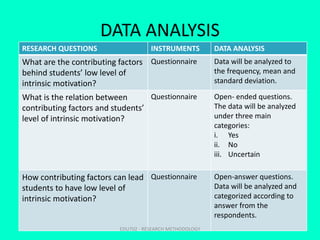
DATA ANALYSIS
RESEARCH QUESTIONS INSTRUMENTS DATA ANALYSIS
What are the contributing factors
behind students’ low level of
intrinsic motivation?
Questionnaire Data will be analyzed to
the frequency, mean and
standard deviation.
What is the relation between
contributing factors and students’
level of intrinsic motivation?
Questionnaire Open- ended questions.
The data will be analyzed
under three main
categories:
i. Yes
ii. No
iii. Uncertain
How contributing factors can lead
students to have low level of
intrinsic motivation?
Questionnaire Open-answer questions.
Data will be analyzed and
categorized according to
answer from the
respondents.
EDU702 - RESEARCH METHODOLOGY

Research proposal chapter 1 presentation

  • 1.
    A STUDY ONCONTRIBUTING FACTORS BEHIND STUDENTS’ LOW LEVEL OF INTRINSIC MOTIVATION TOWARDS ENGLISH LANGUAGE LEARNING IN KOLEJ POLY-TECH MARA KUANTAN Prepared by: MOHD JURAIMI BIN OMAR 2014928935 MASTER IN TESL (ED770) UiTM EDU702 - RESEARCH METHODOLOGY
  • 2.
    INTRODUCTION • Motivating studentsto excel in their English lesson might be a problem to many teachers/lecturers. • Motivation is very important. It is the key to learning (Dornyei, 1998) • There are many improvements in English lessons although the students are still showing minimum level of intrinsic motivation (Vannestal & Lindquist, 2011) EDU702 - RESEARCH METHODOLOGY
  • 3.
    BACKGROUND OF THERESEARCH • Many English teachers/lecturers believe that their students lack intrinsic motivation to excel in English learning. • Johansson (2010) pointed out intrinsic motivation as a factor of influence in students’ English grammar lesson. • Dornyei (2009) indicated that students’ success in second language learning depends on their motivation level. EDU702 - RESEARCH METHODOLOGY
  • 4.
    STATEMENT OF THEPROBLEM • According to Eide Neurolearning website, students tend to lose their intrinsic motivation as their age increases. • It was recorded that students in 6th grade possessed 3.0 points of intrinsic motivation level compared to those in 9th grade who managed to score only 2.5 points out of 3.5 scale. • Ahmed (2014) singled out that learners’ motivation and desire are the main factor for second language acquisition. EDU702 - RESEARCH METHODOLOGY
  • 5.
    RESEACH OBJECTIVES The researchobjectives of this study are as follows: i. To identify contributing factors behind students’ low level of intrinsic motivation in English learning ii. To understand the relation between contributing factors and level of intrinsic motivation iii. To investigate how contributing factors will lead to students’ low level of intrinsic motivation EDU702 - RESEARCH METHODOLOGY
  • 6.
    RESEARCH QUESTIONS The researchquestions of this study are as follows: i. What are the contributing factors behind students’ low level of intrinsic motivation? ii. What is the relation between contributing factors and students’ level of intrinsic motivation? iii. How contributing factors can lead students to have low level of intrinsic motivation? EDU702 - RESEARCH METHODOLOGY
  • 7.
    CONCEPTUAL FRAMEWORK Contributing Factors Students’ Low Levelof Intrinsic Motivation EDU702 - RESEARCH METHODOLOGY
  • 8.
    RESEARCH DESIGN • Thisresearch is a quantitative research. • This research employs a correlational research. • The data will be collected using questionnaire. EDU702 - RESEARCH METHODOLOGY
  • 9.
    RESEARCH INSTRUMENTS RESEARCH QUESTIONSINSTRUMENTS What are the contributing factors behind students’ low level of intrinsic motivation? Questionnaire What is the relation between contributing factors and students’ level of intrinsic motivation? Questionnaire How contributing factors can lead students to have low level of intrinsic motivation? Questionnaire EDU702 - RESEARCH METHODOLOGY
  • 10.
    DATA ANALYSIS RESEARCH QUESTIONSINSTRUMENTS DATA ANALYSIS What are the contributing factors behind students’ low level of intrinsic motivation? Questionnaire Data will be analyzed to the frequency, mean and standard deviation. What is the relation between contributing factors and students’ level of intrinsic motivation? Questionnaire Open- ended questions. The data will be analyzed under three main categories: i. Yes ii. No iii. Uncertain How contributing factors can lead students to have low level of intrinsic motivation? Questionnaire Open-answer questions. Data will be analyzed and categorized according to answer from the respondents. EDU702 - RESEARCH METHODOLOGY