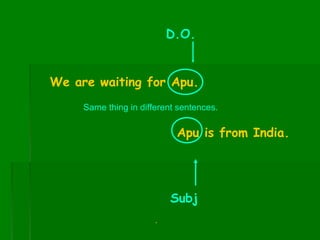
D.O.
We are waiting for Apu.
Same thing in different sentences.

Apu is from India.

Subj
.
We are waiting for Apu, who is from India.

Apu is from India.

Subj
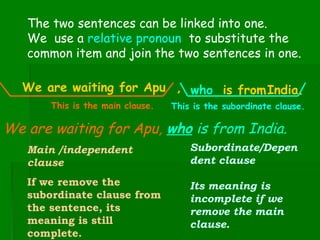
The two sentences can be linked into one.
We use a relative pronoun to substitute the
common item and join the two sentences in one.
We are waiting for Apu , who is fromIndia.
This is the main clause.

This is the subordinate clause.

We are waiting for Apu, who is from India.
Main /independent
clause

Subordinate/Depen
dent clause

If we remove the
subordinate clause from
the sentence, its
meaning is still
complete.

Its meaning is
incomplete if we
remove the main
clause.
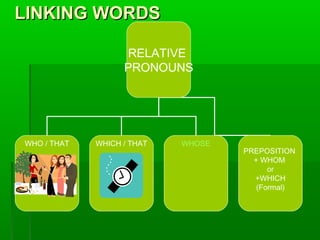
LINKING WORDS
RELATIVE
PRONOUNS

WHO / THAT

WHICH / THAT

WHOSE

PREPOSITION
+ WHOM
or
+WHICH
(Formal)
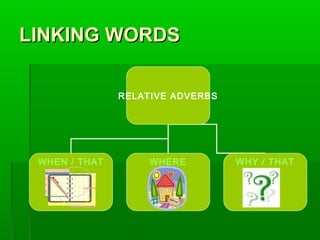
LINKING WORDS
RELATIVE ADVERBS

WHEN / THAT

WHERE

WHY / THAT
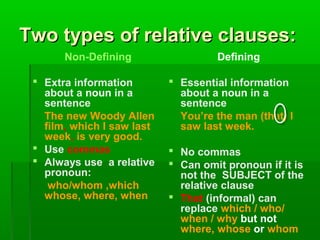
Two types of relative clauses:
Non-Defining
 Extra information
about a noun in a
sentence
The new Woody Allen
film, which I saw last
week, is very good.
 Use commas
 Always use a relative
pronoun:
who/whom ,which
whose, where, when

Defining
 Essential information
about a noun in a
sentence
You’re the man (that) I
saw last week.
 No commas
 Can omit pronoun if it is
not the SUBJECT of the
relative clause
 That (informal) can
replace which / who/
when / why but not
where, whose or whom
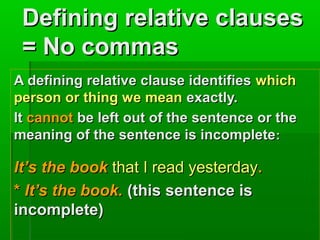
Defining relative clauses
= No commas
A defining relative clause identifies which
person or thing we mean exactly.
It cannot be left out of the sentence or the
meaning of the sentence is incomplete :

It’s the book that I read yesterday.
* It’s the book. (this sentence is
incomplete)
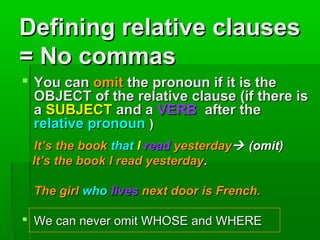
Defining relative clauses
= No commas
 You can omit the pronoun if it is the
OBJECT of the relative clause (if there is
a SUBJECT and a VERB after the
relative pronoun )
It’s the book that I read yesterday (omit)
It’s the book I read yesterday.
The girl who lives next door is French.
 We can never omit WHOSE and WHERE
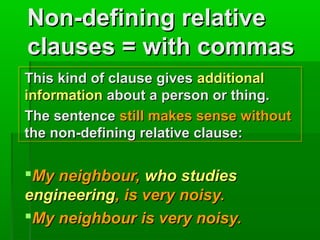
Non-defining relative
clauses = with commas
This kind of clause gives additional
information about a person or thing.
The sentence still makes sense without
the non-defining relative clause:

My neighbour, who studies
engineering, is very noisy.
My neighbour is very noisy.
Formal / Informal

Non-Defining relative clauses (with
commas) are more common in written
English because they are quite formal.
In spoken English we would probably use
two sentences.
Compare:
Elvis Presley, who has sold over one billion albums, died of
prescription drug abuse. [written]

with
Elvis has sold over a billion albums. He died of an
overdose. [spoken]
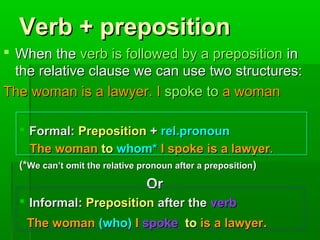
Verb + preposition
 When the verb is followed by a preposition in
the relative clause we can use two structures:
The woman is a lawyer. I spoke to a woman
 Formal: Preposition + rel.pronoun
The woman to whom* I spoke is a lawyer.
(*We can’t omit the relative pronoun after a preposition)

Or
 Informal: Preposition after the verb
The woman (who) I spoke to is a lawyer.
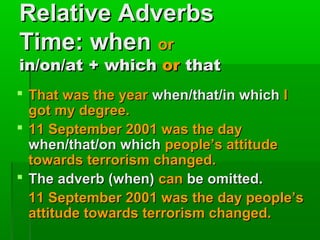
Relative Adverbs
Time: when or

in/on/at + which or that
 That was the year when/that/in which I
got my degree.
 11 September 2001 was the day
when/that/on which people’s attitude
towards terrorism changed.
 The adverb (when) can be omitted.
11 September 2001 was the day people’s
attitude towards terrorism changed.
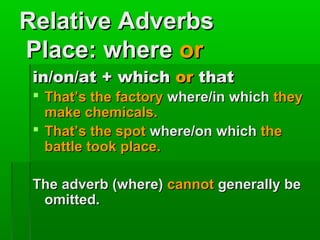
Relative Adverbs
Place: where or
in/on/at + which or that
 That’s the factory where/in which they
make chemicals.
 That’s the spot where/on which the
battle took place.
The adverb (where) cannot generally be
omitted.
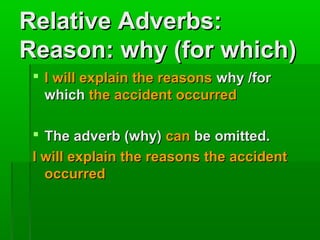
Relative Adverbs:
Reason: why (for which)
 I will explain the reasons why /for
which the accident occurred
 The adverb (why) can be omitted.
I will explain the reasons the accident
occurred
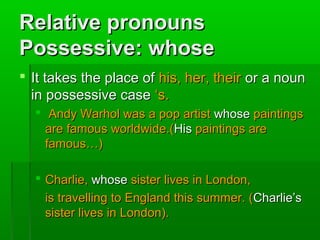
Relative pronouns
Possessive: whose
 It takes the place of his, her, their or a noun
in possessive case ‘s.
 Andy Warhol was a pop artist whose paintings
are famous worldwide.(His paintings are
famous…)
 Charlie, whose sister lives in London,
is travelling to England this summer. (Charlie’s
sister lives in London).

Relative

  • 2.
    D.O. We are waitingfor Apu. Same thing in different sentences. Apu is from India. Subj .
  • 3.
    We are waitingfor Apu, who is from India. Apu is from India. Subj
  • 4.
    The two sentencescan be linked into one. We use a relative pronoun to substitute the common item and join the two sentences in one. We are waiting for Apu , who is fromIndia. This is the main clause. This is the subordinate clause. We are waiting for Apu, who is from India. Main /independent clause Subordinate/Depen dent clause If we remove the subordinate clause from the sentence, its meaning is still complete. Its meaning is incomplete if we remove the main clause.
  • 5.
    LINKING WORDS RELATIVE PRONOUNS WHO /THAT WHICH / THAT WHOSE PREPOSITION + WHOM or +WHICH (Formal)
  • 6.
    LINKING WORDS RELATIVE ADVERBS WHEN/ THAT WHERE WHY / THAT
  • 7.
    Two types ofrelative clauses: Non-Defining  Extra information about a noun in a sentence The new Woody Allen film, which I saw last week, is very good.  Use commas  Always use a relative pronoun: who/whom ,which whose, where, when Defining  Essential information about a noun in a sentence You’re the man (that) I saw last week.  No commas  Can omit pronoun if it is not the SUBJECT of the relative clause  That (informal) can replace which / who/ when / why but not where, whose or whom
  • 8.
    Defining relative clauses =No commas A defining relative clause identifies which person or thing we mean exactly. It cannot be left out of the sentence or the meaning of the sentence is incomplete : It’s the book that I read yesterday. * It’s the book. (this sentence is incomplete)
  • 9.
    Defining relative clauses =No commas  You can omit the pronoun if it is the OBJECT of the relative clause (if there is a SUBJECT and a VERB after the relative pronoun ) It’s the book that I read yesterday (omit) It’s the book I read yesterday. The girl who lives next door is French.  We can never omit WHOSE and WHERE
  • 10.
    Non-defining relative clauses =with commas This kind of clause gives additional information about a person or thing. The sentence still makes sense without the non-defining relative clause: My neighbour, who studies engineering, is very noisy. My neighbour is very noisy.
  • 11.
    Formal / Informal Non-Definingrelative clauses (with commas) are more common in written English because they are quite formal. In spoken English we would probably use two sentences. Compare: Elvis Presley, who has sold over one billion albums, died of prescription drug abuse. [written] with Elvis has sold over a billion albums. He died of an overdose. [spoken]
  • 12.
    Verb + preposition When the verb is followed by a preposition in the relative clause we can use two structures: The woman is a lawyer. I spoke to a woman  Formal: Preposition + rel.pronoun The woman to whom* I spoke is a lawyer. (*We can’t omit the relative pronoun after a preposition) Or  Informal: Preposition after the verb The woman (who) I spoke to is a lawyer.
  • 13.
    Relative Adverbs Time: whenor in/on/at + which or that  That was the year when/that/in which I got my degree.  11 September 2001 was the day when/that/on which people’s attitude towards terrorism changed.  The adverb (when) can be omitted. 11 September 2001 was the day people’s attitude towards terrorism changed.
  • 14.
    Relative Adverbs Place: whereor in/on/at + which or that  That’s the factory where/in which they make chemicals.  That’s the spot where/on which the battle took place. The adverb (where) cannot generally be omitted.
  • 15.
    Relative Adverbs: Reason: why(for which)  I will explain the reasons why /for which the accident occurred  The adverb (why) can be omitted. I will explain the reasons the accident occurred
  • 16.
    Relative pronouns Possessive: whose It takes the place of his, her, their or a noun in possessive case ‘s.  Andy Warhol was a pop artist whose paintings are famous worldwide.(His paintings are famous…)  Charlie, whose sister lives in London, is travelling to England this summer. (Charlie’s sister lives in London).