DETERMINATION
OF
CARBON DIOXIDE
IN WATER
SAIMA ALEEM
M.PHIL
ENVIRONMENTAL CHEMISTRY
Introduction
Surface waters
 Surface waters normally contain less
than 10 ppm free carbon dioxide.
Ground water
Ground waters may easily exceed that
concentration.
Classical method
Buret titration method.
Improved evolution method.
Instrumental method
Coulometry method.
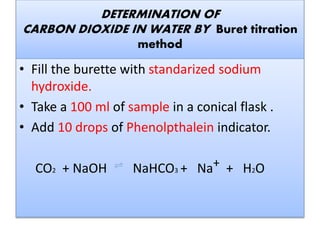
Fill the burette with standarized sodium
hydroxide.
Take a 100 ml of sample in a conical flask .
Add 10 drops of Phenolpthalein indicator.
CO2 + NaOH NaHCO3 + Na+ +
H2O
precaution
Sample must be fresh.
performed immediately after collection of
water sample.
REAGENTS
1.5 N sulfuric acid (for acidifying the
sample).
0.03N barium hydroxide (for absorbing
carbon dioxide).
Standard 0.04N hydrochloric acid( for
titrating the barium hydroxide).
Phenolphthalein indicator.
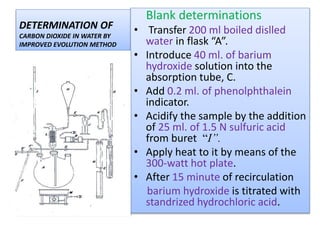
Blank determinations
 Transfer 200 ml boiled dislled
water in flask “A”.
 Introduce 40 ml. of barium
hydroxide solution into the
absorption tube, C.
 Add 0.2 ml. of phenolphthalein
indicator.
 Acidify the sample by the
addition of 25 ml. of 1.5 N
sulfuric acid from buret “I”.
 Apply heat to it by means of
the 300-watt hot plate.
 After 15 minute of recirculation
barium hydroxide is titrated
with standrized hydrochloric
acid.
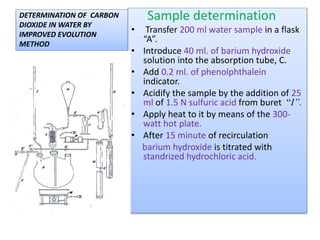
Sample determination
 Transfer 200 ml water sample in a
flask “A”.
 Introduce 40 ml. of barium hydroxide
solution into the absorption tube, C.
 Add 0.2 ml. of phenolphthalein
indicator.
 Acidify the sample by the addition of
25 ml of 1.5 N sulfuric acid from
buret “I”.
 Apply heat to it by means of the 300-
watt hot plate.
 After 15 minute of recirculation
barium hydroxide is titrated with
standrized hydrochloric acid.
DETERMINATION OF CARBON DIOXIDE IN
WATER BY COULOMETRY
Collection of sample
 Sample are drawn into 12 individually borosilicate
glass bottles.
Procedure
 First the back ground level and calibration factor
have been determined.
 Dispense the sample (30 cm3) into the
stripping chamber.
 Acidify it with phosphoric acid (1.5 cm3).
 Record the final coulometer reading.
 when the coulometer titration rate returns to
the background level ,system is ready to
analyze next sample.
“ THANK YOU”

determination of carbon dioxide in water

  • 1.
    DETERMINATION OF CARBON DIOXIDE IN WATER SAIMAALEEM M.PHIL ENVIRONMENTAL CHEMISTRY
  • 2.
    Introduction Surface waters  Surfacewaters normally contain less than 10 ppm free carbon dioxide. Ground water Ground waters may easily exceed that concentration.
  • 3.
    Classical method Buret titrationmethod. Improved evolution method. Instrumental method Coulometry method.
  • 4.
    Fill the burettewith standarized sodium hydroxide. Take a 100 ml of sample in a conical flask . Add 10 drops of Phenolpthalein indicator. CO2 + NaOH NaHCO3 + Na+ + H2O
  • 5.
    precaution Sample must befresh. performed immediately after collection of water sample.
  • 6.
    REAGENTS 1.5 N sulfuricacid (for acidifying the sample). 0.03N barium hydroxide (for absorbing carbon dioxide). Standard 0.04N hydrochloric acid( for titrating the barium hydroxide). Phenolphthalein indicator.
  • 7.
    Blank determinations  Transfer200 ml boiled dislled water in flask “A”.  Introduce 40 ml. of barium hydroxide solution into the absorption tube, C.  Add 0.2 ml. of phenolphthalein indicator.  Acidify the sample by the addition of 25 ml. of 1.5 N sulfuric acid from buret “I”.  Apply heat to it by means of the 300-watt hot plate.  After 15 minute of recirculation barium hydroxide is titrated with standrized hydrochloric acid.
  • 8.
    Sample determination  Transfer200 ml water sample in a flask “A”.  Introduce 40 ml. of barium hydroxide solution into the absorption tube, C.  Add 0.2 ml. of phenolphthalein indicator.  Acidify the sample by the addition of 25 ml of 1.5 N sulfuric acid from buret “I”.  Apply heat to it by means of the 300- watt hot plate.  After 15 minute of recirculation barium hydroxide is titrated with standrized hydrochloric acid.
  • 9.
    DETERMINATION OF CARBONDIOXIDE IN WATER BY COULOMETRY Collection of sample  Sample are drawn into 12 individually borosilicate glass bottles.
  • 10.
    Procedure  First theback ground level and calibration factor have been determined.  Dispense the sample (30 cm3) into the stripping chamber.  Acidify it with phosphoric acid (1.5 cm3).  Record the final coulometer reading.  when the coulometer titration rate returns to the background level ,system is ready to analyze next sample.
  • 11.