LOVE 
I LOVE YOU 
UNFATHOMABLE LOVE OF GOD 
I LOVE TO TEASE YOU 
I LOVE TO IGNORE YOU.
“Words so innocent and powerless as they 
are, standing in a dictionary; how potent 
for good and evil they become in the 
hands of one who knows how to choose 
and combine them.” 
Nathaniel Hawthorne
 A large vocabulary is more specifically 
predictive and reflective of high levels of 
reading achievement. 
REPORT OF THE NATIONAL READING 
PANEL(2000) 
“ The importance of vocabulary knowledge 
has long been recognized in the 
development of reading skills. As early as 
1924, researchers noted that growth in 
reading power relies on continuous growth 
in word knowledge.”
THE AMERICAN HERITAGE DICTIONARY 
defines vocabulary as 
“the sum of words used by, understood by, 
or at the command of a particular 
person or group.”
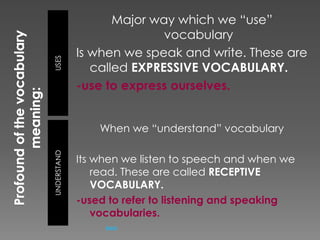
UNDERSTAND USES 
Major way which we “use” 
vocabulary 
Is when we speak and write. These are 
called EXPRESSIVE VOCABULARY. 
-use to express ourselves. 
When we “understand” vocabulary 
Its when we listen to speech and when we 
read. These are called RECEPTIVE 
VOCABULARY. 
-used to refer to listening and speaking 
vocabularies. 
back
meaning 
meaning 
meaning 
NEXT
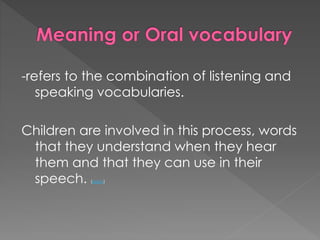
-refers to the combination of listening and 
speaking vocabularies. 
Children are involved in this process, words 
that they understand when they hear 
them and that they can use in their 
speech. (back)
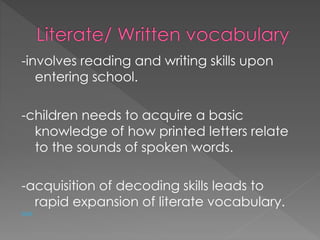
-involves reading and writing skills upon 
entering school. 
-children needs to acquire a basic 
knowledge of how printed letters relate 
to the sounds of spoken words. 
-acquisition of decoding skills leads to 
rapid expansion of literate vocabulary. 
back
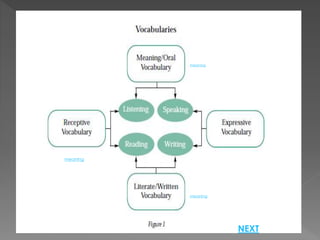
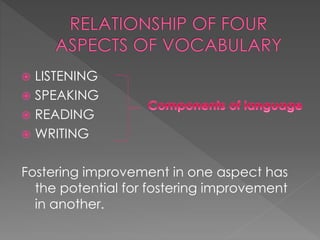
 LISTENING 
 SPEAKING 
 READING 
 WRITING 
Fostering improvement in one aspect has 
the potential for fostering improvement 
in another.
Scarborough(2001) reviews 
-children who enter kindergarten with 
weak language skills are likely to 
encounter difficulty in learning to read. 
Hart and Risley (1995) 
-studio on the variation of the amount of 
talk that took place between parents 
and children from family to family. study
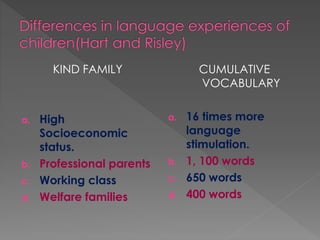
KIND FAMILY 
a. High 
Socioeconomic 
status. 
b. Professional parents 
c. Working class 
d. Welfare families 
CUMULATIVE 
VOCABULARY 
a. 16 times more 
language 
stimulation. 
b. 1, 100 words 
c. 650 words 
d. 400 words
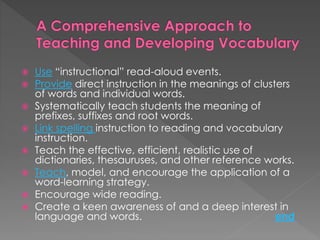
 Use “instructional” read-aloud events. 
 Provide direct instruction in the meanings of clusters 
of words and individual words. 
 Systematically teach students the meaning of 
prefixes, suffixes and root words. 
 Link spelling instruction to reading and vocabulary 
instruction. 
 Teach the effective, efficient, realistic use of 
dictionaries, thesauruses, and other reference works. 
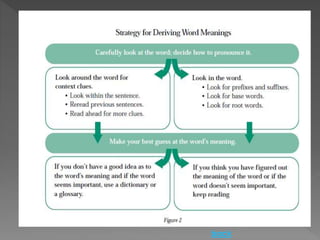
 Teach, model, and encourage the application of a 
word-learning strategy. 
 Encourage wide reading. 
 Create a keen awareness of and a deep interest in 
language and words. end
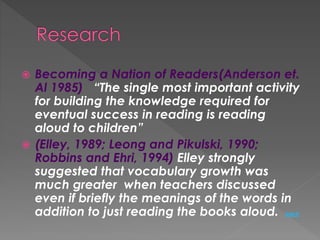
 Becoming a Nation of Readers(Anderson et. 
Al 1985) “The single most important activity 
for building the knowledge required for 
eventual success in reading is reading 
aloud to children” 
 (Elley, 1989; Leong and Pikulski, 1990; 
Robbins and Ehri, 1994) Elley strongly 
suggested that vocabulary growth was 
much greater when teachers discussed 
even if briefly the meanings of the words in 
addition to just reading the books aloud. back
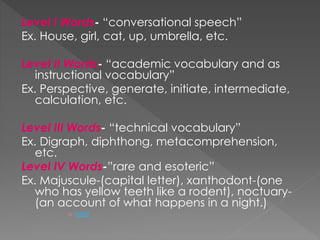
Level I Words- “conversational speech” 
Ex. House, girl, cat, up, umbrella, etc. 
Level II Words- “academic vocabulary and as 
instructional vocabulary” 
Ex. Perspective, generate, initiate, intermediate, 
calculation, etc. 
Level III Words- “technical vocabulary” 
Ex. Digraph, diphthong, metacomprehension, 
etc. 
Level IV Words-”rare and esoteric” 
Ex. Majuscule-(capital letter), xanthodont-(one 
who has yellow teeth like a rodent), noctuary- 
(an account of what happens in a night.) 
o next
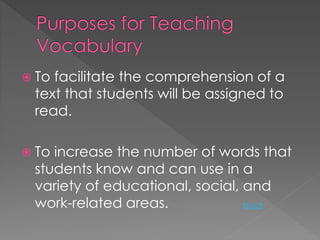
 To facilitate the comprehension of a 
text that students will be assigned to 
read. 
 To increase the number of words that 
students know and can use in a 
variety of educational, social, and 
work-related areas. back
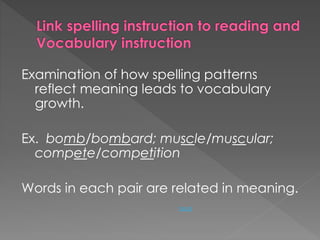
Examination of how spelling patterns 
reflect meaning leads to vocabulary 
growth. 
Ex. bomb/bombard; muscle/muscular; 
compete/competition 
Words in each pair are related in meaning. 
back
back
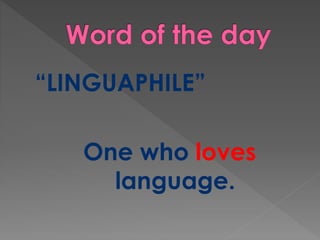
“LINGUAPHILE” 
One who loves 
language.
Report in vocabulary development

Report in vocabulary development

  • 2.
    LOVE I LOVEYOU UNFATHOMABLE LOVE OF GOD I LOVE TO TEASE YOU I LOVE TO IGNORE YOU.
  • 3.
    “Words so innocentand powerless as they are, standing in a dictionary; how potent for good and evil they become in the hands of one who knows how to choose and combine them.” Nathaniel Hawthorne
  • 4.
     A largevocabulary is more specifically predictive and reflective of high levels of reading achievement. REPORT OF THE NATIONAL READING PANEL(2000) “ The importance of vocabulary knowledge has long been recognized in the development of reading skills. As early as 1924, researchers noted that growth in reading power relies on continuous growth in word knowledge.”
  • 5.
    THE AMERICAN HERITAGEDICTIONARY defines vocabulary as “the sum of words used by, understood by, or at the command of a particular person or group.”
  • 6.
    UNDERSTAND USES Majorway which we “use” vocabulary Is when we speak and write. These are called EXPRESSIVE VOCABULARY. -use to express ourselves. When we “understand” vocabulary Its when we listen to speech and when we read. These are called RECEPTIVE VOCABULARY. -used to refer to listening and speaking vocabularies. back
  • 7.
  • 8.
    -refers to thecombination of listening and speaking vocabularies. Children are involved in this process, words that they understand when they hear them and that they can use in their speech. (back)
  • 9.
    -involves reading andwriting skills upon entering school. -children needs to acquire a basic knowledge of how printed letters relate to the sounds of spoken words. -acquisition of decoding skills leads to rapid expansion of literate vocabulary. back
  • 10.
     LISTENING SPEAKING  READING  WRITING Fostering improvement in one aspect has the potential for fostering improvement in another.
  • 11.
    Scarborough(2001) reviews -childrenwho enter kindergarten with weak language skills are likely to encounter difficulty in learning to read. Hart and Risley (1995) -studio on the variation of the amount of talk that took place between parents and children from family to family. study
  • 12.
    KIND FAMILY a.High Socioeconomic status. b. Professional parents c. Working class d. Welfare families CUMULATIVE VOCABULARY a. 16 times more language stimulation. b. 1, 100 words c. 650 words d. 400 words
  • 13.
     Use “instructional”read-aloud events.  Provide direct instruction in the meanings of clusters of words and individual words.  Systematically teach students the meaning of prefixes, suffixes and root words.  Link spelling instruction to reading and vocabulary instruction.  Teach the effective, efficient, realistic use of dictionaries, thesauruses, and other reference works.  Teach, model, and encourage the application of a word-learning strategy.  Encourage wide reading.  Create a keen awareness of and a deep interest in language and words. end
  • 14.
     Becoming aNation of Readers(Anderson et. Al 1985) “The single most important activity for building the knowledge required for eventual success in reading is reading aloud to children”  (Elley, 1989; Leong and Pikulski, 1990; Robbins and Ehri, 1994) Elley strongly suggested that vocabulary growth was much greater when teachers discussed even if briefly the meanings of the words in addition to just reading the books aloud. back
  • 15.
    Level I Words-“conversational speech” Ex. House, girl, cat, up, umbrella, etc. Level II Words- “academic vocabulary and as instructional vocabulary” Ex. Perspective, generate, initiate, intermediate, calculation, etc. Level III Words- “technical vocabulary” Ex. Digraph, diphthong, metacomprehension, etc. Level IV Words-”rare and esoteric” Ex. Majuscule-(capital letter), xanthodont-(one who has yellow teeth like a rodent), noctuary- (an account of what happens in a night.) o next
  • 16.
     To facilitatethe comprehension of a text that students will be assigned to read.  To increase the number of words that students know and can use in a variety of educational, social, and work-related areas. back
  • 17.
    Examination of howspelling patterns reflect meaning leads to vocabulary growth. Ex. bomb/bombard; muscle/muscular; compete/competition Words in each pair are related in meaning. back
  • 18.
  • 19.