The Development of Productive
Vocabulary in Knowledge
Building: A Longitudinal Study
Bodong Chen, Leanne Ma, Yoshiaki Matsuzawa,
and Marlene Scardamalia
Institute for Knowledge Innovation and Technology
CSCL • June 9, 2015 • Gothenburg
LANGUAGE AND
DEVELOPMENT
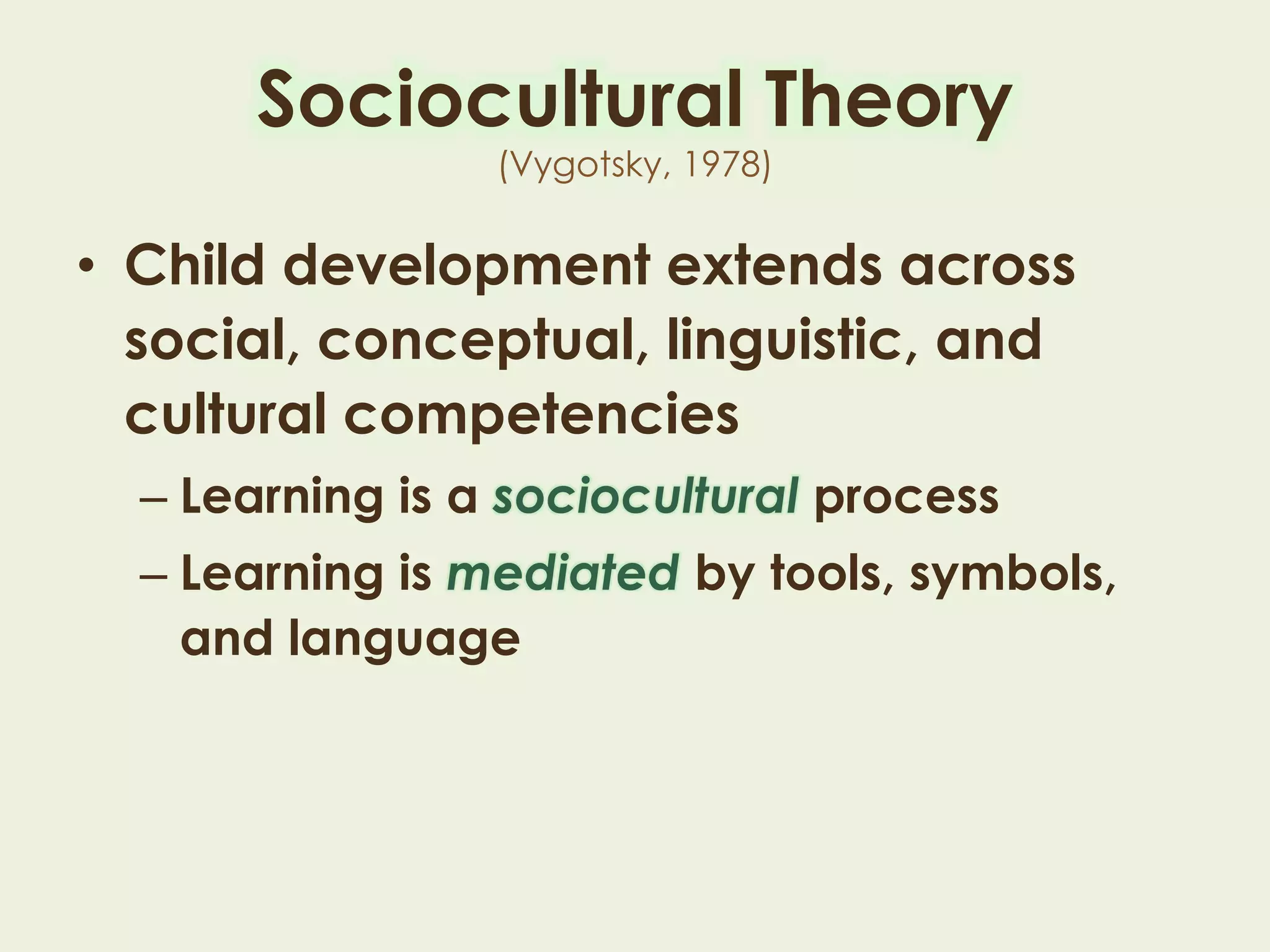
Sociocultural Theory
(Vygotsky, 1978)
• Child development extends across
social, conceptual, linguistic, and
cultural competencies
– Learning is a sociocultural process
– Learning is mediated by tools, symbols,
and language
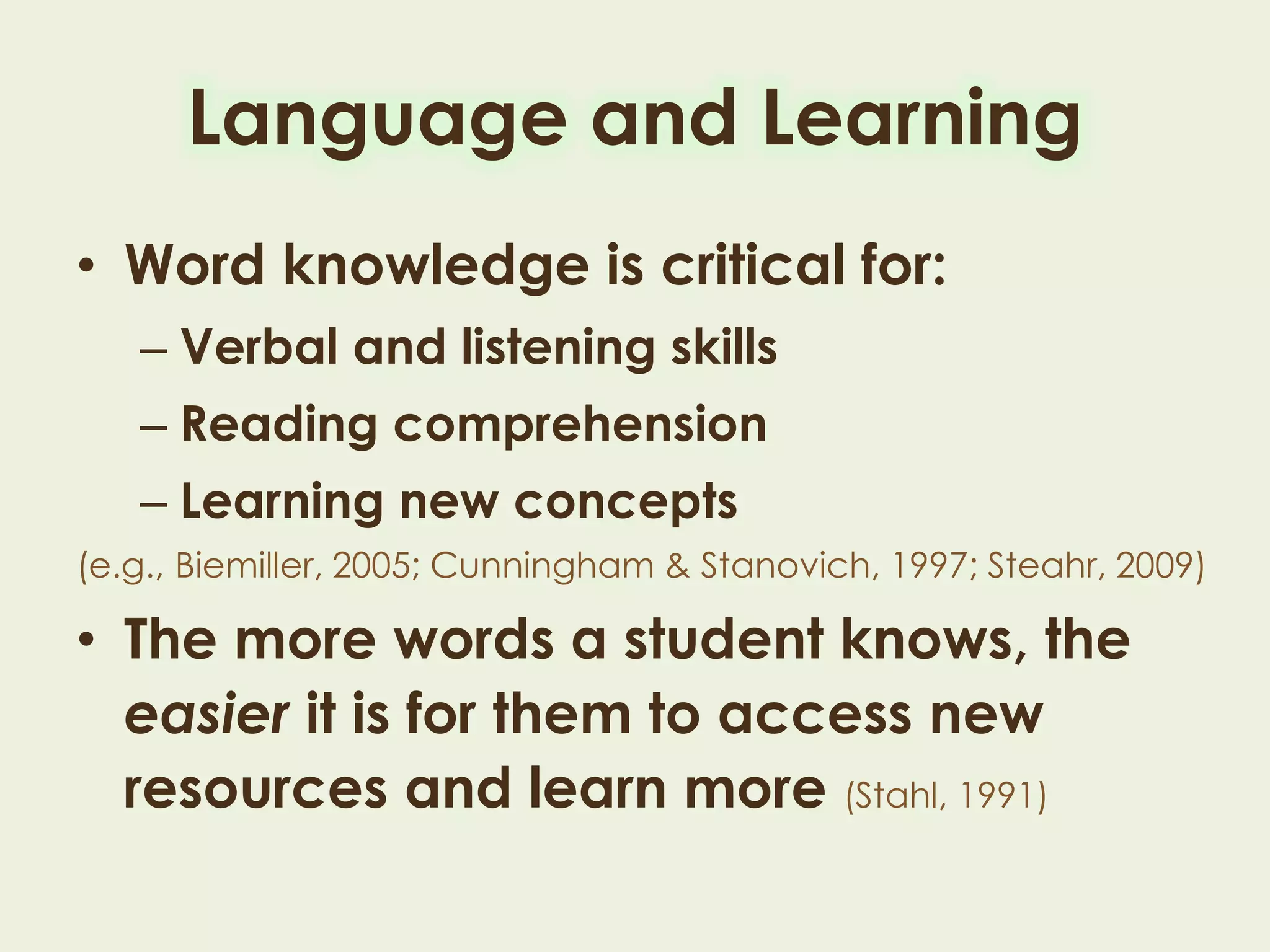
Language and Learning
• Word knowledge is critical for:
– Verbal and listening skills
– Reading comprehension
– Learning new concepts
(e.g., Biemiller, 2005; Cunningham & Stanovich, 1997; Steahr, 2009)
• The more words a student knows, the
easier it is for them to access new
resources and learn more (Stahl, 1991)
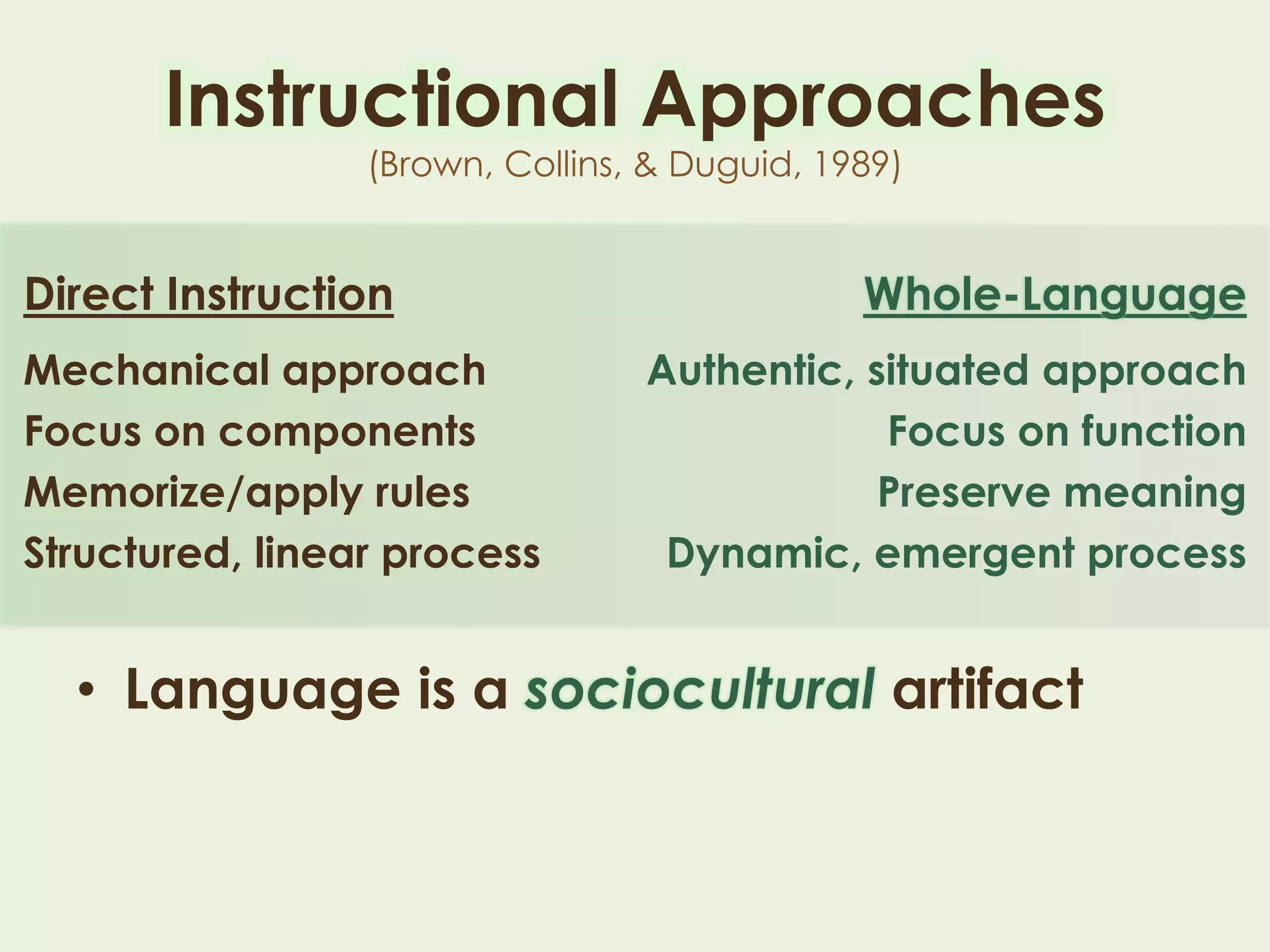
Instructional Approaches
(Brown, Collins, & Duguid, 1989)
Direct Instruction Whole-Language
Mechanical approach
Focus on components
Memorize/apply rules
Structured, linear process
Authentic, situated approach
Focus on function
Preserve meaning
Dynamic, emergent process
• Language is a sociocultural artifact
In Knowledge Building it is not enough
that students incorporate new words into
their speech and writing, they need to
incorporate new word meanings into
their thinking and into their contributions
to collective knowledge spaces, where
these terms can be further discussed and
elaborated. (Resendes et. al., 2013)
Knowledge Building
• Collective goal is to create and refine
community knowledge
• Principle-based pedagogy
– Idea diversity
– Continual idea improvement
– Collective cognitive responsibility
Knowledge Building
(Scardamalia, 2002)
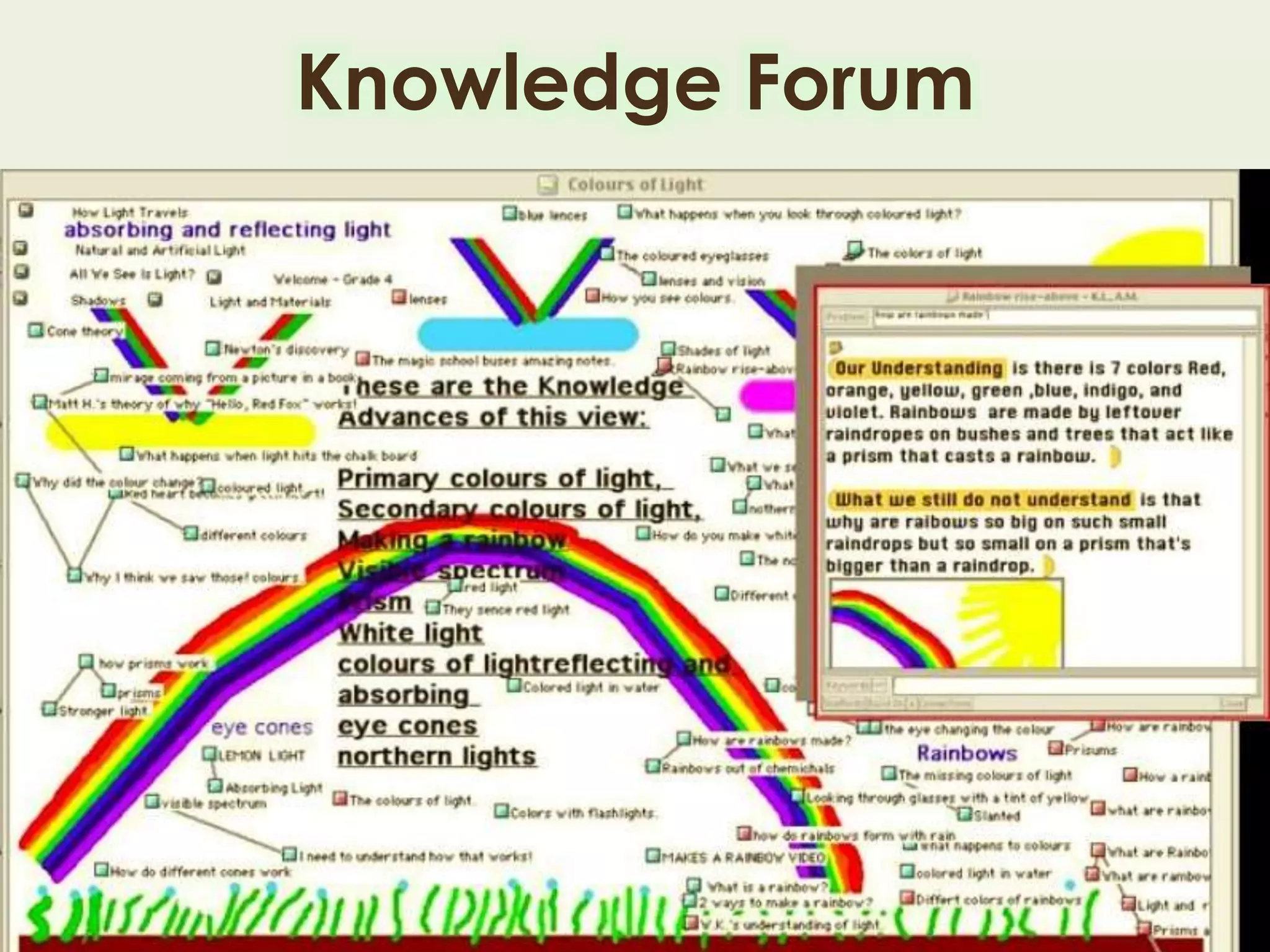
Knowledge Forum
CURRENT STUDY
Objectives
• To explore students’ productive
vocabulary growth over elementary
years within a Knowledge Building
context
• To expand CSCL literature with
longitudinal study
Methods
• Longitudinal cohort study of KB class
– 22 students in Toronto, Canada
• Data sources
– KF notes
– KF activity logs
Question 1
How did students’ productive vocabulary
change over the span of six years?
– Lexical proficiency
– Rate of vocabulary growth
Lexical Proficiency
• Lexical richness
– Total tokens and types
• Lexical frequency profile
– First 1000 words (Laufer & Nation, 2000)
– Second 1000 words (Laufer & Nation, 2000)
– Academic words (Coxhead, 2000)
– Other words
Vocabulary Growth
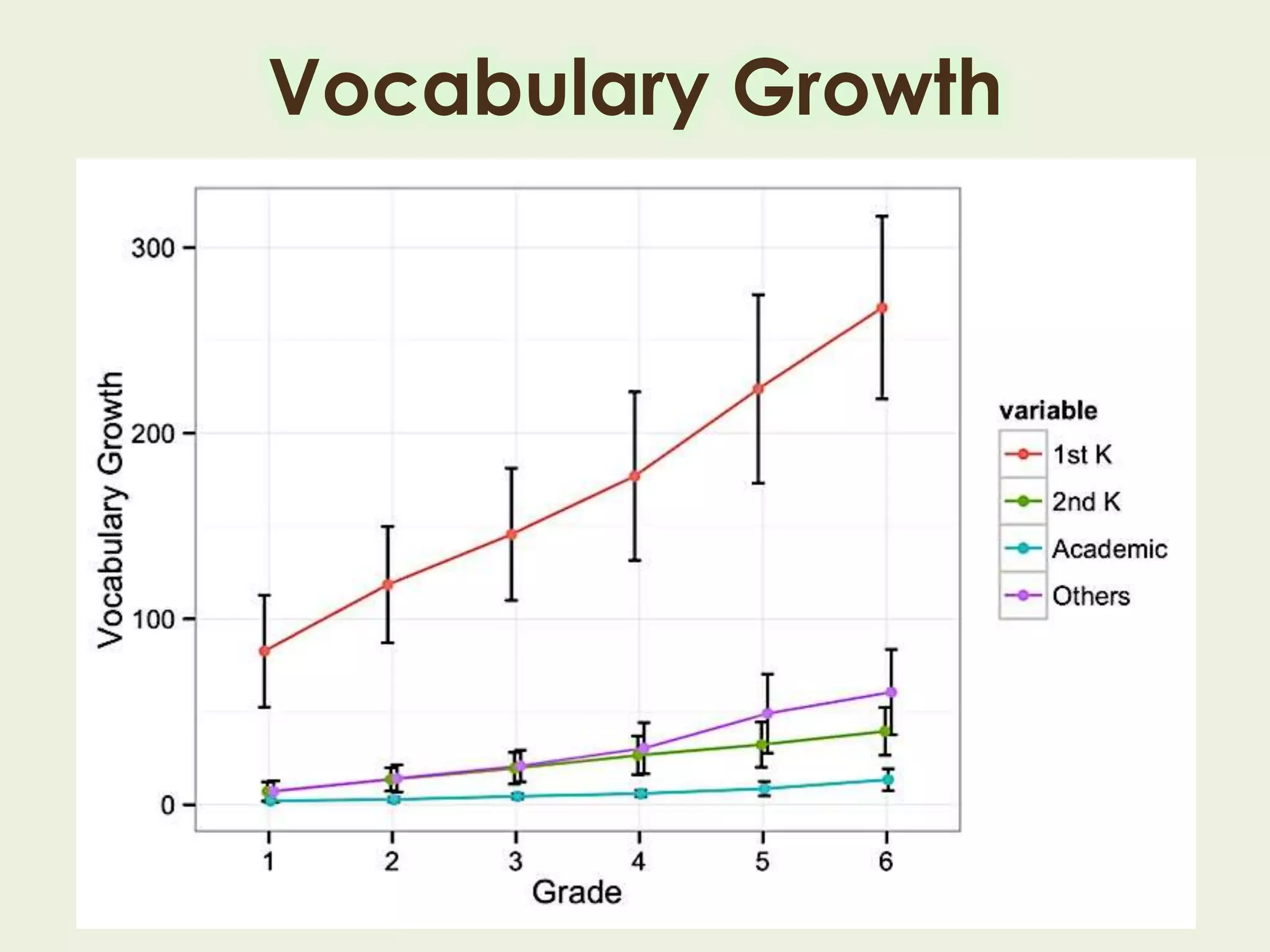
• Appearance of new words each year
– First 1000 words (Laufer & Nation, 2000)
– Second 1000 words (Laufer & Nation, 2000)
– Academic words (Coxhead, 2000)
– Other words
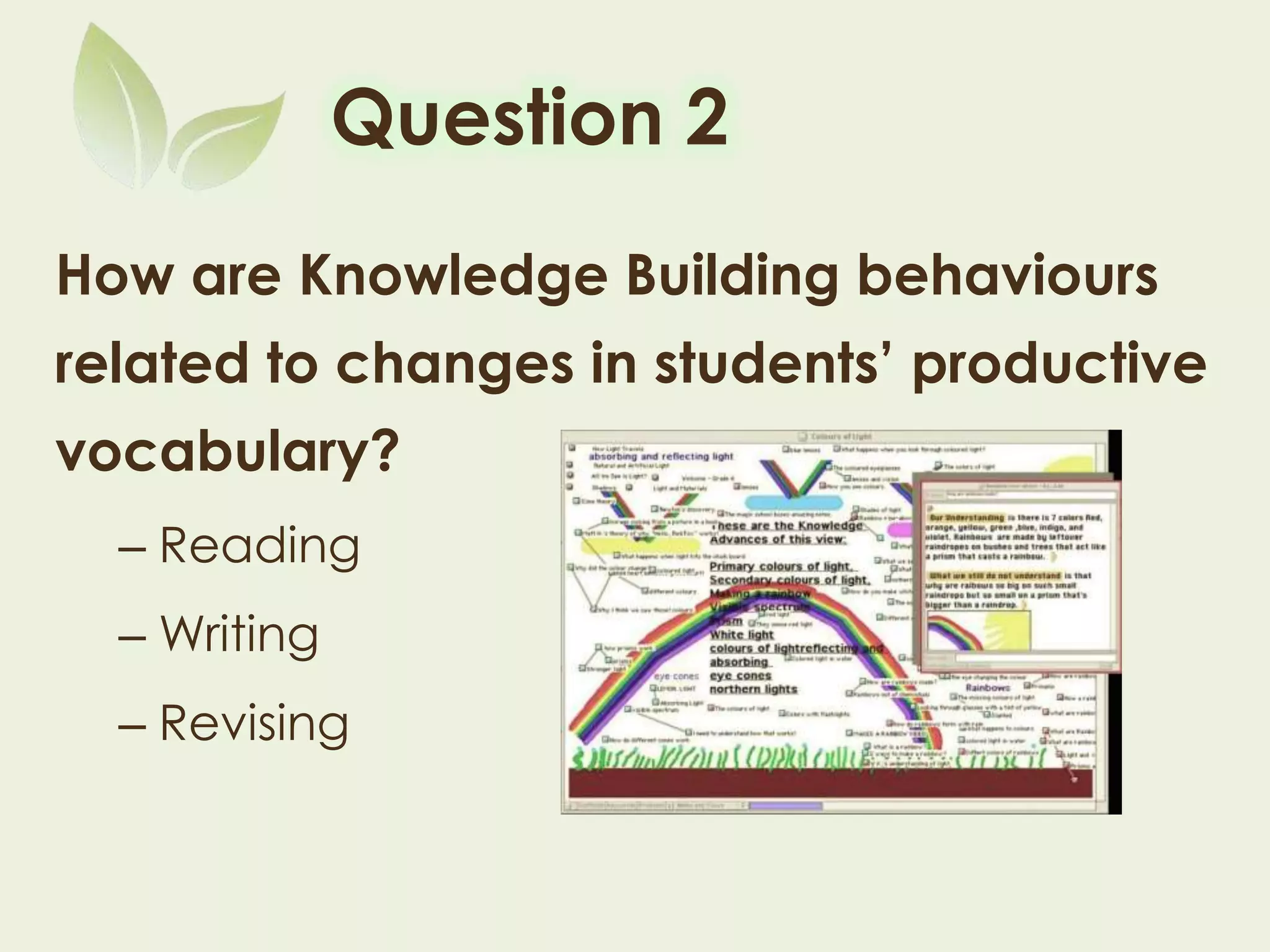
Question 2
How are Knowledge Building behaviours
related to changes in students’ productive
vocabulary?
– Reading
– Writing
– Revising
FINDINGS
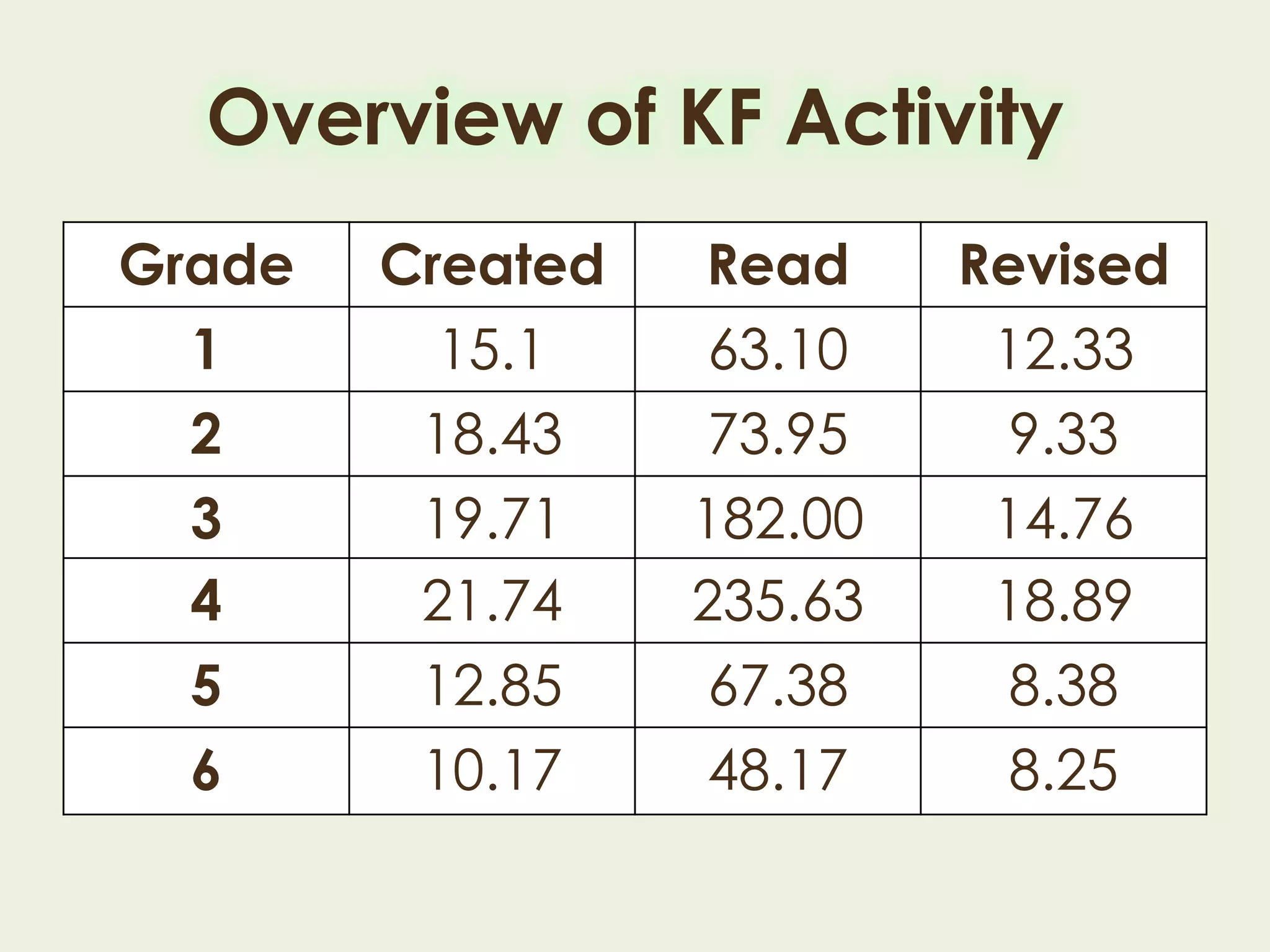
Overview of KF Activity
Grade Created Read Revised
1 15.1 63.10 12.33
2 18.43 73.95 9.33
3 19.71 182.00 14.76
4 21.74 235.63 18.89
5 12.85 67.38 8.38
6 10.17 48.17 8.25
Question 1
How did students’ productive vocabulary
change over the span of six years?
– Lexical proficiency (i.e., lexical richness,
lexical frequency profile)
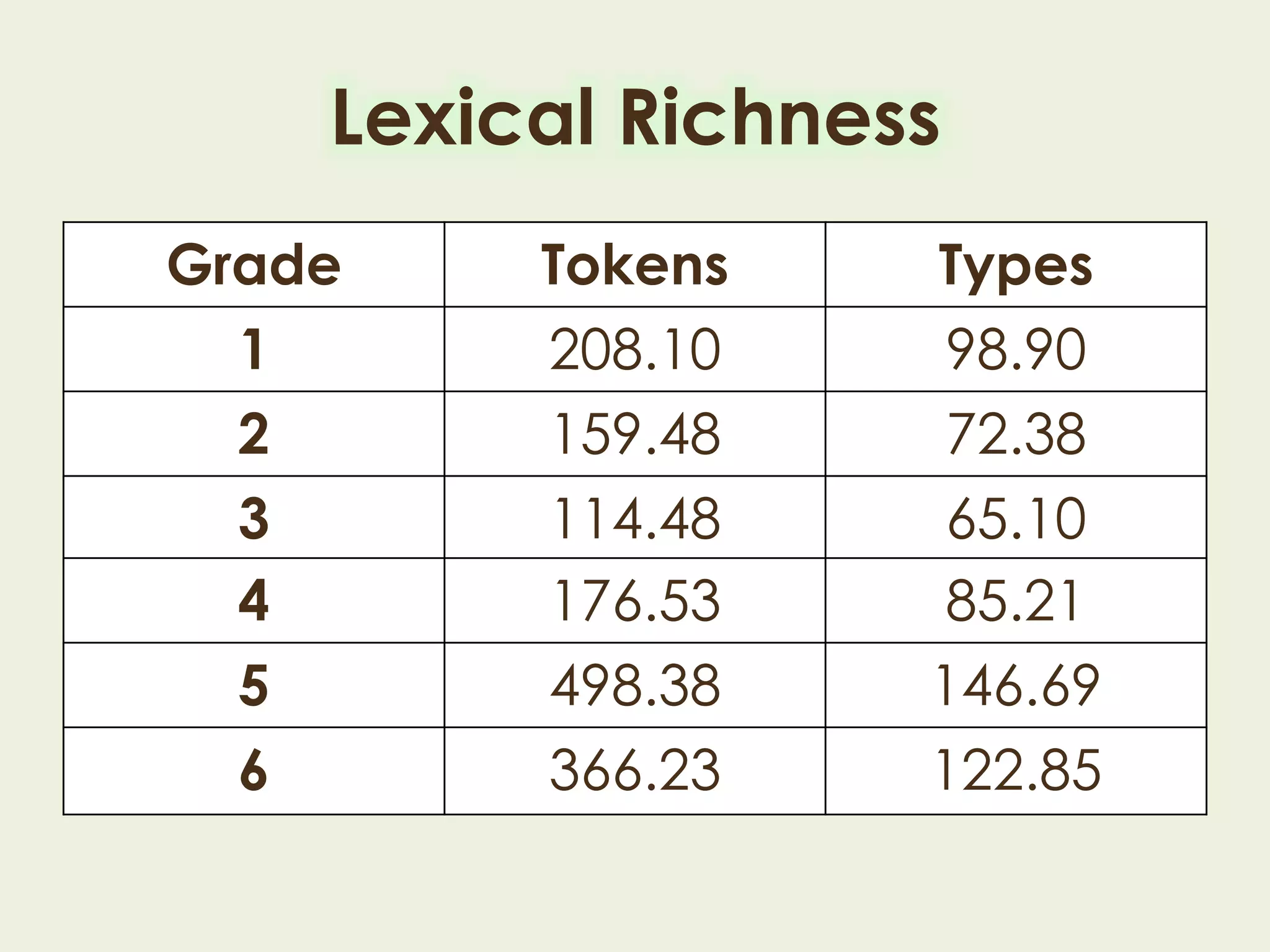
Lexical Richness
Grade Tokens Types
1 208.10 98.90
2 159.48 72.38
3 114.48 65.10
4 176.53 85.21
5 498.38 146.69
6 366.23 122.85
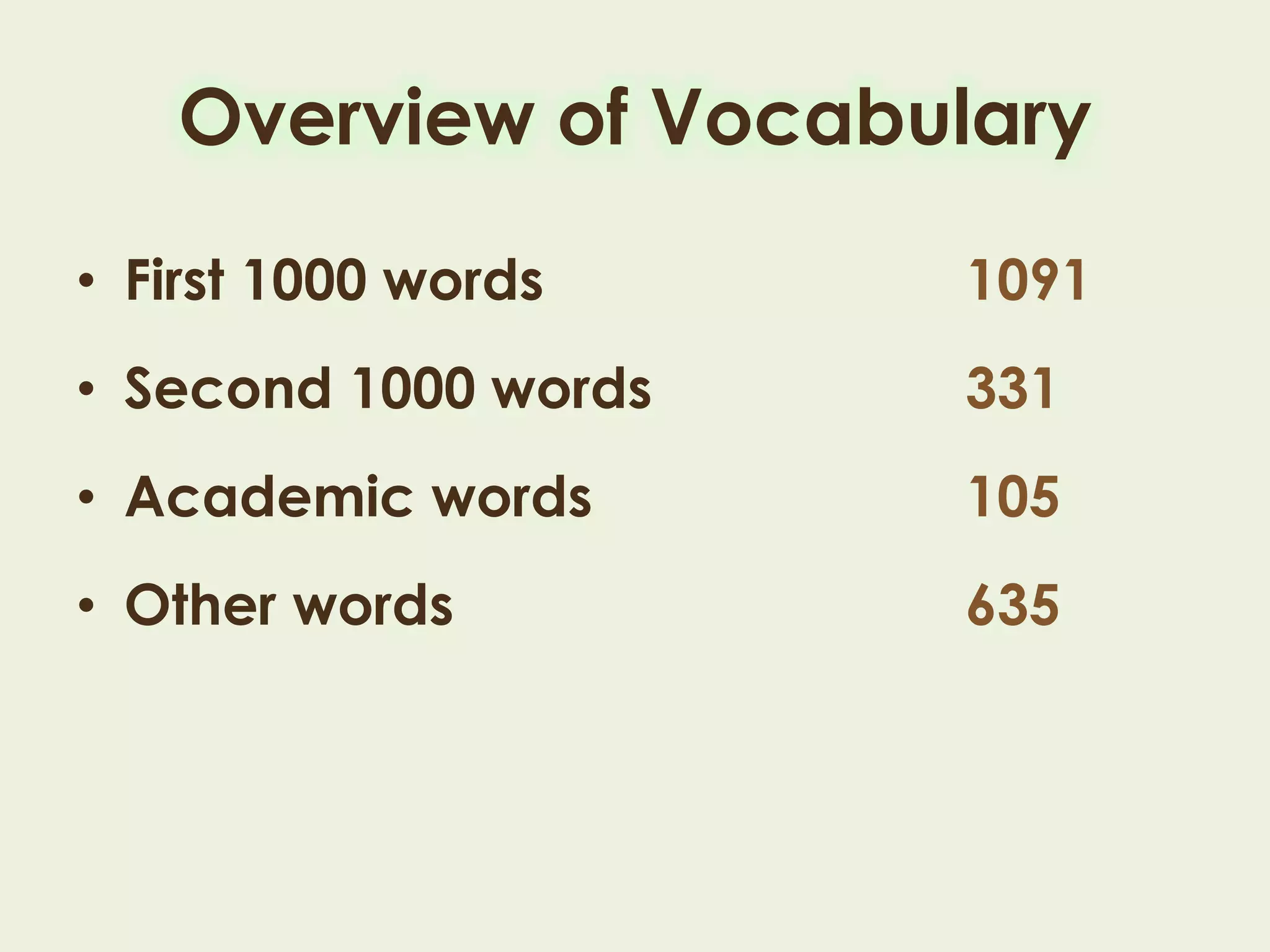
Overview of Vocabulary
• First 1000 words 1091
• Second 1000 words 331
• Academic words 105
• Other words 635
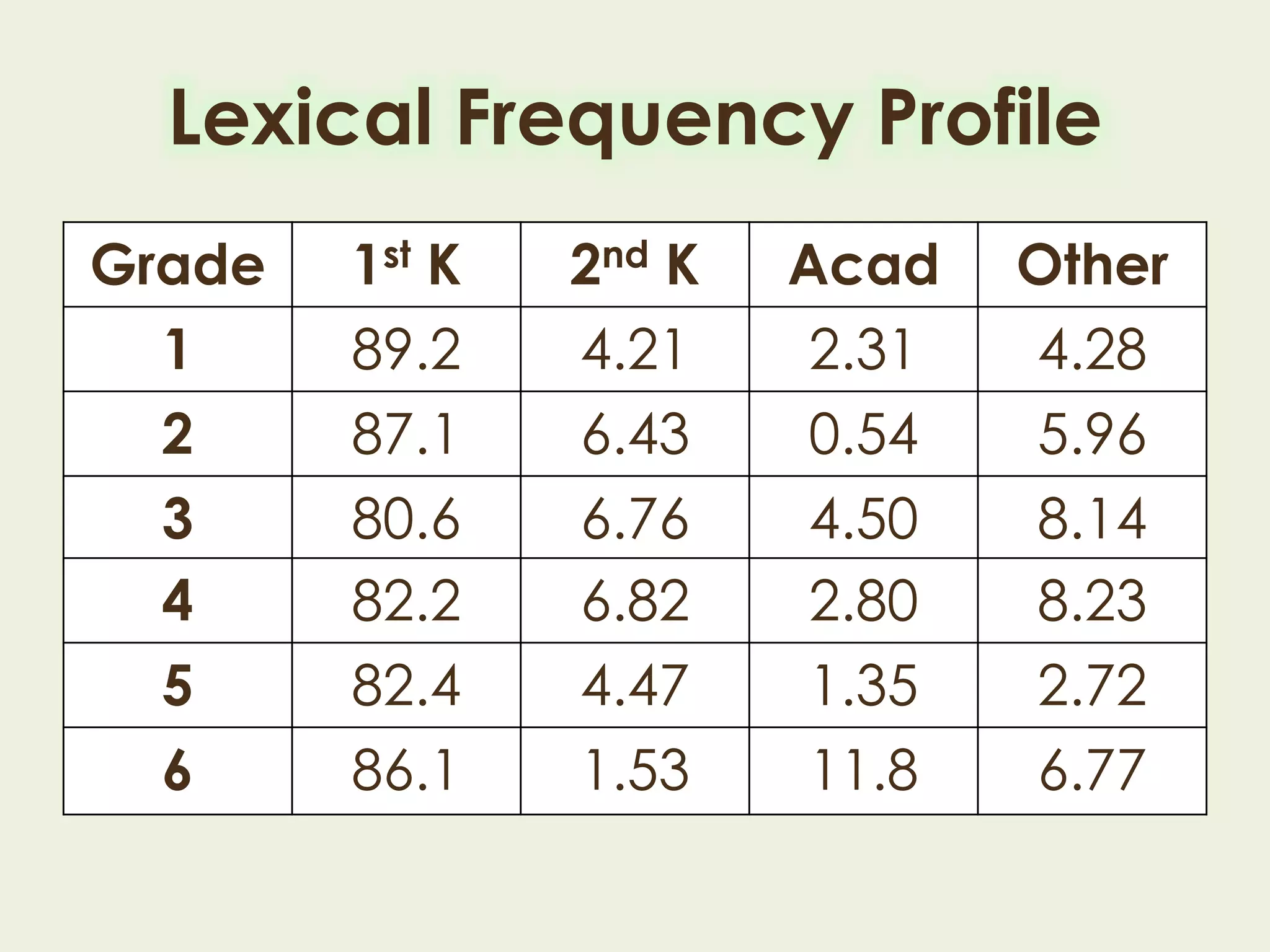
Lexical Frequency Profile
Grade 1st K 2nd K Acad Other
1 89.2 4.21 2.31 4.28
2 87.1 6.43 0.54 5.96
3 80.6 6.76 4.50 8.14
4 82.2 6.82 2.80 8.23
5 82.4 4.47 1.35 2.72
6 86.1 1.53 11.8 6.77
Question 1
How did students’ productive vocabulary
change over the span of six years?
– Rate of vocabulary growth
Vocabulary Growth
Question 2
How are Knowledge Building behaviours
related to changes in students’ productive
vocabulary?
– Reading
– Writing
– Revising
*p <.05
** p <.01
*** p <.001
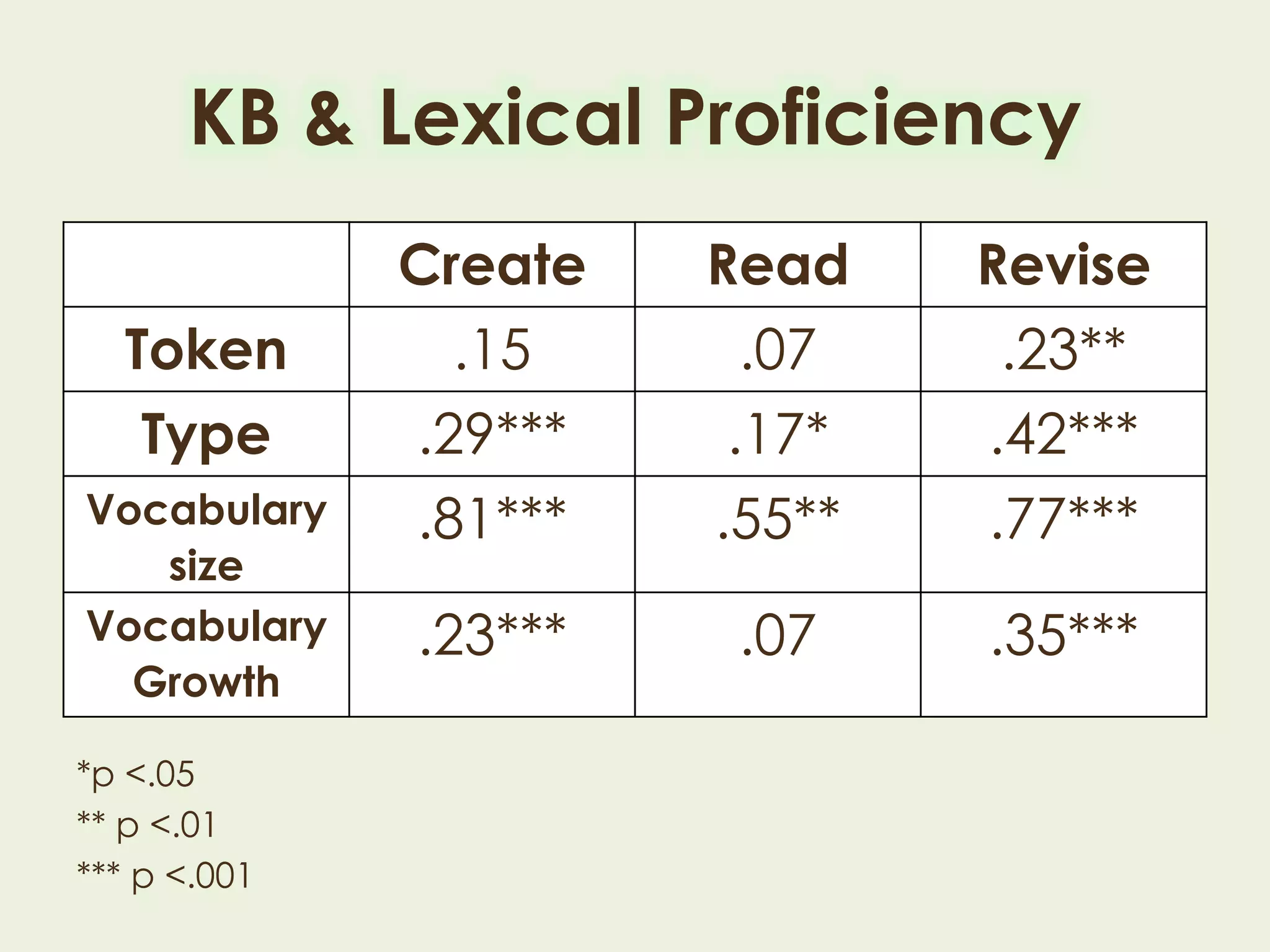
KB & Lexical Proficiency
Create Read Revise
Token .15 .07 .23**
Type .29*** .17* .42***
Vocabulary
size
.81*** .55** .77***
Vocabulary
Growth
.23*** .07 .35***
KB Discourse: Definition
What is claymore? My theory is that it
is a type of [pottery] wheel.
I think a claymore was a type of big
expensive sword that only the richest
nobles or or "earls" owned.
C
D
My theory [is] its a very big Scottish
[sword].
E
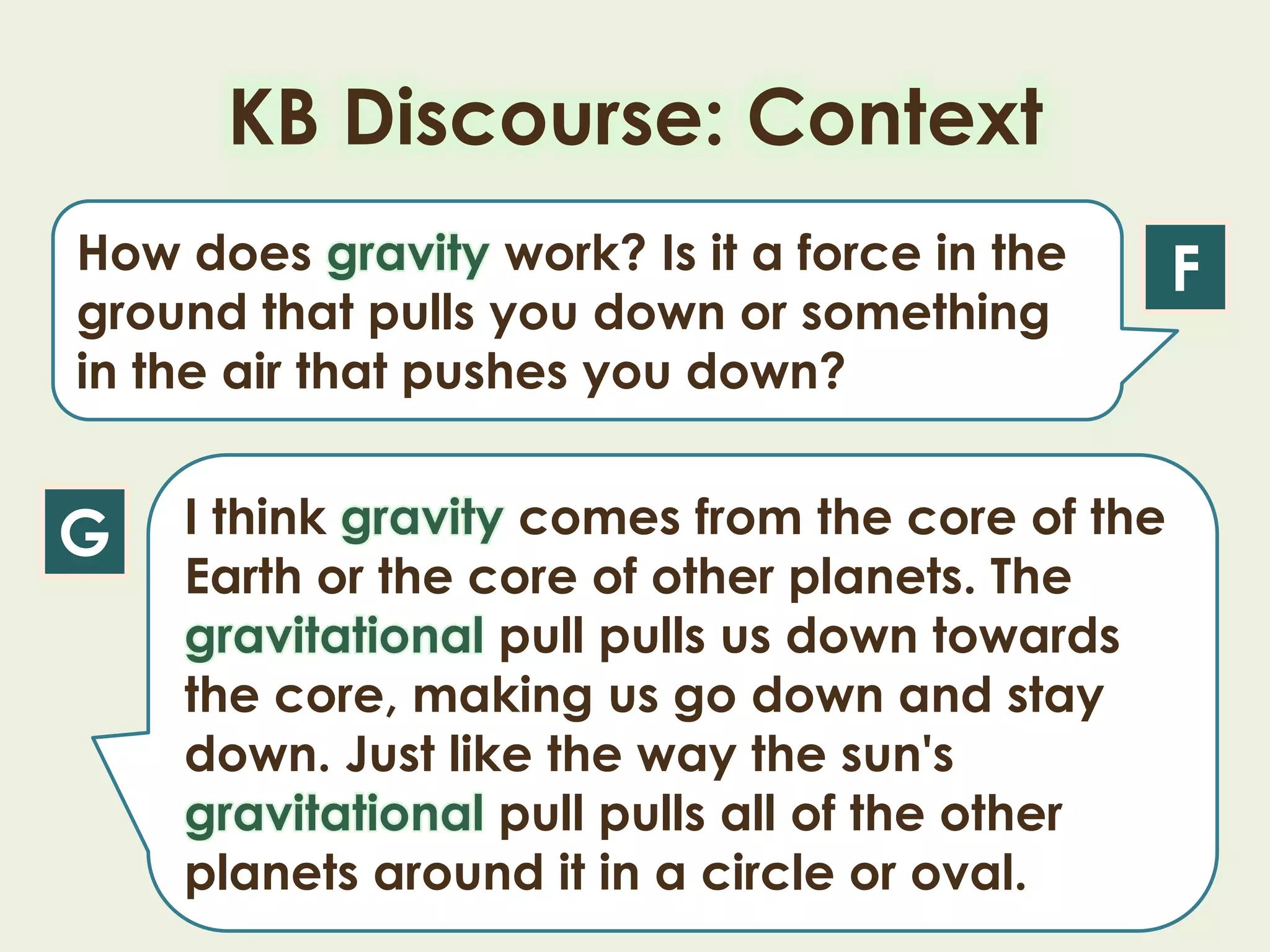
KB Discourse: Context
How does gravity work? Is it a force in the
ground that pulls you down or something
in the air that pushes you down?
I think gravity comes from the core of the
Earth or the core of other planets. The
gravitational pull pulls us down towards
the core, making us go down and stay
down. Just like the way the sun's
gravitational pull pulls all of the other
planets around it in a circle or oval.
F
G
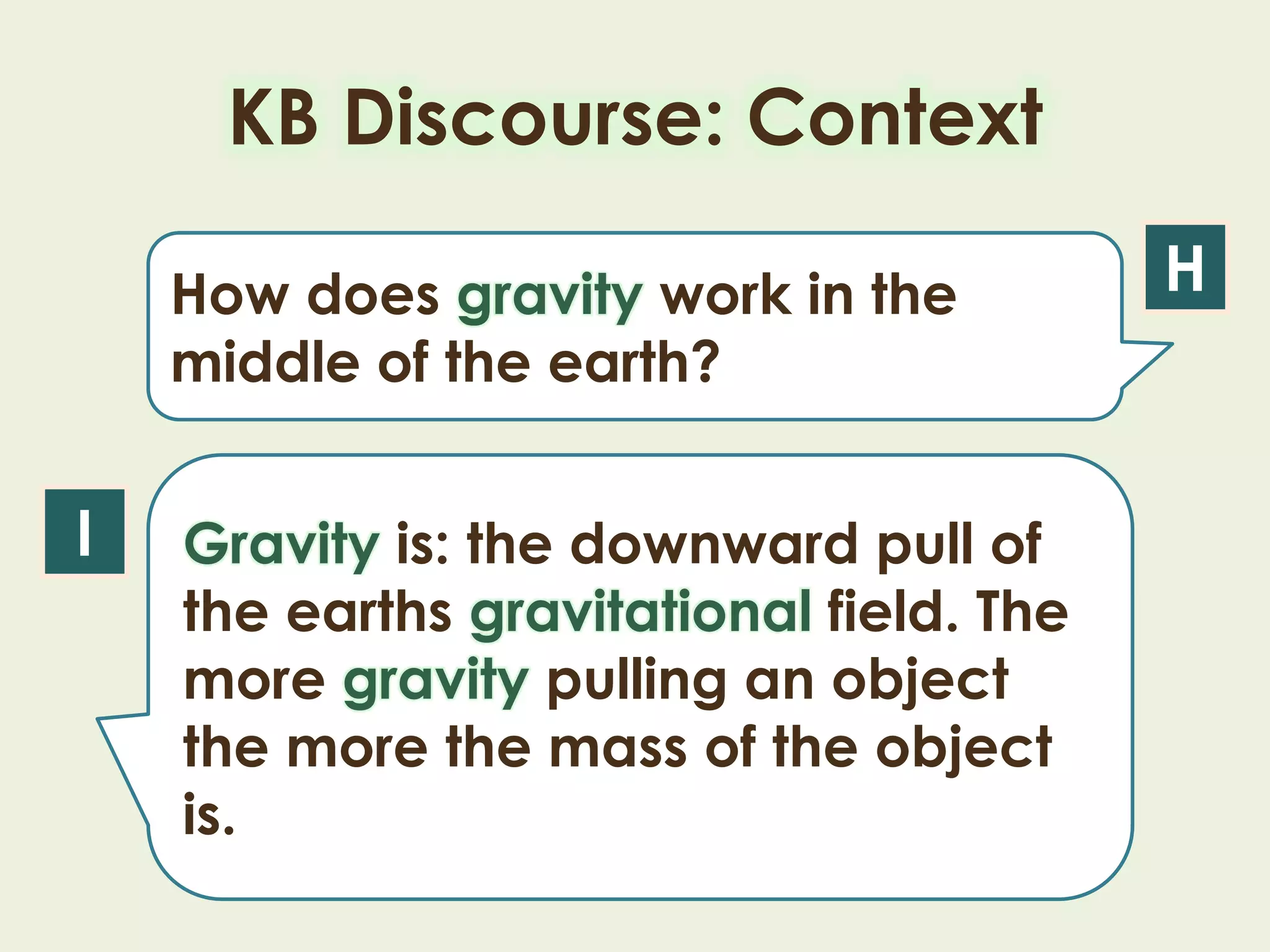
KB Discourse: Context
How does gravity work in the
middle of the earth?
Gravity is: the downward pull of
the earths gravitational field. The
more gravity pulling an object the
more the mass of the object is.
H
I
SUMMARY
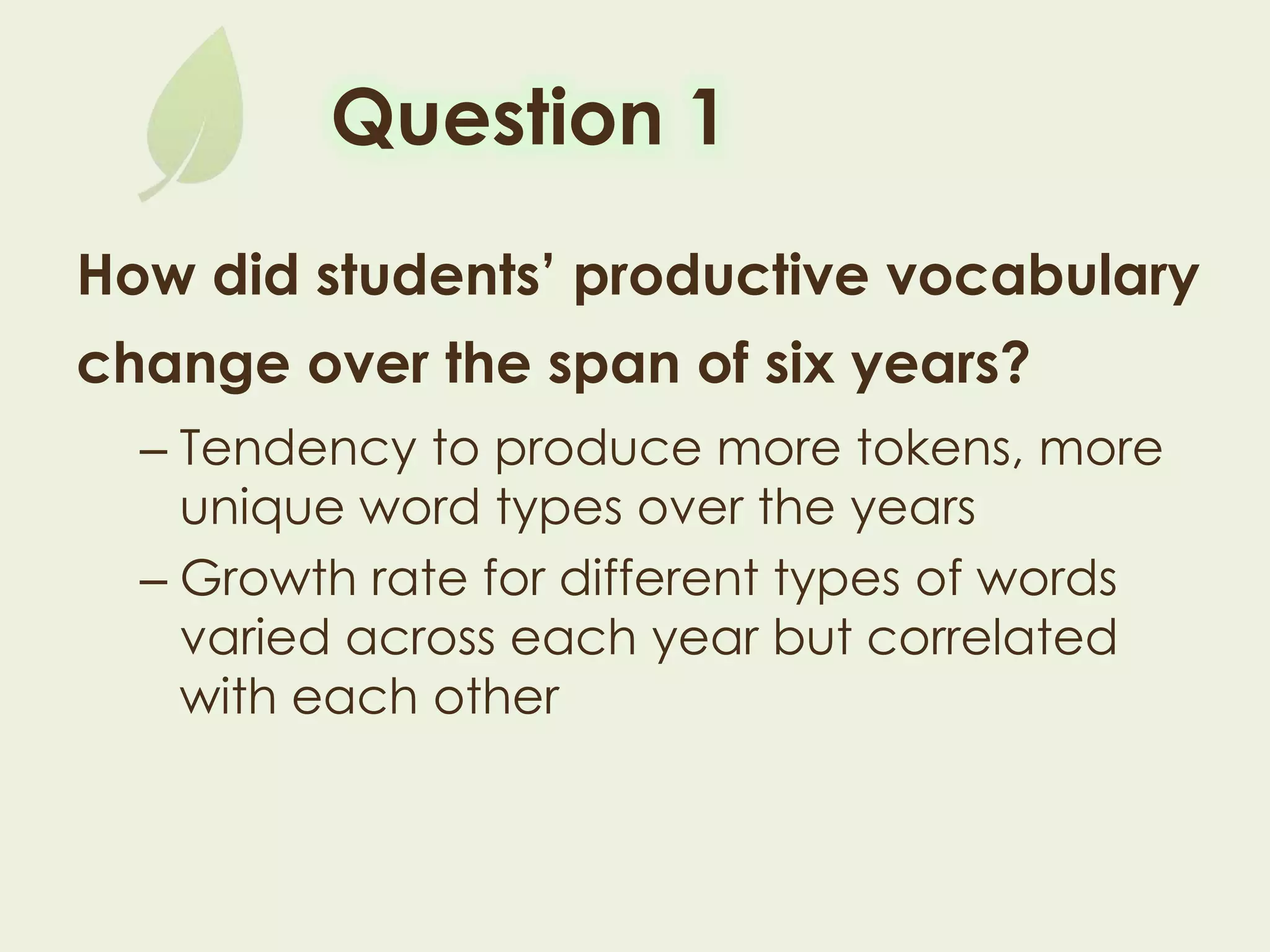
Question 1
How did students’ productive vocabulary
change over the span of six years?
– Tendency to produce more tokens, more
unique word types over the years
– Growth rate for different types of words varied
across each year but correlated with each
other
Question 2
How are Knowledge Building behaviours
related to changes in students’ productive
vocabulary?
– All behaviours were related to lexical proficiency
measures to varying extents
– Note revising is the strongest predictor of
vocabulary growth rate
Future Directions
• Comparison groups (e.g., demographics)
• Classroom context
– Role of teacher
– Face-to-face interactions
– Social network analysis
• Embedded, transformative assessment
– Individual and group-level analytics
– Lexical indicators of conceptual development
and KB advances
We ought to assume that there is
potential for a collective zone of
proximal development in any
classroom, and that within it
there is at least some potential
for the students to move toward
higher levels of agency.
(Scardamalia & Bereiter, 1991)

CSCL 2015 | The Development of Productive Vocabulary in Knowledge Building: A Longitudinal Study

  • 1.
    The Development ofProductive Vocabulary in Knowledge Building: A Longitudinal Study Bodong Chen, Leanne Ma, Yoshiaki Matsuzawa, and Marlene Scardamalia Institute for Knowledge Innovation and Technology CSCL • June 9, 2015 • Gothenburg
  • 2.
  • 3.
    Sociocultural Theory (Vygotsky, 1978) •Child development extends across social, conceptual, linguistic, and cultural competencies – Learning is a sociocultural process – Learning is mediated by tools, symbols, and language
  • 4.
    Language and Learning •Word knowledge is critical for: – Verbal and listening skills – Reading comprehension – Learning new concepts (e.g., Biemiller, 2005; Cunningham & Stanovich, 1997; Steahr, 2009) • The more words a student knows, the easier it is for them to access new resources and learn more (Stahl, 1991)
  • 5.
    Instructional Approaches (Brown, Collins,& Duguid, 1989) Direct Instruction Whole-Language Mechanical approach Focus on components Memorize/apply rules Structured, linear process Authentic, situated approach Focus on function Preserve meaning Dynamic, emergent process • Language is a sociocultural artifact
  • 6.
    In Knowledge Buildingit is not enough that students incorporate new words into their speech and writing, they need to incorporate new word meanings into their thinking and into their contributions to collective knowledge spaces, where these terms can be further discussed and elaborated. (Resendes et. al., 2013) Knowledge Building
  • 7.
    • Collective goalis to create and refine community knowledge • Principle-based pedagogy – Idea diversity – Continual idea improvement – Collective cognitive responsibility Knowledge Building (Scardamalia, 2002)
  • 8.
  • 9.
  • 10.
    Objectives • To explorestudents’ productive vocabulary growth over elementary years within a Knowledge Building context • To expand CSCL literature with longitudinal study
  • 11.
    Methods • Longitudinal cohortstudy of KB class – 22 students in Toronto, Canada • Data sources – KF notes – KF activity logs
  • 12.
    Question 1 How didstudents’ productive vocabulary change over the span of six years? – Lexical proficiency – Rate of vocabulary growth
  • 13.
    Lexical Proficiency • Lexicalrichness – Total tokens and types • Lexical frequency profile – First 1000 words (Laufer & Nation, 2000) – Second 1000 words (Laufer & Nation, 2000) – Academic words (Coxhead, 2000) – Other words
  • 14.
    Vocabulary Growth • Appearanceof new words each year – First 1000 words (Laufer & Nation, 2000) – Second 1000 words (Laufer & Nation, 2000) – Academic words (Coxhead, 2000) – Other words
  • 15.
    Question 2 How areKnowledge Building behaviours related to changes in students’ productive vocabulary? – Reading – Writing – Revising
  • 16.
  • 17.
    Overview of KFActivity Grade Created Read Revised 1 15.1 63.10 12.33 2 18.43 73.95 9.33 3 19.71 182.00 14.76 4 21.74 235.63 18.89 5 12.85 67.38 8.38 6 10.17 48.17 8.25
  • 18.
    Question 1 How didstudents’ productive vocabulary change over the span of six years? – Lexical proficiency (i.e., lexical richness, lexical frequency profile)
  • 19.
    Lexical Richness Grade TokensTypes 1 208.10 98.90 2 159.48 72.38 3 114.48 65.10 4 176.53 85.21 5 498.38 146.69 6 366.23 122.85
  • 20.
    Overview of Vocabulary •First 1000 words 1091 • Second 1000 words 331 • Academic words 105 • Other words 635
  • 21.
    Lexical Frequency Profile Grade1st K 2nd K Acad Other 1 89.2 4.21 2.31 4.28 2 87.1 6.43 0.54 5.96 3 80.6 6.76 4.50 8.14 4 82.2 6.82 2.80 8.23 5 82.4 4.47 1.35 2.72 6 86.1 1.53 11.8 6.77
  • 22.
    Question 1 How didstudents’ productive vocabulary change over the span of six years? – Rate of vocabulary growth
  • 23.
  • 24.
    Question 2 How areKnowledge Building behaviours related to changes in students’ productive vocabulary? – Reading – Writing – Revising
  • 25.
    *p <.05 ** p<.01 *** p <.001 KB & Lexical Proficiency Create Read Revise Token .15 .07 .23** Type .29*** .17* .42*** Vocabulary size .81*** .55** .77*** Vocabulary Growth .23*** .07 .35***
  • 26.
    KB Discourse: Definition Whatis claymore? My theory is that it is a type of [pottery] wheel. I think a claymore was a type of big expensive sword that only the richest nobles or or "earls" owned. C D My theory [is] its a very big Scottish [sword]. E
  • 27.
    KB Discourse: Context Howdoes gravity work? Is it a force in the ground that pulls you down or something in the air that pushes you down? I think gravity comes from the core of the Earth or the core of other planets. The gravitational pull pulls us down towards the core, making us go down and stay down. Just like the way the sun's gravitational pull pulls all of the other planets around it in a circle or oval. F G
  • 28.
    KB Discourse: Context Howdoes gravity work in the middle of the earth? Gravity is: the downward pull of the earths gravitational field. The more gravity pulling an object the more the mass of the object is. H I
  • 29.
  • 30.
    Question 1 How didstudents’ productive vocabulary change over the span of six years? – Tendency to produce more tokens, more unique word types over the years – Growth rate for different types of words varied across each year but correlated with each other
  • 31.
    Question 2 How areKnowledge Building behaviours related to changes in students’ productive vocabulary? – All behaviours were related to lexical proficiency measures to varying extents – Note revising is the strongest predictor of vocabulary growth rate
  • 32.
    Future Directions • Comparisongroups (e.g., demographics) • Classroom context – Role of teacher – Face-to-face interactions – Social network analysis • Embedded, transformative assessment – Individual and group-level analytics – Lexical indicators of conceptual development and KB advances
  • 33.
    We ought toassume that there is potential for a collective zone of proximal development in any classroom, and that within it there is at least some potential for the students to move toward higher levels of agency. (Scardamalia & Bereiter, 1991)