EN0909A5_TEV_A4   17/6/08   9:39 am   Page 2


    Teaching effective
    vocabulary
    What can teachers do to increase the vocabulary of
    children who start education with a limited vocabulary?
EN0909A5_TEV_A4   17/6/08   9:39 am   Page 3


                                                                                    Teaching Effective Vocabulary 3


                  Foreword

                  Vocabulary is more than a list of words, and although the size of one’s vocabulary
                  matters, it’s knowing how to use it which matters most. The best comparison
                  is to an artist’s palette of colours which can be mixed and applied to create
                  powerful effects.

                  When the English Board at the DCSF enquired into research about vocabulary, it
                  was thinking mainly about children who are constrained by a lack of vocabulary:
                  those who suffer language delay, those who arrive new to English from another
                  country, and those who are simply stuck for words. But of course, the development
                  of vocabulary is an important experience for everyone and continues as one
                  grows older.

                  Of course, everyday life provides most of the vocabulary we need – words are all
                  around us – but taking them in takes time as we become acquainted with their
                  many uses and the contexts in which they are appropriate. A mix of rich language
                  experiences helps to expose us to words and appreciate their meanings, but not
                  all pupils get this in their lives. The question was, what can we do to hasten and
                  enhance that process?

                  It was refreshing when DCSF researcher Jenny Buckland trawled the literature
                  and fetched up excellent research about classroom practice with clear findings
                  and ready-to-go recommendations. To this we have added a list of useful ideas
                  developed for us by practitioners.

                  We hope you find the combination of research and practical classroom strategies
                  useful. It is the first time we have published a literature review in this form, and
                  if you want more, please let us know on research.summaries@dcsf.gsi.gov.uk

                  Sue Hackman,
                  Chief Adviser on School Standards,
                  March 2008
EN0909A5_TEV_A4   17/6/08   9:39 am   Page 4


      4     Teaching Effective Vocabulary


      Background: the impact of having a
      limited vocabulary


                                               Children start school with a vocabulary which
                                               has been learned mainly from their contact with
                                               parents and the literacy environment at home, as
                                               well as their experiences with the wider world. A
                                               child’s vocabulary at this age will largely be oral
                                               (i.e. words which they can understand when
                                               heard and use themselves), with some elements
                                               of a reading or writing vocabulary (i.e. words
                                               which they can understand when read, and
                                               words which they can write).

                                               Recent research shows that vocabulary growth
                                               is largely determined by parental practices,
                                               particularly before the age of 7 (Biemiller 2003).
                                               Children mainly use words their parents and
                                               other adults use with them in conversation, and
                                               acquire larger vocabularies when their parents
                                               use more words (Hant and Risley, 1995).

                                               However, considerable differences in vocabulary
                                               size amongst children aged seven were reported
                                               by Biemiller (2003). In terms of the numbers of
                                               words known, when starting school, relatively
                                               high performing children (the upper quartile i.e.
                                               a pupil at the 75th point in a distribution of 100
                                               pupils) know an average estimated vocabulary of
                                               7100 root words. In contrast, relatively poor
                                               performing pupils (the lower quartile i.e. a pupil
                                               at the 25th point in a distribution of 100 pupils)
                                               know 3000 words, acquiring only one word per
                                               day compared to the three words per day
EN0909A5_TEV_A4   17/6/08   9:39 am   Page 5


                                                                                        Teaching Effective Vocabulary 5


                  acquired by children with the largest vocabularies. Although White et al. (1989)
                  demonstrated that children from a disadvantaged background typically have a
                  smaller vocabulary than children from a more advantaged background, and that
                  the gap widens as children get older, Beals (1997) and Weizman and Snow (2001)
                  reported that the parents using and explaining high-level words was strongly
                  associated with the gaining of a larger vocabulary, even among children from
                  disadvantaged families.

                  Vocabulary is a strong indicator of reading success (Biemiller, 2003). It was
                  established in the 1970s that children’s declining reading comprehension
                  compared to more able peers from age 8 onwards largely resulted from a lack
                  of vocabulary knowledge (Becker, 1977), and that this was primarily caused by a
                  lack of learning opportunities, not a lack of natural ability. Chall et al. (1990) also
                  found that disadvantaged students showed declining reading comprehension
                  as their narrow vocabulary limited what they could understand from texts.

                  Having a low vocabulary can trap children in a vicious circle, since children who
                  cannot read more advanced texts miss out on opportunities to extend their
                  vocabulary (Fisher and Blachnowicz, 2005) and are also less successful in using
                  strategies for word learning (Blachnowicz and Fisher, 2000). Cunningham and
                  Stanovich (1997) reported that spoken assessment of vocabulary levels in pupils
                  aged 6 accounted for 30% of reading comprehension variance at age 16, whilst
                  Becker (1977) identified poor vocabulary knowledge as the primary cause of
                  academic failure of disadvantaged students. This means that children with low
                  vocabularies need to be targeted early, since catching up is very difficult.


                     Children with low vocabularies would have to learn words much faster
                     than their peers, at a rate of three to four root words per day, if they were
                     to catch up within five or six years. Biemiller (2003)
EN0909A5_TEV_A4   17/6/08   9:39 am   Page 6


      6     Teaching Effective Vocabulary


                  Supporting vocabulary
                  development in school
                  Research suggests that although many children acquire vocabulary naturally
                  through activities at school, this cannot be left to chance in the case of children
                  with low vocabularies.

                  Duke and Moses (2003) concluded that reading to children and getting children
                  to read themselves are the basis of vocabulary growth, together with engaging
                  children in rich oral language and encouraging reading and talk at home.

                  The National Reading Panel’s review (2000) identified five basic approaches to
                  vocabulary instruction which should be used together:

                      • explicit instruction (particularly of difficult words and words that are not
                        part of pupils’ everyday experience),

                      • indirect instruction (i.e. exposure to a wide range of reading materials),

                      • multimedia methods (going beyond the text to include other medias such
                        as visual stimulus, the use of the computer or sign language),

                      • capacity methods (focusing on making reading an automatic activity), and

                      • association methods (encouraging learners to draw connections between
                        what they do know and unfamiliar words).

                  Evidence from Apthorp (2006) supports and extends the National Reading Panel’s
                  conclusions. She concluded that there was a solid evidence base supporting three
                  key elements of vocabulary instruction:

                      • defining and explaining word meanings;

                      • arranging frequent encounters with new words (at least six exposures to a
                        new word); and

                      • encouraging pupils’ deep and active processing of words and meanings
                        in a range of contexts. These kinds of activities are effective for vocabulary
                        development and improved reading comprehension.
EN0909A5_TEV_A4   17/6/08   9:39 am   Page 7


                                                                                    Teaching Effective Vocabulary 7


                  Fisher and Blachnowicz (2005) additionally recommended:

                      • ensuring the learning environment is word rich;

                      • addressing vocabulary learning as a distinct area in the curriculum;

                      • careful selection of appropriate words for planned teaching and
                        reinforcement (for example, words that have parts found in many other
                        words, such as medicine/medical/medicate). Duke and Moses (2003)
                        concluded that key factors in deciding which words to teach explicitly
                        include how easily related they are to other words children know, and how
                        much knowing the word will help them with the texts and experiences are
                        likely to encounter in the future.

                  Duke and Moses (2003) also pointed to the effectiveness of raising word
                  consciousness by playing with words through games, songs and humour, and
                  encouraging children to recognise when they have encountered new words and
                  notice special characteristics of words.

                  All of these studies reiterate the importance of repetition in the learning of
                  vocabulary: children must engage with a word several times in different contexts
                  before it is learnt.

                  The National Institute for Literacy (2003) concluded that, since it is not possible
                  for teachers to provide specific instruction for all the words children don’t know,
                  children need to be able to determine the meaning of words that are new to
                  them by using a range of taught word learning strategies.
EN0909A5_TEV_A4   17/6/08   9:39 am   Page 8


      8     Teaching Effective Vocabulary
EN0909A5_TEV_A4   17/6/08   9:39 am   Page 9


                                                                                    Teaching Effective Vocabulary 9


                  Practical classroom ideas to
                  support vocabulary development
                  The following suggestions have been generated by teachers from the
                  Foundation Stage and across key stages 1-3 who took part in a vocabulary
                  development workshop.

                  Help pupils to extend vocabulary through whole class and guided group work by:

                      • Planning for the introduction of new vocabulary. You could indicate on short
                        term plans where and how new vocabulary will be introduced.

                      • Encouraging “word of the day” You and the pupils identify a new word each
                                                       .
                        day and attempt to use it in context as many times as possible.

                      • Modelling specific reading strategies to develop vocabulary, for example
                        drawing on analogies (rain, snow, sleet) or word families (either linked to
                        spelling patterns or meaning).

                      • Exploring prediction of story and dialogue through either the use of textless
                        picture books or the masking/covering of a specific piece of dialogue or text.

                      • Pre-teaching vocabulary before meeting it in a text, for example key words
                        such as technical terms, or words in unfamiliar contexts.

                      • Developing the role of the class novel to enthuse and engage children in
                        reading and to extend and introduce new vocabulary.

                      • Checking understanding of vocabulary meaning through targeted
                        questioning particularly in guided reading and writing sessions.

                      • Providing clear objectives for developing vocabulary, for example giving
                        pupils four words and asking them to use them during the lesson.

                      • Modelling a piece of writing in front of the class, explaining and verbalising
                        vocabulary choices as you go.

                      • Using guided writing sessions to support small, targeted groups to review a
                        piece of writing and challenge vocabulary choices made.
EN0909A5_TEV_A4   17/6/08   9:39 am   Page 10


      10    Teaching Effective Vocabulary
EN0909A5_TEV_A4   17/6/08   9:39 am   Page 11


                                                                                   Teaching Effective Vocabulary 11


                  Encourage pupils to develop vocabulary during independent tasks by:

                      • Promoting the use of dictionaries, thesauruses and spelling investigations to
                        extend the range of words used.

                      • Giving pupils a vocabulary notebook in which to record unfamiliar or newly
                        discovered words which can be stored until they need to use them.

                      • Playing word games to extend and challenge understanding of vocabulary,
                        for example exploring words in other curriculum areas (e.g. a foul in sport and
                        other meanings and usages), or identifying and focusing on words which act
                        as more than one part of speech (e.g. address (noun) and address (verb)).

                      • Developing and extending independent reading experiences, for example,
                        you have a ‘special set’ of books by the same author or text type of class
                        novel. The pupils recommend and swap books from the set and then discuss
                        through a reading circle.

                      • Encouraging reading partners/buddies to talk about books read, to ask
                        questions and make recommendations. This could effectively be run across
                        year groups or with targeted specific groups.

                      • Encouraging pupils to use the learning environment to support
                        independence by making sure they know where to find resources
                        and prompts.

                  Develop vocabulary through the use of ICT by:

                      • Encouraging pupils to compose and edit on screen, using word processing
                        tools such as dictionary and thesaurus.

                      • Showing a short film (e.g. BFI story shorts) without sound and asking pupils
                        to discuss what dialogue they would expect to hear.

                      • Showing a scene from a film without sound and asking pupils to use the
                        facial expression to determine emotion. They could then add thought
                        bubbles to the image on the Interactive Whiteboard.

                      • Using Digi-blue cameras to create a short film or take stills to produce
                        promotional material. Pupils would be encouraged to produce a storyboard
                        and write a script using appropriate language to the task.

                      • Promoting online book communities to establish the top ten reads as
                        recommendations for the class or school.
EN0909A5_TEV_A4   17/6/08   9:39 am   Page 12


      12    Teaching Effective Vocabulary


                  Using talk to support vocabulary development by:

                      • Encouraging the use of talk or response partners whereby pupils can share
                        and orally rehearse ideas before writing.

                      • Asking pupils to provide verbal feedback in response to a piece of writing
                        or question.

                      • Establishing a role play/drama area to develop confidence and functional
                        language skills, for example linked to a travel agents, café, or post office.

                      • Using drama to encourage pupils to use unfamiliar vocabulary in ‘safe’
                        situations to prompt a response and discussion of dialogue used.

                      • Developing STOP REWIND activities whereby pupils have a catch phrase to
                        interrupt read aloud sessions to ask about the meaning of words and phrases.

                  Create a language rich environment which supports vocabulary development by:

                      • Providing a range of quality texts and text types that link to and extend the
                        pupils’ interests.

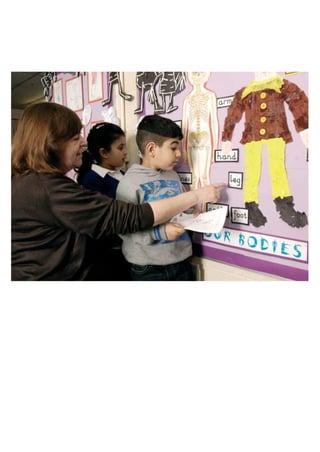
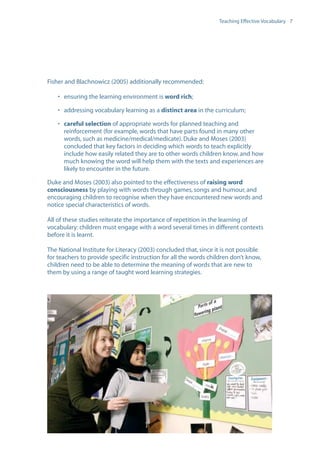
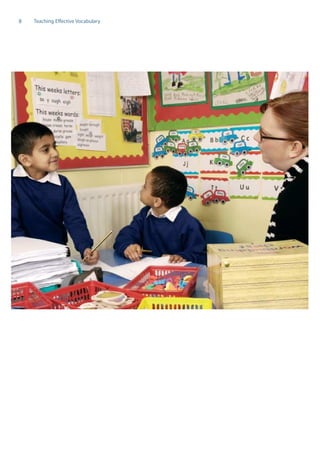
                      • Creating interactive working walls/displays so that pupils can capture new,
                        exciting and unusual vocabulary for later use.

                      • Displaying whole class vocabulary choices, for example by using images of
                        the pupils, with speech bubbles showing good examples. This could be
                        populated by you or the pupils and regularly updated with links to specific
                        themes or texts.


                     Direct teaching of vocabulary enhances listening and
                     reading comprehension.
EN0909A5_TEV_A4   17/6/08   9:39 am   Page 13


                                                                                        Teaching Effective Vocabulary 13


                  References and further reading

                  Apthorp, H. (2006) ’Effects of a supplemental vocabulary programme in third grade
                  reading/language arts.’ Journal of Educational Research, 100:2, 67-79

                  Beals, D. (1997) ’Sources of support for learning words in conversation: evidence
                  from mealtimes.’ Child Language, 24:673-694.

                  Beck I and McKeown M (2007) ’Increasing you low income children’s oral vocabulary
                  repertoires through rich and focused instruction’ The Elementary School Journal
                  Vol 107, No 3

                  Becker, W.C. (1977) ’Teaching reading and language to the disadvantaged – what we
                  have learned from field research.’ Harvard Educational Review, 47: 518-543.

                  Biemiller, A. (2003) ’Vocabulary: needed if more children are to read well.’ Reading
                  Psychology, 24:323-335.

                  Blachnowicz, C. and Fisher, P. (2000) Teaching vocabulary in all classrooms. Columbus,
                  Ohio: Merrill Prentice Hall.

                  Chall, J.S., Jacobs, V.A. and Baldwin, L.E. (1990) The reading crisis: why poor children
                  fall behind. Cambridge, Massachusetts: Harvard University Press.

                  Cunningham, A.E. and Stanovich, K.E. (1997) ’Early reading acquisition and its
                  relation to reading experience and ability 10 years later.’ Developmental Psychology,
                  33:934-945

                  Duke, N. and Moses, A. (2003) 10 research tested ways to build children’s vocabulary.
                  New York, NY: Scholastic Inc.

                  Ewer, C. and Brownson, S. (1999) ’Kindergarteners’ vocabulary acquisition as a
                  function of active versus passive storybook reading, prior vocabulary, and working
                  memory.’ Journal of Reading Psychology, 20:11-20

                  Fisher, P. and Blachnowicz, C. (2005) ’Vocabulary instruction in a remedial setting.’
                  Reading and Writing Quarterly, 21:281-300.

                  Hant, B. and Risley, T.R. (1995) Meaningful differences in the everyday experience of
                  young American children. Baltimore: Paul Brookes.

                  National Institute for Literacy (2003) Putting Reading First: the Research Building
                  Blocks of Reading Instruction, Kindergarten through Grade Three.

                   National Reading Panel (2000) Teaching Children to Read: and evidence-based
                  assessment of the scientific research literature on reading and its implications for
                  reading instruction. Reports of subgroups. NICHD.
EN0909A5_TEV_A4   17/6/08   9:39 am   Page 14


      14    Teaching Effective Vocabulary


                  Stahl, S. and Fairbanks, M.M. (1986) ’The effects of vocabulary instruction: a model
                  based meta-analysis.’ Review of Educational Research, 56:72-110

                  Weizman, Z.O. and Snow, C.E. (2001) ’Lexical input as related to children’s vocabulary
                  acquisition: effects of sophisticated exposure and support for meaning.’
                  Developmental Psychology, 37 (2): 265-279


                      With thanks to the following foundation stage, primary and secondary
                      practitioners: David Atter, Suzanne Bello, Andrea Blyth, Di Bruce,
                      Lesley Childs, Graham Gibson, Gayle Gorman, Charlotte Hacking,
                      Charlotte Savage, Craig Woollard.

                      Thanks also to Sue Phillips, Jenny Buckland and Victoria White at the DCSF.
EN0909A5_TEV_A4   17/6/08   9:39 am   Page 15
EN0909A5_TEV_A4   17/6/08   9:39 am   Page 1


      You can download this publication or order copies
      online at www.teachernet.gov.uk/publications
      Search using ref: DCSF-00376-2008
      Copies of this publication can also be obtained from:
      DCSF
      PO Box 5050
      Sherwood Park
      Annesley
      Nottingham NG15 0DJ
      Tel: 0845 60 222 60
      Fax: 0845 60 333 60
      Textphone: 0845 60 555 60
      Please quote ref: 00376-2008BKT-EN
      ISBN: 978-1-84775-105-8
      PP/APG/ENG/0508/53
      © Crown copyright 2008
      Published by the Department for Children,
      Schools and Families
      Extracts from this document may be reproduced for
      non-commercial research, education or training
      purposes on the condition that the source is
      acknowledged. For any other use please contact
      HMSOlicensing@opsi.gsi.gov.uk

Tev a4

  • 1.
    EN0909A5_TEV_A4 17/6/08 9:39 am Page 2 Teaching effective vocabulary What can teachers do to increase the vocabulary of children who start education with a limited vocabulary?
  • 2.
    EN0909A5_TEV_A4 17/6/08 9:39 am Page 3
  • 3.
    EN0909A5_TEV_A4 17/6/08 9:39 am Page 3 Teaching Effective Vocabulary 3 Foreword Vocabulary is more than a list of words, and although the size of one’s vocabulary matters, it’s knowing how to use it which matters most. The best comparison is to an artist’s palette of colours which can be mixed and applied to create powerful effects. When the English Board at the DCSF enquired into research about vocabulary, it was thinking mainly about children who are constrained by a lack of vocabulary: those who suffer language delay, those who arrive new to English from another country, and those who are simply stuck for words. But of course, the development of vocabulary is an important experience for everyone and continues as one grows older. Of course, everyday life provides most of the vocabulary we need – words are all around us – but taking them in takes time as we become acquainted with their many uses and the contexts in which they are appropriate. A mix of rich language experiences helps to expose us to words and appreciate their meanings, but not all pupils get this in their lives. The question was, what can we do to hasten and enhance that process? It was refreshing when DCSF researcher Jenny Buckland trawled the literature and fetched up excellent research about classroom practice with clear findings and ready-to-go recommendations. To this we have added a list of useful ideas developed for us by practitioners. We hope you find the combination of research and practical classroom strategies useful. It is the first time we have published a literature review in this form, and if you want more, please let us know on research.summaries@dcsf.gsi.gov.uk Sue Hackman, Chief Adviser on School Standards, March 2008
  • 4.
    EN0909A5_TEV_A4 17/6/08 9:39 am Page 4 4 Teaching Effective Vocabulary Background: the impact of having a limited vocabulary Children start school with a vocabulary which has been learned mainly from their contact with parents and the literacy environment at home, as well as their experiences with the wider world. A child’s vocabulary at this age will largely be oral (i.e. words which they can understand when heard and use themselves), with some elements of a reading or writing vocabulary (i.e. words which they can understand when read, and words which they can write). Recent research shows that vocabulary growth is largely determined by parental practices, particularly before the age of 7 (Biemiller 2003). Children mainly use words their parents and other adults use with them in conversation, and acquire larger vocabularies when their parents use more words (Hant and Risley, 1995). However, considerable differences in vocabulary size amongst children aged seven were reported by Biemiller (2003). In terms of the numbers of words known, when starting school, relatively high performing children (the upper quartile i.e. a pupil at the 75th point in a distribution of 100 pupils) know an average estimated vocabulary of 7100 root words. In contrast, relatively poor performing pupils (the lower quartile i.e. a pupil at the 25th point in a distribution of 100 pupils) know 3000 words, acquiring only one word per day compared to the three words per day
  • 5.
    EN0909A5_TEV_A4 17/6/08 9:39 am Page 5 Teaching Effective Vocabulary 5 acquired by children with the largest vocabularies. Although White et al. (1989) demonstrated that children from a disadvantaged background typically have a smaller vocabulary than children from a more advantaged background, and that the gap widens as children get older, Beals (1997) and Weizman and Snow (2001) reported that the parents using and explaining high-level words was strongly associated with the gaining of a larger vocabulary, even among children from disadvantaged families. Vocabulary is a strong indicator of reading success (Biemiller, 2003). It was established in the 1970s that children’s declining reading comprehension compared to more able peers from age 8 onwards largely resulted from a lack of vocabulary knowledge (Becker, 1977), and that this was primarily caused by a lack of learning opportunities, not a lack of natural ability. Chall et al. (1990) also found that disadvantaged students showed declining reading comprehension as their narrow vocabulary limited what they could understand from texts. Having a low vocabulary can trap children in a vicious circle, since children who cannot read more advanced texts miss out on opportunities to extend their vocabulary (Fisher and Blachnowicz, 2005) and are also less successful in using strategies for word learning (Blachnowicz and Fisher, 2000). Cunningham and Stanovich (1997) reported that spoken assessment of vocabulary levels in pupils aged 6 accounted for 30% of reading comprehension variance at age 16, whilst Becker (1977) identified poor vocabulary knowledge as the primary cause of academic failure of disadvantaged students. This means that children with low vocabularies need to be targeted early, since catching up is very difficult. Children with low vocabularies would have to learn words much faster than their peers, at a rate of three to four root words per day, if they were to catch up within five or six years. Biemiller (2003)
  • 6.
    EN0909A5_TEV_A4 17/6/08 9:39 am Page 6 6 Teaching Effective Vocabulary Supporting vocabulary development in school Research suggests that although many children acquire vocabulary naturally through activities at school, this cannot be left to chance in the case of children with low vocabularies. Duke and Moses (2003) concluded that reading to children and getting children to read themselves are the basis of vocabulary growth, together with engaging children in rich oral language and encouraging reading and talk at home. The National Reading Panel’s review (2000) identified five basic approaches to vocabulary instruction which should be used together: • explicit instruction (particularly of difficult words and words that are not part of pupils’ everyday experience), • indirect instruction (i.e. exposure to a wide range of reading materials), • multimedia methods (going beyond the text to include other medias such as visual stimulus, the use of the computer or sign language), • capacity methods (focusing on making reading an automatic activity), and • association methods (encouraging learners to draw connections between what they do know and unfamiliar words). Evidence from Apthorp (2006) supports and extends the National Reading Panel’s conclusions. She concluded that there was a solid evidence base supporting three key elements of vocabulary instruction: • defining and explaining word meanings; • arranging frequent encounters with new words (at least six exposures to a new word); and • encouraging pupils’ deep and active processing of words and meanings in a range of contexts. These kinds of activities are effective for vocabulary development and improved reading comprehension.
  • 7.
    EN0909A5_TEV_A4 17/6/08 9:39 am Page 7 Teaching Effective Vocabulary 7 Fisher and Blachnowicz (2005) additionally recommended: • ensuring the learning environment is word rich; • addressing vocabulary learning as a distinct area in the curriculum; • careful selection of appropriate words for planned teaching and reinforcement (for example, words that have parts found in many other words, such as medicine/medical/medicate). Duke and Moses (2003) concluded that key factors in deciding which words to teach explicitly include how easily related they are to other words children know, and how much knowing the word will help them with the texts and experiences are likely to encounter in the future. Duke and Moses (2003) also pointed to the effectiveness of raising word consciousness by playing with words through games, songs and humour, and encouraging children to recognise when they have encountered new words and notice special characteristics of words. All of these studies reiterate the importance of repetition in the learning of vocabulary: children must engage with a word several times in different contexts before it is learnt. The National Institute for Literacy (2003) concluded that, since it is not possible for teachers to provide specific instruction for all the words children don’t know, children need to be able to determine the meaning of words that are new to them by using a range of taught word learning strategies.
  • 8.
    EN0909A5_TEV_A4 17/6/08 9:39 am Page 8 8 Teaching Effective Vocabulary
  • 9.
    EN0909A5_TEV_A4 17/6/08 9:39 am Page 9 Teaching Effective Vocabulary 9 Practical classroom ideas to support vocabulary development The following suggestions have been generated by teachers from the Foundation Stage and across key stages 1-3 who took part in a vocabulary development workshop. Help pupils to extend vocabulary through whole class and guided group work by: • Planning for the introduction of new vocabulary. You could indicate on short term plans where and how new vocabulary will be introduced. • Encouraging “word of the day” You and the pupils identify a new word each . day and attempt to use it in context as many times as possible. • Modelling specific reading strategies to develop vocabulary, for example drawing on analogies (rain, snow, sleet) or word families (either linked to spelling patterns or meaning). • Exploring prediction of story and dialogue through either the use of textless picture books or the masking/covering of a specific piece of dialogue or text. • Pre-teaching vocabulary before meeting it in a text, for example key words such as technical terms, or words in unfamiliar contexts. • Developing the role of the class novel to enthuse and engage children in reading and to extend and introduce new vocabulary. • Checking understanding of vocabulary meaning through targeted questioning particularly in guided reading and writing sessions. • Providing clear objectives for developing vocabulary, for example giving pupils four words and asking them to use them during the lesson. • Modelling a piece of writing in front of the class, explaining and verbalising vocabulary choices as you go. • Using guided writing sessions to support small, targeted groups to review a piece of writing and challenge vocabulary choices made.
  • 10.
    EN0909A5_TEV_A4 17/6/08 9:39 am Page 10 10 Teaching Effective Vocabulary
  • 11.
    EN0909A5_TEV_A4 17/6/08 9:39 am Page 11 Teaching Effective Vocabulary 11 Encourage pupils to develop vocabulary during independent tasks by: • Promoting the use of dictionaries, thesauruses and spelling investigations to extend the range of words used. • Giving pupils a vocabulary notebook in which to record unfamiliar or newly discovered words which can be stored until they need to use them. • Playing word games to extend and challenge understanding of vocabulary, for example exploring words in other curriculum areas (e.g. a foul in sport and other meanings and usages), or identifying and focusing on words which act as more than one part of speech (e.g. address (noun) and address (verb)). • Developing and extending independent reading experiences, for example, you have a ‘special set’ of books by the same author or text type of class novel. The pupils recommend and swap books from the set and then discuss through a reading circle. • Encouraging reading partners/buddies to talk about books read, to ask questions and make recommendations. This could effectively be run across year groups or with targeted specific groups. • Encouraging pupils to use the learning environment to support independence by making sure they know where to find resources and prompts. Develop vocabulary through the use of ICT by: • Encouraging pupils to compose and edit on screen, using word processing tools such as dictionary and thesaurus. • Showing a short film (e.g. BFI story shorts) without sound and asking pupils to discuss what dialogue they would expect to hear. • Showing a scene from a film without sound and asking pupils to use the facial expression to determine emotion. They could then add thought bubbles to the image on the Interactive Whiteboard. • Using Digi-blue cameras to create a short film or take stills to produce promotional material. Pupils would be encouraged to produce a storyboard and write a script using appropriate language to the task. • Promoting online book communities to establish the top ten reads as recommendations for the class or school.
  • 12.
    EN0909A5_TEV_A4 17/6/08 9:39 am Page 12 12 Teaching Effective Vocabulary Using talk to support vocabulary development by: • Encouraging the use of talk or response partners whereby pupils can share and orally rehearse ideas before writing. • Asking pupils to provide verbal feedback in response to a piece of writing or question. • Establishing a role play/drama area to develop confidence and functional language skills, for example linked to a travel agents, café, or post office. • Using drama to encourage pupils to use unfamiliar vocabulary in ‘safe’ situations to prompt a response and discussion of dialogue used. • Developing STOP REWIND activities whereby pupils have a catch phrase to interrupt read aloud sessions to ask about the meaning of words and phrases. Create a language rich environment which supports vocabulary development by: • Providing a range of quality texts and text types that link to and extend the pupils’ interests. • Creating interactive working walls/displays so that pupils can capture new, exciting and unusual vocabulary for later use. • Displaying whole class vocabulary choices, for example by using images of the pupils, with speech bubbles showing good examples. This could be populated by you or the pupils and regularly updated with links to specific themes or texts. Direct teaching of vocabulary enhances listening and reading comprehension.
  • 13.
    EN0909A5_TEV_A4 17/6/08 9:39 am Page 13 Teaching Effective Vocabulary 13 References and further reading Apthorp, H. (2006) ’Effects of a supplemental vocabulary programme in third grade reading/language arts.’ Journal of Educational Research, 100:2, 67-79 Beals, D. (1997) ’Sources of support for learning words in conversation: evidence from mealtimes.’ Child Language, 24:673-694. Beck I and McKeown M (2007) ’Increasing you low income children’s oral vocabulary repertoires through rich and focused instruction’ The Elementary School Journal Vol 107, No 3 Becker, W.C. (1977) ’Teaching reading and language to the disadvantaged – what we have learned from field research.’ Harvard Educational Review, 47: 518-543. Biemiller, A. (2003) ’Vocabulary: needed if more children are to read well.’ Reading Psychology, 24:323-335. Blachnowicz, C. and Fisher, P. (2000) Teaching vocabulary in all classrooms. Columbus, Ohio: Merrill Prentice Hall. Chall, J.S., Jacobs, V.A. and Baldwin, L.E. (1990) The reading crisis: why poor children fall behind. Cambridge, Massachusetts: Harvard University Press. Cunningham, A.E. and Stanovich, K.E. (1997) ’Early reading acquisition and its relation to reading experience and ability 10 years later.’ Developmental Psychology, 33:934-945 Duke, N. and Moses, A. (2003) 10 research tested ways to build children’s vocabulary. New York, NY: Scholastic Inc. Ewer, C. and Brownson, S. (1999) ’Kindergarteners’ vocabulary acquisition as a function of active versus passive storybook reading, prior vocabulary, and working memory.’ Journal of Reading Psychology, 20:11-20 Fisher, P. and Blachnowicz, C. (2005) ’Vocabulary instruction in a remedial setting.’ Reading and Writing Quarterly, 21:281-300. Hant, B. and Risley, T.R. (1995) Meaningful differences in the everyday experience of young American children. Baltimore: Paul Brookes. National Institute for Literacy (2003) Putting Reading First: the Research Building Blocks of Reading Instruction, Kindergarten through Grade Three. National Reading Panel (2000) Teaching Children to Read: and evidence-based assessment of the scientific research literature on reading and its implications for reading instruction. Reports of subgroups. NICHD.
  • 14.
    EN0909A5_TEV_A4 17/6/08 9:39 am Page 14 14 Teaching Effective Vocabulary Stahl, S. and Fairbanks, M.M. (1986) ’The effects of vocabulary instruction: a model based meta-analysis.’ Review of Educational Research, 56:72-110 Weizman, Z.O. and Snow, C.E. (2001) ’Lexical input as related to children’s vocabulary acquisition: effects of sophisticated exposure and support for meaning.’ Developmental Psychology, 37 (2): 265-279 With thanks to the following foundation stage, primary and secondary practitioners: David Atter, Suzanne Bello, Andrea Blyth, Di Bruce, Lesley Childs, Graham Gibson, Gayle Gorman, Charlotte Hacking, Charlotte Savage, Craig Woollard. Thanks also to Sue Phillips, Jenny Buckland and Victoria White at the DCSF.
  • 15.
    EN0909A5_TEV_A4 17/6/08 9:39 am Page 15
  • 16.
    EN0909A5_TEV_A4 17/6/08 9:39 am Page 1 You can download this publication or order copies online at www.teachernet.gov.uk/publications Search using ref: DCSF-00376-2008 Copies of this publication can also be obtained from: DCSF PO Box 5050 Sherwood Park Annesley Nottingham NG15 0DJ Tel: 0845 60 222 60 Fax: 0845 60 333 60 Textphone: 0845 60 555 60 Please quote ref: 00376-2008BKT-EN ISBN: 978-1-84775-105-8 PP/APG/ENG/0508/53 © Crown copyright 2008 Published by the Department for Children, Schools and Families Extracts from this document may be reproduced for non-commercial research, education or training purposes on the condition that the source is acknowledged. For any other use please contact HMSOlicensing@opsi.gsi.gov.uk