DNA REPLICATION
MISS SOFIA PAZ
REPLICACIÓN DELADN
WHEN A CELL DIVIDES A COMPLETE
SET OF GENETIC INSTRUCTIONS IS
GENERATED FOR EACH NEW CELL.
Template mechanism
 Based on the specific pairing
rules of complementary bases
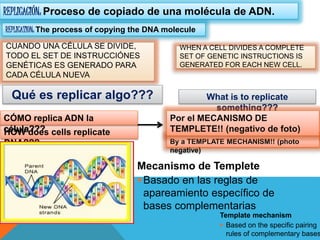
REPLICATION: The process of copying the DNA molecule
What is to replicate
something???
HOW does cells replicate
DNA??? By a TEMPLATE MECHANISM!! (photo
negative)
REPLICACIÓN: Proceso de copiado de una molécula de ADN.
CUANDO UNA CÉLULA SE DIVIDE,
TODO EL SET DE INSTRUCCIÓNES
GENÉTICAS ES GENERADO PARA
CADA CÉLULA NUEVA
Qué es replicar algo???
CÓMO replica ADN la
célula???
Por el MECANISMO DE
TEMPLETE!! (negativo de foto)
Mecanismo de Templete
Basado en las reglas de
apareamiento específico de
bases complementarias
REPLICATION
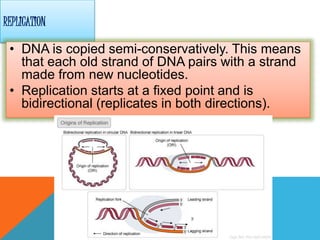
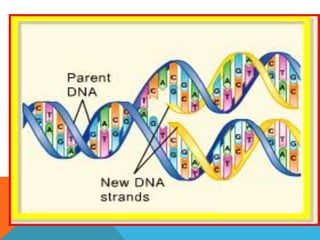
• DNA is copied semi-conservatively. This means
that each old strand of DNA pairs with a strand
made from new nucleotides.
• Replication starts at a fixed point and is
bidirectional (replicates in both directions).
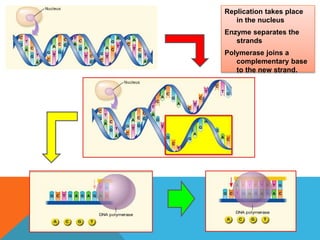
Replication takes place
in the nucleus
Enzyme separates the
strands
Polymerase joins a
complementary base
to the new strand.
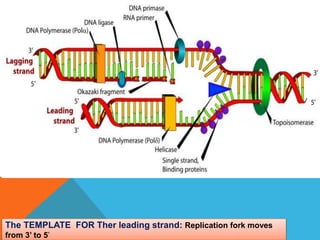
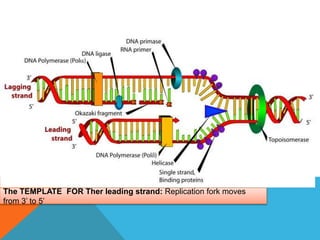
The TEMPLATE FOR Ther leading strand: Replication fork moves
from 3’ to 5’
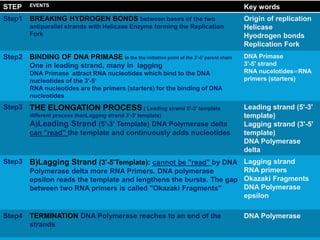
STEP EVENTS Key words
Step1 BREAKING HYDROGEN BONDS between bases of the two
antiparallel strands with Helicase Enzyme forming the Replication
Fork
Origin of replication
Helicase
Hyodrogen bonds
Replication Fork
Step2 BINDING OF DNA PRIMASE in the the initiation point of the 3'-5' parent chain
One in leading strand, many in lagging
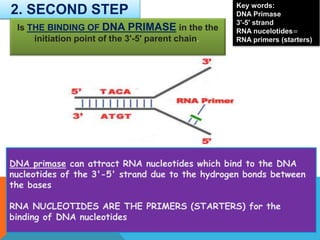
DNA Primase attract RNA nucleotides which bind to the DNA
nucleotides of the 3'-5‘
RNA nucleotides are the primers (starters) for the binding of DNA
nucleotides
DNA Primase
3'-5' strand
RNA nucelotides=RNA
primers (starters)
Step3 THE ELONGATION PROCESS ( Leading strand 5'-3' template
different process thanLagging strand 3'-5' template)
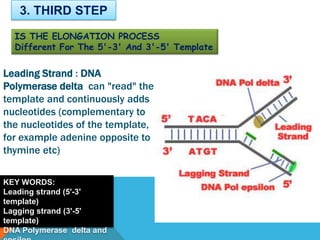
A)Leading Strand (5'-3' Template) DNA Polymerase delta
can "read" the template and continuously adds nucleotides
Leading strand (5'-3'
template)
Lagging strand (3'-5'
template)
DNA Polymerase
delta
Step3 B)Lagging Strand (3'-5'Template): cannot be "read" by DNA
Polymerase delta more RNA Primers. DNA polymerase
epsilon reads the template and lengthens the bursts. The gap
between two RNA primers is called "Okazaki Fragments"
Lagging strand
RNA primers
Okazaki Fragments
DNA Polymerase
epsilon
Step4 TERMINATION DNA Polymerase reaches to an end of the
strands
DNA Polymerase
STEPS
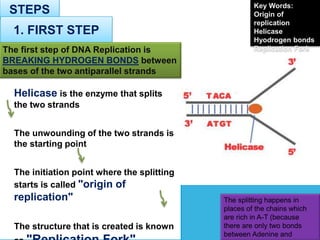
Helicase is the enzyme that splits
the two strands
The unwounding of the two strands is
the starting point
The initiation point where the splitting
starts is called "origin of
replication"
The structure that is created is known
1. FIRST STEP
The first step of DNA Replication is
BREAKING HYDROGEN BONDS between
bases of the two antiparallel strands
The splitting happens in
places of the chains which
are rich in A-T (because
there are only two bonds
between Adenine and
Key Words:
Origin of
replication
Helicase
Hyodrogen bonds
Replication Fork
DNA primase can attract RNA nucleotides which bind to the DNA
nucleotides of the 3'-5' strand due to the hydrogen bonds between
the bases
RNA NUCLEOTIDES ARE THE PRIMERS (STARTERS) for the
binding of DNA nucleotides
2. SECOND STEP
Is THE BINDING OF DNA PRIMASE in the the
initiation point of the 3'-5' parent chain.
Key words:
DNA Primase
3'-5' strand
RNA nucelotides=
RNA primers (starters)
Leading Strand : DNA
Polymerase delta can "read" the
template and continuously adds
nucleotides (complementary to
the nucleotides of the template,
for example adenine opposite to
thymine etc)
3. THIRD STEP
IS THE ELONGATION PROCESS
Different For The 5'-3' And 3'-5' Template
KEY WORDS:
Leading strand (5'-3'
template)
Lagging strand (3'-5'
template)
DNA Polymerase delta and
The TEMPLATE FOR Ther leading strand: Replication fork moves
from 3’ to 5’
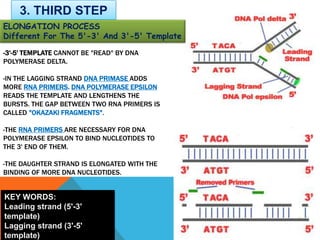
-3'-5' TEMPLATE CANNOT BE "READ" BY DNA
POLYMERASE DELTA.
-IN THE LAGGING STRAND DNA PRIMASE ADDS
MORE RNA PRIMERS. DNA POLYMERASE EPSILON
READS THE TEMPLATE AND LENGTHENS THE
BURSTS. THE GAP BETWEEN TWO RNA PRIMERS IS
CALLED "OKAZAKI FRAGMENTS".
-THE RNA PRIMERS ARE NECESSARY FOR DNA
POLYMERASE EPSILON TO BIND NUCLEOTIDES TO
THE 3' END OF THEM.
-THE DAUGHTER STRAND IS ELONGATED WITH THE
BINDING OF MORE DNA NUCLEOTIDES.
3. THIRD STEP
ELONGATION PROCESS
Different For The 5'-3' And 3'-5' Template
KEY WORDS:
Leading strand (5'-3'
template)
Lagging strand (3'-5'
template)
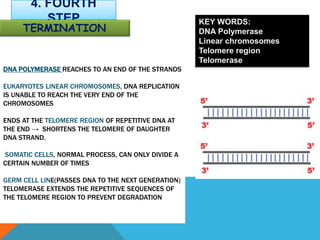
DNA POLYMERASE REACHES TO AN END OF THE STRANDS
EUKARYOTES LINEAR CHROMOSOMES, DNA REPLICATION
IS UNABLE TO REACH THE VERY END OF THE
CHROMOSOMES
ENDS AT THE TELOMERE REGION OF REPETITIVE DNA AT
THE END → SHORTENS THE TELOMERE OF DAUGHTER
DNA STRAND.
SOMATIC CELLS, NORMAL PROCESS, CAN ONLY DIVIDE A
CERTAIN NUMBER OF TIMES
GERM CELL LINE(PASSES DNA TO THE NEXT GENERATION)
TELOMERASE EXTENDS THE REPETITIVE SEQUENCES OF
THE TELOMERE REGION TO PREVENT DEGRADATION
4. FOURTH
STEP
TERMINATION
KEY WORDS:
DNA Polymerase
Linear chromosomes
Telomere region
Telomerase
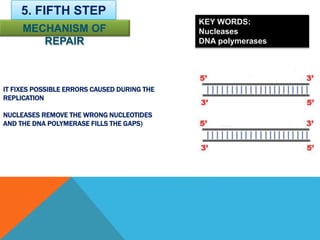
IT FIXES POSSIBLE ERRORS CAUSED DURING THE
REPLICATION
NUCLEASES REMOVE THE WRONG NUCLEOTIDES
AND THE DNA POLYMERASE FILLS THE GAPS)
5. FIFTH STEP
MECHANISM OF
REPAIR
KEY WORDS:
Nucleases
DNA polymerases
http://www.youtube.com/watch?v=8kK2zwjRV0M
http://www.youtube.com/watch?v=dIZpb93NYlw
http://www.youtube.com/watch?v=2iVltkYy0jg
http://www.youtube.com/watch?v=gW3qZF9cLIA
http://www.youtube.com/watch?v=1L8Xb6j7A4w

Replicación adn 2015

  • 1.
    DNA REPLICATION MISS SOFIAPAZ REPLICACIÓN DELADN
  • 2.
    WHEN A CELLDIVIDES A COMPLETE SET OF GENETIC INSTRUCTIONS IS GENERATED FOR EACH NEW CELL. Template mechanism  Based on the specific pairing rules of complementary bases REPLICATION: The process of copying the DNA molecule What is to replicate something??? HOW does cells replicate DNA??? By a TEMPLATE MECHANISM!! (photo negative) REPLICACIÓN: Proceso de copiado de una molécula de ADN. CUANDO UNA CÉLULA SE DIVIDE, TODO EL SET DE INSTRUCCIÓNES GENÉTICAS ES GENERADO PARA CADA CÉLULA NUEVA Qué es replicar algo??? CÓMO replica ADN la célula??? Por el MECANISMO DE TEMPLETE!! (negativo de foto) Mecanismo de Templete Basado en las reglas de apareamiento específico de bases complementarias
  • 3.
    REPLICATION • DNA iscopied semi-conservatively. This means that each old strand of DNA pairs with a strand made from new nucleotides. • Replication starts at a fixed point and is bidirectional (replicates in both directions).
  • 5.
    Replication takes place inthe nucleus Enzyme separates the strands Polymerase joins a complementary base to the new strand.
  • 6.
    The TEMPLATE FORTher leading strand: Replication fork moves from 3’ to 5’
  • 7.
    STEP EVENTS Keywords Step1 BREAKING HYDROGEN BONDS between bases of the two antiparallel strands with Helicase Enzyme forming the Replication Fork Origin of replication Helicase Hyodrogen bonds Replication Fork Step2 BINDING OF DNA PRIMASE in the the initiation point of the 3'-5' parent chain One in leading strand, many in lagging DNA Primase attract RNA nucleotides which bind to the DNA nucleotides of the 3'-5‘ RNA nucleotides are the primers (starters) for the binding of DNA nucleotides DNA Primase 3'-5' strand RNA nucelotides=RNA primers (starters) Step3 THE ELONGATION PROCESS ( Leading strand 5'-3' template different process thanLagging strand 3'-5' template) A)Leading Strand (5'-3' Template) DNA Polymerase delta can "read" the template and continuously adds nucleotides Leading strand (5'-3' template) Lagging strand (3'-5' template) DNA Polymerase delta Step3 B)Lagging Strand (3'-5'Template): cannot be "read" by DNA Polymerase delta more RNA Primers. DNA polymerase epsilon reads the template and lengthens the bursts. The gap between two RNA primers is called "Okazaki Fragments" Lagging strand RNA primers Okazaki Fragments DNA Polymerase epsilon Step4 TERMINATION DNA Polymerase reaches to an end of the strands DNA Polymerase
  • 8.
    STEPS Helicase is theenzyme that splits the two strands The unwounding of the two strands is the starting point The initiation point where the splitting starts is called "origin of replication" The structure that is created is known 1. FIRST STEP The first step of DNA Replication is BREAKING HYDROGEN BONDS between bases of the two antiparallel strands The splitting happens in places of the chains which are rich in A-T (because there are only two bonds between Adenine and Key Words: Origin of replication Helicase Hyodrogen bonds Replication Fork
  • 9.
    DNA primase canattract RNA nucleotides which bind to the DNA nucleotides of the 3'-5' strand due to the hydrogen bonds between the bases RNA NUCLEOTIDES ARE THE PRIMERS (STARTERS) for the binding of DNA nucleotides 2. SECOND STEP Is THE BINDING OF DNA PRIMASE in the the initiation point of the 3'-5' parent chain. Key words: DNA Primase 3'-5' strand RNA nucelotides= RNA primers (starters)
  • 10.
    Leading Strand :DNA Polymerase delta can "read" the template and continuously adds nucleotides (complementary to the nucleotides of the template, for example adenine opposite to thymine etc) 3. THIRD STEP IS THE ELONGATION PROCESS Different For The 5'-3' And 3'-5' Template KEY WORDS: Leading strand (5'-3' template) Lagging strand (3'-5' template) DNA Polymerase delta and
  • 11.
    The TEMPLATE FORTher leading strand: Replication fork moves from 3’ to 5’
  • 12.
    -3'-5' TEMPLATE CANNOTBE "READ" BY DNA POLYMERASE DELTA. -IN THE LAGGING STRAND DNA PRIMASE ADDS MORE RNA PRIMERS. DNA POLYMERASE EPSILON READS THE TEMPLATE AND LENGTHENS THE BURSTS. THE GAP BETWEEN TWO RNA PRIMERS IS CALLED "OKAZAKI FRAGMENTS". -THE RNA PRIMERS ARE NECESSARY FOR DNA POLYMERASE EPSILON TO BIND NUCLEOTIDES TO THE 3' END OF THEM. -THE DAUGHTER STRAND IS ELONGATED WITH THE BINDING OF MORE DNA NUCLEOTIDES. 3. THIRD STEP ELONGATION PROCESS Different For The 5'-3' And 3'-5' Template KEY WORDS: Leading strand (5'-3' template) Lagging strand (3'-5' template)
  • 13.
    DNA POLYMERASE REACHESTO AN END OF THE STRANDS EUKARYOTES LINEAR CHROMOSOMES, DNA REPLICATION IS UNABLE TO REACH THE VERY END OF THE CHROMOSOMES ENDS AT THE TELOMERE REGION OF REPETITIVE DNA AT THE END → SHORTENS THE TELOMERE OF DAUGHTER DNA STRAND. SOMATIC CELLS, NORMAL PROCESS, CAN ONLY DIVIDE A CERTAIN NUMBER OF TIMES GERM CELL LINE(PASSES DNA TO THE NEXT GENERATION) TELOMERASE EXTENDS THE REPETITIVE SEQUENCES OF THE TELOMERE REGION TO PREVENT DEGRADATION 4. FOURTH STEP TERMINATION KEY WORDS: DNA Polymerase Linear chromosomes Telomere region Telomerase
  • 14.
    IT FIXES POSSIBLEERRORS CAUSED DURING THE REPLICATION NUCLEASES REMOVE THE WRONG NUCLEOTIDES AND THE DNA POLYMERASE FILLS THE GAPS) 5. FIFTH STEP MECHANISM OF REPAIR KEY WORDS: Nucleases DNA polymerases
  • 15.