Occlusal Considerations in
Complete Dentures
Dr. M Anil Goud.
Professor
Dept of Prosthodontics NRDRN Dental College Nanded
Introduction
 A literal definition of the term occlusion is the act of closure
or being closed
 But this term should have in it’s definition the concept of a
multifactorial, functional relationship between the teeth and
the other components of the masticatory system as well as
other areas of head and neck that directly or indirectly relate
to function, Para function or dysfunction of the masticatory
system
www.asiandentalacademy.orgwww.asiandentalacademy.org
Definitions
 Dorland’s dictionary(1985)-relation of
maxillary and mandibular teeth when in
functional contact during activity of mandible
 GPT 8 – 1) The act or process of closure or of
being closed or shut off
2) The static relationship between
incising or masticating surfaces of the maxillary
or mandibular teeth or tooth analogue
www.asiandentalacademy.orgwww.asiandentalacademy.org
Difference between natural
and artificial teeth
 Proprioceptive feedback of periodontal tissues
 Pressure of occlusion on Individual tooth unit
 Malocclusion of occlusion uneventful for years
 Incising
 Bilateral balance
 Forces of mastication
5 to 175 pounds in natural teeth
9 pound in incisor area,22-24 pound in premolar &
molar area in complete denture
www.asiandentalacademy.orgwww.asiandentalacademy.org
Requirements of complete
denture occlusion
Stability
Balanced occlusion
Functional lever balance by tooth to ridge
position
Cutting penetrating and shearing efficiency of
occlusal surfaces
Anterior incisal clearance during posterior
masticatory functions
Minimum area of occlusal contacts to reduce
the forces www.asiandentalacademy.orgwww.asiandentalacademy.org
Requirements of incising units
Sharp
No contact during mastication
Less incisal guidance considering esthetics
and phonetics
Contact only during protrusive incising
function
www.asiandentalacademy.orgwww.asiandentalacademy.org
Requirements of the working
occlusal units
Efficient in cutting and grinding
Should have decreased Buccolingual width
Should function as group with
simultaneous harmonious contacts
Should over the ridge crest for lever
balance
Should have plane of occlusion as parallel
as possible to mean foundation area
www.asiandentalacademy.orgwww.asiandentalacademy.org
Requirements of balancing
occlusal units
Should contact on the second molars
when the incising units contact in
function
Should contact at the end of chewing
cycle when the working units contact
Should have smooth gliding contacts for
lateral and protrusive excursions
www.asiandentalacademy.orgwww.asiandentalacademy.org
Axioms for artificial occlusion
Sears
 Smaller area of occlusal surfaces, smaller the forces transmitted
 Vertical forces on inclined surface causes non vertical force
 Vertical forces on inclined supporting tissue causes non vertical
force
 Vertical force outside & lateral to the ridge creates tipping
forces on the bases
www.asiandentalacademy.orgwww.asiandentalacademy.org
Occlusal schemes for
complete denture
Anatomically shaped teeth in upper and
lower dentures
Non-anatomically shaped teeth in both
dentures
A combination of both types, usually
anatomically shaped teeth in the upper
www.asiandentalacademy.orgwww.asiandentalacademy.org
Anatomic teeth
Advantages
Efficient in cutting of food
Cuspal inclination facilitates bilateral
balance in various eccentric occlusions
Cusp teeth provides resistance to rotation in
relation to each other and to there bases
Esthetically acceptable
www.asiandentalacademy.orgwww.asiandentalacademy.org
Disadvantages
Mandatory to use adjustable articulators
Eccentric records must be made for
articulator adjustment
The bases need prompt and frequent
refitting to keep the occlusion stable and
balanced
Cusp inclinations generate more horizontal
forces
www.asiandentalacademy.orgwww.asiandentalacademy.org
Selection of posterior teeth
History
Anatomic teeth of 33º or more
Modified anatomic teeth between 30º and 0º
Non-anatomic or zero degree teeth
www.asiandentalacademy.orgwww.asiandentalacademy.org
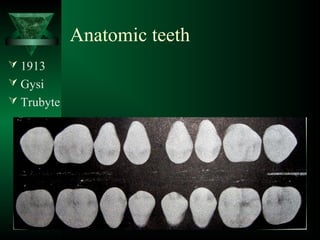
Anatomic teeth
 1913
 Gysi
 Trubyte
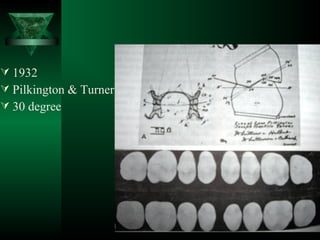
 1932
 Pilkington & Turner
 30 degree
Non-anatomic teeth
Advantages:
Area of freedom
Poor neuromuscular control
Horizontal forces
Simple technique and articulator
www.asiandentalacademy.orgwww.asiandentalacademy.org
Disadvantages
Esthetically inferior
Inefficiency in mastication
www.asiandentalacademy.orgwww.asiandentalacademy.org
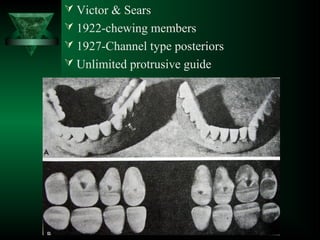
 Victor & Sears
 1922-chewing members
 1927-Channel type posteriors
 Unlimited protrusive guide
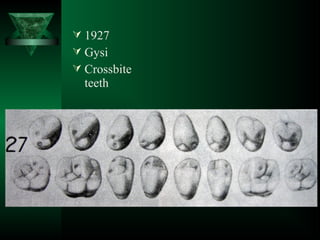
 1927
 Gysi
 Crossbite
teeth
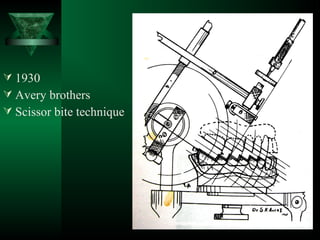
 1930
 Avery brothers
 Scissor bite technique
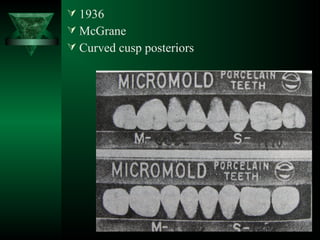
 1936
 McGrane
 Curved cusp posteriors
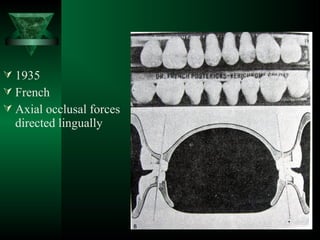
 1935
 French
 Axial occlusal forces
directed lingually
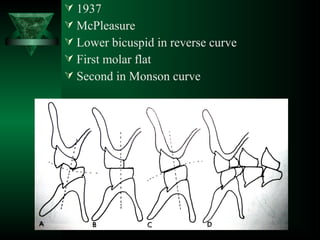
 1937
 McPleasure
 Lower bicuspid in reverse curve
 First molar flat
 Second in Monson curve
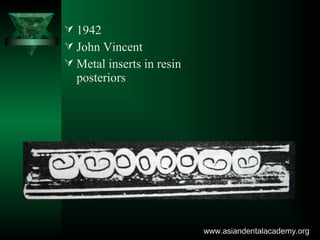
 1942
 John Vincent
 Metal inserts in resin
posteriors
www.asiandentalacademy.orgwww.asiandentalacademy.org
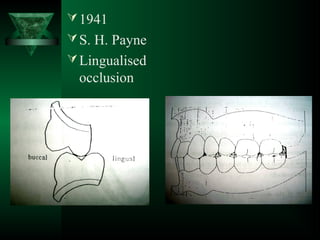
1941
S. H. Payne
Lingualised
occlusion
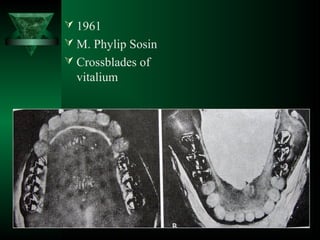
 1961
 M. Phylip Sosin
 Crossblades of
vitalium
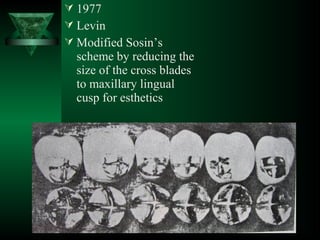
 1977
 Levin
 Modified Sosin’s
scheme by reducing the
size of the cross blades
to maxillary lingual
cusp for esthetics
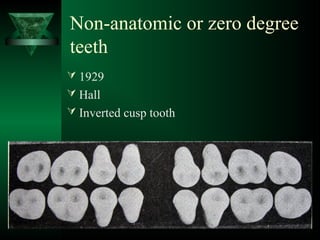
Non-anatomic or zero degree
teeth
 1929
 Hall
 Inverted cusp tooth
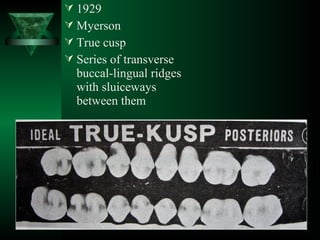
 1929
 Myerson
 True cusp
 Series of transverse
buccal-lingual ridges
with sluiceways
between them
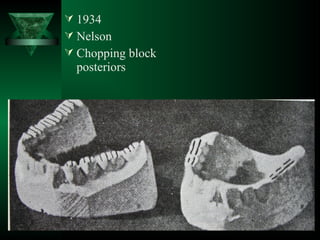
 1934
 Nelson
 Chopping block
posteriors
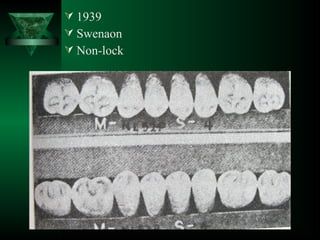
 1939
 Swenaon
 Non-lock
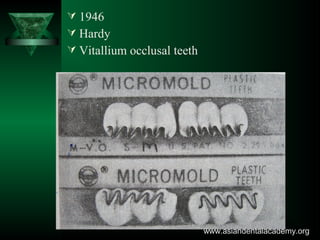
 1946
 Hardy
 Vitallium occlusal teeth
www.asiandentalacademy.orgwww.asiandentalacademy.org
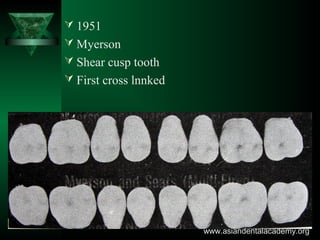
 1951
 Myerson
 Shear cusp tooth
 First cross lnnked
www.asiandentalacademy.orgwww.asiandentalacademy.org
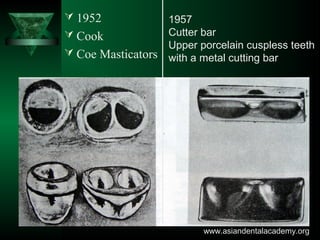
 1952
 Cook
 Coe Masticators
1957
Cutter bar
Upper porcelain cuspless teeth
with a metal cutting bar
www.asiandentalacademy.orgwww.asiandentalacademy.org
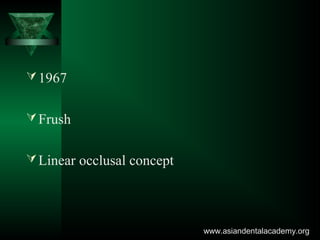
1967
Frush
Linear occlusal concept
www.asiandentalacademy.orgwww.asiandentalacademy.org
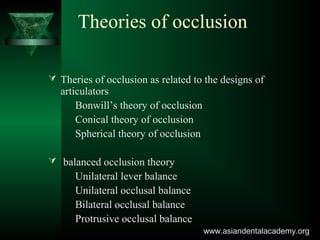
Theories of occlusion
 Theries of occlusion as related to the designs of
articulators
Bonwill’s theory of occlusion
Conical theory of occlusion
Spherical theory of occlusion
 balanced occlusion theory
Unilateral lever balance
Unilateral occlusal balance
Bilateral occlusal balance
Protrusive occlusal balance
www.asiandentalacademy.orgwww.asiandentalacademy.org
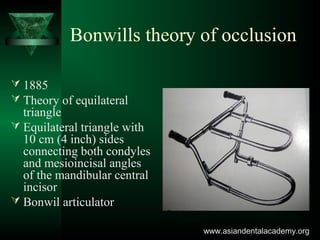
Bonwills theory of occlusion
 1885
 Theory of equilateral
triangle
 Equilateral triangle with
10 cm (4 inch) sides
connecting both condyles
and mesioincisal angles
of the mandibular central
incisor
 Bonwil articulator
www.asiandentalacademy.orgwww.asiandentalacademy.org
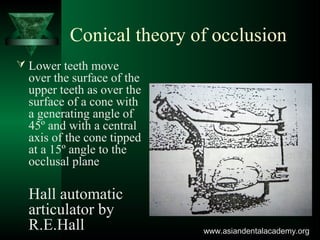
Conical theory of occlusion
 Lower teeth move
over the surface of the
upper teeth as over the
surface of a cone with
a generating angle of
45º and with a central
axis of the cone tipped
at a 15º angle to the
occlusal plane
Hall automatic
articulator by
R.E.Hall www.asiandentalacademy.orgwww.asiandentalacademy.org
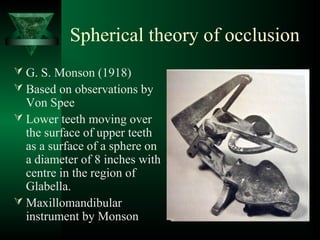
Spherical theory of occlusion
 G. S. Monson (1918)
 Based on observations by
Von Spee
 Lower teeth moving over
the surface of upper teeth
as a surface of a sphere on
a diameter of 8 inches with
centre in the region of
Glabella.
 Maxillomandibular
instrument by Monson
Axioms for balance
 Wider & larger the ridge and closer the teeth to the
ridge, greater the lever balance vice versa
 Wider the ridge and the narrower the teeth greater
the balance and vice versa
 More lingual the teeth arrangement in relation to
the ridge crest, greater the balance and vice versa
 More centered the occlusal force anteroposteriorly,
greater the stability of base
www.asiandentalacademy.orgwww.asiandentalacademy.org
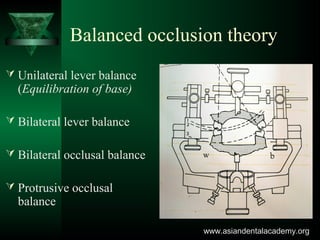
Balanced occlusion theory
 Unilateral lever balance
(Equilibration of base)
 Bilateral lever balance
 Bilateral occlusal balance
 Protrusive occlusal
balance
www.asiandentalacademy.orgwww.asiandentalacademy.org
Development of balanced
occlusion
Concept
Definition
Rationale
Goals
www.asiandentalacademy.orgwww.asiandentalacademy.org
Concept
Von Spee (1890)- curve of Spee-
masticatory surfaces of the molars are
aligned in downward convex curve along
the upper jaw and in an upward concave
curve along the lower jaw
Alfred Gysy (1910)- condylar path follows
curved line or an S shaped curve
www.asiandentalacademy.orgwww.asiandentalacademy.org
 B. B. McCollum (1926)-completely balanced
occlusion for natural dentition
 Clyde H. Schuyler (1929)- non-working side
contacts may be contributing factors to traumatic
injury
 Balanced occlusion good theory for complete
denture
www.asiandentalacademy.orgwww.asiandentalacademy.org
Definition
1. Bilateral simultanious anterior and
posterior contacts of the teeth in centric
and eccentric position –(GPT 8)
2. Stable, simultaneous contact of the
opposing upper and lower teeth in centric
relation position and a continuous smooth
bilateral gliding from this position to any
eccentric positions within the normal
range of mandibular functions (Winkler)
www.asiandentalacademy.orgwww.asiandentalacademy.org
Rationale
 Stabilization of denture
 Combination of tissue resiliency and denture
movement during function accounts for thee high
frequency of non chewing or balancing side
contacts. Denture movement regardless of
posterior occlusal form
 Shepperd(1964)- enter bolus enter balance
 Prime- enter bolus exit balance-value of smooth
gliding non-interfering bilateral tooth contact
www.asiandentalacademy.orgwww.asiandentalacademy.org
Breumer & Hudson (1961)-complete denture do
contact at times during mastication.
Bilateral balance is even more important during
swallowing saliva, closing to reseat denture,
bruxing of teeth during stress
Do not upset the normal, static, stable and
retentive movement of denture
Ensures even pressure in all pressure in all parts
of the arch www.asiandentalacademy.orgwww.asiandentalacademy.org
Goals of balanced occlusion
Maximum simultanious bilateral contact in
centric relation
Working side contacts all along the working
side from cuspides posteriorly
Balancing in molar region in lateral position ,
one contact is sufficient
Occlusal plane parallel to the maxillary &
mandibular residual ridge
www.asiandentalacademy.orgwww.asiandentalacademy.org
Balancing in protrusive position require
tipping of distal end of mandibular second
molar up so that mesiolingual cusp of
maxillary second molar will contact the distal
marginal ridge of mandibular second molar
Compensating curve for protrusive balance
created buy tipping the second premolar
distally, depressing the mandibular first
molar,and placing upword inclination on the
mandibular second molar www.asiandentalacademy.orgwww.asiandentalacademy.org
Laws of protrusive occlusion
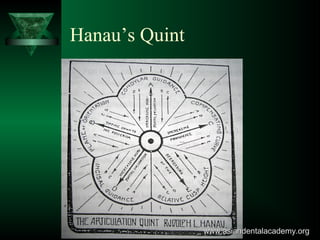
 Hanau’s
study was
pioneer
explanation
 Hanau’s
laws of
articulation
and the
Hanau
Quint
1.Horizontal condylar inclination
2.Compensating curve
3.Prtrusive incisal guidance
4.Plane of orientation
5.Buccolingual inclination of tooth axis
6.Sagital condylar pathway
7.Sagital incisal guidance
8.Tooth alignment
9.Relative cusp hight
Condylar guidance
Compensating curve
Relative cusp height
Incisal guidance
Plane of orientation
www.asiandentalacademy.orgwww.asiandentalacademy.org
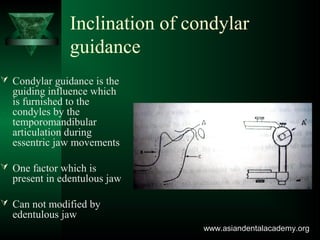
Inclination of condylar
guidance
 Condylar guidance is the
guiding influence which
is furnished to the
condyles by the
temporomandibular
articulation during
essentric jaw movements
 One factor which is
present in edentulous jaw
 Can not modified by
edentulous jaw
www.asiandentalacademy.orgwww.asiandentalacademy.org
Inclination of incisal guidance
 Guding influence which results from positional
relationships of the upper and lower anterior teeth
when the mandible ,moved into eccentric relations
to the maxillary while anterior teeth remain in
contact
 Angle in sagittal plane between incisal edges of
the upper and lower incisar teeth when closed in
centric occlusion
www.asiandentalacademy.orgwww.asiandentalacademy.org
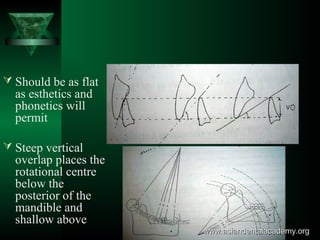
 Should be as flat
as esthetics and
phonetics will
permit
 Steep vertical
overlap places the
rotational centre
below the
posterior of the
mandible and
shallow above
www.asiandentalacademy.orgwww.asiandentalacademy.org
Orientation of the occlusal
plane
Vertical location of the anteroposterior
alignment of the occlusal plane in the space
between the Camper’s line to a point, not at
the superior border, but at the centre of the
ear (Hanau)
 Camper’s plane is not only misunderstood
but also unreliable
www.asiandentalacademy.orgwww.asiandentalacademy.org
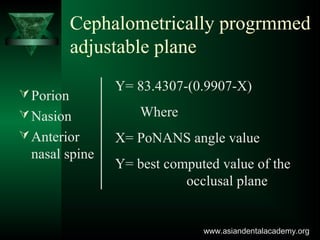
Cephalometrically progrmmed
adjustable plane
Porion
Nasion
Anterior
nasal spine
Y= 83.4307-(0.9907-X)
Where
X= PoNANS angle value
Y= best computed value of the
occlusal plane
www.asiandentalacademy.orgwww.asiandentalacademy.org
Inclination of the cusp
Angle between the total occlusal
surfaces of the tooth and inclination of
the cusp in relation to that surface
www.asiandentalacademy.orgwww.asiandentalacademy.org
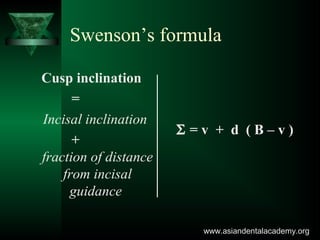
Swenson’s formula
Cusp inclination
=
Incisal inclination
+
fraction of distance
from incisal
guidance
Σ = v + d ( B – v )
www.asiandentalacademy.orgwww.asiandentalacademy.org
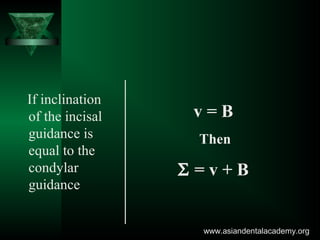
If inclination
of the incisal
guidance is
equal to the
condylar
guidance
v = B
Then
Σ = v + B
www.asiandentalacademy.orgwww.asiandentalacademy.org
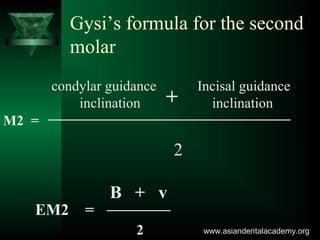
Gysi’s formula for the second
molar
condylar guidance
inclination
M2 =
Incisal guidance
inclination
2
+
B + v
2
EM2 =
www.asiandentalacademy.orgwww.asiandentalacademy.org
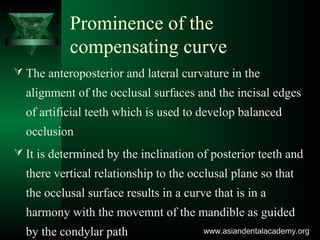
Prominence of the
compensating curve
 The anteroposterior and lateral curvature in the
alignment of the occlusal surfaces and the incisal edges
of artificial teeth which is used to develop balanced
occlusion
 It is determined by the inclination of posterior teeth and
there vertical relationship to the occlusal plane so that
the occlusal surface results in a curve that is in a
harmony with the movemnt of the mandible as guided
by the condylar path www.asiandentalacademy.orgwww.asiandentalacademy.org
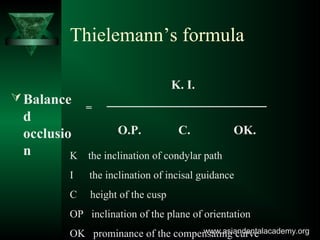
Thielemann’s formula
Balance
d
occlusio
n
=
K. I.
O.P. C. OK.
K the inclination of condylar path
I the inclination of incisal guidance
C height of the cusp
OP inclination of the plane of orientation
OK prominance of the compensating curvewww.asiandentalacademy.orgwww.asiandentalacademy.org
Cusp plane and cusp plane
angle
Cusp plane- when two buccal cusps tips
and the highest situated lingual cusp cusp
tip are connected form a cusp plane
Cusp plane angle- the inclination of the
cusp plane to the plane of occlusionis called
“cusp plane angle”
www.asiandentalacademy.orgwww.asiandentalacademy.org
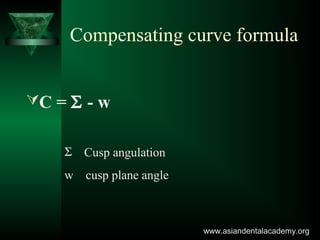
Compensating curve formula
C = Σ - w
Σ Cusp angulation
w cusp plane angle
www.asiandentalacademy.orgwww.asiandentalacademy.org
Hanau’s Quint
www.asiandentalacademy.orgwww.asiandentalacademy.org
Trapozzano concept
Eliminated plane of orientation
Compensating curve inclination
www.asiandentalacademy.orgwww.asiandentalacademy.org
Boucher’s concept
Three fixed factors
Compensating curve is also important
Both the cusp height and & the
compensating curve are means for solving
the problems imposed by the
Christensen’s phenomena
Occlusal plane shoud be located according
to esthetic appearance and soft tissue
anatomy
www.asiandentalacademy.orgwww.asiandentalacademy.org
The Lott concept
Divided five factors in clear and simple chart
www.asiandentalacademy.orgwww.asiandentalacademy.org
Levin’s concept
Eliminates the plane of orientation
www.asiandentalacademy.orgwww.asiandentalacademy.org
Arrangement of anatomic artificial
teeth into balanced occlusion
www.asiandentalacademy.orgwww.asiandentalacademy.org
Arrangement of nonanatomic
teeth into balanced occlusion
www.asiandentalacademy.orgwww.asiandentalacademy.org
Centre of rotation
A line drawn at right angle to the buccal
incline of mandibular lingual cusp on the
working side and another line at right angle
to the lingual surfaces of mandibular buccal
cusp on the balancing side meet at B
www.asiandentalacademy.orgwww.asiandentalacademy.org
Influence of incisal and condylar
guidance on the working and
balancing side
Working side inclines are not so steep as
balancing side contacts
Angle of inclination on the working side is
less in posterior area and greater towards
the incisal area
Since incisal guidance is 30 degree, a
smaller degree of angulation is seen in the
posterior region which gradually increases
towards 30 degrees the incisal area is
approached
www.asiandentalacademy.orgwww.asiandentalacademy.org
Concepts of occlusion
Neutrocentric
Lingualized occlusion
Monoplane concept of occlusion
Lineal occlusal concept
www.asiandentalacademy.orgwww.asiandentalacademy.org
Neutrocentric concept
De Van
Neutralization of inclines
Centralization of occlusal forces acting on
the denture foundation
Teeth should be placed where they grew as
long as mechanical laws are not violated
Factors such as orientation of occlusal
plane, compensating curve, incisal
guidance must be neutralized before
neutralization of inclineswww.asiandentalacademy.orgwww.asiandentalacademy.org
Elements of neutrocentric
concept
1.1. PositionPosition
posterior teeth over the posterior residualposterior teeth over the posterior residual
ridge as far lingually as tongue wouldridge as far lingually as tongue would
allow so that forces would beallow so that forces would be
perpendicular to the support areasperpendicular to the support areas
www.asiandentalacademy.orgwww.asiandentalacademy.org
Proportion-
Devan reduced tooth width by 40% to
correct tooth proportion thus reduce vertical
stress on the ridge
Also horizontal and shearing stress was
reduced because friction between opposing
surfaces was decreased;such frictional
forces are resisted by the o
www.asiandentalacademy.orgwww.asiandentalacademy.org
Pitch
Inclination or tilt
Pitch as found in
natural dentition
Parallel to the
maxillary and
mandibular bases
In natural dentition pitch of
posteriors is determined by
1.Orientation of occlusal
plane in reference to the
condylar guidance
2.The steepness of
compensating curve
www.asiandentalacademy.orgwww.asiandentalacademy.org
Form
Flat teeth with no deflecting inclines
Reduction of destructive lateral forces
www.asiandentalacademy.orgwww.asiandentalacademy.org
Number
 Number is reduced from 8 to 6
 Thus decreased magnitude of the occlusal force
and centralised it to second premolar & first
premolar area
 Aids in stabilityby freeing the lower molar
incline of occlusion
www.asiandentalacademy.orgwww.asiandentalacademy.org
There should be no hesitancy in reducing
the number of teeth.
Krogman, the Anthropologist-the human
dental formula of 2-1-2-3 is evolving into
the formula 1-1-1-2
www.asiandentalacademy.orgwww.asiandentalacademy.org
Lingualised occlusion
Occlusal scheme which uses maxillary
lingual cusps as the major functioning
occlusal element occluding with
nonanatomic or semianatomic teeth in the
lower arch
Payne- first suggested
Pound- used the term
www.asiandentalacademy.orgwww.asiandentalacademy.org
Indications
 High priority on esthetics but the nonanatomic
occlusal scheme is indicated by oral conditions
such as sever resorption, class 2 jaw relationship
or desplaceable supporting tissue
 Complete denture opposed by a removable partial
denture
www.asiandentalacademy.orgwww.asiandentalacademy.org
Principles
Anatomic posterior teeth in maxillary denture
Non anatomic or semianatomic in mandibular
denture
Selective grinding of mandibular posterior teeth
creates slight concavity on the occlusal surfaces
Maxillary lingual cusp contacting mandibular
teeth in working, balancing as well as protrusive
movements
www.asiandentalacademy.orgwww.asiandentalacademy.org
Monoplane concept of
occlusion
 Sear (1949) & Devan (1984)
 Anterior teeth without vertical overlap, normal
horizontal overlap
 From 0 mm for class 3 to 12 mm for sever class 2
 Occlusal plane-
anterior point- incisal edges of canine
posterior point- a) equal division of space
b) parallel to mean foundation
c)2/3rd
way up of retromolar pad
www.asiandentalacademy.orgwww.asiandentalacademy.org
Line from distoincisal edges of canine to
buccolingual centre of retromolar pad on
mandibular wax rim
Upper premolars and first molars arranged
in such a way that there central grooves
coincide with the line
Upper molar 2 mm above the occlusal planewww.asiandentalacademy.orgwww.asiandentalacademy.org
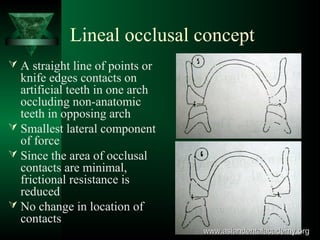
Lineal occlusal concept
 A straight line of points or
knife edges contacts on
artificial teeth in one arch
occluding non-anatomic
teeth in opposing arch
 Smallest lateral component
of force
 Since the area of occlusal
contacts are minimal,
frictional resistance is
reduced
 No change in location of
contacts
www.asiandentalacademy.orgwww.asiandentalacademy.org
Locating the line of occlusal
contacts
 Stabilization of mandibular denture-
with the ridge of occlusal contacts in mandibular
arch, occlusal forses in any jaw position will be
applied to the mandibular denture at the same point
 Esthetics-
nonanatomic maxillary first premolar contoured to
the anatomically and esthetically pleasant
anatomic maxillary teeth with lingual cisps in
straight line and keeping baccal cusps out of
contacts
www.asiandentalacademy.orgwww.asiandentalacademy.org
Combination of occlusal
forms
Non-anatomic maxillary porcelain teeth
opposing mandibular porcelain teeth
 least wear, hence in young healthy patient
with adequate interridge distance
 earlier occlusal disharmonies as porcelain
does not wear fast enough to keep up with
changes of the residual ridge
www.asiandentalacademy.orgwww.asiandentalacademy.org
 Non-anatomic maxillary plastic teeth opposing
mandibular plastic lineal teeth
 Susceptibility to wear
 Lineal becomes flat plane type
 Contraindicated in young patients and patients with
bruxism and abrasive diet
 Advantageous in patientas with resorbed ridges and
poor muscle function and who need treatment dentures
for rapidly deterioring ridges www.asiandentalacademy.orgwww.asiandentalacademy.org
Nonanatomic maxillary plastic teeth
opposing mandiblar porcelain lineal teeth
More self adjusting as mouth changes occur
Necessity to reshape maxillary posterior
teeth
www.asiandentalacademy.orgwww.asiandentalacademy.org
Anatomic maxillary porcelain teeth
opposing non-anatomic mandibular
plastic teeth
Esthetics
Line of contact between lingual cusps of
maxillary porcelain teeth and non-anatomic
mandibular posterior teeth
www.asiandentalacademy.orgwww.asiandentalacademy.org
 Tooth positioning for lineal occlusion
 Anterior teeth with no vertical overlap
interferance
 Posteriorly as high as practical to aid in
developing protrusive balancing contacts with flat
plane of occlusion
 Lower teeth set first and centered over the crest of
the ridge
 Flat surfaces of maxillary posterior teeth parellel
to cross arch horizontal plane www.asiandentalacademy.orgwww.asiandentalacademy.org
Discussion
 Various contravercies in various concepts, theories and
philosophies
 Occlusion is a part of stomatognathic system and not
just setting of teeth
 occlusion in complete denture if based on unsound
principles, actually worsens the physical, mental and
social condition of old patients rather than improving it
 There is nothing called ideal occlusion before the great
variable Human factor
www.asiandentalacademy.orgwww.asiandentalacademy.org
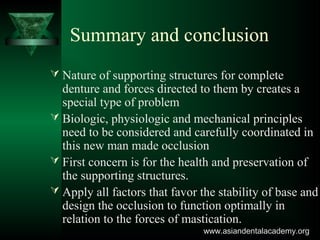
Summary and conclusion
 Nature of supporting structures for complete
denture and forces directed to them by creates a
special type of problem
 Biologic, physiologic and mechanical principles
need to be considered and carefully coordinated in
this new man made occlusion
 First concern is for the health and preservation of
the supporting structures.
 Apply all factors that favor the stability of base and
design the occlusion to function optimally in
relation to the forces of mastication.
www.asiandentalacademy.orgwww.asiandentalacademy.org

Occlusion in complete denture

  • 1.
    Occlusal Considerations in CompleteDentures Dr. M Anil Goud. Professor Dept of Prosthodontics NRDRN Dental College Nanded
  • 2.
    Introduction  A literaldefinition of the term occlusion is the act of closure or being closed  But this term should have in it’s definition the concept of a multifactorial, functional relationship between the teeth and the other components of the masticatory system as well as other areas of head and neck that directly or indirectly relate to function, Para function or dysfunction of the masticatory system www.asiandentalacademy.orgwww.asiandentalacademy.org
  • 3.
    Definitions  Dorland’s dictionary(1985)-relationof maxillary and mandibular teeth when in functional contact during activity of mandible  GPT 8 – 1) The act or process of closure or of being closed or shut off 2) The static relationship between incising or masticating surfaces of the maxillary or mandibular teeth or tooth analogue www.asiandentalacademy.orgwww.asiandentalacademy.org
  • 4.
    Difference between natural andartificial teeth  Proprioceptive feedback of periodontal tissues  Pressure of occlusion on Individual tooth unit  Malocclusion of occlusion uneventful for years  Incising  Bilateral balance  Forces of mastication 5 to 175 pounds in natural teeth 9 pound in incisor area,22-24 pound in premolar & molar area in complete denture www.asiandentalacademy.orgwww.asiandentalacademy.org
  • 5.
    Requirements of complete dentureocclusion Stability Balanced occlusion Functional lever balance by tooth to ridge position Cutting penetrating and shearing efficiency of occlusal surfaces Anterior incisal clearance during posterior masticatory functions Minimum area of occlusal contacts to reduce the forces www.asiandentalacademy.orgwww.asiandentalacademy.org
  • 6.
    Requirements of incisingunits Sharp No contact during mastication Less incisal guidance considering esthetics and phonetics Contact only during protrusive incising function www.asiandentalacademy.orgwww.asiandentalacademy.org
  • 7.
    Requirements of theworking occlusal units Efficient in cutting and grinding Should have decreased Buccolingual width Should function as group with simultaneous harmonious contacts Should over the ridge crest for lever balance Should have plane of occlusion as parallel as possible to mean foundation area www.asiandentalacademy.orgwww.asiandentalacademy.org
  • 8.
    Requirements of balancing occlusalunits Should contact on the second molars when the incising units contact in function Should contact at the end of chewing cycle when the working units contact Should have smooth gliding contacts for lateral and protrusive excursions www.asiandentalacademy.orgwww.asiandentalacademy.org
  • 9.
    Axioms for artificialocclusion Sears  Smaller area of occlusal surfaces, smaller the forces transmitted  Vertical forces on inclined surface causes non vertical force  Vertical forces on inclined supporting tissue causes non vertical force  Vertical force outside & lateral to the ridge creates tipping forces on the bases www.asiandentalacademy.orgwww.asiandentalacademy.org
  • 10.
    Occlusal schemes for completedenture Anatomically shaped teeth in upper and lower dentures Non-anatomically shaped teeth in both dentures A combination of both types, usually anatomically shaped teeth in the upper www.asiandentalacademy.orgwww.asiandentalacademy.org
  • 11.
    Anatomic teeth Advantages Efficient incutting of food Cuspal inclination facilitates bilateral balance in various eccentric occlusions Cusp teeth provides resistance to rotation in relation to each other and to there bases Esthetically acceptable www.asiandentalacademy.orgwww.asiandentalacademy.org
  • 12.
    Disadvantages Mandatory to useadjustable articulators Eccentric records must be made for articulator adjustment The bases need prompt and frequent refitting to keep the occlusion stable and balanced Cusp inclinations generate more horizontal forces www.asiandentalacademy.orgwww.asiandentalacademy.org
  • 13.
    Selection of posteriorteeth History Anatomic teeth of 33º or more Modified anatomic teeth between 30º and 0º Non-anatomic or zero degree teeth www.asiandentalacademy.orgwww.asiandentalacademy.org
  • 14.
  • 15.
     1932  Pilkington& Turner  30 degree
  • 16.
    Non-anatomic teeth Advantages: Area offreedom Poor neuromuscular control Horizontal forces Simple technique and articulator www.asiandentalacademy.orgwww.asiandentalacademy.org
  • 17.
    Disadvantages Esthetically inferior Inefficiency inmastication www.asiandentalacademy.orgwww.asiandentalacademy.org
  • 18.
     Victor &Sears  1922-chewing members  1927-Channel type posteriors  Unlimited protrusive guide
  • 19.
     1927  Gysi Crossbite teeth
  • 20.
     1930  Averybrothers  Scissor bite technique
  • 21.
     1936  McGrane Curved cusp posteriors
  • 22.
     1935  French Axial occlusal forces directed lingually
  • 23.
     1937  McPleasure Lower bicuspid in reverse curve  First molar flat  Second in Monson curve
  • 24.
     1942  JohnVincent  Metal inserts in resin posteriors www.asiandentalacademy.orgwww.asiandentalacademy.org
  • 25.
  • 26.
     1961  M.Phylip Sosin  Crossblades of vitalium
  • 27.
     1977  Levin Modified Sosin’s scheme by reducing the size of the cross blades to maxillary lingual cusp for esthetics
  • 28.
    Non-anatomic or zerodegree teeth  1929  Hall  Inverted cusp tooth
  • 29.
     1929  Myerson True cusp  Series of transverse buccal-lingual ridges with sluiceways between them
  • 30.
     1934  Nelson Chopping block posteriors
  • 31.
  • 32.
     1946  Hardy Vitallium occlusal teeth www.asiandentalacademy.orgwww.asiandentalacademy.org
  • 33.
     1951  Myerson Shear cusp tooth  First cross lnnked www.asiandentalacademy.orgwww.asiandentalacademy.org
  • 34.
     1952  Cook Coe Masticators 1957 Cutter bar Upper porcelain cuspless teeth with a metal cutting bar www.asiandentalacademy.orgwww.asiandentalacademy.org
  • 35.
  • 36.
    Theories of occlusion Theries of occlusion as related to the designs of articulators Bonwill’s theory of occlusion Conical theory of occlusion Spherical theory of occlusion  balanced occlusion theory Unilateral lever balance Unilateral occlusal balance Bilateral occlusal balance Protrusive occlusal balance www.asiandentalacademy.orgwww.asiandentalacademy.org
  • 37.
    Bonwills theory ofocclusion  1885  Theory of equilateral triangle  Equilateral triangle with 10 cm (4 inch) sides connecting both condyles and mesioincisal angles of the mandibular central incisor  Bonwil articulator www.asiandentalacademy.orgwww.asiandentalacademy.org
  • 38.
    Conical theory ofocclusion  Lower teeth move over the surface of the upper teeth as over the surface of a cone with a generating angle of 45º and with a central axis of the cone tipped at a 15º angle to the occlusal plane Hall automatic articulator by R.E.Hall www.asiandentalacademy.orgwww.asiandentalacademy.org
  • 39.
    Spherical theory ofocclusion  G. S. Monson (1918)  Based on observations by Von Spee  Lower teeth moving over the surface of upper teeth as a surface of a sphere on a diameter of 8 inches with centre in the region of Glabella.  Maxillomandibular instrument by Monson
  • 40.
    Axioms for balance Wider & larger the ridge and closer the teeth to the ridge, greater the lever balance vice versa  Wider the ridge and the narrower the teeth greater the balance and vice versa  More lingual the teeth arrangement in relation to the ridge crest, greater the balance and vice versa  More centered the occlusal force anteroposteriorly, greater the stability of base www.asiandentalacademy.orgwww.asiandentalacademy.org
  • 41.
    Balanced occlusion theory Unilateral lever balance (Equilibration of base)  Bilateral lever balance  Bilateral occlusal balance  Protrusive occlusal balance www.asiandentalacademy.orgwww.asiandentalacademy.org
  • 42.
  • 43.
    Concept Von Spee (1890)-curve of Spee- masticatory surfaces of the molars are aligned in downward convex curve along the upper jaw and in an upward concave curve along the lower jaw Alfred Gysy (1910)- condylar path follows curved line or an S shaped curve www.asiandentalacademy.orgwww.asiandentalacademy.org
  • 44.
     B. B.McCollum (1926)-completely balanced occlusion for natural dentition  Clyde H. Schuyler (1929)- non-working side contacts may be contributing factors to traumatic injury  Balanced occlusion good theory for complete denture www.asiandentalacademy.orgwww.asiandentalacademy.org
  • 45.
    Definition 1. Bilateral simultaniousanterior and posterior contacts of the teeth in centric and eccentric position –(GPT 8) 2. Stable, simultaneous contact of the opposing upper and lower teeth in centric relation position and a continuous smooth bilateral gliding from this position to any eccentric positions within the normal range of mandibular functions (Winkler) www.asiandentalacademy.orgwww.asiandentalacademy.org
  • 46.
    Rationale  Stabilization ofdenture  Combination of tissue resiliency and denture movement during function accounts for thee high frequency of non chewing or balancing side contacts. Denture movement regardless of posterior occlusal form  Shepperd(1964)- enter bolus enter balance  Prime- enter bolus exit balance-value of smooth gliding non-interfering bilateral tooth contact www.asiandentalacademy.orgwww.asiandentalacademy.org
  • 47.
    Breumer & Hudson(1961)-complete denture do contact at times during mastication. Bilateral balance is even more important during swallowing saliva, closing to reseat denture, bruxing of teeth during stress Do not upset the normal, static, stable and retentive movement of denture Ensures even pressure in all pressure in all parts of the arch www.asiandentalacademy.orgwww.asiandentalacademy.org
  • 48.
    Goals of balancedocclusion Maximum simultanious bilateral contact in centric relation Working side contacts all along the working side from cuspides posteriorly Balancing in molar region in lateral position , one contact is sufficient Occlusal plane parallel to the maxillary & mandibular residual ridge www.asiandentalacademy.orgwww.asiandentalacademy.org
  • 49.
    Balancing in protrusiveposition require tipping of distal end of mandibular second molar up so that mesiolingual cusp of maxillary second molar will contact the distal marginal ridge of mandibular second molar Compensating curve for protrusive balance created buy tipping the second premolar distally, depressing the mandibular first molar,and placing upword inclination on the mandibular second molar www.asiandentalacademy.orgwww.asiandentalacademy.org
  • 50.
    Laws of protrusiveocclusion  Hanau’s study was pioneer explanation  Hanau’s laws of articulation and the Hanau Quint 1.Horizontal condylar inclination 2.Compensating curve 3.Prtrusive incisal guidance 4.Plane of orientation 5.Buccolingual inclination of tooth axis 6.Sagital condylar pathway 7.Sagital incisal guidance 8.Tooth alignment 9.Relative cusp hight
  • 51.
    Condylar guidance Compensating curve Relativecusp height Incisal guidance Plane of orientation www.asiandentalacademy.orgwww.asiandentalacademy.org
  • 52.
    Inclination of condylar guidance Condylar guidance is the guiding influence which is furnished to the condyles by the temporomandibular articulation during essentric jaw movements  One factor which is present in edentulous jaw  Can not modified by edentulous jaw www.asiandentalacademy.orgwww.asiandentalacademy.org
  • 53.
    Inclination of incisalguidance  Guding influence which results from positional relationships of the upper and lower anterior teeth when the mandible ,moved into eccentric relations to the maxillary while anterior teeth remain in contact  Angle in sagittal plane between incisal edges of the upper and lower incisar teeth when closed in centric occlusion www.asiandentalacademy.orgwww.asiandentalacademy.org
  • 54.
     Should beas flat as esthetics and phonetics will permit  Steep vertical overlap places the rotational centre below the posterior of the mandible and shallow above www.asiandentalacademy.orgwww.asiandentalacademy.org
  • 55.
    Orientation of theocclusal plane Vertical location of the anteroposterior alignment of the occlusal plane in the space between the Camper’s line to a point, not at the superior border, but at the centre of the ear (Hanau)  Camper’s plane is not only misunderstood but also unreliable www.asiandentalacademy.orgwww.asiandentalacademy.org
  • 56.
    Cephalometrically progrmmed adjustable plane Porion Nasion Anterior nasalspine Y= 83.4307-(0.9907-X) Where X= PoNANS angle value Y= best computed value of the occlusal plane www.asiandentalacademy.orgwww.asiandentalacademy.org
  • 57.
    Inclination of thecusp Angle between the total occlusal surfaces of the tooth and inclination of the cusp in relation to that surface www.asiandentalacademy.orgwww.asiandentalacademy.org
  • 58.
    Swenson’s formula Cusp inclination = Incisalinclination + fraction of distance from incisal guidance Σ = v + d ( B – v ) www.asiandentalacademy.orgwww.asiandentalacademy.org
  • 59.
    If inclination of theincisal guidance is equal to the condylar guidance v = B Then Σ = v + B www.asiandentalacademy.orgwww.asiandentalacademy.org
  • 60.
    Gysi’s formula forthe second molar condylar guidance inclination M2 = Incisal guidance inclination 2 + B + v 2 EM2 = www.asiandentalacademy.orgwww.asiandentalacademy.org
  • 61.
    Prominence of the compensatingcurve  The anteroposterior and lateral curvature in the alignment of the occlusal surfaces and the incisal edges of artificial teeth which is used to develop balanced occlusion  It is determined by the inclination of posterior teeth and there vertical relationship to the occlusal plane so that the occlusal surface results in a curve that is in a harmony with the movemnt of the mandible as guided by the condylar path www.asiandentalacademy.orgwww.asiandentalacademy.org
  • 62.
    Thielemann’s formula Balance d occlusio n = K. I. O.P.C. OK. K the inclination of condylar path I the inclination of incisal guidance C height of the cusp OP inclination of the plane of orientation OK prominance of the compensating curvewww.asiandentalacademy.orgwww.asiandentalacademy.org
  • 63.
    Cusp plane andcusp plane angle Cusp plane- when two buccal cusps tips and the highest situated lingual cusp cusp tip are connected form a cusp plane Cusp plane angle- the inclination of the cusp plane to the plane of occlusionis called “cusp plane angle” www.asiandentalacademy.orgwww.asiandentalacademy.org
  • 64.
    Compensating curve formula C= Σ - w Σ Cusp angulation w cusp plane angle www.asiandentalacademy.orgwww.asiandentalacademy.org
  • 65.
  • 66.
    Trapozzano concept Eliminated planeof orientation Compensating curve inclination www.asiandentalacademy.orgwww.asiandentalacademy.org
  • 67.
    Boucher’s concept Three fixedfactors Compensating curve is also important Both the cusp height and & the compensating curve are means for solving the problems imposed by the Christensen’s phenomena Occlusal plane shoud be located according to esthetic appearance and soft tissue anatomy www.asiandentalacademy.orgwww.asiandentalacademy.org
  • 68.
    The Lott concept Dividedfive factors in clear and simple chart www.asiandentalacademy.orgwww.asiandentalacademy.org
  • 69.
    Levin’s concept Eliminates theplane of orientation www.asiandentalacademy.orgwww.asiandentalacademy.org
  • 70.
    Arrangement of anatomicartificial teeth into balanced occlusion www.asiandentalacademy.orgwww.asiandentalacademy.org
  • 71.
    Arrangement of nonanatomic teethinto balanced occlusion www.asiandentalacademy.orgwww.asiandentalacademy.org
  • 72.
    Centre of rotation Aline drawn at right angle to the buccal incline of mandibular lingual cusp on the working side and another line at right angle to the lingual surfaces of mandibular buccal cusp on the balancing side meet at B www.asiandentalacademy.orgwww.asiandentalacademy.org
  • 73.
    Influence of incisaland condylar guidance on the working and balancing side Working side inclines are not so steep as balancing side contacts Angle of inclination on the working side is less in posterior area and greater towards the incisal area Since incisal guidance is 30 degree, a smaller degree of angulation is seen in the posterior region which gradually increases towards 30 degrees the incisal area is approached www.asiandentalacademy.orgwww.asiandentalacademy.org
  • 74.
    Concepts of occlusion Neutrocentric Lingualizedocclusion Monoplane concept of occlusion Lineal occlusal concept www.asiandentalacademy.orgwww.asiandentalacademy.org
  • 75.
    Neutrocentric concept De Van Neutralizationof inclines Centralization of occlusal forces acting on the denture foundation Teeth should be placed where they grew as long as mechanical laws are not violated Factors such as orientation of occlusal plane, compensating curve, incisal guidance must be neutralized before neutralization of inclineswww.asiandentalacademy.orgwww.asiandentalacademy.org
  • 76.
    Elements of neutrocentric concept 1.1.PositionPosition posterior teeth over the posterior residualposterior teeth over the posterior residual ridge as far lingually as tongue wouldridge as far lingually as tongue would allow so that forces would beallow so that forces would be perpendicular to the support areasperpendicular to the support areas www.asiandentalacademy.orgwww.asiandentalacademy.org
  • 77.
    Proportion- Devan reduced toothwidth by 40% to correct tooth proportion thus reduce vertical stress on the ridge Also horizontal and shearing stress was reduced because friction between opposing surfaces was decreased;such frictional forces are resisted by the o www.asiandentalacademy.orgwww.asiandentalacademy.org
  • 78.
    Pitch Inclination or tilt Pitchas found in natural dentition Parallel to the maxillary and mandibular bases In natural dentition pitch of posteriors is determined by 1.Orientation of occlusal plane in reference to the condylar guidance 2.The steepness of compensating curve www.asiandentalacademy.orgwww.asiandentalacademy.org
  • 79.
    Form Flat teeth withno deflecting inclines Reduction of destructive lateral forces www.asiandentalacademy.orgwww.asiandentalacademy.org
  • 80.
    Number  Number isreduced from 8 to 6  Thus decreased magnitude of the occlusal force and centralised it to second premolar & first premolar area  Aids in stabilityby freeing the lower molar incline of occlusion www.asiandentalacademy.orgwww.asiandentalacademy.org
  • 81.
    There should beno hesitancy in reducing the number of teeth. Krogman, the Anthropologist-the human dental formula of 2-1-2-3 is evolving into the formula 1-1-1-2 www.asiandentalacademy.orgwww.asiandentalacademy.org
  • 82.
    Lingualised occlusion Occlusal schemewhich uses maxillary lingual cusps as the major functioning occlusal element occluding with nonanatomic or semianatomic teeth in the lower arch Payne- first suggested Pound- used the term www.asiandentalacademy.orgwww.asiandentalacademy.org
  • 83.
    Indications  High priorityon esthetics but the nonanatomic occlusal scheme is indicated by oral conditions such as sever resorption, class 2 jaw relationship or desplaceable supporting tissue  Complete denture opposed by a removable partial denture www.asiandentalacademy.orgwww.asiandentalacademy.org
  • 84.
    Principles Anatomic posterior teethin maxillary denture Non anatomic or semianatomic in mandibular denture Selective grinding of mandibular posterior teeth creates slight concavity on the occlusal surfaces Maxillary lingual cusp contacting mandibular teeth in working, balancing as well as protrusive movements www.asiandentalacademy.orgwww.asiandentalacademy.org
  • 85.
    Monoplane concept of occlusion Sear (1949) & Devan (1984)  Anterior teeth without vertical overlap, normal horizontal overlap  From 0 mm for class 3 to 12 mm for sever class 2  Occlusal plane- anterior point- incisal edges of canine posterior point- a) equal division of space b) parallel to mean foundation c)2/3rd way up of retromolar pad www.asiandentalacademy.orgwww.asiandentalacademy.org
  • 86.
    Line from distoincisaledges of canine to buccolingual centre of retromolar pad on mandibular wax rim Upper premolars and first molars arranged in such a way that there central grooves coincide with the line Upper molar 2 mm above the occlusal planewww.asiandentalacademy.orgwww.asiandentalacademy.org
  • 87.
    Lineal occlusal concept A straight line of points or knife edges contacts on artificial teeth in one arch occluding non-anatomic teeth in opposing arch  Smallest lateral component of force  Since the area of occlusal contacts are minimal, frictional resistance is reduced  No change in location of contacts www.asiandentalacademy.orgwww.asiandentalacademy.org
  • 88.
    Locating the lineof occlusal contacts  Stabilization of mandibular denture- with the ridge of occlusal contacts in mandibular arch, occlusal forses in any jaw position will be applied to the mandibular denture at the same point  Esthetics- nonanatomic maxillary first premolar contoured to the anatomically and esthetically pleasant anatomic maxillary teeth with lingual cisps in straight line and keeping baccal cusps out of contacts www.asiandentalacademy.orgwww.asiandentalacademy.org
  • 89.
    Combination of occlusal forms Non-anatomicmaxillary porcelain teeth opposing mandibular porcelain teeth  least wear, hence in young healthy patient with adequate interridge distance  earlier occlusal disharmonies as porcelain does not wear fast enough to keep up with changes of the residual ridge www.asiandentalacademy.orgwww.asiandentalacademy.org
  • 90.
     Non-anatomic maxillaryplastic teeth opposing mandibular plastic lineal teeth  Susceptibility to wear  Lineal becomes flat plane type  Contraindicated in young patients and patients with bruxism and abrasive diet  Advantageous in patientas with resorbed ridges and poor muscle function and who need treatment dentures for rapidly deterioring ridges www.asiandentalacademy.orgwww.asiandentalacademy.org
  • 91.
    Nonanatomic maxillary plasticteeth opposing mandiblar porcelain lineal teeth More self adjusting as mouth changes occur Necessity to reshape maxillary posterior teeth www.asiandentalacademy.orgwww.asiandentalacademy.org
  • 92.
    Anatomic maxillary porcelainteeth opposing non-anatomic mandibular plastic teeth Esthetics Line of contact between lingual cusps of maxillary porcelain teeth and non-anatomic mandibular posterior teeth www.asiandentalacademy.orgwww.asiandentalacademy.org
  • 93.
     Tooth positioningfor lineal occlusion  Anterior teeth with no vertical overlap interferance  Posteriorly as high as practical to aid in developing protrusive balancing contacts with flat plane of occlusion  Lower teeth set first and centered over the crest of the ridge  Flat surfaces of maxillary posterior teeth parellel to cross arch horizontal plane www.asiandentalacademy.orgwww.asiandentalacademy.org
  • 94.
    Discussion  Various contraverciesin various concepts, theories and philosophies  Occlusion is a part of stomatognathic system and not just setting of teeth  occlusion in complete denture if based on unsound principles, actually worsens the physical, mental and social condition of old patients rather than improving it  There is nothing called ideal occlusion before the great variable Human factor www.asiandentalacademy.orgwww.asiandentalacademy.org
  • 95.
    Summary and conclusion Nature of supporting structures for complete denture and forces directed to them by creates a special type of problem  Biologic, physiologic and mechanical principles need to be considered and carefully coordinated in this new man made occlusion  First concern is for the health and preservation of the supporting structures.  Apply all factors that favor the stability of base and design the occlusion to function optimally in relation to the forces of mastication. www.asiandentalacademy.orgwww.asiandentalacademy.org
  • 96.