OCCLUSION IN COMPLETE DENTURE
Subtitle
Resource Faculties
Prof. Dr. Pramita Suwal
Dr. Prakash K. Parajuli
Dr. Arati Sharma
Dr. Indra K. Limbu
Dr. Bishal Babu Basnet
Dr. Meena Mishra
Presenter
Dr. Nishesh karna
Junior Resident
Department Of Prosthodontics and
Crown-bridge
 Introduction
 Requirements of complete denture occlusion
 Theories of occlusion
 Concepts of occlusion
 Factors that affect the occlusal balance
 Neutrocentric occlusion
 Lingualized articulation
 Monoplane occlusion
 Linear occlusion
 Summary and conclusion
 References
INTRODUCTION:
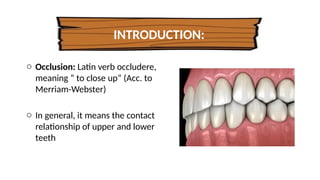
o Occlusion: Latin verb occludere,
meaning “ to close up” (Acc. to
Merriam-Webster)
o In general, it means the contact
relationship of upper and lower
teeth
OCCLUSION:
1. the act or process of closure or of
being closed or shut off;
2. the static relationship between
the incising or masticating
surfaces of the maxillary or
mandibular teeth or tooth
analogues.
ARTICULATION :
- in dentistry, the static and dynamic
contact relationship between the
occlusal surfaces of the teeth
during function.
DEFINITIONS AND TERMINOLOGIES:
 Retained by
periodontal ligaments.
Teeth receive individual
pressure of occlusion
and can move
independently.
 All teeth are on bases
seated on slippery
tissues.
 Move as a unit on their
base.
NATURAL OCCLUSION ARTIFICIAL OCCLUSION
DIFFERENCE
BETWEEN
NATURAL AND
ARTIFICIAL
OCCLUSION:
Malocclusion may be
uneventful for years.
Non-vertical force affect
only the teeth involved.
Incising with natural
teeth does not affect the
posterior teeth
Malocclusion evokes an
immediate response on
all the teeth and the
base.
Non-vertical force
effects all the teeth on
base and is usually
traumatic to the
supporting tissue.
Incising with artificial
teeth tends to
destabilize the denture.
NATURAL OCCLUSION ARTIFICIAL OCCLUSION
2nd
molar is the favoured
area for mastication.
Bilateral balance rarely
found.
Masticating in the 2nd
molar area will tilt the
denture so hard food
usually chewed on
bicuspid area.
(Sheppard)
Bilateral balancing is
usually considered for
base stability.
NATURAL OCCLUSION ARTIFICIAL OCCLUSION
Proprioceptive feedback
mechanism helps to
avoid prematurities and
interferences in order to
establish a stable
occlusion away from
centric relation.
5 to 175 pounds force
on natural teeth.
No such feed back
mechanism.
Prematurities if present,
will shift the base from
its foundation tissue.
9 pound in the incisor
area,
22- 24 pound in
premolar and molar
area.
NATURAL OCCLUSION ARTIFICIAL OCCLUSION
REQUIREMENTS OF COMPLETE DENTURE OCCLUSION:
1. Stability of occlusion at centric relation position and in area forward and
lateral to it.
2. Balanced occlusion contact bilaterally for all eccentric mandibular
movements.
3. Control horizontal force by reduction of buccolingual cusp height.
4. Functional lever balance by favorable
tooth-to-ridge crest position.
Contd…….
5. Unlock the cusp mesiodistally.
6. Cutting, penetrating and shearing efficiency of occlusal surfaces.
7. Anterior incisal clearance during all posterior masticatory activities.
8. Minimum occlusal contact areas for reduced pressure in
comminuting food. (Lingual contact area)
9. Sharp ridge or cusps and generous sluiceways to shear and shred food with
the minimum of force necessary.
INCISING UNIT
WORKING
UNIT
BALANCING
UNIT
THREE UNITS OF
OCCLUSION
INCISING UNITS
 Sharp
 No contact during mastication
 Flat incisal guidance
 Contact only during protrusive incising
function
 Should have horizontal overlap to allow
for base settling without interference.
WORKING OCCLUSAL UNITS:
 Efficient in cutting and grinding.
 Decreased bucco-lingual width.
 Function as group with simultaneous harmonious contacts.
 Over the ridge crest in masticating area
for lever balance.
 Should center work load near
anteroposterior center of the denture.
 Plane of occlusion as parallel as possible to mean foundation area.
BALANCING OCCLUSAL UNITS
 They should contact on the second molars when
the incising units contact in function.
 Should contact at the end of chewing cycle when
the working units contact.
 Should have smooth gliding contacts for lateral
and protrusive excursions.
AXIOMS FOR ARTIFICIAL OCCLUSION – BY SEARS
 Smaller area of occlusal surfaces,
smaller the forces transmitted
 Vertical forces on inclined surface
causes non vertical force
• Vertical forces on inclined
supporting tissue causes non
vertical force
• Vertical force outside & lateral to
the ridge creates tipping forces
on the bases
THEORIES OF OCCLUSION
o This theory proposed that teeth move in relation to each other as
guided by the condylar controls and the incisal point.
WGA Bonwill
BONWILL’S THEORY 1858
THEORY OF
EQUILATERAL
TRIANGLE.
4 inches
CONICAL THEORY ( R.E. HALL)
 The lower teeth move over the
surfaces of the upper teeth as over
the surfaces of a cone and with a
central axis of the cone tipped at a
45 degree angle to the occlusal
plane.
SPHERICAL THEORY
• Given by Monson (1918), derived from an idea by VonSpee.
• Lower teeth move over the
surface of the upper teeth
as over a surface of sphere
with a diameter of 8 inches,
center being at glabella
Balanced Occlusion
Lingualised Occlusion
Neutrocentric Occlusion
Monoplane Occlusion
Linear Occlusion
BALANCED OCCLUSION
Balanced occlusion :
Stable, simultaneous contact of the opposing upper and lower
teeth in centric relation position
and a continuous smooth bilateral gliding
from this position to any eccentric positions
within the normal range of mandibular function (Winkler)
The bilateral, simultaneous occlusal contact of the anterior and
posterior teeth in excursive movements;
CROSS-ARCH BALANCED ARTICULATION,
CROSS-TOOTH BALANCED ARTICULATION
Balanced occlusion :
Unique to CD
Does not occur with natural teeth
If occurs, considered as a premature contact on the
nonworking side; pathologic.
Balanced occlusion :
A stable base is the ultimate goal.
Total stability is not possible but control of the physical factors must
be understood.
TOTAL DENTURE BASE STABILITY
Balanced occlusion :
GREATER BALANCE
The wider and
larger ridge and
teeth closer to
the ridge.
The wider ridge
with narrow
bucco-lingual
width of the
teeth.
More lingual
(inside') the teeth,
are placed in
relation to the
ridge crest.
POOR LEVER
BALANCE
Balanced occlusion :
The small and narrow ridge with
teeth farther from the ridge
The narrow ridge with
wider teeth
More buccal (outside) placement of
the teeth
Balance may be :
UNILATERAL
OCCLUSAL BALANCE
This is present when
the occlusal surfaces of
teeth on one side
articulate
simultaneously, as a
group, with a smooth
uninterrupted glide.
BILATERAL OCCLUSAL
BALANCE
Simultaneous contact
on both side in centric
and eccentric
occlusion.
Minimum of three
contacts for
establishing a plane of
equilibrium.
PROTRUSIVE
OCCLUSAL BALANCE
When mandible moves
forward and the
occlusal contacts are
smooth and
simultaneous in the
posterior both on right
and left sides and on
the anterior.
It is slightly different from
bilateral balance in that it
requires a minimum of three
contacts, one on each side
posteriorly and one anteriorly,
and is dependent on the
interaction of the same factors
as bilateral occlusal balance.
1. The tooth size and position in relation to the
ridge size and shape.
2. The extent of denture base coverage.
3. Occlusal balance with stable contacts at the
retruded border position and in an area (long
centric) anterior to it.
Total concept of balanced complete denture occlusion must be
considered in terms of the following:
4. Right and left eccentric occlusal balance by simultaneous
contacts at the limit of functional and parafunctional activity.
5. Intermediate occlusal balance for all positions between centric
occlusion and all other functional or parafunctional excursions to
the right, left, and protrusive. This balance is probably the most
important, as it allows for smooth uninterrupted tooth contacts
in the dynamics of daily mandibular movements.
IN CENTRIC RELATION IN PROTRUSION
ANTERIOR TEETH no contact maxillary and mandibular
teeth contact
POSTERIOR TEETH Multiple bilateral
posterior contacts
Multiple bilateral posterior
contacts between maxillary
and mandibular teeth
LATERAL
EXCURSION
WORKING SIDE BALANCING SIDE
ANTERIOR
TEETH
Maxillary and
mandibular teeth
contact on working
side
maxillary and mandibular teeth may
contact on the balancing side.
POSTERIOR
TEETH
The buccal and lingual
cusps of maxillary and
mandibular posterior
teeth are in contact.
The lingual cusps of the maxillary
teeth will be in contact with the
inner inclines of the buccal cusps of
the mandibular teeth.
Traditionally, bilateral balance was achieved with
anatomic posterior denture teeth.
However, it can be achieved with non-anatomic teeth
using balancing ramps or by manipulating the
compensating curve.
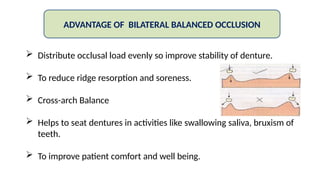
ADVANTAGE OF BILATERAL BALANCED OCCLUSION
 Distribute occlusal load evenly so improve stability of denture.
 To reduce ridge resorption and soreness.
 Cross-arch Balance
 Helps to seat dentures in activities like swallowing saliva, bruxism of
teeth.
 To improve patient comfort and well being.
DISADVANTAGE OF BILATERAL BALANCED OCCLUSION
 Tend to encourage lateral and protrusive grinding.
 Difficult to achieve where an increased vertical incisor overlap
is indicated.
 Tedious job to obtain BBO.
 Semi adjustable or fully adjustable articulator required.
CONCEPT S PROPOSED TO ATTAIN BALANCED OCCLUSION
GYSI’S CONCEPT
FRENCH’S CONCEPT
SEAR’S CONCEPT
PLEASURE’S CONCEPT BOUCHER’S CONCEPT
TRAPOZZANO’S CONCEPT
HANAU’S CONCEPT
FRUSH’S CONCEPT
LOTT’S CONCEPT LEVIN’S CONCEPT
FACTORS THAT AFFECT OCCLUSAL BALANCE
Rudolph L Hanau : 9 factors governing articulation of artificial teeth k/a
Laws Of Balanced Articulation
1. Horizontal condylar inclination
2. Compensating curve
3. Protrusive incisal guidance
4. Plane of orientation
5. Buccolingual inclination of tooth axis
6. Sagittal Condylar pathway
7. Sagittal Incisal guidance
8. Tooth alignment
9. Relative cusp height
Incisal
guidance
Plane of
inclination
Cuspal
inclination
Condylar
guidance
Compensatory
curve
HANAU’S QUINT
1. INCLINATION OF CONDYLAR
GUIDANCE
• FIRST factor of occlusion.
• Only factor which can be recorded from the patient.
• Recorded from the patient using protrusive registration.
• Mechanics: Increase in the condylar guidance will increase
the jaw separation during protrusion.
• So in patients with steep condylar guidance, incisal guidance
is decreased to prevent the posterior jaw separation.
INCLINATION OF CONDYLAR GUIDANCE
This factor of balanced occlusion cannot be modified, so, other
four factors need to be modified to compensate the effect of this
factor.
2. INCLINATION OF INCISAL GUIDANCE
o “ The influence of the contacting surfaces of the
mandibular and maxillary anterior teeth on mandibular
movements.” – GPT
o During protrusive movements, movement of mandibular teeth is guided
by the palatal surfaces of the maxillary teeth which is called incisal
guidance or protrusive path.
o It is the most important determinant of occlusion.
o It is determined by dentist during anterior try in.
o IG should be as shallow as esthetics and phonetics will permit to reduce
protrusive displacing forces.
Incisal Guidance Angle ↓ by
 ↑ Horizontal overlap
 ↓ Vertical overlap
This angle is set to 10˚ in CD and not exceeding 20˚
↑ Incisal Guidance Angle For CD
During protrusion,
 Upper denture drops at the back,
 Lower denture slides backward
 Also, Steep IG requires steep cusps , steep OP, or steep CC
 Steep inclined planes are detrimental to stability and
equilibrium of denture base
3. ORIENTATION OF THE OCCLUSAL PLANE
 Anteriorly : Height of lower cuspid , commissure of the mouth
 Posteriorly : height of retromolar pad, ala tragus line
 Value of acceptable change in occlusal plane : 10 degree.
 Too high plane of occlusion : increases leverage forces acting on
denture exponentially.
4. INCLINATION OF THE CUSP
 Mesiodistal cusp heights that interdigitate, lock the occlusion,
hence are eliminated.
 Only the buccolingual inclines need to be considered as
determinants of balanced occlusion.
 Steep cusps – more displacement of denture base
 Shallow cusps allow opposing dentition to slide through during
mastication
 Anatomic teeth are easier to balance than
nonanatomic teeth.
 Cuspal inclines should not be too steep as it
can increase lateral forces.
 It is possible to decrease cuspal height by
using compensating curves.
 In deep bite cases, steep incisal
guidance – jaw separation is
more during protrusion, - teeth
with high cuspal inclines
needed.
 In shallow bite cases, cuspal angle should be reduced to balance incisal
guidance.
5. COMPENSATING CURVE
“The anteroposterior and lateral curvatures in the alignment of the
occluding surfaces and incisal edges of artificial teeth which are
used to develop balanced occlusion”
 Determined by inclination of posterior teeth and their vertical
relationship to occlusal plane
 Two types
1. Anteroposterior compensating curve 2.Lateral compensative curve
ANTEROPOSTERIOR COMPENSATING CURVES
CURVE OF SPEE “ Anatomic curvature of the occlusal alignment of teeth
beginning at the tip of lower canine and following the buccal cusps of the
natural premolars and the molars, continuing to the anterior border of the
ramus” as described by Graf Von Spee
SIGNIFICANCE –
When the patient moves his mandible forward, the posterior
teeth set on this curve will continue to remain in contact thus
avoiding disocclusion.
LATERAL COMPENSATING CURVES
 The curve of occlusion in which each cusp and incisal edge
touches to a segment of the sphere of 8” in diameter with its
center at glabella”-GPT
1. Monson curve
2. Wilson curve
A. MONSON’S CURVE
 Runs across the palatal & buccal cusps of maxillary molars.
 Combination of curve of Spee and Wilson.
 Coronal and sagittal plane.
 Concave for maxillary arch and convex for mandibular arch.
SIGNIFICANCE:
 During lateral movements, mandibular lingual cusps on the
working side should slide along inner inclines of maxillary palatal
cusp. This forms a balance.
 Important for lateral balance of occlusion.
WILSON’S CURVE /ANTI-MONSON CURVE
 A curve of occlusion which is convex upwards- GPT9
 “Curve is concave above and convex below and they contact the buccal
and lingual cusp of the MANDIBULAR and MAXILLARY MOLARS,
respectively.
 The facial and lingual cusp tips on both sides of the dental arch
form the curve.
 This curve is followed when first premolars are arranged.
 The premolars are arranged according to this curve so that
they do not produce any interference to lateral movements.
Significance:
 Teeth aligned parallel to direction of medial pterygoid for
optimum resistance to masticatory forces.
 The elevated buccal cusps prevent food from going past the
occlusal table.
REVERSE CURVE
 A helicoid curve of occlusion that, when viewed in the frontal plane,
conforms to a curve in which the lingual surfaces of the teeth are more
coronal to the buccal surfaces.
 Originally developed to improve the stability of the lower denture
 Lateral view with 2nd PM & 1st molar follow the reverse curve
 Reverse curve is used in the bicuspid area for lever balance
 Modified by Max. pleasure to form pleasure curve
PLEASURE CURVE
 A helicoid curve of occlusion that, when viewed in the frontal plane,
conforms to a mediolaterally convex curve in which the lingual
surfaces of the teeth are more coronal to the buccal surfaces, except
for the last molars, which reverse that pattern.
 1st molar is horizontal, 2nd premolar is buccally tilted and 2nd molar
independently follows AP curve and tilted lingually.
 Runs from palatal cusp of 1st PM to the distobuccal cusp of 2nd
molar.
 2nd molar gives occlusal balance and 2nd PM gives lever balance.
HANAU ‘S QUINT
 Inter relationship of these 5 factors may be described by
Thielemann’s Formula
 In order to maintain a balanced occlusion :
DURING PROTRUSIVE EXCURSION
If incisal guidance is increased , posterior disocclusion will
occur:
To compensate ,
 A steep condylar path
requires a steep
compensatory curve
and vice a versa.
 Of these 5 factors, patient presents to us with Condylar
inclination.
 Occlusal plane cannot be altered substantially since functional
requirements dictate its position and orientation.
 The remaining 3 factors can be controlled by the dentist.
 Within the confines of esthetics and phonetics , minimize incisal
guidance in CD to minimize inclined tipping force
 Adjust remaining factors to maintain balance.
Prime gave the concept of “ENTER BOLUS, EXIT BALANCE”
 Introduction of food on one side will prevent the teeth of the
opposite side from contacting and hence occlusal balance is
impossible during mastication.
Is bilateral balanced
articulation necessary for
successful denture
treatment?
 Allen A. Brewer and Donald C. Hudson have shown that complete denture
teeth do contact at times during mastication. However, it will last for 17 min in
a day.
 Excursive movements such as swallowing saliva, closing to reseat dentures,
and bruxism performed by patients in between meals requires balancing.
 Hence if, balancing is not present, the base could shift or tilt during eccentric
movement leading to accelerated bone resorption.
 Hobkirk concluded that the artificial teeth come into contact for a
total of about 20 minutes a day during swallowing and briefly during
mastication.
During mastication the dentures comes in close contact or even
contact with each other, if any interference occurs instability will
result.
Because of these intermittent tooth contacts, Hobkirk believed
that complete dentures should have balanced occlusion
 Hickey et al, in contrast, thought that dentures make several thousand
contacts a day in both centric and eccentric positions with no food in
the mouth and that, even while chewing, the teeth cut through to
contact every few fractions of a second.
 Because of this, balanced occlusion is desirable to ensure even
pressure in all parts of the arch to maintain the stability of the
dentures while the mandible is in centric and eccentric positions.
OCCLUSION IN COMPLETE DENTURE
Subtitle
PART II
Resource Faculties
Prof.Dr. Pramita Suwal
Dr. Prakash K. Parajuli
Dr. Arati Sharma
Dr. Indra K. Limbu
Dr. Bishal Babu Basnet
Dr. Meena Mishra
Presenter
Dr. Nishesh Karna
Junior Resident
Department Of Prosthodontics and
Crown-bridge
LINGUALISED
OCCLUSION
This form of denture occlusion articulates the maxillary lingual
cusps with the mandibular occlusal surfaces in centric occlusion,
working and nonworking mandibular positions.-GPT9
LINGUALISED OCCLUSION
"Lingual Contact
Occlusion"
Alfred Gysi designed and patented “Cross-Bite Posterior
Teeth” on 1927.
By 1935, French had patented his “Modified Posterior Teeth”.
The maxillary teeth featured shallow fossae, while the
mandibular teeth displayed narrow, planar occlusal
surfaces.
According to Payne’s article, a mortar-and-pestle
arrangement was created via judicious recontouring of
30-degree teeth.
First, lingualized occlusion yielded cross-arch balance which result in
improved denture stability.
As a result, potentially damaging lateral forces were minimized.
Third, vertical forces could be centered upon the mandibular residual
ridges.
ACCORDING TO PAYNE, THIS ARRANGEMENT PROVIDED
DISTINCT ADVANTAGES.
• Lingualized occlusion is developed to
maintain the Esthetic , food penetration
‑
advantages of the anatomic form
While,
• Maintaining the mechanical freedom
( elimination of lateral interferences) of
the nonanatomic form.
Implant supported
‐
overdentures
Distal extensions
Intracoronal
attachments
Residual ridge
resoprtion
CHARACTERISTICS OF LINGUALIZED OCCLUSION
IN CENTRIC
Lingual cusps of maxillary posterior teeth must rest in central fossa of
opposing mandibular teeth.
No max. buccal cusp contacts in centric or in lateral excursions.
 Nonworking side contact is limited to
maxillary lingual cusps which in
contact with the inner inclines of the
mandibular buccal cusp in
movement.
 Working side contact is limited to
maxillary lingual cusps.
 Maxillary buccal cusps do not contact
mandibular teeth in centric or
eccentric positions.
IN ECCENTRIC
LINGUALIZED OPPOSING MONOPLANE
WITH BALANCING RAMP
o When lingualized maxillary teeth
oppose non anatomic teeth in the
mandible.
o In all lateral excursions, at least 3
points of contact bilaterally if bilateral
balanced occlusion is to be achieved.
 Maximised cutting efficiency with minimized
lateral forces.
 Improved esthetic over purely zero-degree
posterior teeth.
 Facilitates better bolus penetration than zero
degree teeth (mortar and pestle effect).
 Centralizes vertical forces and less
lateral/tipping force hence improved stability.
 Wear of maxillary lingual cusps and/or mandibular fossae rapidly results
in buccal and lingual contacts of equal intensity and increase the
likelihood of lateral displacement.
 In area where asthetic is of importance, well defined buccal cusp may be
needed.
TOOTH FORMS FOR LINGUALISED OCCLUSION
Maxillary anatomic (33°) Mandibular Teeth
Shallow cusped or Non anatomic
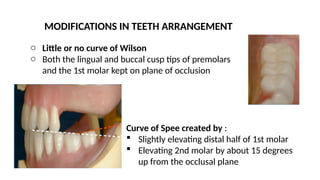
MODIFICATIONS IN TEETH ARRANGEMENT
o Little or no curve of Wilson
o Both the lingual and buccal cusp tips of premolars
and the 1st molar kept on plane of occlusion
o Curve of Spee created by :
 Slightly elevating distal half of 1st molar
 Elevating 2nd molar by about 15 degrees
up from the occlusal plane
o While positioning maxillary
posterior teeth, 1mm space
between lingual inclines of
buccal cusps of maxillary teeth
and buccal slopes of buccal
cusps of mandibular teeth
should be maintained.
o Lingual cusp tips in contact with
central fossae of opposing
mandibular teeth.
o Need not be arranged in cusp-
embrasure relationship.
An occlusal arrangement wherein the posterior teeth have
masticatory surfaces that lack any cuspal height.- GPT9
MONOPLANE OCCLUSION
 Sear (1949) : Monoplane occlusion
with posterior balancing ramps.
 Ramp functioned only during
eccentric movements.
 Devan (1954) : Monoplane
occlusion, but without balancing
ramp
CHARACTERISTICS
o Flat mesiodistally and buccolingually.
o Oriented parallel to upper and lower mean
foundation plane.
o No compensating curve incorporated.
o No vertical overlap of anterior teeth.
o Patient instructed not to incise with this
teeth.
MODIFICATIONS IN TEETH ARRANGEMENTS
No overbite
Overjet
Mandibular 2nd
molar set on the
slope area , called
“Skid Row”.
Maxillary 2nd
molar set 2mm
above the
occlusal plane.
Monoplane occlusion can be balanced to minimize tilting potential :
with balancing ramps
ADVANTAGES
o They are more adaptable to the unusual jaw relation : class II and
class III relations.
o Freedom to the patients, do not lock mandible in one position.
o They eliminate horizontal forces, more damaging than vertical
forces.
o Because the monoplane teeth occlude in more than one
relationship, so centric relation developed to an area instead of a
point.
o Simplified and less time-consuming technique
o Greater comfort and efficiency for a longer period.
o They accommodate better to the negative changes in the ridge
height that occur with aging.
DISADVANTAGES
o No vertical component to aid in shearing during mastication.
o Do not function efficiently unless cutting ridges and generous sluiceways
are provided.
o Patients may complain of lack of positive intercuspation position.
o Esthetically limited.
o Occlude only in 2D, but the mandible has a 3D movement .
o With purely flat occlusion , bilateral and protrusive balance is not possible
INDICATION
o Abnormal closure imbalance, pathosis,
trauma, neuromuscular disturbances.
o Posterior displaceable mucosa.
o Mutilated , tortuous ridges with an
excessive denture space .
o Ridges are flat or knife edge.
This may be disadvantageous in the patients exhibiting
parafunctional grinding habits.
Not indicated in cases where deep vertical overlap is required
and horizontal overlap must be limited : potential for anterior
interference.
NEUTROCENTRIC OCCLUSION
STABILITY
o M. M. De Van proposed the concept of “Neutrocentric Occlusion” 1954
2 key objectives :
Neutralization of cuspal
inclines
Centralization of occlusal
forces acting on the
denture foundation
Reduce the size and the
number of teeth
Abandon attempts to secure
balancing contacts in eccentric
positions beyond the range of the
“masticatory stroke.”
o Factors such as orientation of occlusal plane, compensating curve,
incisal guidance must be neutralized before neutralization of inclines.
Five factors that need to be considered in the relation of the teeth
to the denture foundations in Neutrocentric concept are: 1.
position,
2. proportion,
3. pitch,
4. form and
5. number.
 There is probably no single tooth factor as important as
position.
 Positioning posterior teeth in as central a position in reference
to the foundation as tongue function will allow in order to
provide greater stability for the denture. (perpendicular to the
support area)
1. POSITION
Devan recommended use of substitutes with a
reduced proportion, than the natural posterior teeth
(by 40 %).
Also horizontal and shearing stress was reduced
because friction between opposing surfaces was
decreased.
2. PROPORTION
3. PITCH
 Synonymous with inclination or tilt.
 Two-fold aims:
o To reduce pitch as found in the natural dentition and
o To parallel the pitch of the occlusal plane with that of the
maxillary and mandibular base planes.
 No compensating curve and no incisal guidance
FORM
 Flat teeth with no deflecting inclines.
 According to DeVan, there will be no
interference in movements of the mandible into
centric position if there is no projection above
the occlusal plane.
NUMBER
 Posterior teeth Number reduced from 8 to 6.
 This decreased magnitude of the occlusal force
and centralised it to second premolar & first
molar area
 Aids in stability by freeing the lower molar
incline of occlusion
ADVANTAGES DISADVANTAGES
Technique is simple. Least esthetic
By removing inclines, destructive lateral
forces are reduced.
May impair mastication because of poor
bolus penetration.
Provides an area of closure and does not
lock the mandible into a single position.
Hence, Ideal for
Geriatric patient with limited oral
dexterity.
Resorbed friable ridges.
Moving the teeth lingually and altering
their vertical position may not be
compatible with the tongue, lip and
cheek function.
Good for Class II (retrognathic), Class III
(prognathic) and crossbite cases.
Changes from the natural tooth factors are as follows:
(1) position is centralized,
(2) proportion is reduced,
(3) pitch is made parallel to the foundational base planes,
(4) The tooth form is cuspless,
(5) the number of teeth is reduced.
LINEAR
OCCLUSION
The occlusal arrangement of artificial teeth, as viewed in the
horizontal plane, wherein the masticatory surfaces of the mandibular
posterior artificial teeth have a straight, long, narrow occlusal form
resembling that of a line, usually articulating with opposing
monoplane teeth. –GPT9
LINEAR OCCLUSION
Lingualized occlusion has been likened to a
mortar and pestle, whereas linear occlusion
resembles a knife on a chopping block.
o One arch contains a bladed occlusal form and articulates
with flat monoplane.
o The posterior linear occlusal teeth are manufactured in
porcelain only. This allows the blades to be sharpened and
resist wear.
o The arch with the flat occlusal surfaces is milled on a plate
glass slab with 220- grit wet and dry sandpaper until all
posterior teeth are in contact on the horizontal plane.
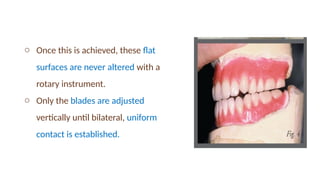
o Once this is achieved, these flat
surfaces are never altered with a
rotary instrument.
o Only the blades are adjusted
vertically until bilateral, uniform
contact is established.
o Linear occlusion was promoted as an occlusal scheme that led to
increased stability of denture bases by minimizing the lateral forces
applied to those bases.
Gronas and stouts : linear occlusion had the potential for creating the
smallest lateral force.
Massad : linear occlusion minimize the lateral force.
SALIENT FEATURES OF A ONE-
DIMENSIONAL OCCLUSION
Lower teeth on flat
occlusion plane
Lower posterior teeth
form a perfect straight
blade
Zero vertical overlap
between the anterior
teeth.
Lingual to buccal blade –
inter-occlusal crushing table
of 1 mm. approx.
In 1966 J. P. Frush described occlusion in geometric terms as :
o In cusp occlusion, the contact between the opposing surfaces of any
two teeth occurs in three dimensions. Width, length and depth of the
occluding surface.
o In flat plane occlusion, the contact occurs in two dimensions, the
width and the length of the occluding surface.
o The contact occurs only in one dimension which is the length
of the contacting blade (not surface).
o In linear occlusion, the requirement of greater stability may
determine the arch receiving the bladed teeth.
o The mandible most often requires greater stability, thus in this
case the bladed teeth are placed on the mandibular arch.
ADVANTAGES OVER EITHER TWO OR THREE-DIMENSIONAL OCCLUSION
Geometric simplicity of the occlusal contact.
The reduction in the amount of occluding surface reduces the potential
occlusal deflections which may occur with broader contacting surfaces
The minimal surface contact area between flat plane and bladed teeth
minimizes frictional resistance hence reduces denture base movement
Provides consistent vertical seating force in both centric and eccentric
movement : hence transverse force vectors are essentially eliminated.
IDEAL OCCLUSION IN SPECIFIC CONDITIONS
Resorbed or flabby ridge
Poor neuromuscular control
Ideal- lingualized
occlusion
Best scheme
monoplane occlusal
Chronic bruxer and clencher Monoplane occlusal scheme
Previous denture
If previous denture has anatomic
teeth which has not been severely
worn or ground , and the alveolar
ridge are not severely resorbed ,
anatomic teeth can be used
If teeth has been worn : flat non
anatomic teeth is better choice
Ridge relationship
Skeletal class II relationship requires
non anatomic posterior teeth or
cusps to open fossae teeth which
permit multiple contact position with
out interferences
SINGLE DENTURE OPPOSING NATURAL DENTITION: will require cusp
teeth
Since artificial teeth have their own morphology they do not occlude well
against natural teeth unless the natural teeth are recontoured via
enameloplasty to better receive the prosthetic teeth
In the case of maxillary denture opposing mandibular natural teeth the
most likely, practical occlusal scheme will use the mandibular buccal
cusps as the functional cusps opposing the maxillary fossae
Class I, II, III, IV RPD in maxilla CD in mandible or vice versa
- BALANCED OCCLUSION
IMMEDIATE DENTURES
Many dentulous patients, especially those with severely worn
dentitions, have a discrepancy between ICP (intercuspal position)
and RCP (retruded cuspal position in centric jaw relation)
Removal of the natural teeth will permit and encourage a retrusive
shift in mandibular posture. If so cusp fossae or monoplane
posterior denture teeth should be used
 Occlusion is a part of stomatognathic system
and not just setting of teeth.
 Occlusion in complete denture if based on
unsound principles, actually worsens the
physical, mental and social condition of old
patients rather than improving it.
 Various controversies in various concepts, theories and philosophies
are found.
 First concern is for the health and preservation of the supporting
structures.
 Apply all factors that favor the stability of base and design the
occlusion to function optimally in relation to the forces of
mastication.
There is nothing called ideal occlusion before
the great variable Human factor.
• DeVan, M. M. (1954). "The concept of neutrocentric occlusion as related to
denture stability." The Journal of the American Dental Association 48(2): 165-169.
• Essentials of complete denture prosthodontics , second edition , Sheldon Winkler
• Ortman, H. R. (1971). "The role of occlusion in preservation and prevention in
complete denture prosthodontics." The Journal of Prosthetic Dentistry 25(2): 121-
138.
• Trapozzano, V. R. (1960). "Tests of balanced and nonbalanced occlusions." Journal
of Prosthetic Dentistry 10(3): 476-487.
REFERENCES
• Anna M. Dubojska, et al. (1998) The importance of occlusal balance in the control
of complete dentures. Quintessence International 29(6): 389-394.
• Peter E. Dawson. Functional occlusion, from TMJ to Smile Design.
• www. Asian dental academy.
OCCLUSION IN COMPLETE DENTURE presentation.pptx

OCCLUSION IN COMPLETE DENTURE presentation.pptx

  • 1.
    OCCLUSION IN COMPLETEDENTURE Subtitle
  • 2.
    Resource Faculties Prof. Dr.Pramita Suwal Dr. Prakash K. Parajuli Dr. Arati Sharma Dr. Indra K. Limbu Dr. Bishal Babu Basnet Dr. Meena Mishra Presenter Dr. Nishesh karna Junior Resident Department Of Prosthodontics and Crown-bridge
  • 3.
     Introduction  Requirementsof complete denture occlusion  Theories of occlusion  Concepts of occlusion  Factors that affect the occlusal balance  Neutrocentric occlusion  Lingualized articulation  Monoplane occlusion  Linear occlusion  Summary and conclusion  References
  • 4.
    INTRODUCTION: o Occlusion: Latinverb occludere, meaning “ to close up” (Acc. to Merriam-Webster) o In general, it means the contact relationship of upper and lower teeth
  • 5.
    OCCLUSION: 1. the actor process of closure or of being closed or shut off; 2. the static relationship between the incising or masticating surfaces of the maxillary or mandibular teeth or tooth analogues. ARTICULATION : - in dentistry, the static and dynamic contact relationship between the occlusal surfaces of the teeth during function. DEFINITIONS AND TERMINOLOGIES:
  • 6.
     Retained by periodontalligaments. Teeth receive individual pressure of occlusion and can move independently.  All teeth are on bases seated on slippery tissues.  Move as a unit on their base. NATURAL OCCLUSION ARTIFICIAL OCCLUSION DIFFERENCE BETWEEN NATURAL AND ARTIFICIAL OCCLUSION:
  • 7.
    Malocclusion may be uneventfulfor years. Non-vertical force affect only the teeth involved. Incising with natural teeth does not affect the posterior teeth Malocclusion evokes an immediate response on all the teeth and the base. Non-vertical force effects all the teeth on base and is usually traumatic to the supporting tissue. Incising with artificial teeth tends to destabilize the denture. NATURAL OCCLUSION ARTIFICIAL OCCLUSION
  • 8.
    2nd molar is thefavoured area for mastication. Bilateral balance rarely found. Masticating in the 2nd molar area will tilt the denture so hard food usually chewed on bicuspid area. (Sheppard) Bilateral balancing is usually considered for base stability. NATURAL OCCLUSION ARTIFICIAL OCCLUSION
  • 9.
    Proprioceptive feedback mechanism helpsto avoid prematurities and interferences in order to establish a stable occlusion away from centric relation. 5 to 175 pounds force on natural teeth. No such feed back mechanism. Prematurities if present, will shift the base from its foundation tissue. 9 pound in the incisor area, 22- 24 pound in premolar and molar area. NATURAL OCCLUSION ARTIFICIAL OCCLUSION
  • 10.
    REQUIREMENTS OF COMPLETEDENTURE OCCLUSION: 1. Stability of occlusion at centric relation position and in area forward and lateral to it. 2. Balanced occlusion contact bilaterally for all eccentric mandibular movements. 3. Control horizontal force by reduction of buccolingual cusp height. 4. Functional lever balance by favorable tooth-to-ridge crest position.
  • 11.
    Contd……. 5. Unlock thecusp mesiodistally. 6. Cutting, penetrating and shearing efficiency of occlusal surfaces. 7. Anterior incisal clearance during all posterior masticatory activities. 8. Minimum occlusal contact areas for reduced pressure in comminuting food. (Lingual contact area) 9. Sharp ridge or cusps and generous sluiceways to shear and shred food with the minimum of force necessary.
  • 12.
  • 13.
    INCISING UNITS  Sharp No contact during mastication  Flat incisal guidance  Contact only during protrusive incising function  Should have horizontal overlap to allow for base settling without interference.
  • 14.
    WORKING OCCLUSAL UNITS: Efficient in cutting and grinding.  Decreased bucco-lingual width.  Function as group with simultaneous harmonious contacts.  Over the ridge crest in masticating area for lever balance.  Should center work load near anteroposterior center of the denture.  Plane of occlusion as parallel as possible to mean foundation area.
  • 15.
    BALANCING OCCLUSAL UNITS They should contact on the second molars when the incising units contact in function.  Should contact at the end of chewing cycle when the working units contact.  Should have smooth gliding contacts for lateral and protrusive excursions.
  • 16.
    AXIOMS FOR ARTIFICIALOCCLUSION – BY SEARS  Smaller area of occlusal surfaces, smaller the forces transmitted  Vertical forces on inclined surface causes non vertical force
  • 17.
    • Vertical forceson inclined supporting tissue causes non vertical force • Vertical force outside & lateral to the ridge creates tipping forces on the bases
  • 18.
    THEORIES OF OCCLUSION oThis theory proposed that teeth move in relation to each other as guided by the condylar controls and the incisal point. WGA Bonwill BONWILL’S THEORY 1858 THEORY OF EQUILATERAL TRIANGLE. 4 inches
  • 19.
    CONICAL THEORY (R.E. HALL)  The lower teeth move over the surfaces of the upper teeth as over the surfaces of a cone and with a central axis of the cone tipped at a 45 degree angle to the occlusal plane.
  • 20.
    SPHERICAL THEORY • Givenby Monson (1918), derived from an idea by VonSpee. • Lower teeth move over the surface of the upper teeth as over a surface of sphere with a diameter of 8 inches, center being at glabella
  • 21.
    Balanced Occlusion Lingualised Occlusion NeutrocentricOcclusion Monoplane Occlusion Linear Occlusion
  • 22.
  • 23.
    Balanced occlusion : Stable,simultaneous contact of the opposing upper and lower teeth in centric relation position and a continuous smooth bilateral gliding from this position to any eccentric positions within the normal range of mandibular function (Winkler)
  • 24.
    The bilateral, simultaneousocclusal contact of the anterior and posterior teeth in excursive movements; CROSS-ARCH BALANCED ARTICULATION, CROSS-TOOTH BALANCED ARTICULATION
  • 25.
    Balanced occlusion : Uniqueto CD Does not occur with natural teeth If occurs, considered as a premature contact on the nonworking side; pathologic.
  • 26.
    Balanced occlusion : Astable base is the ultimate goal. Total stability is not possible but control of the physical factors must be understood.
  • 27.
  • 28.
    Balanced occlusion : GREATERBALANCE The wider and larger ridge and teeth closer to the ridge. The wider ridge with narrow bucco-lingual width of the teeth. More lingual (inside') the teeth, are placed in relation to the ridge crest.
  • 29.
    POOR LEVER BALANCE Balanced occlusion: The small and narrow ridge with teeth farther from the ridge The narrow ridge with wider teeth More buccal (outside) placement of the teeth
  • 30.
    Balance may be: UNILATERAL OCCLUSAL BALANCE This is present when the occlusal surfaces of teeth on one side articulate simultaneously, as a group, with a smooth uninterrupted glide. BILATERAL OCCLUSAL BALANCE Simultaneous contact on both side in centric and eccentric occlusion. Minimum of three contacts for establishing a plane of equilibrium. PROTRUSIVE OCCLUSAL BALANCE When mandible moves forward and the occlusal contacts are smooth and simultaneous in the posterior both on right and left sides and on the anterior.
  • 31.
    It is slightlydifferent from bilateral balance in that it requires a minimum of three contacts, one on each side posteriorly and one anteriorly, and is dependent on the interaction of the same factors as bilateral occlusal balance.
  • 32.
    1. The toothsize and position in relation to the ridge size and shape. 2. The extent of denture base coverage. 3. Occlusal balance with stable contacts at the retruded border position and in an area (long centric) anterior to it. Total concept of balanced complete denture occlusion must be considered in terms of the following:
  • 33.
    4. Right andleft eccentric occlusal balance by simultaneous contacts at the limit of functional and parafunctional activity.
  • 34.
    5. Intermediate occlusalbalance for all positions between centric occlusion and all other functional or parafunctional excursions to the right, left, and protrusive. This balance is probably the most important, as it allows for smooth uninterrupted tooth contacts in the dynamics of daily mandibular movements.
  • 35.
    IN CENTRIC RELATIONIN PROTRUSION ANTERIOR TEETH no contact maxillary and mandibular teeth contact POSTERIOR TEETH Multiple bilateral posterior contacts Multiple bilateral posterior contacts between maxillary and mandibular teeth
  • 36.
    LATERAL EXCURSION WORKING SIDE BALANCINGSIDE ANTERIOR TEETH Maxillary and mandibular teeth contact on working side maxillary and mandibular teeth may contact on the balancing side. POSTERIOR TEETH The buccal and lingual cusps of maxillary and mandibular posterior teeth are in contact. The lingual cusps of the maxillary teeth will be in contact with the inner inclines of the buccal cusps of the mandibular teeth.
  • 37.
    Traditionally, bilateral balancewas achieved with anatomic posterior denture teeth. However, it can be achieved with non-anatomic teeth using balancing ramps or by manipulating the compensating curve.
  • 38.
    ADVANTAGE OF BILATERALBALANCED OCCLUSION  Distribute occlusal load evenly so improve stability of denture.  To reduce ridge resorption and soreness.  Cross-arch Balance  Helps to seat dentures in activities like swallowing saliva, bruxism of teeth.  To improve patient comfort and well being.
  • 39.
    DISADVANTAGE OF BILATERALBALANCED OCCLUSION  Tend to encourage lateral and protrusive grinding.  Difficult to achieve where an increased vertical incisor overlap is indicated.  Tedious job to obtain BBO.  Semi adjustable or fully adjustable articulator required.
  • 40.
    CONCEPT S PROPOSEDTO ATTAIN BALANCED OCCLUSION GYSI’S CONCEPT FRENCH’S CONCEPT SEAR’S CONCEPT PLEASURE’S CONCEPT BOUCHER’S CONCEPT TRAPOZZANO’S CONCEPT HANAU’S CONCEPT FRUSH’S CONCEPT LOTT’S CONCEPT LEVIN’S CONCEPT
  • 41.
    FACTORS THAT AFFECTOCCLUSAL BALANCE Rudolph L Hanau : 9 factors governing articulation of artificial teeth k/a Laws Of Balanced Articulation 1. Horizontal condylar inclination 2. Compensating curve 3. Protrusive incisal guidance 4. Plane of orientation 5. Buccolingual inclination of tooth axis 6. Sagittal Condylar pathway 7. Sagittal Incisal guidance 8. Tooth alignment 9. Relative cusp height
  • 42.
  • 43.
    1. INCLINATION OFCONDYLAR GUIDANCE • FIRST factor of occlusion. • Only factor which can be recorded from the patient. • Recorded from the patient using protrusive registration. • Mechanics: Increase in the condylar guidance will increase the jaw separation during protrusion. • So in patients with steep condylar guidance, incisal guidance is decreased to prevent the posterior jaw separation.
  • 44.
    INCLINATION OF CONDYLARGUIDANCE This factor of balanced occlusion cannot be modified, so, other four factors need to be modified to compensate the effect of this factor.
  • 45.
    2. INCLINATION OFINCISAL GUIDANCE o “ The influence of the contacting surfaces of the mandibular and maxillary anterior teeth on mandibular movements.” – GPT o During protrusive movements, movement of mandibular teeth is guided by the palatal surfaces of the maxillary teeth which is called incisal guidance or protrusive path.
  • 46.
    o It isthe most important determinant of occlusion. o It is determined by dentist during anterior try in. o IG should be as shallow as esthetics and phonetics will permit to reduce protrusive displacing forces.
  • 47.
    Incisal Guidance Angle↓ by  ↑ Horizontal overlap  ↓ Vertical overlap This angle is set to 10˚ in CD and not exceeding 20˚
  • 48.
    ↑ Incisal GuidanceAngle For CD During protrusion,  Upper denture drops at the back,  Lower denture slides backward  Also, Steep IG requires steep cusps , steep OP, or steep CC  Steep inclined planes are detrimental to stability and equilibrium of denture base
  • 49.
    3. ORIENTATION OFTHE OCCLUSAL PLANE  Anteriorly : Height of lower cuspid , commissure of the mouth  Posteriorly : height of retromolar pad, ala tragus line  Value of acceptable change in occlusal plane : 10 degree.  Too high plane of occlusion : increases leverage forces acting on denture exponentially.
  • 50.
    4. INCLINATION OFTHE CUSP  Mesiodistal cusp heights that interdigitate, lock the occlusion, hence are eliminated.  Only the buccolingual inclines need to be considered as determinants of balanced occlusion.  Steep cusps – more displacement of denture base  Shallow cusps allow opposing dentition to slide through during mastication
  • 51.
     Anatomic teethare easier to balance than nonanatomic teeth.  Cuspal inclines should not be too steep as it can increase lateral forces.  It is possible to decrease cuspal height by using compensating curves.
  • 52.
     In deepbite cases, steep incisal guidance – jaw separation is more during protrusion, - teeth with high cuspal inclines needed.  In shallow bite cases, cuspal angle should be reduced to balance incisal guidance.
  • 53.
    5. COMPENSATING CURVE “Theanteroposterior and lateral curvatures in the alignment of the occluding surfaces and incisal edges of artificial teeth which are used to develop balanced occlusion”
  • 54.
     Determined byinclination of posterior teeth and their vertical relationship to occlusal plane  Two types 1. Anteroposterior compensating curve 2.Lateral compensative curve
  • 55.
    ANTEROPOSTERIOR COMPENSATING CURVES CURVEOF SPEE “ Anatomic curvature of the occlusal alignment of teeth beginning at the tip of lower canine and following the buccal cusps of the natural premolars and the molars, continuing to the anterior border of the ramus” as described by Graf Von Spee
  • 56.
    SIGNIFICANCE – When thepatient moves his mandible forward, the posterior teeth set on this curve will continue to remain in contact thus avoiding disocclusion.
  • 57.
    LATERAL COMPENSATING CURVES The curve of occlusion in which each cusp and incisal edge touches to a segment of the sphere of 8” in diameter with its center at glabella”-GPT 1. Monson curve 2. Wilson curve
  • 58.
    A. MONSON’S CURVE Runs across the palatal & buccal cusps of maxillary molars.  Combination of curve of Spee and Wilson.  Coronal and sagittal plane.  Concave for maxillary arch and convex for mandibular arch.
  • 59.
    SIGNIFICANCE:  During lateralmovements, mandibular lingual cusps on the working side should slide along inner inclines of maxillary palatal cusp. This forms a balance.  Important for lateral balance of occlusion.
  • 60.
    WILSON’S CURVE /ANTI-MONSONCURVE  A curve of occlusion which is convex upwards- GPT9  “Curve is concave above and convex below and they contact the buccal and lingual cusp of the MANDIBULAR and MAXILLARY MOLARS, respectively.
  • 61.
     The facialand lingual cusp tips on both sides of the dental arch form the curve.  This curve is followed when first premolars are arranged.  The premolars are arranged according to this curve so that they do not produce any interference to lateral movements.
  • 62.
    Significance:  Teeth alignedparallel to direction of medial pterygoid for optimum resistance to masticatory forces.  The elevated buccal cusps prevent food from going past the occlusal table.
  • 63.
    REVERSE CURVE  Ahelicoid curve of occlusion that, when viewed in the frontal plane, conforms to a curve in which the lingual surfaces of the teeth are more coronal to the buccal surfaces.  Originally developed to improve the stability of the lower denture
  • 64.
     Lateral viewwith 2nd PM & 1st molar follow the reverse curve  Reverse curve is used in the bicuspid area for lever balance  Modified by Max. pleasure to form pleasure curve
  • 65.
    PLEASURE CURVE  Ahelicoid curve of occlusion that, when viewed in the frontal plane, conforms to a mediolaterally convex curve in which the lingual surfaces of the teeth are more coronal to the buccal surfaces, except for the last molars, which reverse that pattern.
  • 66.
     1st molaris horizontal, 2nd premolar is buccally tilted and 2nd molar independently follows AP curve and tilted lingually.  Runs from palatal cusp of 1st PM to the distobuccal cusp of 2nd molar.  2nd molar gives occlusal balance and 2nd PM gives lever balance.
  • 67.
    HANAU ‘S QUINT Inter relationship of these 5 factors may be described by Thielemann’s Formula  In order to maintain a balanced occlusion :
  • 68.
  • 69.
    If incisal guidanceis increased , posterior disocclusion will occur:
  • 70.
  • 71.
     A steepcondylar path requires a steep compensatory curve and vice a versa.
  • 72.
     Of these5 factors, patient presents to us with Condylar inclination.  Occlusal plane cannot be altered substantially since functional requirements dictate its position and orientation.
  • 73.
     The remaining3 factors can be controlled by the dentist.  Within the confines of esthetics and phonetics , minimize incisal guidance in CD to minimize inclined tipping force  Adjust remaining factors to maintain balance.
  • 74.
    Prime gave theconcept of “ENTER BOLUS, EXIT BALANCE”  Introduction of food on one side will prevent the teeth of the opposite side from contacting and hence occlusal balance is impossible during mastication.
  • 75.
    Is bilateral balanced articulationnecessary for successful denture treatment?
  • 76.
     Allen A.Brewer and Donald C. Hudson have shown that complete denture teeth do contact at times during mastication. However, it will last for 17 min in a day.  Excursive movements such as swallowing saliva, closing to reseat dentures, and bruxism performed by patients in between meals requires balancing.  Hence if, balancing is not present, the base could shift or tilt during eccentric movement leading to accelerated bone resorption.
  • 77.
     Hobkirk concludedthat the artificial teeth come into contact for a total of about 20 minutes a day during swallowing and briefly during mastication. During mastication the dentures comes in close contact or even contact with each other, if any interference occurs instability will result. Because of these intermittent tooth contacts, Hobkirk believed that complete dentures should have balanced occlusion
  • 78.
     Hickey etal, in contrast, thought that dentures make several thousand contacts a day in both centric and eccentric positions with no food in the mouth and that, even while chewing, the teeth cut through to contact every few fractions of a second.  Because of this, balanced occlusion is desirable to ensure even pressure in all parts of the arch to maintain the stability of the dentures while the mandible is in centric and eccentric positions.
  • 82.
    OCCLUSION IN COMPLETEDENTURE Subtitle PART II
  • 83.
    Resource Faculties Prof.Dr. PramitaSuwal Dr. Prakash K. Parajuli Dr. Arati Sharma Dr. Indra K. Limbu Dr. Bishal Babu Basnet Dr. Meena Mishra Presenter Dr. Nishesh Karna Junior Resident Department Of Prosthodontics and Crown-bridge
  • 84.
  • 85.
    This form ofdenture occlusion articulates the maxillary lingual cusps with the mandibular occlusal surfaces in centric occlusion, working and nonworking mandibular positions.-GPT9 LINGUALISED OCCLUSION
  • 86.
  • 87.
    Alfred Gysi designedand patented “Cross-Bite Posterior Teeth” on 1927. By 1935, French had patented his “Modified Posterior Teeth”. The maxillary teeth featured shallow fossae, while the mandibular teeth displayed narrow, planar occlusal surfaces. According to Payne’s article, a mortar-and-pestle arrangement was created via judicious recontouring of 30-degree teeth.
  • 88.
    First, lingualized occlusionyielded cross-arch balance which result in improved denture stability. As a result, potentially damaging lateral forces were minimized. Third, vertical forces could be centered upon the mandibular residual ridges. ACCORDING TO PAYNE, THIS ARRANGEMENT PROVIDED DISTINCT ADVANTAGES.
  • 89.
    • Lingualized occlusionis developed to maintain the Esthetic , food penetration ‑ advantages of the anatomic form While, • Maintaining the mechanical freedom ( elimination of lateral interferences) of the nonanatomic form.
  • 90.
  • 91.
    CHARACTERISTICS OF LINGUALIZEDOCCLUSION IN CENTRIC Lingual cusps of maxillary posterior teeth must rest in central fossa of opposing mandibular teeth. No max. buccal cusp contacts in centric or in lateral excursions.
  • 92.
     Nonworking sidecontact is limited to maxillary lingual cusps which in contact with the inner inclines of the mandibular buccal cusp in movement.  Working side contact is limited to maxillary lingual cusps.  Maxillary buccal cusps do not contact mandibular teeth in centric or eccentric positions. IN ECCENTRIC
  • 93.
    LINGUALIZED OPPOSING MONOPLANE WITHBALANCING RAMP o When lingualized maxillary teeth oppose non anatomic teeth in the mandible. o In all lateral excursions, at least 3 points of contact bilaterally if bilateral balanced occlusion is to be achieved.
  • 94.
     Maximised cuttingefficiency with minimized lateral forces.  Improved esthetic over purely zero-degree posterior teeth.  Facilitates better bolus penetration than zero degree teeth (mortar and pestle effect).  Centralizes vertical forces and less lateral/tipping force hence improved stability.
  • 95.
     Wear ofmaxillary lingual cusps and/or mandibular fossae rapidly results in buccal and lingual contacts of equal intensity and increase the likelihood of lateral displacement.  In area where asthetic is of importance, well defined buccal cusp may be needed.
  • 96.
    TOOTH FORMS FORLINGUALISED OCCLUSION Maxillary anatomic (33°) Mandibular Teeth Shallow cusped or Non anatomic
  • 97.
    MODIFICATIONS IN TEETHARRANGEMENT o Little or no curve of Wilson o Both the lingual and buccal cusp tips of premolars and the 1st molar kept on plane of occlusion o Curve of Spee created by :  Slightly elevating distal half of 1st molar  Elevating 2nd molar by about 15 degrees up from the occlusal plane
  • 98.
    o While positioningmaxillary posterior teeth, 1mm space between lingual inclines of buccal cusps of maxillary teeth and buccal slopes of buccal cusps of mandibular teeth should be maintained.
  • 99.
    o Lingual cusptips in contact with central fossae of opposing mandibular teeth. o Need not be arranged in cusp- embrasure relationship.
  • 101.
    An occlusal arrangementwherein the posterior teeth have masticatory surfaces that lack any cuspal height.- GPT9 MONOPLANE OCCLUSION
  • 102.
     Sear (1949): Monoplane occlusion with posterior balancing ramps.  Ramp functioned only during eccentric movements.  Devan (1954) : Monoplane occlusion, but without balancing ramp
  • 103.
    CHARACTERISTICS o Flat mesiodistallyand buccolingually. o Oriented parallel to upper and lower mean foundation plane. o No compensating curve incorporated. o No vertical overlap of anterior teeth. o Patient instructed not to incise with this teeth.
  • 104.
    MODIFICATIONS IN TEETHARRANGEMENTS No overbite Overjet Mandibular 2nd molar set on the slope area , called “Skid Row”. Maxillary 2nd molar set 2mm above the occlusal plane.
  • 105.
    Monoplane occlusion canbe balanced to minimize tilting potential : with balancing ramps
  • 106.
    ADVANTAGES o They aremore adaptable to the unusual jaw relation : class II and class III relations. o Freedom to the patients, do not lock mandible in one position. o They eliminate horizontal forces, more damaging than vertical forces.
  • 107.
    o Because themonoplane teeth occlude in more than one relationship, so centric relation developed to an area instead of a point. o Simplified and less time-consuming technique o Greater comfort and efficiency for a longer period. o They accommodate better to the negative changes in the ridge height that occur with aging.
  • 108.
    DISADVANTAGES o No verticalcomponent to aid in shearing during mastication. o Do not function efficiently unless cutting ridges and generous sluiceways are provided. o Patients may complain of lack of positive intercuspation position. o Esthetically limited. o Occlude only in 2D, but the mandible has a 3D movement . o With purely flat occlusion , bilateral and protrusive balance is not possible
  • 109.
    INDICATION o Abnormal closureimbalance, pathosis, trauma, neuromuscular disturbances. o Posterior displaceable mucosa. o Mutilated , tortuous ridges with an excessive denture space . o Ridges are flat or knife edge.
  • 110.
    This may bedisadvantageous in the patients exhibiting parafunctional grinding habits. Not indicated in cases where deep vertical overlap is required and horizontal overlap must be limited : potential for anterior interference.
  • 111.
  • 112.
    o M. M.De Van proposed the concept of “Neutrocentric Occlusion” 1954 2 key objectives : Neutralization of cuspal inclines Centralization of occlusal forces acting on the denture foundation
  • 113.
    Reduce the sizeand the number of teeth Abandon attempts to secure balancing contacts in eccentric positions beyond the range of the “masticatory stroke.” o Factors such as orientation of occlusal plane, compensating curve, incisal guidance must be neutralized before neutralization of inclines.
  • 114.
    Five factors thatneed to be considered in the relation of the teeth to the denture foundations in Neutrocentric concept are: 1. position, 2. proportion, 3. pitch, 4. form and 5. number.
  • 115.
     There isprobably no single tooth factor as important as position.  Positioning posterior teeth in as central a position in reference to the foundation as tongue function will allow in order to provide greater stability for the denture. (perpendicular to the support area) 1. POSITION
  • 116.
    Devan recommended useof substitutes with a reduced proportion, than the natural posterior teeth (by 40 %). Also horizontal and shearing stress was reduced because friction between opposing surfaces was decreased. 2. PROPORTION
  • 117.
    3. PITCH  Synonymouswith inclination or tilt.  Two-fold aims: o To reduce pitch as found in the natural dentition and o To parallel the pitch of the occlusal plane with that of the maxillary and mandibular base planes.  No compensating curve and no incisal guidance
  • 118.
    FORM  Flat teethwith no deflecting inclines.  According to DeVan, there will be no interference in movements of the mandible into centric position if there is no projection above the occlusal plane.
  • 119.
    NUMBER  Posterior teethNumber reduced from 8 to 6.  This decreased magnitude of the occlusal force and centralised it to second premolar & first molar area  Aids in stability by freeing the lower molar incline of occlusion
  • 120.
    ADVANTAGES DISADVANTAGES Technique issimple. Least esthetic By removing inclines, destructive lateral forces are reduced. May impair mastication because of poor bolus penetration. Provides an area of closure and does not lock the mandible into a single position. Hence, Ideal for Geriatric patient with limited oral dexterity. Resorbed friable ridges. Moving the teeth lingually and altering their vertical position may not be compatible with the tongue, lip and cheek function. Good for Class II (retrognathic), Class III (prognathic) and crossbite cases.
  • 121.
    Changes from thenatural tooth factors are as follows: (1) position is centralized, (2) proportion is reduced, (3) pitch is made parallel to the foundational base planes, (4) The tooth form is cuspless, (5) the number of teeth is reduced.
  • 122.
  • 123.
    The occlusal arrangementof artificial teeth, as viewed in the horizontal plane, wherein the masticatory surfaces of the mandibular posterior artificial teeth have a straight, long, narrow occlusal form resembling that of a line, usually articulating with opposing monoplane teeth. –GPT9 LINEAR OCCLUSION
  • 124.
    Lingualized occlusion hasbeen likened to a mortar and pestle, whereas linear occlusion resembles a knife on a chopping block.
  • 125.
    o One archcontains a bladed occlusal form and articulates with flat monoplane. o The posterior linear occlusal teeth are manufactured in porcelain only. This allows the blades to be sharpened and resist wear. o The arch with the flat occlusal surfaces is milled on a plate glass slab with 220- grit wet and dry sandpaper until all posterior teeth are in contact on the horizontal plane.
  • 126.
    o Once thisis achieved, these flat surfaces are never altered with a rotary instrument. o Only the blades are adjusted vertically until bilateral, uniform contact is established.
  • 127.
    o Linear occlusionwas promoted as an occlusal scheme that led to increased stability of denture bases by minimizing the lateral forces applied to those bases. Gronas and stouts : linear occlusion had the potential for creating the smallest lateral force. Massad : linear occlusion minimize the lateral force.
  • 128.
    SALIENT FEATURES OFA ONE- DIMENSIONAL OCCLUSION Lower teeth on flat occlusion plane Lower posterior teeth form a perfect straight blade Zero vertical overlap between the anterior teeth. Lingual to buccal blade – inter-occlusal crushing table of 1 mm. approx.
  • 129.
    In 1966 J.P. Frush described occlusion in geometric terms as : o In cusp occlusion, the contact between the opposing surfaces of any two teeth occurs in three dimensions. Width, length and depth of the occluding surface.
  • 130.
    o In flatplane occlusion, the contact occurs in two dimensions, the width and the length of the occluding surface.
  • 131.
    o The contactoccurs only in one dimension which is the length of the contacting blade (not surface).
  • 132.
    o In linearocclusion, the requirement of greater stability may determine the arch receiving the bladed teeth. o The mandible most often requires greater stability, thus in this case the bladed teeth are placed on the mandibular arch.
  • 133.
    ADVANTAGES OVER EITHERTWO OR THREE-DIMENSIONAL OCCLUSION Geometric simplicity of the occlusal contact. The reduction in the amount of occluding surface reduces the potential occlusal deflections which may occur with broader contacting surfaces The minimal surface contact area between flat plane and bladed teeth minimizes frictional resistance hence reduces denture base movement Provides consistent vertical seating force in both centric and eccentric movement : hence transverse force vectors are essentially eliminated.
  • 135.
    IDEAL OCCLUSION INSPECIFIC CONDITIONS
  • 136.
    Resorbed or flabbyridge Poor neuromuscular control Ideal- lingualized occlusion Best scheme monoplane occlusal
  • 137.
    Chronic bruxer andclencher Monoplane occlusal scheme
  • 138.
    Previous denture If previousdenture has anatomic teeth which has not been severely worn or ground , and the alveolar ridge are not severely resorbed , anatomic teeth can be used If teeth has been worn : flat non anatomic teeth is better choice Ridge relationship Skeletal class II relationship requires non anatomic posterior teeth or cusps to open fossae teeth which permit multiple contact position with out interferences
  • 139.
    SINGLE DENTURE OPPOSINGNATURAL DENTITION: will require cusp teeth Since artificial teeth have their own morphology they do not occlude well against natural teeth unless the natural teeth are recontoured via enameloplasty to better receive the prosthetic teeth In the case of maxillary denture opposing mandibular natural teeth the most likely, practical occlusal scheme will use the mandibular buccal cusps as the functional cusps opposing the maxillary fossae
  • 140.
    Class I, II,III, IV RPD in maxilla CD in mandible or vice versa - BALANCED OCCLUSION
  • 141.
    IMMEDIATE DENTURES Many dentulouspatients, especially those with severely worn dentitions, have a discrepancy between ICP (intercuspal position) and RCP (retruded cuspal position in centric jaw relation) Removal of the natural teeth will permit and encourage a retrusive shift in mandibular posture. If so cusp fossae or monoplane posterior denture teeth should be used
  • 142.
     Occlusion isa part of stomatognathic system and not just setting of teeth.  Occlusion in complete denture if based on unsound principles, actually worsens the physical, mental and social condition of old patients rather than improving it.
  • 143.
     Various controversiesin various concepts, theories and philosophies are found.  First concern is for the health and preservation of the supporting structures.  Apply all factors that favor the stability of base and design the occlusion to function optimally in relation to the forces of mastication.
  • 144.
    There is nothingcalled ideal occlusion before the great variable Human factor.
  • 145.
    • DeVan, M.M. (1954). "The concept of neutrocentric occlusion as related to denture stability." The Journal of the American Dental Association 48(2): 165-169. • Essentials of complete denture prosthodontics , second edition , Sheldon Winkler • Ortman, H. R. (1971). "The role of occlusion in preservation and prevention in complete denture prosthodontics." The Journal of Prosthetic Dentistry 25(2): 121- 138. • Trapozzano, V. R. (1960). "Tests of balanced and nonbalanced occlusions." Journal of Prosthetic Dentistry 10(3): 476-487. REFERENCES
  • 146.
    • Anna M.Dubojska, et al. (1998) The importance of occlusal balance in the control of complete dentures. Quintessence International 29(6): 389-394. • Peter E. Dawson. Functional occlusion, from TMJ to Smile Design. • www. Asian dental academy.
Editor's Notes

  • #4 Occludere" in turn comes from the prefix ob-, here meaning "in the way," and the verb claudere, meaning "to close or shut."
  • #8 Favored area for masticating hard food .More favorable leverage and power
  • #10 Control horizontal force reduction of buccolingual cusp height according to the residual ridge resistance form and interarch distance.
  • #30 BILATERAL OCCLUSAL BALANCE This type of balance is dependent on the interaction of the incisal guidance, the plane of occlusion, the angulation of the teeth (tilt and inclination), the cusp angulation (height), the compensating curve, and the inclination of the condylar path.
  • #32 A stable base is the ultimate goal. Total stability is not possible because of the yielding nature of the supporting structures, but control of the physical factors that apply to the relationship of the teeth to each other and that apply to the position of the teeth in the denture base as related to the ridge must be understood.
  • #37 Balanced occlusion with cupless teeth can be achieved by several ways: Zero-degree teeth with inclination of the lower second molar Zero-degree teeth with balancing ramps placed posterior to the most distal molar.
  • #39 Lingualized occlusion is indicated when the patient places high priority on esthetics but a non anatomic occlusal scheme is indicated by oral conditions such as severe alveolar resorption, class II jaw relation or displaceable supporting tissues. Advantages of lingualized occlusion: Most of the advantages attributed to both anatomic and non anatomic forms are retained Cusp form is more natural in appearance Good penetration of the bolus is possible Bilateral balanced occlusion is readily obtained Linear Occlusion concept In this type of occlusion the teeth are arranged so that the masticatory surfaces of the mandibular posterior teeth have straight long, very narrow occlusal form resembling that of a line articulating with apposing monoplane teeth.
  • #40 Help to seat the dentures in a stable position during mastication, swallowing and maintain retention and stability of the denture and the health of the oral tissues. Denture bases are stable even during bruxing activity.
  • #44 There are five factors involved in eccentric occlusal balance in complete denture.
  • #45 The angle formed by the steepness of the articulator surface of the temporal bone as related to a horizontal plane. Only factor which can be recorded from the patient and cannot be modified all the other four factors of occlusion should be modified to compensate the effect of this factor.
  • #47 When the arrangement of anterior teeth necessitate a vertical overlap, a compensating horizontal overlap should be set to prevent dominant incisal guidance from upsetting the occlusal balance on posterior teeth.
  • #52 Angle between the total occlusal surfaces of the tooth and inclination of the cusp in relation to that surface.
  • #53 Steep cusps – more displacement of denture base Shallow cusps allow opposing dentition to slide through during mastication ; higher cuspal angle lock opposing teeth during movement. Cusp angle: It is the angle between palatal incline of mesiobuccal cusp and horizontal plane
  • #56 The posterior teeth should be such that their occlusal surface forms a curve. The curve should be in harmony with the movement of the mandible guided posteriorly by the condylar path.
  • #65 Based on observation that occlusion of dentures and natural dentition were in reverse curve fashion i.e. maxillary lingual and mandibular buccal cusps. in excessive wear of the teeth, the obliteration of the cusps and formation of either flat or cupped-out occlusal surfaces, associated with reversal of the occlusal plane of the premolar, first and second molar teeth (the third molars being generally unaffected), whereby the occlusal surfaces of the mandibular teeth slope facially instead of lingually and those of the maxillary teeth incline lingually; anteroposterior curve slopes inferiorly; comp, CURVE OF PLEASURE, CURVE OF SPEE
  • #73 The posterior teeth should be such that their occlusal surface forms a curve. The curve should be in harmony with the movement of the mandible guided posteriorly by the condylar path.
  • #76 Prime gave the concept of “ ENTER BOLUS EXIT BALANCE During mastication, we can say that ‘when bolus in, balance out’ Balancing contacts are not found during mastication and probably are not physiologically necessary. With the food bolus between the teeth, the occlusal surfaces do not make contact with each other, but with the food. Thus, is bilateral balanced articulation necessary for successful denture treatment? According to those who advocate the need for a balanced articulation, this occlusal concept improves retention and stability, and provides better masticatory function.
  • #82 Balanced occlusion is one of the most important factors that affect denture stability, absence of occlusal balance will result in leverage of the denture during mandibular movement. Balanced occlusion is one of the most important factors that affect denture stability, absence of occlusal balance will result in leverage of the denture during mandibular movement.
  • #88 Payne- first suggested Pound- used the term The term originated from Earl Pound, prosthodontist, U.S.A. Payne SH. A posterior set-up to meet individual requirements. Dent Digest 1941;47:20-22 Pound E. Utilizing speech to simplify a personalized denture service. J Prosthet Dent 1970;24:586-600
  • #89 More recently, the term has changed to "Lingual Contact Occlusion" to dispel the misconception that the mandibular teeth have been moved lingually.
  • #90 Alfred Gysi designed and patented “Cross-Bite Posterior Teeth” on 1927. Each maxillary tooth featured a single, linear cusp that fit into a shallow mandibular depression. These teeth were reasonably esthetic, easy to arrange, and encouraged vertical force transmission their mortar-and-pestle anatomy. By 1935, French had patented his “Modified Posterior Teeth”. The maxillary teeth featured shallow fossae, while the mandibular teeth displayed narrow, planar occlusal surfaces. The shallow mortar-and-pestle anatomy encouraged vertical force transmission. The facial contours of the maxillary teeth yielded desirable facial support and esthetics. According to Payne’s article, a mortar-and-pestle arrangement was created via judicious recontouring of 30-degree teeth (Fig. 3). The maxillary lingual cusps maintained contact with the mandibular teeth in eccentric movements (Fig. 4). In contrast, the maxillary buccal cusps did not contact the opposing teeth during mandibular movements.
  • #91 The application of vertical forces was considered advantageous for denture stability and maintenance of the supporting hard and soft tissues.
  • #92 Theoretically, less lateral displacement of the denture and less lateral forces during function
  • #93 Lingualized occlusion is a set‐up technique developed to enhance denture stability in residual ridge patients. It is also indicated for patients with implant‐supported overdentures to eliminate the stresses of lateral forces rocking abutment implants loose over time, to reduce stress on distal extensions, and to avoid breakage of intracoronal attachments.
  • #95 On balancing side , lingual cusps should be in contact with the inner Inclines of the mandibular buccal cusp in movement. Anterior teeth are in contact during lateral excursions.
  • #97 Good esthetics (natural cusp form ) Facilitates bolus penetration (mortar and pestle effect). Freedom of non anatomic teeth. Centralizes vertical forces, hence improved stability. Minimizes tipping forces, no lateral forces due to one contact point. Potential for bilateral balance – imparts additional stability. Most of the advantages attributed to both anatomic & non-anatomic forms are retained. Good penetration of food bolus is possible. This may reduce the lateral chewing component. • Vertical forces are centralized on mandibular teeth & it provides an area of closure, allowing easier accommodation to unpredictable basal seat changes.
  • #104 Monoplane articulation : the arrangement of teeth by which they are positioned in a flat plane
  • #106 Monoplane occlusion is flat mesiodistally and buccolingually The plane of occlusion oriented as parallel to upper and lower mean foundation planes as possible , create more stable dentures. No compensating curve (Wilson or Curve of Spee ) incorporated. No vertical overlap of anterior teeth Patient is instructed not to incise the bolus , with this tooth arrangement DeVan noted that ‘the patient will become a chopper , not a chewer or a grinder .
  • #107 No overbite ( as it would cause tilting) Overjet increased to create illusion of overbite The amount of horizontal overlap is determined by jaw relation, ranges from 0mm (edge to edge) Class III relation 2mm for severe class II relation Usually the mandibular second molar will be placed on the molar slope area, called 'skid row’. In this the occlusal surface of the maxillary second molar set parallel to the occlusal surface of the mandibular second molar but 2 mm above the occlusal plane, well out of occlusion
  • #108 At balancing and protrusive positions, when Anterior teeth make contact there is separation of the denture teeth in the posterior regions (Christensen's phenomenon) leading to tipping of the dentures.
  • #111 No vertical component to aid in shearing during mastication. Do not function efficiently unless cutting ridges and generous sluiceways are provided. Patients may complain of lack of positive intercuspation position. Esthetically limited. Occlude only in two dimensions, but the mandible has a 3D movement due to its condylar behavior With purely flat occlusion , bilateral and protrusive balance is not possible
  • #112 Abnormal closure imbalance, pathosis, trauma, neuromuscular disturbances. Posterior displaceable mucosa. Mutilated , tortuous ridges with an excessive denture space . Ridges are flat or knife edge, rendering dentures more susceptible to horizontal force. When chewing pattern is milling type with broad excursions. Maximum of vertical force and a minimum of horizontal stress is desired .
  • #114 Stability is not necessary for function; a denture to function needs only to be retained. When a denture is unstable, however, the patient may not be able to maintain the initial chewing performance because of chafing and irritation of the mucosa. Furthermore, an unstable denture may prove traumatic to the ridge bone, in time causing its resorption.
  • #115 This concept revolves around the neutralization of the cuspal inclines and centralization of forces which acts on the denture bearing area during centric relation by incorporating various factors that aid in better stability in the complete denture and can therefore be used in cases with severe ridge resorption .
  • #116 Teeth should be placed where they grew as long as mechanical laws are not violated Factors such as orientation of occlusal plane, compensating curve, incisal guidance must be neutralized before neutralization of inclines.
  • #118 In dentures that have failed, frequently there is a malposition of the posterior teeth in reference to the confines of the denture foundation. Malocclusion is usually stressed as a cause of denturefailure; but malposition, occurring because teeth are set beyond foundational bounds, is also an important factor in failure.
  • #119 Reduction in width is usually necessary to establish centralization. (To avoid encroachment on tongue space)
  • #120 The compensating curve should be neutralized so that the posterior teeth are set on a plane rather than on a spherical surface. In natural dentition pitch of posteriors is determined by Orientation of occlusal plane in reference to the condylar guidance The steepness of compensating curve
  • #121 Manly and Payne have found no provable difference between performances of patients with cusped teeth and those with cuspless teeth.
  • #122 Krogman, the Anthropologist-the human dental formula of 2-1-2-3 is evolving into the formula 1-1-1-2
  • #123 When using this concept of occlusion the patient is instructed not to incise the bolus, with this tooth arrangement Devan noted that “the patient will become a chopper, not a chewer or a grinder
  • #126 Frush JP. Linear occlusion. Ill Dent J 1966;35:788-94
  • #131 All the lower teeth on a flat occlusal plane extending from the lower anteriors towards the top of the retromolar pads. The combined buccal blades of the lower posterior teeth should form a perfect straight blade. This blade should be perfectly straight to support one-dimensional contact against the opposing occlusion. The crushing table lingual to the buccal blade on the lowers should be adjusted to create an inter-occlusal crushing space of approximately one millimeter. Zero vertical overlap between the anterior teeth.
  • #132 A geometric classification of occlusion describes the dimensional contact (one, two or three dimensional) between the occluding surfaces of any two opposing teeth. In cusp occlusion, the contact between the opposing surfaces of any two teeth occurs in three dimensions. Width, length and depth of the occluding surface. In flat plane occlusion, the contact occurs in two dimensions, the width and the length of the occluding surface. The contact occurs only in one dimension which is the length of the contacting blade (not surface).