Mc Cracken’s
Removable Partial Prosthodontics
Edition - XII
Seminar Created By
Dr. Joel Koshy Joseph MDS
Chapter 4
Biomechanics of Removable Partial
Dentures
Chapter Outline
1. Biomechanics and Design Solutions
2. Biomechanical Considerations
3. Possible Movements of Partial Dentures
4. Impact of Implants on Movements of Partial
Dentures.
Removable partial dentures are not rigidly
attached to teeth, so it has a potential for lots of
movement under functional loads.
As a result, huge stresses are exerted on to the
tooth and other supporting structure.
Hence, it is important that the stress does not
exceed physiologic tolerance limit.
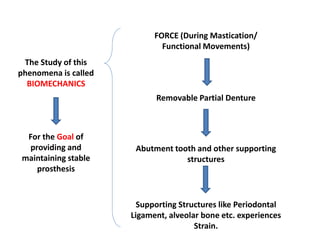
FORCE (During Mastication/
Functional Movements)
Removable Partial Denture
Abutment tooth and other supporting
structures
Supporting Structures like Periodontal
Ligament, alveolar bone etc. experiences
Strain.
The Study of this
phenomena is called
BIOMECHANICS
For the Goal of
providing and
maintaining stable
prosthesis
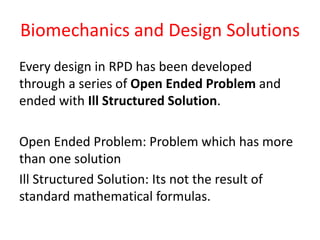
Biomechanics and Design Solutions
Every design in RPD has been developed
through a series of Open Ended Problem and
ended with Ill Structured Solution.
Open Ended Problem: Problem which has more
than one solution
Ill Structured Solution: Its not the result of
standard mathematical formulas.
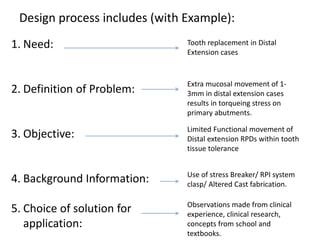
Design process includes (with Example):
1. Need:
2. Definition of Problem:
3. Objective:
4. Background Information:
5. Choice of solution for
application:
Tooth replacement in Distal
Extension cases
Extra mucosal movement of 1-
3mm in distal extension cases
results in torqueing stress on
primary abutments.
Limited Functional movement of
Distal extension RPDs within tooth
tissue tolerance
Use of stress Breaker/ RPI system
clasp/ Altered Cast fabrication.
Observations made from clinical
experience, clinical research,
concepts from school and
textbooks.
Biomechanical Considerations
As Maxfield states:
“Common observation clearly indicates that the
ability of living things to tolerate force is largely
dependent upon the magnitude or intensity of
forces”
Support structures of RPD:
ABUTMENT TEETH
RESIDUAL RIDGES
Depending factors include:
1. Type of Forces
2. Duration and intensity of forces
3. Capacity of the teeth and mucosa to resist
these forces (Health of the supporting
structures)
4. Material used and application influencing
this teeth-tissue resistances
5. Whether resistance changes over time.
Main objective is to:
‘Reduce the potentially destructive forces to
minimum, so that the physiological tolerances
of the supporting structures are not exceeded
and pathologic change does not occur.’
How to achieve this:
‘…..by appropriate design of removable partial
denture, which includes the selection and
location of components in conjunction with a
harmonious occlusion….’
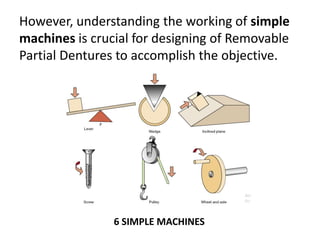
However, understanding the working of simple
machines is crucial for designing of Removable
Partial Dentures to accomplish the objective.
6 SIMPLE MACHINES
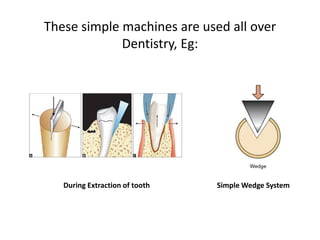
These simple machines are used all over
Dentistry, Eg:
During Extraction of tooth Simple Wedge System
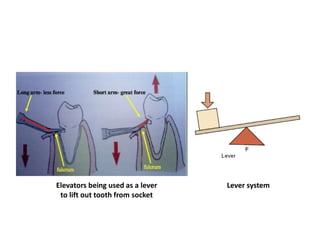
Elevators being used as a lever
to lift out tooth from socket
Lever system
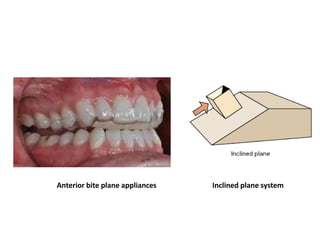
Anterior bite plane appliances Inclined plane system
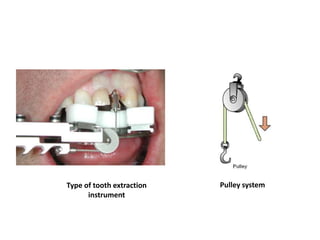
Type of tooth extraction
instrument
Pulley system
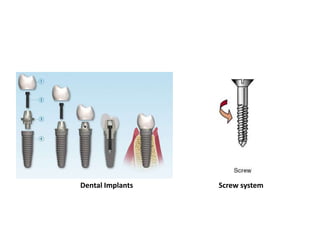
Dental Implants Screw system
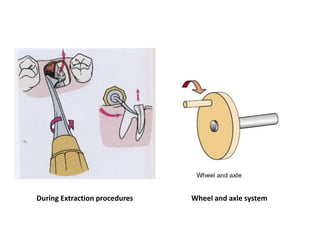
Wheel and axle systemDuring Extraction procedures
Among simple machines, forces generated
by Lever, the wedge, wheel and axle and
the inclined plane systems should be
avoided in the design of removable partial
dentures.
Possible movements of Partial
Dentures
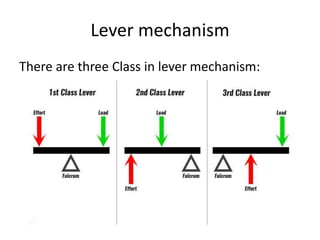
Lever mechanism
There are three Class in lever mechanism:
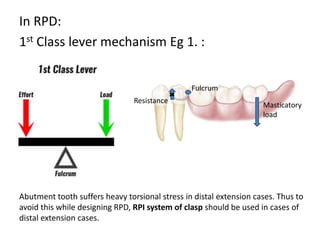
In RPD:
1st Class lever mechanism Eg 1. :
Resistance
Fulcrum
Masticatory
load
Abutment tooth suffers heavy torsional stress in distal extension cases. Thus to
avoid this while designing RPD, RPI system of clasp should be used in cases of
distal extension cases.
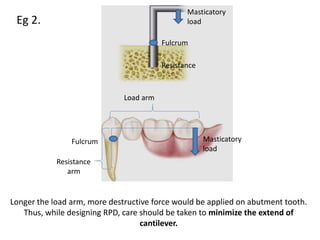
Fulcrum
Fulcrum
Resistance
arm
Load arm
Masticatory
load
Resistance
Masticatory
load
Longer the load arm, more destructive force would be applied on abutment tooth.
Thus, while designing RPD, care should be taken to minimize the extend of
cantilever.
Eg 2.
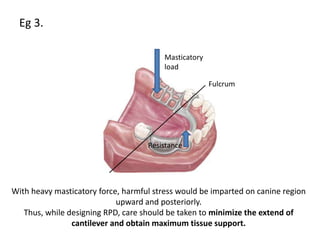
Eg 3.
Masticatory
load
Resistance
Fulcrum
With heavy masticatory force, harmful stress would be imparted on canine region
upward and posteriorly.
Thus, while designing RPD, care should be taken to minimize the extend of
cantilever and obtain maximum tissue support.
The most beneficial design in cases of distal
edentulous cases is to use Dental implants in
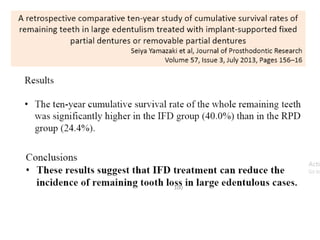
conjunction with removable partial dentures.
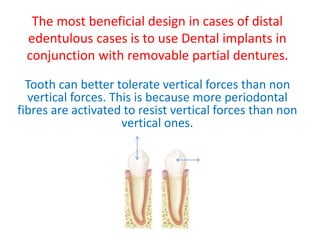
Tooth can better tolerate vertical forces than non
vertical forces. This is because more periodontal
fibres are activated to resist vertical forces than non
vertical ones.
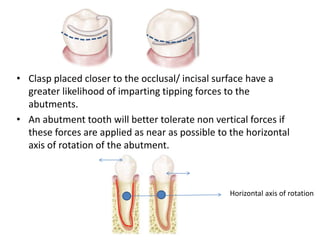
• Clasp placed closer to the occlusal/ incisal surface have a
greater likelihood of imparting tipping forces to the
abutments.
• An abutment tooth will better tolerate non vertical forces if
these forces are applied as near as possible to the horizontal
axis of rotation of the abutment.
Horizontal axis of rotation
Key to minimize damage from First
Order lever movements
• minimize the extend of cantilever.
• obtain maximum tissue support.
• non vertical forces to be applied as near as
possible to the horizontal axis of rotation of
the abutment.
• use Dental implants in conjunction with
removable partial dentures whenever
possible
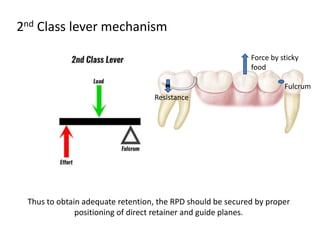
2nd Class lever mechanism
Resistance
Fulcrum
Force by sticky
food
Thus to obtain adequate retention, the RPD should be secured by proper
positioning of direct retainer and guide planes.
Key to minimize damage from Second
Order lever movements
• By proper positioning of direct retainer and
guide planes.
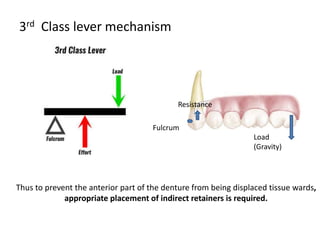
3rd Class lever mechanism
Resistance
Fulcrum
Load
(Gravity)
Thus to prevent the anterior part of the denture from being displaced tissue wards,
appropriate placement of indirect retainers is required.
Key to minimize damage from third
Order lever movements
• By appropriate placement of indirect
retainers.
• minimize the extend of cantilever
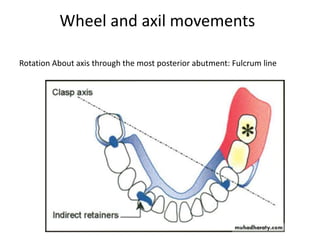
Rotation About axis through the most posterior abutment: Fulcrum line
Wheel and axil movements
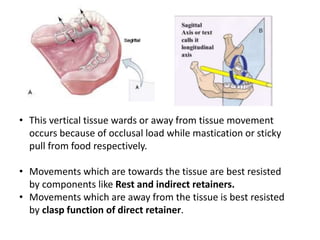
• This vertical tissue wards or away from tissue movement
occurs because of occlusal load while mastication or sticky
pull from food respectively.
• Movements which are towards the tissue are best resisted
by components like Rest and indirect retainers.
• Movements which are away from the tissue is best resisted
by clasp function of direct retainer.
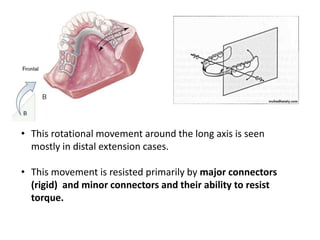
• This rotational movement around the long axis is seen
mostly in distal extension cases.
• This movement is resisted primarily by major connectors
(rigid) and minor connectors and their ability to resist
torque.
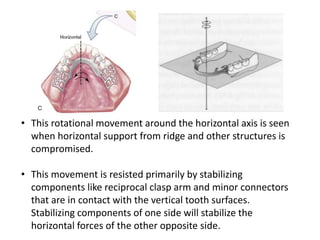
• This rotational movement around the horizontal axis is seen
when horizontal support from ridge and other structures is
compromised.
• This movement is resisted primarily by stabilizing
components like reciprocal clasp arm and minor connectors
that are in contact with the vertical tooth surfaces.
Stabilizing components of one side will stabilize the
horizontal forces of the other opposite side.
Impact of implants on movements of
RPD
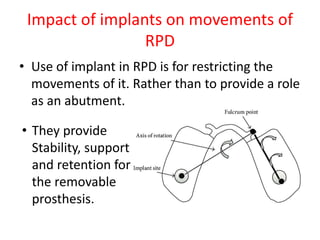
• Use of implant in RPD is for restricting the
movements of it. Rather than to provide a role
as an abutment.
• They provide
Stability, support
and retention for
the removable
prosthesis.
References
1. Mc Cracken Removable Partial
Prosthodontics Edition 12.
2. Picture source: Google search engine.

Mc Cracken chapter 4: Biomechanics of Removable Partial Denture.

  • 1.
    Mc Cracken’s Removable PartialProsthodontics Edition - XII Seminar Created By Dr. Joel Koshy Joseph MDS
  • 2.
    Chapter 4 Biomechanics ofRemovable Partial Dentures
  • 3.
    Chapter Outline 1. Biomechanicsand Design Solutions 2. Biomechanical Considerations 3. Possible Movements of Partial Dentures 4. Impact of Implants on Movements of Partial Dentures.
  • 4.
    Removable partial denturesare not rigidly attached to teeth, so it has a potential for lots of movement under functional loads. As a result, huge stresses are exerted on to the tooth and other supporting structure. Hence, it is important that the stress does not exceed physiologic tolerance limit.
  • 5.
    FORCE (During Mastication/ FunctionalMovements) Removable Partial Denture Abutment tooth and other supporting structures Supporting Structures like Periodontal Ligament, alveolar bone etc. experiences Strain. The Study of this phenomena is called BIOMECHANICS For the Goal of providing and maintaining stable prosthesis
  • 6.
    Biomechanics and DesignSolutions Every design in RPD has been developed through a series of Open Ended Problem and ended with Ill Structured Solution. Open Ended Problem: Problem which has more than one solution Ill Structured Solution: Its not the result of standard mathematical formulas.
  • 7.
    Design process includes(with Example): 1. Need: 2. Definition of Problem: 3. Objective: 4. Background Information: 5. Choice of solution for application: Tooth replacement in Distal Extension cases Extra mucosal movement of 1- 3mm in distal extension cases results in torqueing stress on primary abutments. Limited Functional movement of Distal extension RPDs within tooth tissue tolerance Use of stress Breaker/ RPI system clasp/ Altered Cast fabrication. Observations made from clinical experience, clinical research, concepts from school and textbooks.
  • 8.
    Biomechanical Considerations As Maxfieldstates: “Common observation clearly indicates that the ability of living things to tolerate force is largely dependent upon the magnitude or intensity of forces” Support structures of RPD: ABUTMENT TEETH RESIDUAL RIDGES
  • 9.
    Depending factors include: 1.Type of Forces 2. Duration and intensity of forces 3. Capacity of the teeth and mucosa to resist these forces (Health of the supporting structures) 4. Material used and application influencing this teeth-tissue resistances 5. Whether resistance changes over time.
  • 10.
    Main objective isto: ‘Reduce the potentially destructive forces to minimum, so that the physiological tolerances of the supporting structures are not exceeded and pathologic change does not occur.’ How to achieve this: ‘…..by appropriate design of removable partial denture, which includes the selection and location of components in conjunction with a harmonious occlusion….’
  • 11.
    However, understanding theworking of simple machines is crucial for designing of Removable Partial Dentures to accomplish the objective. 6 SIMPLE MACHINES
  • 12.
    These simple machinesare used all over Dentistry, Eg: During Extraction of tooth Simple Wedge System
  • 13.
    Elevators being usedas a lever to lift out tooth from socket Lever system
  • 14.
    Anterior bite planeappliances Inclined plane system
  • 15.
    Type of toothextraction instrument Pulley system
  • 16.
  • 17.
    Wheel and axlesystemDuring Extraction procedures
  • 18.
    Among simple machines,forces generated by Lever, the wedge, wheel and axle and the inclined plane systems should be avoided in the design of removable partial dentures. Possible movements of Partial Dentures
  • 19.
    Lever mechanism There arethree Class in lever mechanism:
  • 20.
    In RPD: 1st Classlever mechanism Eg 1. : Resistance Fulcrum Masticatory load Abutment tooth suffers heavy torsional stress in distal extension cases. Thus to avoid this while designing RPD, RPI system of clasp should be used in cases of distal extension cases.
  • 21.
    Fulcrum Fulcrum Resistance arm Load arm Masticatory load Resistance Masticatory load Longer theload arm, more destructive force would be applied on abutment tooth. Thus, while designing RPD, care should be taken to minimize the extend of cantilever. Eg 2.
  • 22.
    Eg 3. Masticatory load Resistance Fulcrum With heavymasticatory force, harmful stress would be imparted on canine region upward and posteriorly. Thus, while designing RPD, care should be taken to minimize the extend of cantilever and obtain maximum tissue support.
  • 23.
    The most beneficialdesign in cases of distal edentulous cases is to use Dental implants in conjunction with removable partial dentures. Tooth can better tolerate vertical forces than non vertical forces. This is because more periodontal fibres are activated to resist vertical forces than non vertical ones.
  • 24.
    • Clasp placedcloser to the occlusal/ incisal surface have a greater likelihood of imparting tipping forces to the abutments. • An abutment tooth will better tolerate non vertical forces if these forces are applied as near as possible to the horizontal axis of rotation of the abutment. Horizontal axis of rotation
  • 26.
    Key to minimizedamage from First Order lever movements • minimize the extend of cantilever. • obtain maximum tissue support. • non vertical forces to be applied as near as possible to the horizontal axis of rotation of the abutment. • use Dental implants in conjunction with removable partial dentures whenever possible
  • 27.
    2nd Class levermechanism Resistance Fulcrum Force by sticky food Thus to obtain adequate retention, the RPD should be secured by proper positioning of direct retainer and guide planes.
  • 28.
    Key to minimizedamage from Second Order lever movements • By proper positioning of direct retainer and guide planes.
  • 29.
    3rd Class levermechanism Resistance Fulcrum Load (Gravity) Thus to prevent the anterior part of the denture from being displaced tissue wards, appropriate placement of indirect retainers is required.
  • 30.
    Key to minimizedamage from third Order lever movements • By appropriate placement of indirect retainers. • minimize the extend of cantilever
  • 31.
    Rotation About axisthrough the most posterior abutment: Fulcrum line Wheel and axil movements
  • 32.
    • This verticaltissue wards or away from tissue movement occurs because of occlusal load while mastication or sticky pull from food respectively. • Movements which are towards the tissue are best resisted by components like Rest and indirect retainers. • Movements which are away from the tissue is best resisted by clasp function of direct retainer.
  • 33.
    • This rotationalmovement around the long axis is seen mostly in distal extension cases. • This movement is resisted primarily by major connectors (rigid) and minor connectors and their ability to resist torque.
  • 34.
    • This rotationalmovement around the horizontal axis is seen when horizontal support from ridge and other structures is compromised. • This movement is resisted primarily by stabilizing components like reciprocal clasp arm and minor connectors that are in contact with the vertical tooth surfaces. Stabilizing components of one side will stabilize the horizontal forces of the other opposite side.
  • 35.
    Impact of implantson movements of RPD • Use of implant in RPD is for restricting the movements of it. Rather than to provide a role as an abutment. • They provide Stability, support and retention for the removable prosthesis.
  • 36.
    References 1. Mc CrackenRemovable Partial Prosthodontics Edition 12. 2. Picture source: Google search engine.

Editor's Notes

  • #24 it seems rational that more periodontal fibers are activated to resist the application of vertical forces to teeth than are activated to resist the application of non-vertical forces
  • #36 Other benefits of using Implant with RPD is the cost factor in case of long span edentulous areas, where minimum implants placed at the most advantageous position to augment the basic design needs of RPD, rather than replace all the missing teeth with implant or opt for implant supported fixed prosthesis where many implants are required.