Dr. Amal Fathy Kaddah
Prof. of Prosthodontic,
Faculty of Oral & Dental Medicine,
Cairo University
• The stomatognathic system
• What 'occlusion' is and why it is important
• Definitions.
• The significance of 'ideal occlusion‘
• Difference between natural and artificial Occ.
• Mandibular Movements.
• Articulators and Facebows.
• Balanced Occlusion and Factors affecting Balanced O.
• Concepts of occlusion (Balanced and Non balanced Occlusion).
• Recording of Occlusion for removable prosthodontics.
• Occlusal correction for Removable Prosthesis.
• Occlusion and implant restorations (Loading protocols)
Occlusion
Outline
It is an important factorIt is an important factor
forfor maintaining thethe
stabilitystability of completeof complete
dentures,dentures, with the least
amount of trauma to the
A maxillomandibular relationship,
independent of tooth contact, in which
the condyles articulate in the anterior-
superior position against the posterior
slopes of the articular eminences; in this
position, the mandible is restricted to a
purely rotary movements; from this
unstrained, physiologic,
maxillomandibular relationship, the
patient can make vertical, lateral or
protrusive movements, it is a clinically
useful, repeatable reference position
(within functional range of movement).
(GPT 9)(GPT 9)
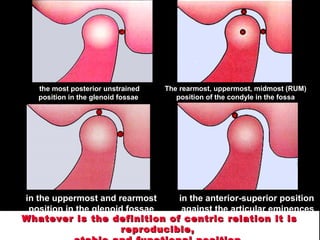
Whatever is the definition of centric relation it isWhatever is the definition of centric relation it is
reproducible,reproducible,
The rearmost, uppermost, midmost (RUM)
position of the condyle in the fossa
the most posterior unstrained
position in the glenoid fossae
in the uppermost and rearmost
position in the glenoid fossae
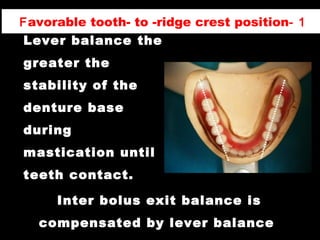
in the anterior-superior position
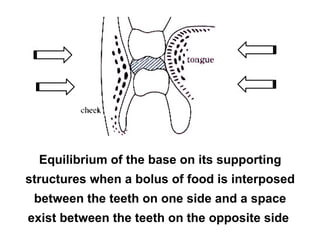
against the articular eminences
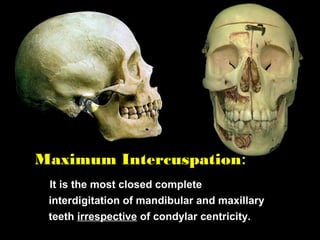
Maximum Intercuspation:
It is the most closed complete
interdigitation of mandibular and maxillary
teeth irrespective of condylar centricity.
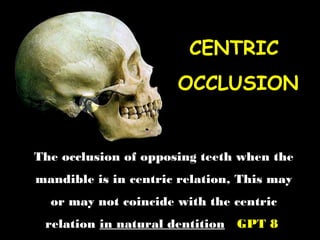
CENTRICCENTRIC
OCCLUSIONOCCLUSION
The occlusion of opposing teeth when theThe occlusion of opposing teeth when the
mandible is in centric relation,mandible is in centric relation, This may
or may not coincide with the centric
relation in natural dentition GPT 8
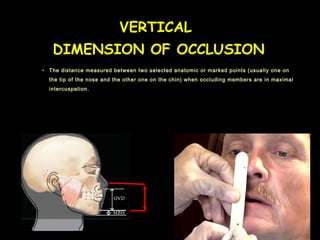
VERTICAL
DIMENSION OF OCCLUSION
• The distance measured between two selected anatomic or marked points (usually one on
the tip of the nose and the other one on the chin) when occluding members are in maximal
intercuspation.
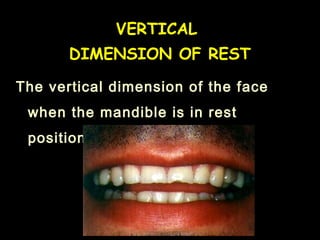
The vertical dimension of the face
when the mandible is in rest
position.
VERTICAL
DIMENSION OF REST
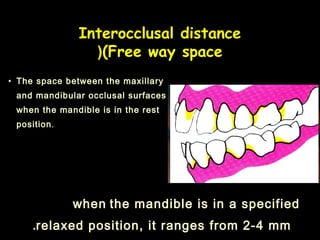
Interocclusal distance
(Free way space)
• The space between the maxillary
and mandibular occlusal surfaces
when the mandible is in the rest
position.
when the mandible is in a specified
relaxed position, it ranges from 2-4 mm.
This relation exists
when the jaws are in
centric relation and
the teeth are in
centric occlusion
Three - dimensional record,
Vertical relation,
Antero - posterior relation
and lateral relation,
i.e. to obtain a centric relation
record it is necessary to
determine the vertical dimension
of occlusion.
The simultaneous contacting of the
maxillary and mandibular teeth on the
right and left side and in the posterior
and anterior occlusal areas in centric
and eccentric positions, developed to
limit tipping of the denture bases in
relation to the supporting structures”-
(GPT5)
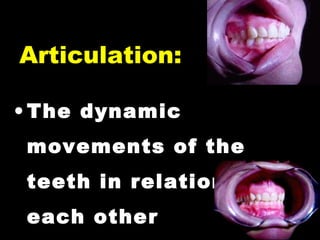
• The dynamic
movements of the
teeth in relation to
each other
Articulation:
Stable simultaneous contact of the
opposing upper and lower teeth in
centric relation position with a
continuous smooth bilateral gliding
from this position to any eccentric
position within the normal range of
mandibular function
BalancedBalanced
Occlusion/ArticulationOcclusion/Articulation
• The Bilateral simultaneous
contact of the anterior and
posterior teeth in excursive
movements. (GPT 9)
• There should be no interferences
during movement from centric
position to eccentric positions.
• The movements should be in
harmony with TMJ &
neuromuscular control
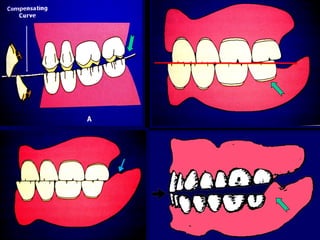
1- Provide maximum denture stability during functional
and parafunctional movements of the mandible
2- Help in distribution of the masticatory pressure
over the supporting tissues and reduce trauma to the
underlying tissues
3- Increased efficiency of mastication
4- Psychologically it is more comfortable to the
patients who enjoy comfort and satisfaction only
when eccentric balance is present
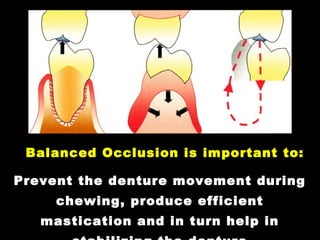
Balanced Occlusion is important to:
Prevent the denture movement during
chewing, produce efficient
mastication and in turn help in
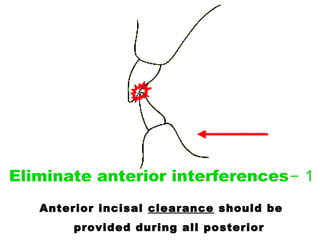
1. Eliminate anterior interferences
during posterior functions.
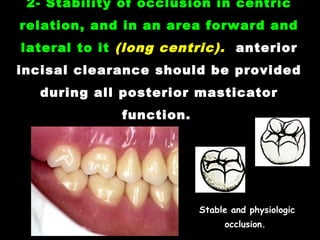
2. Stability of occlusion in centric
relation, and in an area forward and
lateral to it (long centric).
3. Stability of occlusal contacts for all
eccentric mandibular movements at
the limit of functional activity.
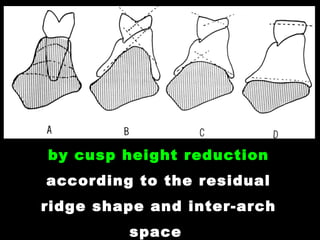
4. Control of horizontal force by cusp
height reduction according to the
residual ridge shape and inter-arch
space
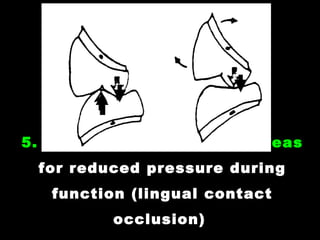
5. Minimum occlusal stop areas for
reduced pressure during function
(lingual contact occlusion)
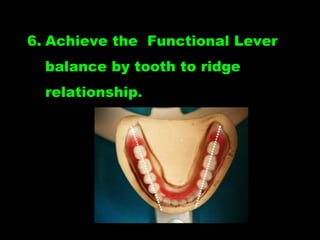
6. Achieve the Functional Lever
balance by tooth to ridge
relationship.
7. Cutting, penetrating and shearing
1-Eliminate anterior interferences
Anterior incisal clearance should be
provided during all posterior
2- Stability of occlusion in centric
relation, and in an area forward and
lateral to it (long centric). anterior
incisal clearance should be provided
during all posterior masticator
function.
Stable and physiologic
occlusion.
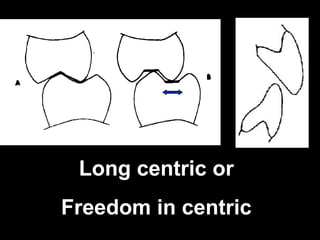
Long centric or
Freedom in centric
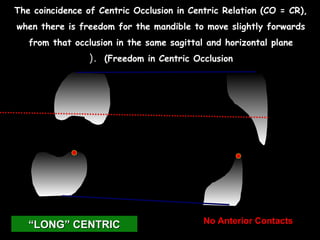
The coincidence of Centric Occlusion in Centric Relation (CO = CR),
when there is freedom for the mandible to move slightly forwards
from that occlusion in the same sagittal and horizontal plane
(Freedom in Centric Occlusion(.
““LONG” CENTRICLONG” CENTRIC No Anterior Contacts
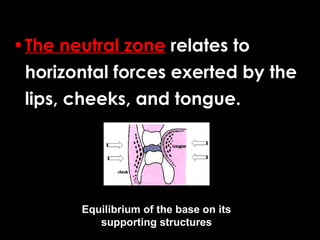
•The neutral zone relates to
horizontal forces exerted by the
lips, cheeks, and tongue.
Equilibrium of the base on its
supporting structures
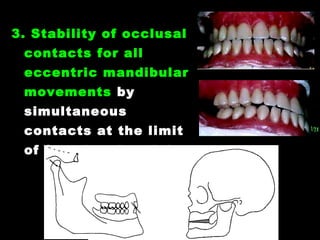
3. Stability of occlusal
contacts for all
eccentric mandibular
movements by
simultaneous
contacts at the limit
of functional activity.
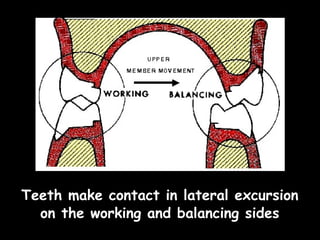
Teeth make contact in lateral excursion
on the working and balancing sides
4- Control of horizontal force
by cusp height reduction
according to the residual
ridge shape and inter-arch
space
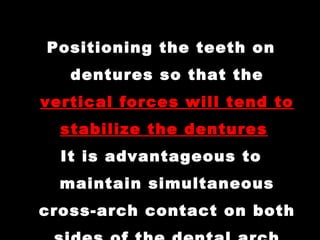
Positioning the teeth on
dentures so that the
vertical forces will tend to
stabilize the dentures
It is advantageous to
maintain simultaneous
cross-arch contact on both
5. Minimum occlusal stop areas
for reduced pressure during
function (lingual contact
occlusion)
6. Achieve the Functional Lever
balance by tooth to ridge
relationship.
Types of Balance as Related
to Complete Denture
1) Lever balance
2) Occlusal
balance
1- Lever1- Lever
balancebalance
Dependent on
tooth position as
related to its
base
Greater the lever balance by
favorable tooth denture
relationship Greater
the stability of the base
during mastication until the
teeth contact.
Lever balance and the
greater the stability of the
base.
1. The larger ridge.
2. The closer the teeth to ridge.
3. The more lingualized
occlusion.
4. The more centered the force of
occlusion antero- posteriorly
The better the
Lever balance the
greater the
stability of the
denture base
during
mastication until
teeth contact.
1-Favorable tooth- to -ridge crest position
Inter bolus exit balance is
compensated by lever balance
Equilibrium of the base on its supporting
structures when a bolus of food is interposed
between the teeth on one side and a space
exist between the teeth on the opposite side
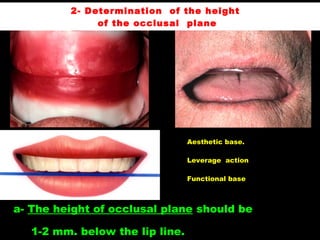
a- The height of occlusal plane should be
1-2 mm. below the lip line.
Aesthetic base.
Leverage action
Functional base
2- Determination of the height
of the occlusal plane
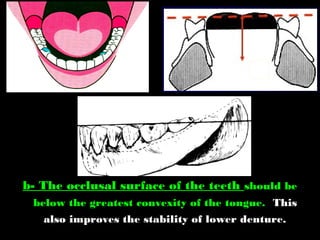
b- The occlusal surface of the teeth should be
below the greatest convexity of the tongue. This
also improves the stability of lower denture.
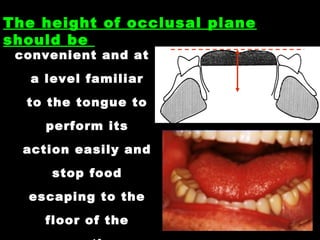
convenient and at
a level familiar
to the tongue to
perform its
action easily and
stop food
escaping to the
floor of the
The height of occlusal plane
should be
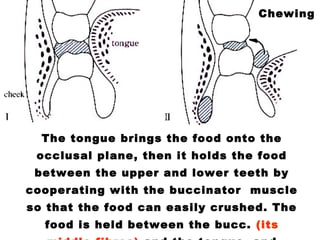
The tongue brings the food onto the
occlusal plane, then it holds the food
between the upper and lower teeth by
cooperating with the buccinator muscle
so that the food can easily crushed. The
food is held between the bucc. (its
Chewing
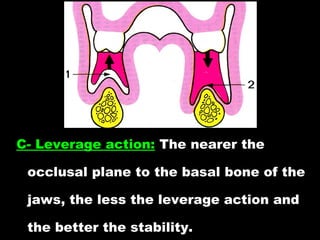
C- Leverage action: The nearer the
occlusal plane to the basal bone of the
jaws, the less the leverage action and
the better the stability.
Unilateral lever
balanceEquilibrium of the base on
its supporting structures
when a bolus of food is
interposed between the
teeth on one side and a
space exist between the
teeth on the opposite side
1. Placing the teeth over the
ridge.
2. Denture base area covers as
wide area on the ridge as
possible.
3. Placing the teeth as close to
the ridge as other factors
will permit.
4. Using as narrow a
buccolingual width occlusal
food table.
To achieve the unilateral lever
balance
2- Occlusal2- Occlusal
balancebalance
Is dependent on
tooth contact
2- Occlusal2- Occlusal
balancebalance
1) Unilateral occlusal balance
(Group function) This is not followed for
balanced occlusion of complete denture It is more
pertained to fixed partial dentures
2) Bilateral occlusal balance
3) Protrusive occlusal balance
4) Mutually protected occlusion
(Canine protected) This is not followed for
complete denture
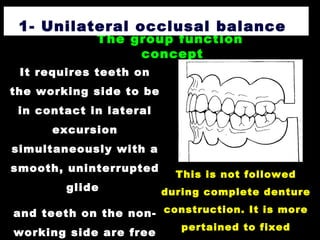
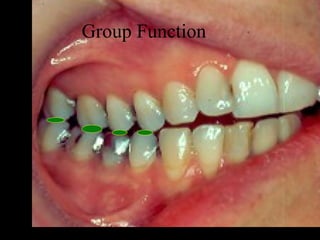
The group function
concept
.
It requires teeth on
the working side to be
in contact in lateral
excursion
simultaneously with a
smooth, uninterrupted
glide
and teeth on the non-
working side are free
1- Unilateral occlusal balance
This is not followed
during complete denture
construction. It is more
pertained to fixed
Group Function
Bilateral simultaneous occlusal
contact of teeth, anteriorly and
posteriorly, in both centric and
eccentric positions.
Gliding of the teeth across each
other during their movement from
one position to another, without any
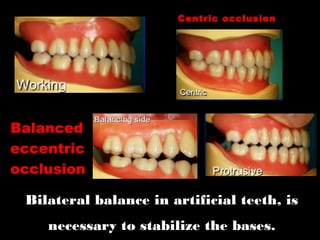
2- Bilateral occlusal balance
Bilateral balance in artificial teeth, is
necessary to stabilize the bases.
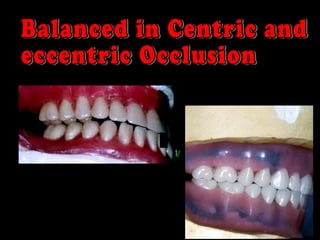
Centric occlusion
Balanced
eccentric
occlusion
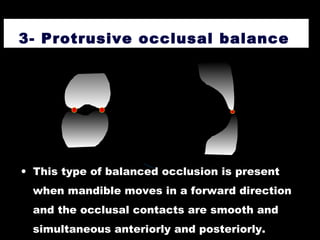
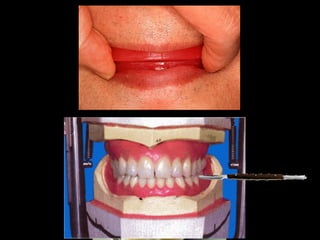
3- Protrusive occlusal balance
• This type of balanced occlusion is present
when mandible moves in a forward direction
and the occlusal contacts are smooth and
simultaneous anteriorly and posteriorly.
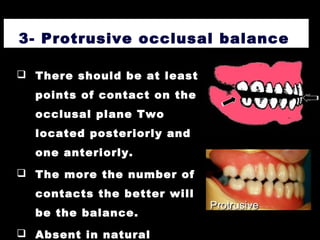
3- Protrusive occlusal balance
 There should be at least 3
points of contact on the
occlusal plane Two
located posteriorly and
one anteriorly.
 The more the number of
contacts the better will
be the balance.
 Absent in natural
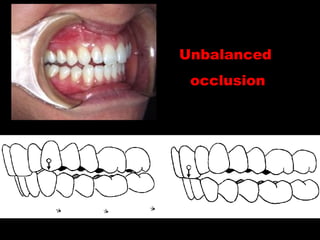
Unbalanced
occlusion
balance is to create
bilateral contacts from the
centric position to all
eccentric position, that areare
free from interference,free from interference,
smooth, uniform and insmooth, uniform and in
harmonyharmony with movement of
the mandible
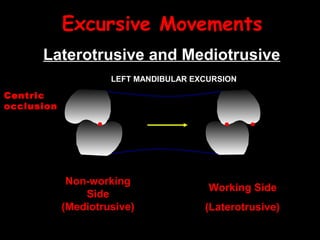
Excursive Movements
Laterotrusive and Mediotrusive
Non-working
Side
(Mediotrusive)
Working Side
(Laterotrusive)
LEFT MANDIBULAR EXCURSION
Centric
occlusion
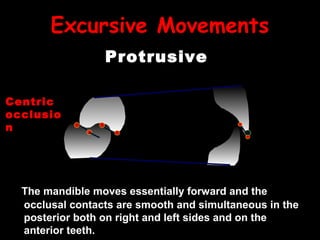
Excursive Movements
Centric
occlusio
n
Protrusive
The mandible moves essentially forward and the
occlusal contacts are smooth and simultaneous in the
posterior both on right and left sides and on the
anterior teeth.
4-Mutually Protected
Occlusion
• Also called canine protected occlusion
• Anterior teeth overlap prevents the posterior
teeth from making any contact on either the
working or the nonworking sides during
mandibular excursions.
• Anterior teeth bear all the load and the
posterior teeth are dis-occluded during
excursions. Protecting the posterior teeth
• In CO, posterior teeth direct forces through
their long axis and anterior teeth are slightly in
or out of contact. Protecting the anterior teeth.
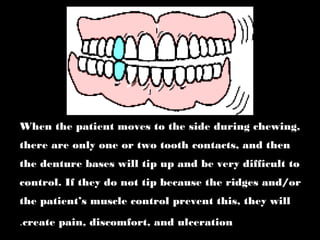
When the patient moves to the side during chewing,
there are only one or two tooth contacts, and then
the denture bases will tip up and be very difficult to
control. If they do not tip because the ridges and/or
the patient’s muscle control prevent this, they will
create pain, discomfort, and ulceration.
Factors Affecting
Balanced Occlusion
Next lecture
THANK
THANK
YOU
YOU

02 occlusion in prosthodontics. balanced occlusion

  • 3.
    Dr. Amal FathyKaddah Prof. of Prosthodontic, Faculty of Oral & Dental Medicine, Cairo University
  • 4.
    • The stomatognathicsystem • What 'occlusion' is and why it is important • Definitions. • The significance of 'ideal occlusion‘ • Difference between natural and artificial Occ. • Mandibular Movements. • Articulators and Facebows. • Balanced Occlusion and Factors affecting Balanced O. • Concepts of occlusion (Balanced and Non balanced Occlusion). • Recording of Occlusion for removable prosthodontics. • Occlusal correction for Removable Prosthesis. • Occlusion and implant restorations (Loading protocols) Occlusion Outline
  • 5.
    It is animportant factorIt is an important factor forfor maintaining thethe stabilitystability of completeof complete dentures,dentures, with the least amount of trauma to the
  • 7.
    A maxillomandibular relationship, independentof tooth contact, in which the condyles articulate in the anterior- superior position against the posterior slopes of the articular eminences; in this position, the mandible is restricted to a purely rotary movements; from this unstrained, physiologic, maxillomandibular relationship, the patient can make vertical, lateral or protrusive movements, it is a clinically useful, repeatable reference position (within functional range of movement). (GPT 9)(GPT 9)
  • 8.
    Whatever is thedefinition of centric relation it isWhatever is the definition of centric relation it is reproducible,reproducible, The rearmost, uppermost, midmost (RUM) position of the condyle in the fossa the most posterior unstrained position in the glenoid fossae in the uppermost and rearmost position in the glenoid fossae in the anterior-superior position against the articular eminences
  • 9.
    Maximum Intercuspation: It isthe most closed complete interdigitation of mandibular and maxillary teeth irrespective of condylar centricity.
  • 10.
    CENTRICCENTRIC OCCLUSIONOCCLUSION The occlusion ofopposing teeth when theThe occlusion of opposing teeth when the mandible is in centric relation,mandible is in centric relation, This may or may not coincide with the centric relation in natural dentition GPT 8
  • 11.
    VERTICAL DIMENSION OF OCCLUSION •The distance measured between two selected anatomic or marked points (usually one on the tip of the nose and the other one on the chin) when occluding members are in maximal intercuspation.
  • 12.
    The vertical dimensionof the face when the mandible is in rest position. VERTICAL DIMENSION OF REST
  • 13.
    Interocclusal distance (Free wayspace) • The space between the maxillary and mandibular occlusal surfaces when the mandible is in the rest position. when the mandible is in a specified relaxed position, it ranges from 2-4 mm.
  • 14.
    This relation exists whenthe jaws are in centric relation and the teeth are in centric occlusion
  • 15.
    Three - dimensionalrecord, Vertical relation, Antero - posterior relation and lateral relation, i.e. to obtain a centric relation record it is necessary to determine the vertical dimension of occlusion.
  • 16.
    The simultaneous contactingof the maxillary and mandibular teeth on the right and left side and in the posterior and anterior occlusal areas in centric and eccentric positions, developed to limit tipping of the denture bases in relation to the supporting structures”- (GPT5)
  • 18.
    • The dynamic movementsof the teeth in relation to each other Articulation:
  • 19.
    Stable simultaneous contactof the opposing upper and lower teeth in centric relation position with a continuous smooth bilateral gliding from this position to any eccentric position within the normal range of mandibular function
  • 20.
    BalancedBalanced Occlusion/ArticulationOcclusion/Articulation • The Bilateralsimultaneous contact of the anterior and posterior teeth in excursive movements. (GPT 9)
  • 21.
    • There shouldbe no interferences during movement from centric position to eccentric positions. • The movements should be in harmony with TMJ & neuromuscular control
  • 23.
    1- Provide maximumdenture stability during functional and parafunctional movements of the mandible 2- Help in distribution of the masticatory pressure over the supporting tissues and reduce trauma to the underlying tissues 3- Increased efficiency of mastication 4- Psychologically it is more comfortable to the patients who enjoy comfort and satisfaction only when eccentric balance is present
  • 24.
    Balanced Occlusion isimportant to: Prevent the denture movement during chewing, produce efficient mastication and in turn help in
  • 26.
    1. Eliminate anteriorinterferences during posterior functions. 2. Stability of occlusion in centric relation, and in an area forward and lateral to it (long centric). 3. Stability of occlusal contacts for all eccentric mandibular movements at the limit of functional activity.
  • 27.
    4. Control ofhorizontal force by cusp height reduction according to the residual ridge shape and inter-arch space 5. Minimum occlusal stop areas for reduced pressure during function (lingual contact occlusion) 6. Achieve the Functional Lever balance by tooth to ridge relationship. 7. Cutting, penetrating and shearing
  • 28.
    1-Eliminate anterior interferences Anteriorincisal clearance should be provided during all posterior
  • 29.
    2- Stability ofocclusion in centric relation, and in an area forward and lateral to it (long centric). anterior incisal clearance should be provided during all posterior masticator function. Stable and physiologic occlusion.
  • 30.
  • 31.
    The coincidence ofCentric Occlusion in Centric Relation (CO = CR), when there is freedom for the mandible to move slightly forwards from that occlusion in the same sagittal and horizontal plane (Freedom in Centric Occlusion(. ““LONG” CENTRICLONG” CENTRIC No Anterior Contacts
  • 32.
    •The neutral zonerelates to horizontal forces exerted by the lips, cheeks, and tongue. Equilibrium of the base on its supporting structures
  • 33.
    3. Stability ofocclusal contacts for all eccentric mandibular movements by simultaneous contacts at the limit of functional activity.
  • 34.
    Teeth make contactin lateral excursion on the working and balancing sides
  • 36.
    4- Control ofhorizontal force by cusp height reduction according to the residual ridge shape and inter-arch space
  • 37.
    Positioning the teethon dentures so that the vertical forces will tend to stabilize the dentures It is advantageous to maintain simultaneous cross-arch contact on both
  • 38.
    5. Minimum occlusalstop areas for reduced pressure during function (lingual contact occlusion)
  • 39.
    6. Achieve theFunctional Lever balance by tooth to ridge relationship.
  • 41.
    Types of Balanceas Related to Complete Denture 1) Lever balance 2) Occlusal balance
  • 42.
    1- Lever1- Lever balancebalance Dependenton tooth position as related to its base
  • 43.
    Greater the leverbalance by favorable tooth denture relationship Greater the stability of the base during mastication until the teeth contact.
  • 44.
    Lever balance andthe greater the stability of the base. 1. The larger ridge. 2. The closer the teeth to ridge. 3. The more lingualized occlusion. 4. The more centered the force of occlusion antero- posteriorly
  • 45.
    The better the Leverbalance the greater the stability of the denture base during mastication until teeth contact. 1-Favorable tooth- to -ridge crest position Inter bolus exit balance is compensated by lever balance
  • 46.
    Equilibrium of thebase on its supporting structures when a bolus of food is interposed between the teeth on one side and a space exist between the teeth on the opposite side
  • 47.
    a- The heightof occlusal plane should be 1-2 mm. below the lip line. Aesthetic base. Leverage action Functional base 2- Determination of the height of the occlusal plane
  • 48.
    b- The occlusalsurface of the teeth should be below the greatest convexity of the tongue. This also improves the stability of lower denture.
  • 49.
    convenient and at alevel familiar to the tongue to perform its action easily and stop food escaping to the floor of the The height of occlusal plane should be
  • 50.
    The tongue bringsthe food onto the occlusal plane, then it holds the food between the upper and lower teeth by cooperating with the buccinator muscle so that the food can easily crushed. The food is held between the bucc. (its Chewing
  • 51.
    C- Leverage action:The nearer the occlusal plane to the basal bone of the jaws, the less the leverage action and the better the stability.
  • 52.
    Unilateral lever balanceEquilibrium ofthe base on its supporting structures when a bolus of food is interposed between the teeth on one side and a space exist between the teeth on the opposite side
  • 53.
    1. Placing theteeth over the ridge. 2. Denture base area covers as wide area on the ridge as possible. 3. Placing the teeth as close to the ridge as other factors will permit. 4. Using as narrow a buccolingual width occlusal food table. To achieve the unilateral lever balance
  • 54.
    2- Occlusal2- Occlusal balancebalance Isdependent on tooth contact
  • 55.
    2- Occlusal2- Occlusal balancebalance 1)Unilateral occlusal balance (Group function) This is not followed for balanced occlusion of complete denture It is more pertained to fixed partial dentures 2) Bilateral occlusal balance 3) Protrusive occlusal balance 4) Mutually protected occlusion (Canine protected) This is not followed for complete denture
  • 56.
    The group function concept . Itrequires teeth on the working side to be in contact in lateral excursion simultaneously with a smooth, uninterrupted glide and teeth on the non- working side are free 1- Unilateral occlusal balance This is not followed during complete denture construction. It is more pertained to fixed
  • 57.
  • 58.
    Bilateral simultaneous occlusal contactof teeth, anteriorly and posteriorly, in both centric and eccentric positions. Gliding of the teeth across each other during their movement from one position to another, without any 2- Bilateral occlusal balance
  • 59.
    Bilateral balance inartificial teeth, is necessary to stabilize the bases. Centric occlusion Balanced eccentric occlusion
  • 60.
    3- Protrusive occlusalbalance • This type of balanced occlusion is present when mandible moves in a forward direction and the occlusal contacts are smooth and simultaneous anteriorly and posteriorly.
  • 61.
    3- Protrusive occlusalbalance  There should be at least 3 points of contact on the occlusal plane Two located posteriorly and one anteriorly.  The more the number of contacts the better will be the balance.  Absent in natural
  • 62.
  • 64.
    balance is tocreate bilateral contacts from the centric position to all eccentric position, that areare free from interference,free from interference, smooth, uniform and insmooth, uniform and in harmonyharmony with movement of the mandible
  • 65.
    Excursive Movements Laterotrusive andMediotrusive Non-working Side (Mediotrusive) Working Side (Laterotrusive) LEFT MANDIBULAR EXCURSION Centric occlusion
  • 66.
    Excursive Movements Centric occlusio n Protrusive The mandiblemoves essentially forward and the occlusal contacts are smooth and simultaneous in the posterior both on right and left sides and on the anterior teeth.
  • 67.
    4-Mutually Protected Occlusion • Alsocalled canine protected occlusion • Anterior teeth overlap prevents the posterior teeth from making any contact on either the working or the nonworking sides during mandibular excursions. • Anterior teeth bear all the load and the posterior teeth are dis-occluded during excursions. Protecting the posterior teeth • In CO, posterior teeth direct forces through their long axis and anterior teeth are slightly in or out of contact. Protecting the anterior teeth.
  • 68.
    When the patientmoves to the side during chewing, there are only one or two tooth contacts, and then the denture bases will tip up and be very difficult to control. If they do not tip because the ridges and/or the patient’s muscle control prevent this, they will create pain, discomfort, and ulceration.
  • 70.
  • 71.

Editor's Notes

  • #2 Merge
  • #32 An illustration of a protrusive excursion, with the mandible moving forward. The lower anterior teeth ride up the lingual of the maxillary anterior teeth as the jaw goes forward.
  • #58 A clinical photo of a group function occlusion. In this one, all 4 posterior teeth are involved, and the canines and anteriors are discluded in this right lateral excursion. Ideally, we would like not to have the second molar or distal cusp of the first molar involved, since they’re getting too far posterior, where muscle forces are greater.
  • #61 An illustration of a protrusive excursion, with the mandible moving forward. The lower anterior teeth ride up the lingual of the maxillary anterior teeth as the jaw goes forward.
  • #66 An illustration of laterotrusive and mediotrusive sides in a lateral excursion. The lower jaw moves towards the right, which is the working or laterotrusive side. The left side is the balancing side, or non-working side, or mediotrusive side- these are all synonomous
  • #67 An illustration of a protrusive excursion, with the mandible moving forward. The lower anterior teeth ride up the lingual of the maxillary anterior teeth as the jaw goes forward.