
1


RENAL PHYSIOLOGY
       (VI)
          M
INTRAVENOUS FLUIDS
 (APPLIED PHYSIOLOGY)


       Mohammed Abdel Gawad
OBJECTIVES
2


       Body water compartments
       Electrolytes & Non-Electrolytes distribution
       IV fluids forms
       Dextrose
       Saline
       Lactated Ringer’s
       Plasma expanders
       IV fluids – Clinical Correlation
OBJECTIVES
3


       Body water compartments
       Electrolytes & Non-Electrolytes distribution
       IV fluids forms
       Dextrose
       Saline
       Lactated Ringer’s
       Plasma expanders
       IV fluids – Clinical Correlation
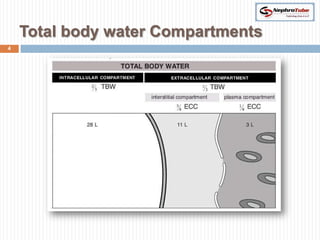
Total body water Compartments
4
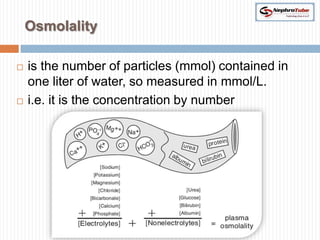
Osmolality

   is the number of particles (mmol) contained in
    one liter of water, so measured in mmol/L.
   i.e. it is the concentration by number
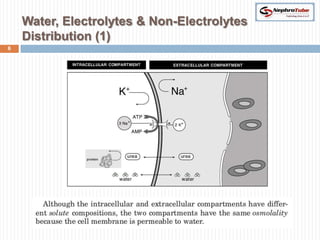
Water, Electrolytes & Non-Electrolytes
    Distribution (1)
6
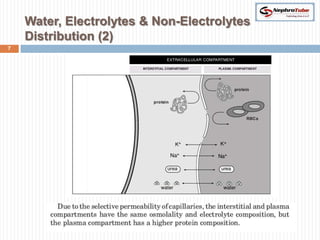
Water, Electrolytes & Non-Electrolytes
    Distribution (2)
7
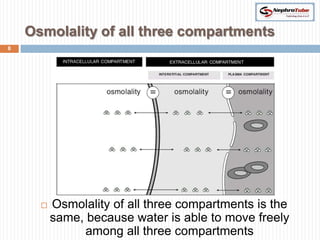
Osmolality of all three compartments
8


         Osmolality of all three compartments is the
          same, because water is able to move freely
                among all three compartments
OBJECTIVES
9


       Body water compartments
       Electrolytes & Non-Electrolytes distribution
       IV fluids forms
       Dextrose
       Saline
       Lactated Ringer’s
       Plasma expanders
       IV fluids – Clinical Correlation
Intravenous fluids forms
10
Applied physiology of IV fluid
11


    Answer this points in every IV fluid type:
    1- Content?


    2- Tonicity?


    3- Distribution, water where are u?          Use in volume replacement?
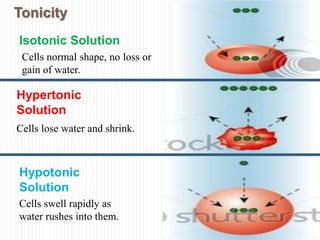
Tonicity

12
     Isotonic Solution
      Cells normal shape, no loss or
      gain of water.

     Hypertonic
     Solution
     Cells lose water and shrink.


     Hypotonic
     Solution
     Cells swell rapidly as
     water rushes into them.
Osmolality

   is the number of particles (mmol) contained in
    one liter of water, so measured in mmol/L.
   i.e. it is the concentration by number
OBJECTIVES
14


        Body water compartments
        Electrolytes & Non-Electrolytes distribution
        IV fluids forms
        Dextrose
        Saline
        Lactated Ringer’s
        Plasma expanders
        IV fluids – Clinical Correlation
Dextrose solutions: Content & Tonicity
15

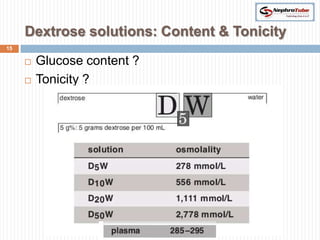
        Glucose content ?
        Tonicity ?
Dextrose solutions: Distribution
16
Dextrose solutions: Distribution
17


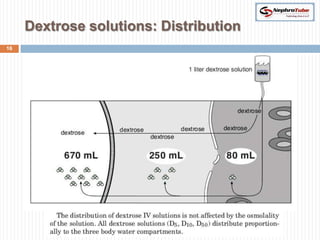
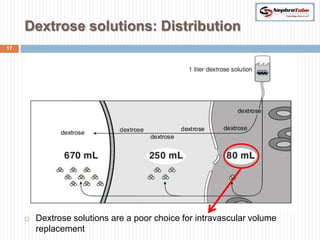
        Dextrose solutions are a poor choice for intravascular volume
         replacement
Dextrose solutions:
         Deliver energy & water to the body.
18


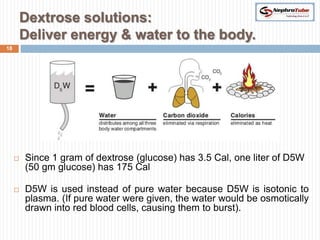
        Since 1 gram of dextrose (glucose) has 3.5 Cal, one liter of D5W
         (50 gm glucose) has 175 Cal

        D5W is used instead of pure water because D5W is isotonic to
         plasma. (If pure water were given, the water would be osmotically
         drawn into red blood cells, causing them to burst).
OBJECTIVES
19


        Body water compartments
        Electrolytes & Non-Electrolytes distribution
        IV fluids forms
        Dextrose
        Saline
        Lactated Ringer’s
        Plasma expanders
        IV fluids – Clinical Correlation
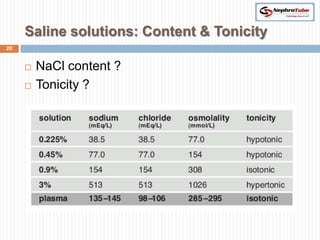
Saline solutions: Content & Tonicity
20


        NaCl content ?
        Tonicity ?
Saline solutions:
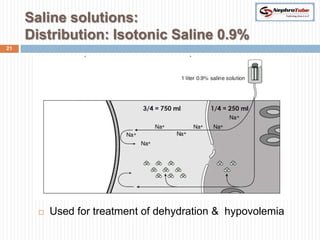
     Distribution: Isotonic Saline 0.9%
21


          Used for treatment of dehydration & hypovolemia
Saline solutions:
     Distribution: Hypotonic Saline 0.45%
22


        0.45% NaCl is commonly combined with D5W and used as a maintenance IV.
        A maintenance IV is meant to replace water and solute losses and provide
         some calories to patients who are not eating.
Saline solutions:
     Distribution: Hypertonic Saline 3%
23


        The NaCl adds 718 milliequivalents (359 mEq of Na and 359 mEq
         of Cl) to the extracellular compartment which draws in 2,500 mL of
         water from the intracellular compartment.
OBJECTIVES
24


        Body water compartments
        Electrolytes & Non-Electrolytes distribution
        IV fluids forms
        Dextrose
        Saline
        Lactated Ringer’s
        Plasma expanders
        IV fluids – Clinical Correlation
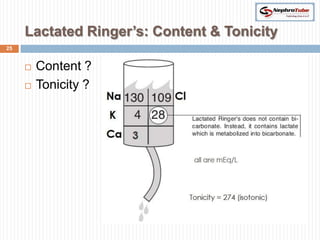
Lactated Ringer’s: Content & Tonicity
25


        Content ?
        Tonicity ?
Lactated Ringer’s: Distribution
26


                             1 liter


                    750 ml             250 ml
Lactated Ringer’s: Caution
27


        Lactated Ringer’s is contraindicated in patients
         with lactic acidosis, lactate is unable to be
         converted to bicarbonate in this disorder.

        Lactated Ringer’s should also be avoided in
         patients with metabolic alkalosis.
OBJECTIVES
28


        Body water compartments
        Electrolytes & Non-Electrolytes distribution
        IV fluids forms
        Dextrose
        Saline
        Lactated Ringer’s
        Plasma expanders
        IV fluids – Clinical Correlation
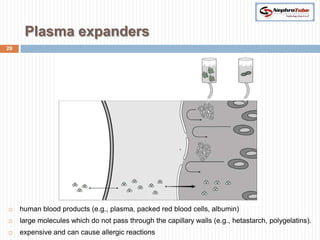
Plasma expanders
29


    human blood products (e.g., plasma, packed red blood cells, albumin)
    large molecules which do not pass through the capillary walls (e.g., hetastarch, polygelatins).
    expensive and can cause allergic reactions
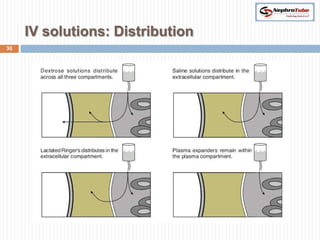
IV solutions: Distribution
30
OBJECTIVES
31


        Body water compartments
        Electrolytes & Non-Electrolytes distribution
        IV fluids forms
        Dextrose
        Saline
        Lactated Ringer’s
        Plasma expanders
        IV fluids – Clinical Correlation
IV solutions: Clinical correlation:
     Caloric Expenditure Method
32


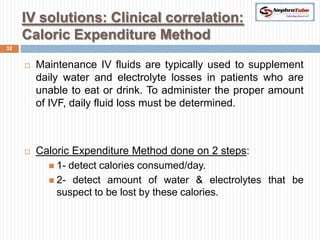
        Maintenance IV fluids are typically used to supplement
         daily water and electrolyte losses in patients who are
         unable to eat or drink. To administer the proper amount
         of IVF, daily fluid loss must be determined.


        Caloric Expenditure Method done on 2 steps:
            1- detect calories consumed/day.
            2- detect amount of water & electrolytes that be
             suspect to be lost by these calories.
IV solutions: Clinical correlation:
     Caloric Expenditure Method
33


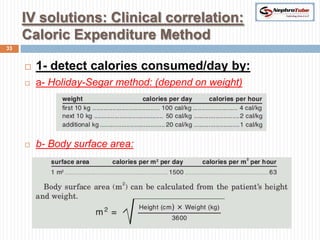
        1- detect calories consumed/day by:
        a- Holiday-Segar method: (depend on weight)


        b- Body surface area:
IV solutions: Clinical correlation:
     Caloric Expenditure Method
34


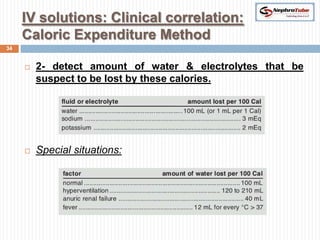
        2- detect amount of water & electrolytes that be
         suspect to be lost by these calories.


        Special situations:
35


            Follow On
     www.nephrotube.blogspot.com
                 &
           Facebook Group
             NephroTube
36


     Gawad

Renal Physiology (VI) - IV fluids (Applied physiology) - Dr. Gawad

  • 1.
    1 RENAL PHYSIOLOGY (VI) M INTRAVENOUS FLUIDS (APPLIED PHYSIOLOGY) Mohammed Abdel Gawad
  • 2.
    OBJECTIVES 2  Body water compartments  Electrolytes & Non-Electrolytes distribution  IV fluids forms  Dextrose  Saline  Lactated Ringer’s  Plasma expanders  IV fluids – Clinical Correlation
  • 3.
    OBJECTIVES 3  Body water compartments  Electrolytes & Non-Electrolytes distribution  IV fluids forms  Dextrose  Saline  Lactated Ringer’s  Plasma expanders  IV fluids – Clinical Correlation
  • 4.
    Total body waterCompartments 4
  • 5.
    Osmolality  is the number of particles (mmol) contained in one liter of water, so measured in mmol/L.  i.e. it is the concentration by number
  • 6.
    Water, Electrolytes &Non-Electrolytes Distribution (1) 6
  • 7.
    Water, Electrolytes &Non-Electrolytes Distribution (2) 7
  • 8.
    Osmolality of allthree compartments 8  Osmolality of all three compartments is the same, because water is able to move freely among all three compartments
  • 9.
    OBJECTIVES 9  Body water compartments  Electrolytes & Non-Electrolytes distribution  IV fluids forms  Dextrose  Saline  Lactated Ringer’s  Plasma expanders  IV fluids – Clinical Correlation
  • 10.
  • 11.
    Applied physiology ofIV fluid 11  Answer this points in every IV fluid type:  1- Content?  2- Tonicity?  3- Distribution, water where are u? Use in volume replacement?
  • 12.
    Tonicity 12 Isotonic Solution Cells normal shape, no loss or gain of water. Hypertonic Solution Cells lose water and shrink. Hypotonic Solution Cells swell rapidly as water rushes into them.
  • 13.
    Osmolality  is the number of particles (mmol) contained in one liter of water, so measured in mmol/L.  i.e. it is the concentration by number
  • 14.
    OBJECTIVES 14  Body water compartments  Electrolytes & Non-Electrolytes distribution  IV fluids forms  Dextrose  Saline  Lactated Ringer’s  Plasma expanders  IV fluids – Clinical Correlation
  • 15.
    Dextrose solutions: Content& Tonicity 15  Glucose content ?  Tonicity ?
  • 16.
  • 17.
    Dextrose solutions: Distribution 17  Dextrose solutions are a poor choice for intravascular volume replacement
  • 18.
    Dextrose solutions: Deliver energy & water to the body. 18  Since 1 gram of dextrose (glucose) has 3.5 Cal, one liter of D5W (50 gm glucose) has 175 Cal  D5W is used instead of pure water because D5W is isotonic to plasma. (If pure water were given, the water would be osmotically drawn into red blood cells, causing them to burst).
  • 19.
    OBJECTIVES 19  Body water compartments  Electrolytes & Non-Electrolytes distribution  IV fluids forms  Dextrose  Saline  Lactated Ringer’s  Plasma expanders  IV fluids – Clinical Correlation
  • 20.
    Saline solutions: Content& Tonicity 20  NaCl content ?  Tonicity ?
  • 21.
    Saline solutions: Distribution: Isotonic Saline 0.9% 21  Used for treatment of dehydration & hypovolemia
  • 22.
    Saline solutions: Distribution: Hypotonic Saline 0.45% 22  0.45% NaCl is commonly combined with D5W and used as a maintenance IV.  A maintenance IV is meant to replace water and solute losses and provide some calories to patients who are not eating.
  • 23.
    Saline solutions: Distribution: Hypertonic Saline 3% 23  The NaCl adds 718 milliequivalents (359 mEq of Na and 359 mEq of Cl) to the extracellular compartment which draws in 2,500 mL of water from the intracellular compartment.
  • 24.
    OBJECTIVES 24  Body water compartments  Electrolytes & Non-Electrolytes distribution  IV fluids forms  Dextrose  Saline  Lactated Ringer’s  Plasma expanders  IV fluids – Clinical Correlation
  • 25.
    Lactated Ringer’s: Content& Tonicity 25  Content ?  Tonicity ?
  • 26.
  • 27.
    Lactated Ringer’s: Caution 27  Lactated Ringer’s is contraindicated in patients with lactic acidosis, lactate is unable to be converted to bicarbonate in this disorder.  Lactated Ringer’s should also be avoided in patients with metabolic alkalosis.
  • 28.
    OBJECTIVES 28  Body water compartments  Electrolytes & Non-Electrolytes distribution  IV fluids forms  Dextrose  Saline  Lactated Ringer’s  Plasma expanders  IV fluids – Clinical Correlation
  • 29.
    Plasma expanders 29  human blood products (e.g., plasma, packed red blood cells, albumin)  large molecules which do not pass through the capillary walls (e.g., hetastarch, polygelatins).  expensive and can cause allergic reactions
  • 30.
  • 31.
    OBJECTIVES 31  Body water compartments  Electrolytes & Non-Electrolytes distribution  IV fluids forms  Dextrose  Saline  Lactated Ringer’s  Plasma expanders  IV fluids – Clinical Correlation
  • 32.
    IV solutions: Clinicalcorrelation: Caloric Expenditure Method 32  Maintenance IV fluids are typically used to supplement daily water and electrolyte losses in patients who are unable to eat or drink. To administer the proper amount of IVF, daily fluid loss must be determined.  Caloric Expenditure Method done on 2 steps:  1- detect calories consumed/day.  2- detect amount of water & electrolytes that be suspect to be lost by these calories.
  • 33.
    IV solutions: Clinicalcorrelation: Caloric Expenditure Method 33  1- detect calories consumed/day by:  a- Holiday-Segar method: (depend on weight)  b- Body surface area:
  • 34.
    IV solutions: Clinicalcorrelation: Caloric Expenditure Method 34  2- detect amount of water & electrolytes that be suspect to be lost by these calories.  Special situations:
  • 35.
    35 Follow On www.nephrotube.blogspot.com & Facebook Group NephroTube
  • 36.
    36 Gawad