Outlines:
• Body fluid distripution
• Body fluid component
• Type of solution
• Type of crystalloid
Can You Imagine life without water?
Of course not, because water is essential to sustain life.
Likewise, body fluids are vital to maintain normal body
functioning
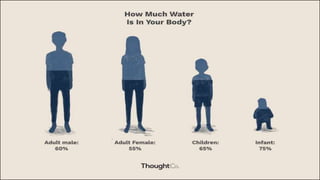
Total body fluid (TBF), accounts for approximately 60% of
total body weight
(this can be 70% or higher in a newborn down to 50–55% in a
mature woman).
Component of body fluids
• Body fluids is a mixture of water with Electrolytes
(sodium chloride, magnesium, calcium, bicarbonates), Nonelectrolytes
(glucose, amino-acids) and Blood (RBCs, WBSs and PLT)
• Electrolytes: chemical component that have electrical
charge such as ( Na, K, Cl, Ca, Mg …)
• Non-electrolyte: chemical component that’s not possess
an electrical charge such as (glucose, amino acid, fatty
acid, urea, creatinine …)
• Blood cells: WBC, RBC, PLT
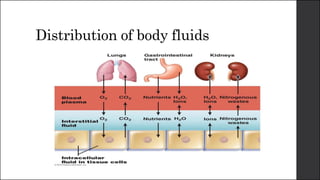
Distribution of body fluids
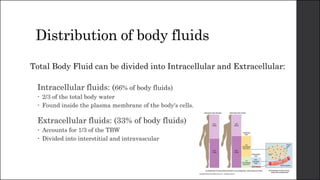
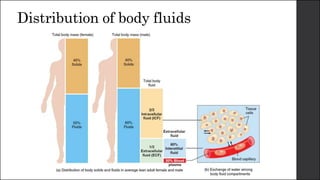
Total Body Fluid can be divided into Intracellular and Extracellular:
Intracellular fluids: (66% of body fluids)
 2/3 of the total body water
 Found inside the plasma membrane of the body's cells.
Extracellular fluids: (33% of body fluids)
 Accounts for 1/3 of the TBW
 Divided into interstitial and intravascular
Distribution of body fluids
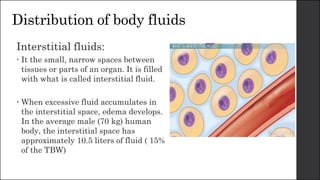
Interstitial fluids:
 It the small, narrow spaces between
tissues or parts of an organ. It is filled
with what is called interstitial fluid.
 When excessive fluid accumulates in
the interstitial space, edema develops.
In the average male (70 kg) human
body, the interstitial space has
approximately 10.5 liters of fluid ( 15%
of the TBW)
Distribution of body fluids
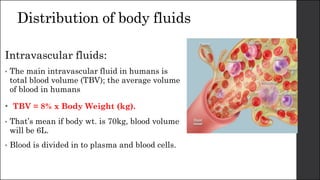
Intravascular fluids:
• The main intravascular fluid in humans is
total blood volume (TBV); the average volume
of blood in humans
• TBV = 8% x Body Weight (kg).
• That’s mean if body wt. is 70kg, blood volume
will be 6L.
• Blood is divided in to plasma and blood cells.
Distribution of body fluids
Fluid volume assessment
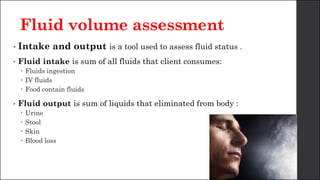
• Intake and output is a tool used to assess fluid status .
• Fluid intake is sum of all fluids that client consumes:
 Fluids ingestion
 IV fluids
 Food contain fluids
• Fluid output is sum of liquids that eliminated from body :
 Urine
 Stool
 Skin
 Blood loss
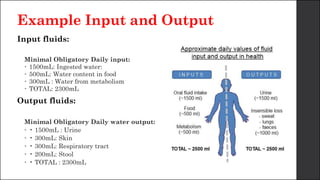
Example Input and Output
Input fluids:
Minimal Obligatory Daily input:
 1500mL: Ingested water:
 500mL: Water content in food
 300mL : Water from metabolism
 TOTAL: 2300mL
Output fluids:
Minimal Obligatory Daily water output:
 • 1500mL : Urine
 • 300mL: Skin
 • 300mL: Respiratory tract
 • 200mL: Stool
 • TOTAL : 2300mL
Not!
Input = output
Any change is
abnormal
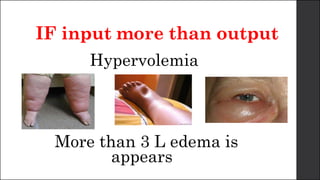
IF input more than output
Hypervolemia
More than 3 L edema is
appears
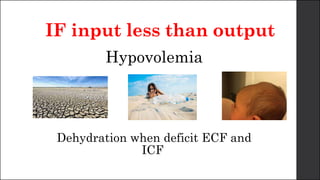
IF input less than output
Hypovolemia
Dehydration when deficit ECF and
ICF
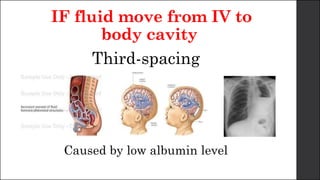
IF fluid move from IV to
body cavity
Third-spacing
Caused by low albumin level
Water requirements increase with:
• Fever
• Sweating
• Burns
• Tachypnea
• Surgical drains
• Polyuria
• Gastrointestinal losses through Vomiting or diarrhea
Not! Water requirements increase by 100 to 150 mL/day for
each C degree of body temperature elevation.
Types of solutions
There are two main type of solutions:
• Colloids solution
• Crystalloid
What is the difference between them?
Types of solutions
• Crystalloid: its made from water and dissolved
crystals (Na) and other electrolytes and have 3
types according to concentration of components.
Before we start we should know Osmolality
so, What is Osmolality?
What’s Osmolality?
• Term refers to the solute concentration in the
body fluid by weight. The number of milliosmoles
(mOsm) in a kilogram (kg) of solution.
note/ In humans normally the osmolality in
plasma is about 275-295 mOsm/Kg
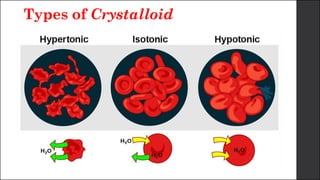
Types of Crystalloid
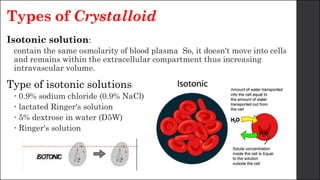
Isotonic solution:
contain the same osmolarity of blood plasma So, it doesn't move into cells
and remains within the extracellular compartment thus increasing
intravascular volume.
Type of isotonic solutions
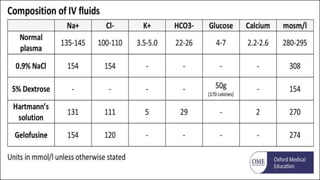
 0.9% sodium chloride (0.9% NaCl)
 lactated Ringer's solution
 5% dextrose in water (D5W)
 Ringer's solution
Type of isotonic solutions
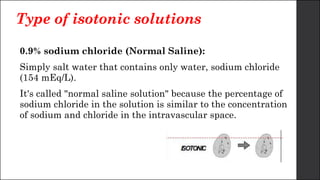
0.9% sodium chloride (Normal Saline):
Simply salt water that contains only water, sodium chloride
(154 mEq/L).
It's called "normal saline solution" because the percentage of
sodium chloride in the solution is similar to the concentration
of sodium and chloride in the intravascular space.
Type of isotonic solutions
0.9% sodium chloride (Normal Saline):
When to be given?
• to treat low extracellular fluid, as in fluid volume deficit from
- Hemorrhage - Severe vomiting or diarrhea - Heavy drainage from
GI suction, fistulas, or wounds.
• Shock
• Mild hyponatremia
• Metabolic acidosis (such as diabetic ketoacidosis)
• It’s the fluid of choice for resuscitation efforts.
• it's the only fluid used with administration of blood products.
Type of isotonic solutions
0.9% sodium chloride (Normal Saline):
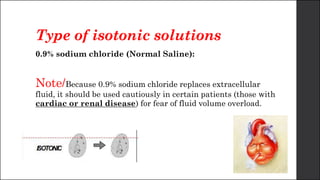
Note/Because 0.9% sodium chloride replaces extracellular
fluid, it should be used cautiously in certain patients (those with
cardiac or renal disease) for fear of fluid volume overload.
Type of isotonic solutions
Ringer's lactate or Hartmann solution:
• is the most physiologically adaptable fluid because its
electrolyte content is most closely related to the composition
of the body's blood serum and plasma.
• Another choice for first-line fluid resuscitation for certain patients,
such as those with burn injuries.
Type of isotonic solutions
Ringer's lactate or Hartmann solution:
When to be used?
• To replace GI tract fluid losses ( Diarrhea or vomiting )
• Fistula drainage
• Fluid losses due to burns and trauma
• Patients experiencing acute blood loss or hypovolemia
due to
• third-space fluid shifts.
Type of isotonic solutions
Ringer's lactate or Hartmann solution:
Note/
 LR is metabolized in the liver, which converts the lactate to
bicarbonate. LR is often administered to patients who have
metabolic acidosis not patients with lactic acidosis
 -Don't give LR to patients with liver disease as they can't
metabolize lactate
 - used cautiously in patients with sever renal impairment
because it contains some potassium
 - LR shouldn't be given to a patient whose pH is greater
than 7.5
Type of isotonic solutions
Dextrose 5%:
How does it work?
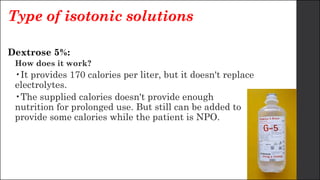
•It provides 170 calories per liter, but it doesn't replace
electrolytes.
•The supplied calories doesn't provide enough
nutrition for prolonged use. But still can be added to
provide some calories while the patient is NPO.
Type of isotonic solutions
Dextrose 5%:
Note/
• patients at risk for intracranial pressure should not receive D5W
since it could increase cerebral edema.
• D5W shouldn't be used in isolation to treat fluid volume deficit because it
dilutes plasma electrolyte concentrations
Precautions in usage of Isotonic
solutions:
• Be aware that patients being treated for hypovolemia can quickly
develop hypervolemia (fluid volume overload) following rapid or over
infusion of isotonic fluids.
• Document baseline vital signs, edema status, lung sounds, and heart
sounds before beginning the infusion, and continue monitoring during
and after the infusion.
• Frequently assess the patient's response to I.V. therapy, monitoring for
signs and symptoms of hypervolemia.
• Monitor intake and output.
• Elevate the head of bed at 35 to 45 degrees, unless contraindicated .
• If edema is present, elevate the patient's legs.
HYPOTONIC FLUIDS:
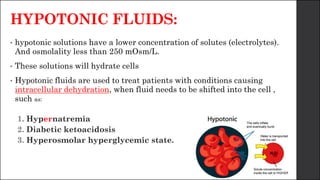
• hypotonic solutions have a lower concentration of solutes (electrolytes).
And osmolality less than 250 mOsm/L.
• These solutions will hydrate cells
• Hypotonic fluids are used to treat patients with conditions causing
intracellular dehydration, when fluid needs to be shifted into the cell ,
such as:
1. Hypernatremia
2. Diabetic ketoacidosis
3. Hyperosmolar hyperglycemic state.
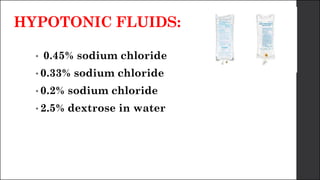
HYPOTONIC FLUIDS:
• 0.45% sodium chloride
• 0.33% sodium chloride
• 0.2% sodium chloride
• 2.5% dextrose in water
Precautions with hypotonic
solutions:
• Never give hypotonic solutions to patients who are at risk for increased
ICP because it may exacerbate cerebral edema.
• Don't use hypotonic solutions in patients with liver disease, trauma,
or burns due to the potential for depletion of intravascular fluid
volume.
• The decrease in vascular bed volume can worsen existing hypovolemia
and hypotension and cause cardiovascular collapse
• Monitor patients for signs and symptoms of fluid volume deficit
• In older adult patients, confusion may be an indicator of a fluid volume
deficit. Instruct patients to inform you if they feel dizzy or just "don’t
feel right."
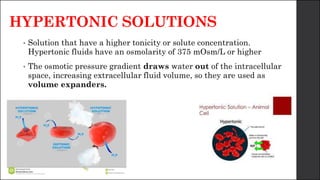
HYPERTONIC SOLUTIONS
• Solution that have a higher tonicity or solute concentration.
Hypertonic fluids have an osmolarity of 375 mOsm/L or higher
• The osmotic pressure gradient draws water out of the intracellular
space, increasing extracellular fluid volume, so they are used as
volume expanders.
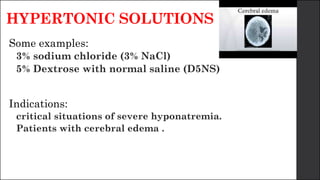
HYPERTONIC SOLUTIONS
Some examples:
3% sodium chloride (3% NaCl)
5% Dextrose with normal saline (D5NS)
Indications:
critical situations of severe hyponatremia.
Patients with cerebral edema .

Body fluids

  • 2.
    Outlines: • Body fluiddistripution • Body fluid component • Type of solution • Type of crystalloid
  • 3.
    Can You Imaginelife without water? Of course not, because water is essential to sustain life. Likewise, body fluids are vital to maintain normal body functioning Total body fluid (TBF), accounts for approximately 60% of total body weight (this can be 70% or higher in a newborn down to 50–55% in a mature woman).
  • 5.
    Component of bodyfluids • Body fluids is a mixture of water with Electrolytes (sodium chloride, magnesium, calcium, bicarbonates), Nonelectrolytes (glucose, amino-acids) and Blood (RBCs, WBSs and PLT) • Electrolytes: chemical component that have electrical charge such as ( Na, K, Cl, Ca, Mg …) • Non-electrolyte: chemical component that’s not possess an electrical charge such as (glucose, amino acid, fatty acid, urea, creatinine …) • Blood cells: WBC, RBC, PLT
  • 6.
    Distribution of bodyfluids Total Body Fluid can be divided into Intracellular and Extracellular: Intracellular fluids: (66% of body fluids)  2/3 of the total body water  Found inside the plasma membrane of the body's cells. Extracellular fluids: (33% of body fluids)  Accounts for 1/3 of the TBW  Divided into interstitial and intravascular
  • 7.
    Distribution of bodyfluids Interstitial fluids:  It the small, narrow spaces between tissues or parts of an organ. It is filled with what is called interstitial fluid.  When excessive fluid accumulates in the interstitial space, edema develops. In the average male (70 kg) human body, the interstitial space has approximately 10.5 liters of fluid ( 15% of the TBW)
  • 8.
    Distribution of bodyfluids Intravascular fluids: • The main intravascular fluid in humans is total blood volume (TBV); the average volume of blood in humans • TBV = 8% x Body Weight (kg). • That’s mean if body wt. is 70kg, blood volume will be 6L. • Blood is divided in to plasma and blood cells.
  • 9.
  • 10.
  • 11.
    Fluid volume assessment •Intake and output is a tool used to assess fluid status . • Fluid intake is sum of all fluids that client consumes:  Fluids ingestion  IV fluids  Food contain fluids • Fluid output is sum of liquids that eliminated from body :  Urine  Stool  Skin  Blood loss
  • 12.
    Example Input andOutput Input fluids: Minimal Obligatory Daily input:  1500mL: Ingested water:  500mL: Water content in food  300mL : Water from metabolism  TOTAL: 2300mL Output fluids: Minimal Obligatory Daily water output:  • 1500mL : Urine  • 300mL: Skin  • 300mL: Respiratory tract  • 200mL: Stool  • TOTAL : 2300mL
  • 13.
    Not! Input = output Anychange is abnormal
  • 14.
    IF input morethan output Hypervolemia More than 3 L edema is appears
  • 15.
    IF input lessthan output Hypovolemia Dehydration when deficit ECF and ICF
  • 16.
    IF fluid movefrom IV to body cavity Third-spacing Caused by low albumin level
  • 17.
    Water requirements increasewith: • Fever • Sweating • Burns • Tachypnea • Surgical drains • Polyuria • Gastrointestinal losses through Vomiting or diarrhea Not! Water requirements increase by 100 to 150 mL/day for each C degree of body temperature elevation.
  • 18.
    Types of solutions Thereare two main type of solutions: • Colloids solution • Crystalloid What is the difference between them?
  • 19.
    Types of solutions •Crystalloid: its made from water and dissolved crystals (Na) and other electrolytes and have 3 types according to concentration of components. Before we start we should know Osmolality so, What is Osmolality?
  • 20.
    What’s Osmolality? • Termrefers to the solute concentration in the body fluid by weight. The number of milliosmoles (mOsm) in a kilogram (kg) of solution. note/ In humans normally the osmolality in plasma is about 275-295 mOsm/Kg
  • 21.
  • 22.
    Types of Crystalloid Isotonicsolution: contain the same osmolarity of blood plasma So, it doesn't move into cells and remains within the extracellular compartment thus increasing intravascular volume. Type of isotonic solutions  0.9% sodium chloride (0.9% NaCl)  lactated Ringer's solution  5% dextrose in water (D5W)  Ringer's solution
  • 23.
    Type of isotonicsolutions 0.9% sodium chloride (Normal Saline): Simply salt water that contains only water, sodium chloride (154 mEq/L). It's called "normal saline solution" because the percentage of sodium chloride in the solution is similar to the concentration of sodium and chloride in the intravascular space.
  • 24.
    Type of isotonicsolutions 0.9% sodium chloride (Normal Saline): When to be given? • to treat low extracellular fluid, as in fluid volume deficit from - Hemorrhage - Severe vomiting or diarrhea - Heavy drainage from GI suction, fistulas, or wounds. • Shock • Mild hyponatremia • Metabolic acidosis (such as diabetic ketoacidosis) • It’s the fluid of choice for resuscitation efforts. • it's the only fluid used with administration of blood products.
  • 25.
    Type of isotonicsolutions 0.9% sodium chloride (Normal Saline): Note/Because 0.9% sodium chloride replaces extracellular fluid, it should be used cautiously in certain patients (those with cardiac or renal disease) for fear of fluid volume overload.
  • 26.
    Type of isotonicsolutions Ringer's lactate or Hartmann solution: • is the most physiologically adaptable fluid because its electrolyte content is most closely related to the composition of the body's blood serum and plasma. • Another choice for first-line fluid resuscitation for certain patients, such as those with burn injuries.
  • 27.
    Type of isotonicsolutions Ringer's lactate or Hartmann solution: When to be used? • To replace GI tract fluid losses ( Diarrhea or vomiting ) • Fistula drainage • Fluid losses due to burns and trauma • Patients experiencing acute blood loss or hypovolemia due to • third-space fluid shifts.
  • 28.
    Type of isotonicsolutions Ringer's lactate or Hartmann solution: Note/  LR is metabolized in the liver, which converts the lactate to bicarbonate. LR is often administered to patients who have metabolic acidosis not patients with lactic acidosis  -Don't give LR to patients with liver disease as they can't metabolize lactate  - used cautiously in patients with sever renal impairment because it contains some potassium  - LR shouldn't be given to a patient whose pH is greater than 7.5
  • 29.
    Type of isotonicsolutions Dextrose 5%: How does it work? •It provides 170 calories per liter, but it doesn't replace electrolytes. •The supplied calories doesn't provide enough nutrition for prolonged use. But still can be added to provide some calories while the patient is NPO.
  • 30.
    Type of isotonicsolutions Dextrose 5%: Note/ • patients at risk for intracranial pressure should not receive D5W since it could increase cerebral edema. • D5W shouldn't be used in isolation to treat fluid volume deficit because it dilutes plasma electrolyte concentrations
  • 32.
    Precautions in usageof Isotonic solutions: • Be aware that patients being treated for hypovolemia can quickly develop hypervolemia (fluid volume overload) following rapid or over infusion of isotonic fluids. • Document baseline vital signs, edema status, lung sounds, and heart sounds before beginning the infusion, and continue monitoring during and after the infusion. • Frequently assess the patient's response to I.V. therapy, monitoring for signs and symptoms of hypervolemia. • Monitor intake and output. • Elevate the head of bed at 35 to 45 degrees, unless contraindicated . • If edema is present, elevate the patient's legs.
  • 33.
    HYPOTONIC FLUIDS: • hypotonicsolutions have a lower concentration of solutes (electrolytes). And osmolality less than 250 mOsm/L. • These solutions will hydrate cells • Hypotonic fluids are used to treat patients with conditions causing intracellular dehydration, when fluid needs to be shifted into the cell , such as: 1. Hypernatremia 2. Diabetic ketoacidosis 3. Hyperosmolar hyperglycemic state.
  • 34.
    HYPOTONIC FLUIDS: • 0.45%sodium chloride • 0.33% sodium chloride • 0.2% sodium chloride • 2.5% dextrose in water
  • 35.
    Precautions with hypotonic solutions: •Never give hypotonic solutions to patients who are at risk for increased ICP because it may exacerbate cerebral edema. • Don't use hypotonic solutions in patients with liver disease, trauma, or burns due to the potential for depletion of intravascular fluid volume. • The decrease in vascular bed volume can worsen existing hypovolemia and hypotension and cause cardiovascular collapse • Monitor patients for signs and symptoms of fluid volume deficit • In older adult patients, confusion may be an indicator of a fluid volume deficit. Instruct patients to inform you if they feel dizzy or just "don’t feel right."
  • 36.
    HYPERTONIC SOLUTIONS • Solutionthat have a higher tonicity or solute concentration. Hypertonic fluids have an osmolarity of 375 mOsm/L or higher • The osmotic pressure gradient draws water out of the intracellular space, increasing extracellular fluid volume, so they are used as volume expanders.
  • 37.
    HYPERTONIC SOLUTIONS Some examples: 3%sodium chloride (3% NaCl) 5% Dextrose with normal saline (D5NS) Indications: critical situations of severe hyponatremia. Patients with cerebral edema .