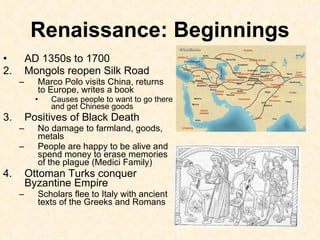
Renaissance: Beginnings AD 1350s to 1700 Mongols reopen Silk Road Marco Polo visits China, returns to Europe, writes a book Causes people to want to go there and get Chinese goods Positives of Black Death No damage to farmland, goods, metals People are happy to be alive and spend money to erase memories of the plague (Medici Family) Ottoman Turks conquer Byzantine Empire Scholars flee to Italy with ancient texts of the Greeks and Romans
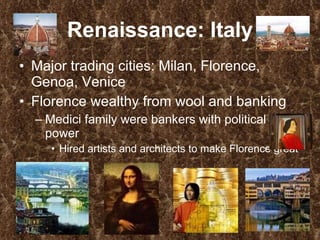
Renaissance: Italy Major trading cities: Milan, Florence, Genoa, Venice Florence wealthy from wool and banking Medici family were bankers with political power Hired artists and architects to make Florence great
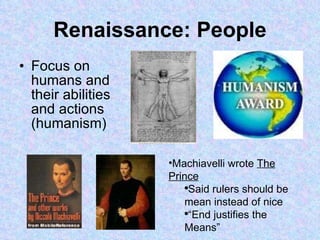
Renaissance: People Focus on humans and their abilities and actions (humanism) Machiavelli wrote  The Prince Said rulers should be mean instead of nice “ End justifies the Means”
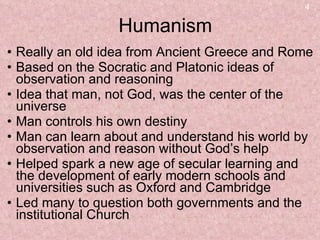
Humanism Really an old idea from Ancient Greece and Rome Based on the Socratic and Platonic ideas of observation and reasoning Idea that man, not God, was the center of the universe Man controls his own destiny Man can learn about and understand his world by observation and reason without God’s help Helped spark a new age of secular learning and the development of early modern schools and universities such as Oxford and Cambridge Led many to question both governments and the institutional Church
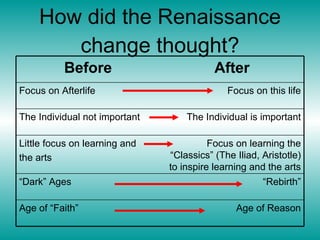
How did the Renaissance change thought? Age of Reason Age of “Faith” “ Rebirth” “ Dark” Ages Focus on learning the “Classics” (The Iliad, Aristotle) to inspire learning and the arts Little focus on learning and  the arts The Individual is important The Individual not important Focus on this life Focus on Afterlife After Before
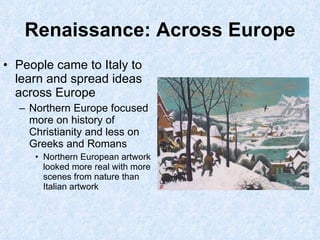
Renaissance: Across Europe People came to Italy to learn and spread ideas across Europe Northern Europe focused more on history of Christianity and less on Greeks and Romans Northern European artwork looked more real with more scenes from nature than Italian artwork
Renaissance: Michelangelo Wrote poetry, carved sculptures, painted ceiling of the Sistine Chapel
Renaissance: Leonardo da Vinci Sculptor, architect, town planner, inventor, engineer, mapmaker, painted  Mona Lisa
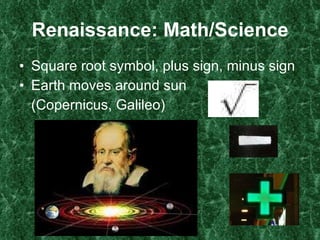
Renaissance: Math/Science Square root symbol, plus sign, minus sign Earth moves around sun  (Copernicus, Galileo)
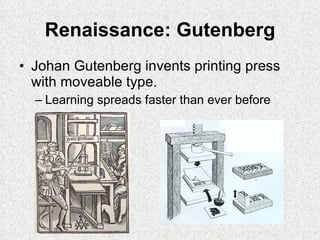
Renaissance: Gutenberg Johan Gutenberg invents printing press with moveable type. Learning spreads faster than ever before

Renaissance

  • 1.
    Renaissance: Beginnings AD1350s to 1700 Mongols reopen Silk Road Marco Polo visits China, returns to Europe, writes a book Causes people to want to go there and get Chinese goods Positives of Black Death No damage to farmland, goods, metals People are happy to be alive and spend money to erase memories of the plague (Medici Family) Ottoman Turks conquer Byzantine Empire Scholars flee to Italy with ancient texts of the Greeks and Romans
  • 2.
    Renaissance: Italy Majortrading cities: Milan, Florence, Genoa, Venice Florence wealthy from wool and banking Medici family were bankers with political power Hired artists and architects to make Florence great
  • 3.
    Renaissance: People Focuson humans and their abilities and actions (humanism) Machiavelli wrote The Prince Said rulers should be mean instead of nice “ End justifies the Means”
  • 4.
    Humanism Really anold idea from Ancient Greece and Rome Based on the Socratic and Platonic ideas of observation and reasoning Idea that man, not God, was the center of the universe Man controls his own destiny Man can learn about and understand his world by observation and reason without God’s help Helped spark a new age of secular learning and the development of early modern schools and universities such as Oxford and Cambridge Led many to question both governments and the institutional Church
  • 5.
    How did theRenaissance change thought? Age of Reason Age of “Faith” “ Rebirth” “ Dark” Ages Focus on learning the “Classics” (The Iliad, Aristotle) to inspire learning and the arts Little focus on learning and the arts The Individual is important The Individual not important Focus on this life Focus on Afterlife After Before
  • 6.
    Renaissance: Across EuropePeople came to Italy to learn and spread ideas across Europe Northern Europe focused more on history of Christianity and less on Greeks and Romans Northern European artwork looked more real with more scenes from nature than Italian artwork
  • 7.
    Renaissance: Michelangelo Wrotepoetry, carved sculptures, painted ceiling of the Sistine Chapel
  • 8.
    Renaissance: Leonardo daVinci Sculptor, architect, town planner, inventor, engineer, mapmaker, painted Mona Lisa
  • 9.
    Renaissance: Math/Science Squareroot symbol, plus sign, minus sign Earth moves around sun (Copernicus, Galileo)
  • 10.
    Renaissance: Gutenberg JohanGutenberg invents printing press with moveable type. Learning spreads faster than ever before