
 The earliest American literature was an
interesting mixture of travel accounts and
religious writings produced mainly by
immigrants from England.
Colonialism, Puritanism, and
Revolutionary Nationalism
(16th to Early 19th Century)

Characteristics
 The Colonial period was dominated by Puritan
beliefs and thus literature of this period is usually
historical, religious, or didactic.
 The most common genres were tracts, polemics,
journals, narratives, sermons, and some poetry.
 Imaginative literature was rare; in some colonies, it
was banned for being immoral.
Colonial Period
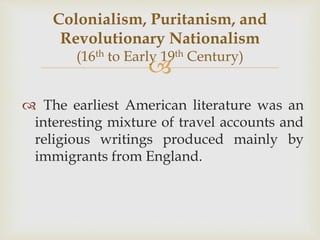
 William Bradford- the first
historian of America, described
in his book History of Plimmoth
Plantation the travel of the
pilgrims from the time they set
sail for the new land to their
landing on the coast of America
in 1620.
 William Bradford's descendants
include Noah Webster, Julia
Child and Supreme Court
Justice William Rehnquist.
Colonial Prose Writers

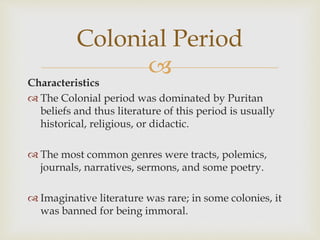
 Captain John Smith –
described the truthful
accounts of his adventures
in A Description of New
England. (1616)
 Francis Higginson –
described America’s wealth
of natural resources in New
England’s Plantation (1630).
Colonial Prose Writers

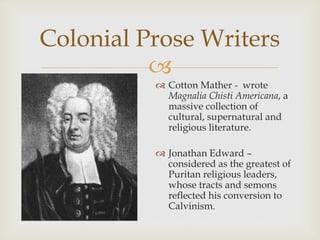
 Cotton Mather - wrote
Magnalia Chisti Americana, a
massive collection of
cultural, supernatural and
religious literature.
 Jonathan Edward –
considered as the greatest of
Puritan religious leaders,
whose tracts and semons
reflected his conversion to
Calvinism.
Colonial Prose Writers
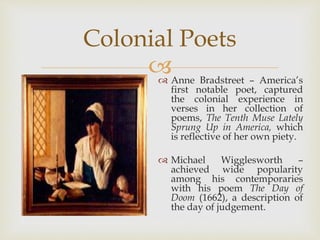
 Anne Bradstreet – America’s
first notable poet, captured
the colonial experience in
verses in her collection of
poems, The Tenth Muse Lately
Sprung Up in America, which
is reflective of her own piety.
 Michael Wigglesworth –
achieved wide popularity
among his contemporaries
with his poem The Day of
Doom (1662), a description of
the day of judgement.
Colonial Poets
Characteristics
 This period begins with the passing of the Stamp
Act in England and ends in 1790.
 The Revolutionary period usually refers to
writings that are politically motivated, either in
support of British rule, in support of American
patriotism and independence, or relating to the
Constitution.
 The Age of Reason—style of writing referred to as
“logical reasoning”.
 The best known writer of the Revolutionary era
outside of the political field is Ben Franklin.
Revolutionary Period
 Writing was meant to be public: during this
period over 50 newspapers were published in coastal
cities. Besides newspapers, most published writings
were pamphlets, magazines, and speeches (oratory).
 Thomas Paine’s Common Sense was influential in
swaying public opinion in favor of independence.
 This period produced political documents for the
ages. However, no American novels or plays of
importance had been written.
Revolutionary Period
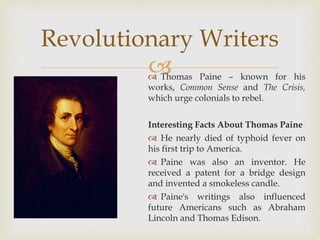
 Thomas Paine – known for his
works, Common Sense and The Crisis,
which urge colonials to rebel.
Interesting Facts About Thomas Paine
 He nearly died of typhoid fever on
his first trip to America.
 Paine was also an inventor. He
received a patent for a bridge design
and invented a smokeless candle.
 Paine's writings also influenced
future Americans such as Abraham
Lincoln and Thomas Edison.
Revolutionary Writers

American literature

  • 2.
      The earliestAmerican literature was an interesting mixture of travel accounts and religious writings produced mainly by immigrants from England. Colonialism, Puritanism, and Revolutionary Nationalism (16th to Early 19th Century)
  • 3.
     Characteristics  The Colonialperiod was dominated by Puritan beliefs and thus literature of this period is usually historical, religious, or didactic.  The most common genres were tracts, polemics, journals, narratives, sermons, and some poetry.  Imaginative literature was rare; in some colonies, it was banned for being immoral. Colonial Period
  • 4.
     William Bradford-the first historian of America, described in his book History of Plimmoth Plantation the travel of the pilgrims from the time they set sail for the new land to their landing on the coast of America in 1620.  William Bradford's descendants include Noah Webster, Julia Child and Supreme Court Justice William Rehnquist. Colonial Prose Writers
  • 5.
      Captain JohnSmith – described the truthful accounts of his adventures in A Description of New England. (1616)  Francis Higginson – described America’s wealth of natural resources in New England’s Plantation (1630). Colonial Prose Writers
  • 6.
      Cotton Mather- wrote Magnalia Chisti Americana, a massive collection of cultural, supernatural and religious literature.  Jonathan Edward – considered as the greatest of Puritan religious leaders, whose tracts and semons reflected his conversion to Calvinism. Colonial Prose Writers
  • 7.
     Anne Bradstreet– America’s first notable poet, captured the colonial experience in verses in her collection of poems, The Tenth Muse Lately Sprung Up in America, which is reflective of her own piety.  Michael Wigglesworth – achieved wide popularity among his contemporaries with his poem The Day of Doom (1662), a description of the day of judgement. Colonial Poets
  • 8.
    Characteristics  This periodbegins with the passing of the Stamp Act in England and ends in 1790.  The Revolutionary period usually refers to writings that are politically motivated, either in support of British rule, in support of American patriotism and independence, or relating to the Constitution.  The Age of Reason—style of writing referred to as “logical reasoning”.  The best known writer of the Revolutionary era outside of the political field is Ben Franklin. Revolutionary Period
  • 9.
     Writing wasmeant to be public: during this period over 50 newspapers were published in coastal cities. Besides newspapers, most published writings were pamphlets, magazines, and speeches (oratory).  Thomas Paine’s Common Sense was influential in swaying public opinion in favor of independence.  This period produced political documents for the ages. However, no American novels or plays of importance had been written. Revolutionary Period
  • 10.
     Thomas Paine– known for his works, Common Sense and The Crisis, which urge colonials to rebel. Interesting Facts About Thomas Paine  He nearly died of typhoid fever on his first trip to America.  Paine was also an inventor. He received a patent for a bridge design and invented a smokeless candle.  Paine's writings also influenced future Americans such as Abraham Lincoln and Thomas Edison. Revolutionary Writers