"English for specific purposes is a term that refers
to teaching or studying English for a particular
career (like law, medicine) or for business in
general." (International Teacher Training
Organization, 2005).
ESP involves teaching and learning the specific skills
and language needed by particular learners for a
particular purpose.
An ESP program is therefore built on an assessment
of purposes and needs and the functions for which
English is required
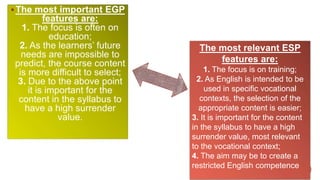
The most important EGP
features are:
1. The focus is often on
education;
2. As the learners’ future
needs are impossible to
predict, the course content
is more difficult to select;
3. Due to the above point
it is important for the
content in the syllabus to
have a high surrender
value.
The most relevant ESP
features are:
1. The focus is on training;
2. As English is intended to be
used in specific vocational
contexts, the selection of the
appropriate content is easier;
3. It is important for the content
in the syllabus to have a high
surrender value, most relevant
to the vocational context;
4. The aim may be to create a
restricted English competence
• The study has been conducted only on the teachers of
Elementary level of government schools of Rawalpindi and
Islamabad;
• It analyzes the needs of the learners by taking into consideration
their present situations.
• The study cannot be used to interpret the teachers on the
whole, because their needs can vary according to their situation.
• Course design can subject to various changes with difference
other than government elementary schools.
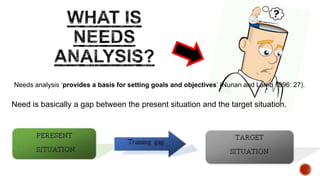
Needs analysis ‘provides a basis for setting goals and objectives’ (Nunan and Lamb 1996: 27).
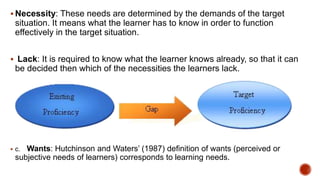
Need is basically a gap between the present situation and the target situation.
 Necessity: These needs are determined by the demands of the target
situation. It means what the learner has to know in order to function
effectively in the target situation.
 Lack: It is required to know what the learner knows already, so that it can
be decided then which of the necessities the learners lack.
 c. Wants: Hutchinson and Waters’ (1987) definition of wants (perceived or
subjective needs of learners) corresponds to learning needs.
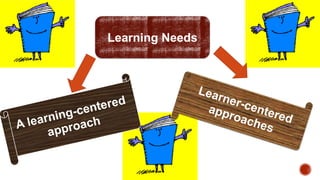
Learning Needs
A course for the teachers of Elementary level has been designed by
taking into account the learner's interest, how, what, why, when and
where they want to learn. This range of acquaintance is important to
design a significant course for the learners.
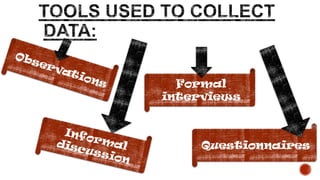
Questionnaires
Formal
interviews
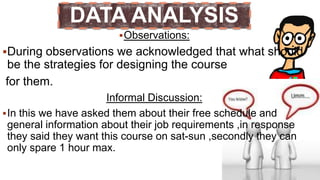
DATA ANALYSIS
Observations:
During observations we acknowledged that what should
be the strategies for designing the course
for them.
Informal Discussion:
In this we have asked them about their free schedule and
general information about their job requirements ,in response
they said they want this course on sat-sun ,secondly they can
only spare 1 hour max.
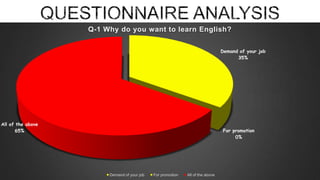
Demand of your job
35%
For promotion
0%
All of the above
65%
Q-1 Why do you want to learn English?
Demand of your job For promotion All of the above
To improve status
9%
To move in society
confidently
10%
Urge to learn
English
10%
To learn
international
modern teaching
techniques
38%
All of the above
33%
Q-2 ANY OTHER PURPOSE FOR LEARNING
ENGLISH?
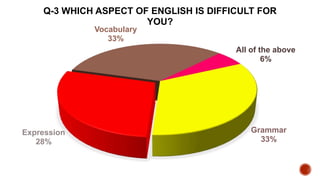
Grammar
33%
Expression
28%
Vocabulary
33%
All of the above
6%
Q-3 WHICH ASPECT OF ENGLISH IS DIFFICULT FOR
YOU?
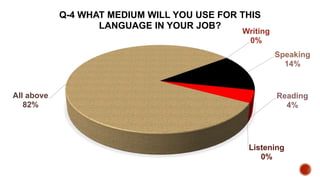
Writing
0%
Speaking
14%
Reading
4%
Listening
0%
All above
82%
Q-4 WHAT MEDIUM WILL YOU USE FOR THIS
LANGUAGE IN YOUR JOB?
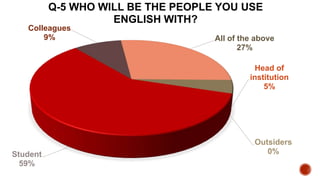
Head of
institution
5%
Outsiders
0%Student
59%
Colleagues
9% All of the above
27%
Q-5 WHO WILL BE THE PEOPLE YOU USE
ENGLISH WITH?
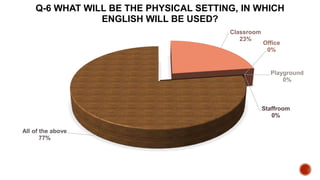
Classroom
23%
Playground
0%
Office
0%
Staffroom
0%
All of the above
77%
Q-6 WHAT WILL BE THE PHYSICAL SETTING, IN WHICH
ENGLISH WILL BE USED?
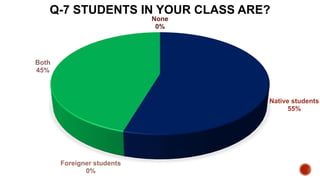
Native students
55%
Foreigner students
0%
Both
45%
None
0%
Q-7 STUDENTS IN YOUR CLASS ARE?
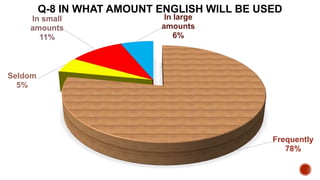
Frequently
78%
Seldom
5%
In small
amounts
11%
In large
amounts
6%
Q-8 IN WHAT AMOUNT ENGLISH WILL BE USED
Lecture and
demostration
18%
Conversation
9%
Meetings
0%
All of the above
73%
Q-9 IN WHAT CONTEXT YOU WILL USE ENGLISH?
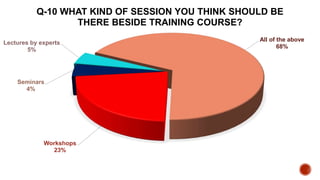
Workshops
23%
Seminars
4%
Lectures by experts
5%
All of the above
68%
Q-10 WHAT KIND OF SESSION YOU THINK SHOULD BE
THERE BESIDE TRAINING COURSE?
0
2
4
6
8
10
12
14
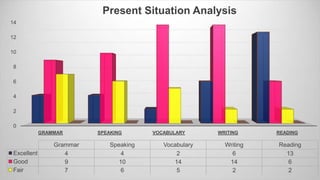
GRAMMAR SPEAKING VOCABULARY WRITING READING
Grammar Speaking Vocabulary Writing Reading
Excellent 4 4 2 6 13
Good 9 10 14 14 6
Fair 7 6 5 2 2
Present Situation Analysis
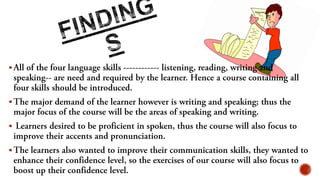
 In the light of the open ended questions that were provided to them, we have
analysed that majority of the people found English speaking and has issues with
Basic Grammar
 . While discussion we analysed that they even preferred to speak Urdu. As a teacher
the main demand of their job was to be fluent in speaking English.
 They also found obstacles in using English grammar. They had insufficient
vocabulary or if they had they didn’t know the appropriate use of that vocabulary. Due
to the lack of vocabulary, it was difficult for them to express their thoughts.
 When they were asked about their demands for the ESP course, they said that the
grammar should be focused in the course. They also wanted to improve their
vocabulary and desired some exercise should be added to improve their vocabulary.
They also wanted to improve their communicative skills as well as expression.




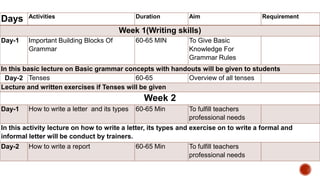
Days Activities Duration Aim Requirement
Week 1(Writing skills)
Day-1 Important Building Blocks Of
Grammar
60-65 MIN To Give Basic
Knowledge For
Grammar Rules
In this basic lecture on Basic grammar concepts with handouts will be given to students
Day-2 Tenses 60-65 Overview of all tenses
Lecture and written exercises if Tenses will be given
Week 2
Day-1 How to write a letter and its types 60-65 Min To fulfill teachers
professional needs
In this activity lecture on how to write a letter, its types and exercise on to write a formal and
informal letter will be conduct by trainers.
Day-2 How to write a report 60-65 Min To fulfill teachers
professional needs
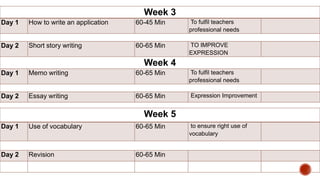
Week 5
Day 1 Use of vocabulary 60-65 Min to ensure right use of
vocabulary
Day 2 Revision 60-65 Min
Week 3
Day 1 How to write an application 60-45 Min To fulfil teachers
professional needs
Day 2 Short story writing 60-65 Min TO IMPROVE
EXPRESSION
Week 4
Day 1 Memo writing 60-65 Min To fulfil teachers
professional needs
Day 2 Essay writing 60-65 Min Expression Improvement
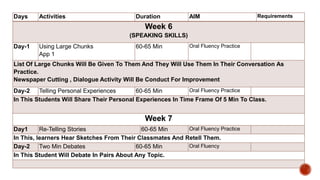
Days Activities Duration AIM Requirements
Week 6
(SPEAKING SKILLS)
Day-1 Using Large Chunks
App 1
60-65 Min Oral Fluency Practice
List Of Large Chunks Will Be Given To Them And They Will Use Them In Their Conversation As
Practice.
Newspaper Cutting , Dialogue Activity Will Be Conduct For Improvement
Day-2 Telling Personal Experiences 60-65 Min Oral Fluency Practice
In This Students Will Share Their Personal Experiences In Time Frame Of 5 Min To Class.
Week 7
Day1 Re-Telling Stories 60-65 Min Oral Fluency Practice
In This, learners Hear Sketches From Their Classmates And Retell Them.
Day-2 Two Min Debates 60-65 Min Oral Fluency
In This Student Will Debate In Pairs About Any Topic.
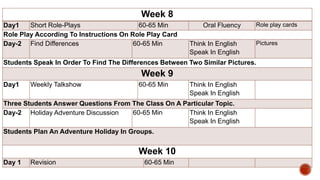
Week 8
Day1 Short Role-Plays 60-65 Min Oral Fluency Role play cards
Role Play According To Instructions On Role Play Card
Day-2 Find Differences 60-65 Min Think In English
Speak In English
Pictures
Students Speak In Order To Find The Differences Between Two Similar Pictures.
Week 9
Day1 Weekly Talkshow 60-65 Min Think In English
Speak In English
Three Students Answer Questions From The Class On A Particular Topic.
Day-2 Holiday Adventure Discussion 60-65 Min Think In English
Speak In English
Students Plan An Adventure Holiday In Groups.
Week 10
Day 1 Revision 60-65 Min
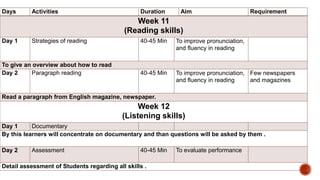
Days Activities Duration Aim Requirement
Week 11
(Reading skills)
Day 1 Strategies of reading 40-45 Min To improve pronunciation,
and fluency in reading
To give an overview about how to read
Day 2 Paragraph reading 40-45 Min To improve pronunciation,
and fluency in reading
Few newspapers
and magazines
Read a paragraph from English magazine, newspaper.
Week 12
(Listening skills)
Day 1 Documentary
By this learners will concentrate on documentary and than questions will be asked by them .
Day 2 Assessment 40-45 Min To evaluate performance
Detail assessment of Students regarding all skills .
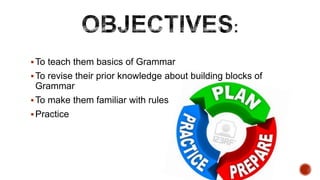
To teach them basics of Grammar
To revise their prior knowledge about building blocks of
Grammar
To make them familiar with rules
Practice
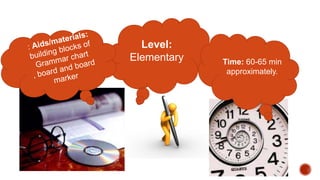
Level:
Elementary Time: 60-65 min
approximately.

1
2
3
4
5
6
7
8
9
10
aha
blah
cheers
darn
eek
goodbye
ouch
pooh
shoo
ugh
scared
meaningless talk
see you soon
get away
it is so easy
looks beautiful
disgust
pain
a drinking toast
got hurt
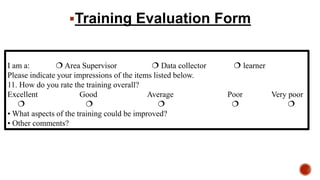
I am a:  Area Supervisor  Data collector  learner
Please indicate your impressions of the items listed below.
11. How do you rate the training overall?
Excellent Good Average Poor Very poor
    
• What aspects of the training could be improved?
• Other comments?
Training Evaluation Form
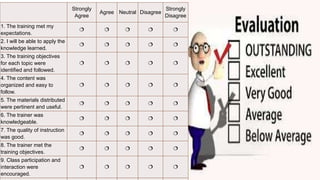
Strongly
Agree
Agree Neutral Disagree
Strongly
Disagree
1. The training met my
expectations.
    
2. I will be able to apply the
knowledge learned.
    
3. The training objectives
for each topic were
identified and followed.
    
4. The content was
organized and easy to
follow.
    
5. The materials distributed
were pertinent and useful.
    
6. The trainer was
knowledgeable.
    
7. The quality of instruction
was good.
    
8. The trainer met the
training objectives.
    
9. Class participation and
interaction were
encouraged.
    
Esp course design for teachers

Esp course design for teachers

  • 3.
    "English for specificpurposes is a term that refers to teaching or studying English for a particular career (like law, medicine) or for business in general." (International Teacher Training Organization, 2005). ESP involves teaching and learning the specific skills and language needed by particular learners for a particular purpose. An ESP program is therefore built on an assessment of purposes and needs and the functions for which English is required
  • 6.
    The most importantEGP features are: 1. The focus is often on education; 2. As the learners’ future needs are impossible to predict, the course content is more difficult to select; 3. Due to the above point it is important for the content in the syllabus to have a high surrender value. The most relevant ESP features are: 1. The focus is on training; 2. As English is intended to be used in specific vocational contexts, the selection of the appropriate content is easier; 3. It is important for the content in the syllabus to have a high surrender value, most relevant to the vocational context; 4. The aim may be to create a restricted English competence
  • 11.
    • The studyhas been conducted only on the teachers of Elementary level of government schools of Rawalpindi and Islamabad; • It analyzes the needs of the learners by taking into consideration their present situations. • The study cannot be used to interpret the teachers on the whole, because their needs can vary according to their situation. • Course design can subject to various changes with difference other than government elementary schools.
  • 12.
    Needs analysis ‘providesa basis for setting goals and objectives’ (Nunan and Lamb 1996: 27). Need is basically a gap between the present situation and the target situation.
  • 13.
     Necessity: Theseneeds are determined by the demands of the target situation. It means what the learner has to know in order to function effectively in the target situation.  Lack: It is required to know what the learner knows already, so that it can be decided then which of the necessities the learners lack.  c. Wants: Hutchinson and Waters’ (1987) definition of wants (perceived or subjective needs of learners) corresponds to learning needs.
  • 14.
  • 15.
    A course forthe teachers of Elementary level has been designed by taking into account the learner's interest, how, what, why, when and where they want to learn. This range of acquaintance is important to design a significant course for the learners.
  • 16.
  • 17.
    DATA ANALYSIS Observations: During observationswe acknowledged that what should be the strategies for designing the course for them. Informal Discussion: In this we have asked them about their free schedule and general information about their job requirements ,in response they said they want this course on sat-sun ,secondly they can only spare 1 hour max.
  • 19.
    Demand of yourjob 35% For promotion 0% All of the above 65% Q-1 Why do you want to learn English? Demand of your job For promotion All of the above
  • 20.
    To improve status 9% Tomove in society confidently 10% Urge to learn English 10% To learn international modern teaching techniques 38% All of the above 33% Q-2 ANY OTHER PURPOSE FOR LEARNING ENGLISH?
  • 21.
    Grammar 33% Expression 28% Vocabulary 33% All of theabove 6% Q-3 WHICH ASPECT OF ENGLISH IS DIFFICULT FOR YOU?
  • 22.
    Writing 0% Speaking 14% Reading 4% Listening 0% All above 82% Q-4 WHATMEDIUM WILL YOU USE FOR THIS LANGUAGE IN YOUR JOB?
  • 23.
    Head of institution 5% Outsiders 0%Student 59% Colleagues 9% Allof the above 27% Q-5 WHO WILL BE THE PEOPLE YOU USE ENGLISH WITH?
  • 24.
    Classroom 23% Playground 0% Office 0% Staffroom 0% All of theabove 77% Q-6 WHAT WILL BE THE PHYSICAL SETTING, IN WHICH ENGLISH WILL BE USED?
  • 25.
  • 26.
  • 27.
    Lecture and demostration 18% Conversation 9% Meetings 0% All ofthe above 73% Q-9 IN WHAT CONTEXT YOU WILL USE ENGLISH?
  • 28.
    Workshops 23% Seminars 4% Lectures by experts 5% Allof the above 68% Q-10 WHAT KIND OF SESSION YOU THINK SHOULD BE THERE BESIDE TRAINING COURSE?
  • 29.
    0 2 4 6 8 10 12 14 GRAMMAR SPEAKING VOCABULARYWRITING READING Grammar Speaking Vocabulary Writing Reading Excellent 4 4 2 6 13 Good 9 10 14 14 6 Fair 7 6 5 2 2 Present Situation Analysis
  • 30.
     In thelight of the open ended questions that were provided to them, we have analysed that majority of the people found English speaking and has issues with Basic Grammar  . While discussion we analysed that they even preferred to speak Urdu. As a teacher the main demand of their job was to be fluent in speaking English.  They also found obstacles in using English grammar. They had insufficient vocabulary or if they had they didn’t know the appropriate use of that vocabulary. Due to the lack of vocabulary, it was difficult for them to express their thoughts.  When they were asked about their demands for the ESP course, they said that the grammar should be focused in the course. They also wanted to improve their vocabulary and desired some exercise should be added to improve their vocabulary. They also wanted to improve their communicative skills as well as expression.
  • 31.
  • 34.
    Days Activities DurationAim Requirement Week 1(Writing skills) Day-1 Important Building Blocks Of Grammar 60-65 MIN To Give Basic Knowledge For Grammar Rules In this basic lecture on Basic grammar concepts with handouts will be given to students Day-2 Tenses 60-65 Overview of all tenses Lecture and written exercises if Tenses will be given Week 2 Day-1 How to write a letter and its types 60-65 Min To fulfill teachers professional needs In this activity lecture on how to write a letter, its types and exercise on to write a formal and informal letter will be conduct by trainers. Day-2 How to write a report 60-65 Min To fulfill teachers professional needs
  • 35.
    Week 5 Day 1Use of vocabulary 60-65 Min to ensure right use of vocabulary Day 2 Revision 60-65 Min Week 3 Day 1 How to write an application 60-45 Min To fulfil teachers professional needs Day 2 Short story writing 60-65 Min TO IMPROVE EXPRESSION Week 4 Day 1 Memo writing 60-65 Min To fulfil teachers professional needs Day 2 Essay writing 60-65 Min Expression Improvement
  • 36.
    Days Activities DurationAIM Requirements Week 6 (SPEAKING SKILLS) Day-1 Using Large Chunks App 1 60-65 Min Oral Fluency Practice List Of Large Chunks Will Be Given To Them And They Will Use Them In Their Conversation As Practice. Newspaper Cutting , Dialogue Activity Will Be Conduct For Improvement Day-2 Telling Personal Experiences 60-65 Min Oral Fluency Practice In This Students Will Share Their Personal Experiences In Time Frame Of 5 Min To Class. Week 7 Day1 Re-Telling Stories 60-65 Min Oral Fluency Practice In This, learners Hear Sketches From Their Classmates And Retell Them. Day-2 Two Min Debates 60-65 Min Oral Fluency In This Student Will Debate In Pairs About Any Topic.
  • 37.
    Week 8 Day1 ShortRole-Plays 60-65 Min Oral Fluency Role play cards Role Play According To Instructions On Role Play Card Day-2 Find Differences 60-65 Min Think In English Speak In English Pictures Students Speak In Order To Find The Differences Between Two Similar Pictures. Week 9 Day1 Weekly Talkshow 60-65 Min Think In English Speak In English Three Students Answer Questions From The Class On A Particular Topic. Day-2 Holiday Adventure Discussion 60-65 Min Think In English Speak In English Students Plan An Adventure Holiday In Groups. Week 10 Day 1 Revision 60-65 Min
  • 38.
    Days Activities DurationAim Requirement Week 11 (Reading skills) Day 1 Strategies of reading 40-45 Min To improve pronunciation, and fluency in reading To give an overview about how to read Day 2 Paragraph reading 40-45 Min To improve pronunciation, and fluency in reading Few newspapers and magazines Read a paragraph from English magazine, newspaper. Week 12 (Listening skills) Day 1 Documentary By this learners will concentrate on documentary and than questions will be asked by them . Day 2 Assessment 40-45 Min To evaluate performance Detail assessment of Students regarding all skills .
  • 40.
    To teach thembasics of Grammar To revise their prior knowledge about building blocks of Grammar To make them familiar with rules Practice
  • 42.
  • 43.
  • 45.
    1 2 3 4 5 6 7 8 9 10 aha blah cheers darn eek goodbye ouch pooh shoo ugh scared meaningless talk see yousoon get away it is so easy looks beautiful disgust pain a drinking toast got hurt
  • 47.
    I am a: Area Supervisor  Data collector  learner Please indicate your impressions of the items listed below. 11. How do you rate the training overall? Excellent Good Average Poor Very poor      • What aspects of the training could be improved? • Other comments? Training Evaluation Form
  • 48.
    Strongly Agree Agree Neutral Disagree Strongly Disagree 1.The training met my expectations.      2. I will be able to apply the knowledge learned.      3. The training objectives for each topic were identified and followed.      4. The content was organized and easy to follow.      5. The materials distributed were pertinent and useful.      6. The trainer was knowledgeable.      7. The quality of instruction was good.      8. The trainer met the training objectives.      9. Class participation and interaction were encouraged.     