Agenda Merchandising Retail Mix Importance of retail mix Retail Mix: Reliance Fresh v/s more. Conclusion
What is merchandising? Merchandising is the methods , practices and operations used to promote and sustain certain categories of commercial activities. It means maximizing merchandise sales using product design, selection, packaging, pricing and display that stimulates consumers to spend more .
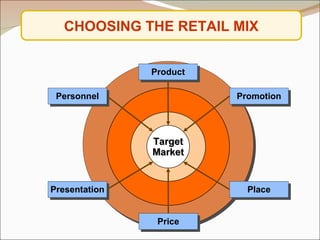
CHOOSING THE RETAIL MIX Target Market Product Price Promotion Place Personnel Presentation
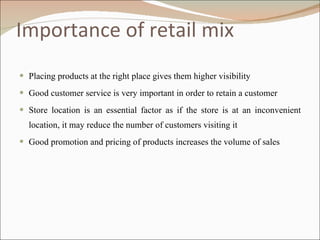
Importance of retail mix Placing products at the right place gives them higher visibility  Good customer service is very important in order to retain a customer Store location is an essential factor as if the store is at an inconvenient location, it may reduce the number of customers visiting it Good promotion and pricing of products increases the volume of sales
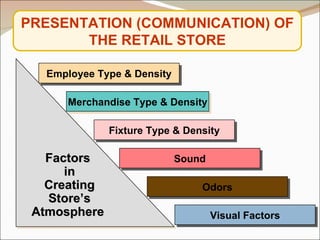
PRESENTATION (COMMUNICATION) OF THE RETAIL STORE Employee Type & Density Merchandise Type & Density Fixture Type & Density Sound Odors Visual Factors Factors  in Creating Store’s Atmosphere
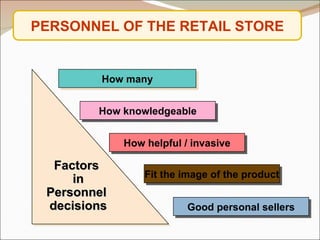
How many How knowledgeable How helpful / invasive Fit the image of the product Good personal sellers Factors  in Personnel  decisions PERSONNEL OF THE RETAIL STORE
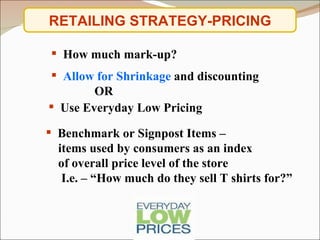
RETAILING STRATEGY-PRICING Use Everyday Low Pricing Benchmark or Signpost Items – items used by consumers as an index  of overall price level of the store I.e. – “How much do they sell T shirts for?” Allow for Shrinkage  and discounting  OR How much mark-up?
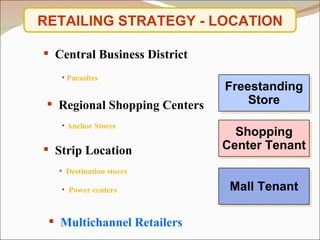
RETAILING STRATEGY - LOCATION Central Business District Regional Shopping Centers Strip Location Multichannel Retailers Anchor Stores  Parasites Destination stores Power centers Freestanding Store Shopping Center Tenant Mall Tenant
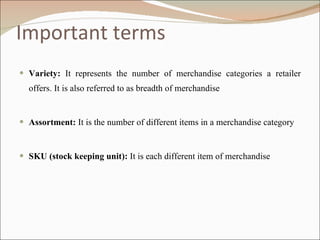
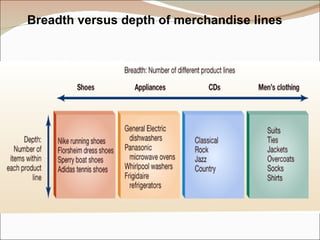
Important terms Variety:  It represents the number of merchandise categories a retailer offers. It is also referred to as breadth of merchandise Assortment:  It is the number of different items in a merchandise category SKU (stock keeping unit):  It is each different item of merchandise
Breadth versus depth of merchandise lines
Retail Mix Reliance Fresh v/s More
Reliance Fresh Reliance Retail Limited (RRL), a subsidiary of the Indian conglomerate Retail Industries Limited, launched its first convenience store in November 2006.  RRL has grown rapidly and operates over 900 stores across 80 cities in 14 States, which include over 750 Reliance Fresh stores. Reliance Fresh is the convenience store format which forms part of the retail business of Reliance Industries of India . It is positioned as a pure play super market focusing on categories like food, FMCG, home, consumer durables, IT and wellness , with food accounting for the bulk of the business.
Place Generally located in small commercial complexes close to 3-4 big residential areas Observation: found close to ‘Crossroads’ Enjoy a clear view from the road
Promotion The main idea behind every effort is to make a bulk purchase Saturday and Sunday are  considered as discount and scheme day Two types of offer: BOGO BXGY Rebates and Premiums focusing on bill value Audio visual tools been employed
Product Strictly vegetarian Product Mix consists of Fresh Fruits, Vegetables, Dairy products, Frozen Items, Groceries, cosmetics and Daily Use products Less Assortment but focus on specific product categories like vegetables, dairy products, detergents, fruits and daily use items
Presentation The pure foods convenience store model of Reliance Fresh requires far less space than a full-fledged supermarket Most of these outlets need around only 2,000-5,000 sq. ft Simple, colorful but cramped Separate entry and exit point Chocolates and other kids items were nearby cash counter Vegetables and Fruits items were in display near entry gate
Pricing Low prized Private labels Discount on bulk buying Measures taken to reduce the length of Supply Chain thereby purchase directly from farmers, which is in turn sent to distribution centre. Two times supply of vegetable and fruits daily to ensure “fresh”
Personnel 2 shift staff for small stores and 3 shift staff for larger ones 5 to 6 sales persons per shift Staff uniform: red, green and blue 1 week training given to staff Amiable staff but poorly informed
Private labels Reliance Fresh: Reliance Fresh’s shelves provide an indication that the group is looking for higher margins. Most of the staples are under its own private label brand — ‘ Reliance Select’.  Excepting a few packets of Nestle’s Maggi, or MTR’s masalas or Pepsi’s Lays chips, there is  very little shelf space given to the big brand owners in the country.  Reason: private labels offer far better profit margin to the retailer than branded products of FMCG companies.
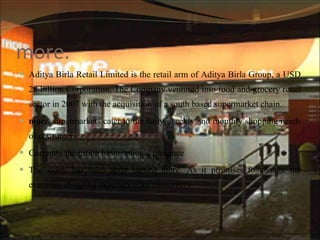
more.  Aditya Birla Retail Limited is the retail arm of Aditya Birla Group, a USD 28 billion Corporation. The Company ventured into food and grocery retail sector in 2007 with the acquisition of a south based supermarket chain. more.  supermarkets cater to the daily, weekly and monthly shopping needs of consumers. Currently the group has a national presence The store, has been aptly named more. As it promises to change the everyday shopping experience for consumers
Place Generally more. is located in a  series of  conveniently located neighbourhood supermarkets Currently it has 18 stores in Ahmedabad Located in areas of high footfalls like movie theatres, shopping malls, restaurants, etc.
Promotion Large size promotional offer banner at the entrance Special offers on private labels displayed near the entrance Audio – visual promotion of private label products New concept:  Color Slips based on product pricing Introduction of $ store concept Promotional schemes combined with vodafone Mobile store kiosk - parasite Attractive offer names like ‘July mein Dhulai’
Product The product offerings of the more supermarkets include a wide range across fresh fruits and vegetables, groceries, personal care, home care, general merchandise and a basic range of apparels Hypermarket stores also have a strong emphasis on general merchandise and apparels  more.  also has a range of products from its own stable available across value, premium and select ranges Variety is a promise delivered across the store
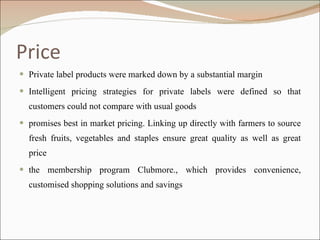
Price Private label products were marked down by a substantial margin Intelligent pricing strategies for private labels were defined so that customers could not compare with usual goods promises best in market pricing. Linking up directly with farmers to source fresh fruits, vegetables and staples ensure great quality as well as great price the membership program Clubmore., which provides convenience, customised shopping solutions and savings
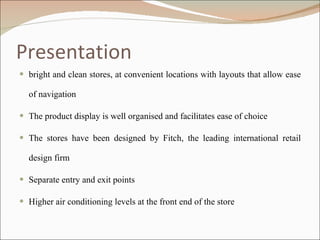
Presentation bright and clean stores, at convenient locations with layouts that allow ease of navigation The product display is well organised and facilitates ease of choice The stores have been designed by Fitch, the leading international retail design firm Separate entry and exit points Higher air conditioning levels at the front end of the store
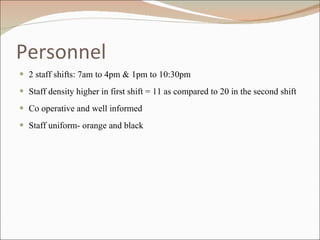
Personnel 2 staff shifts: 7am to 4pm & 1pm to 10:30pm Staff density higher in first shift = 11 as compared to 20 in the second shift Co operative and well informed Staff uniform- orange and black
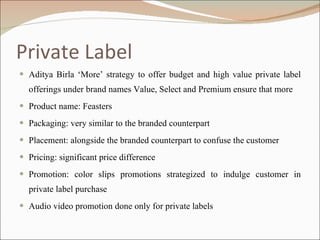
Private Label Aditya Birla ‘More’ strategy to offer budget and high value private label offerings under brand names Value, Select and Premium ensure that more Product name: Feasters Packaging: very similar to the branded counterpart Placement: alongside the branded counterpart to confuse the customer Pricing: significant price difference  Promotion: color slips promotions strategized to indulge customer in private label purchase Audio video promotion done only for private labels
Conclusion Both the retail giants do not vary much in their offerings and image It may be possible in the near future that they are left with no differentiation but still create a loyal customer base for themselves  According to analysts, in the long run, this would develop niche markets for them
 

Reliance Fresh vs more Final

  • 1.
  • 2.
    Agenda Merchandising RetailMix Importance of retail mix Retail Mix: Reliance Fresh v/s more. Conclusion
  • 3.
    What is merchandising?Merchandising is the methods , practices and operations used to promote and sustain certain categories of commercial activities. It means maximizing merchandise sales using product design, selection, packaging, pricing and display that stimulates consumers to spend more .
  • 4.
    CHOOSING THE RETAILMIX Target Market Product Price Promotion Place Personnel Presentation
  • 5.
    Importance of retailmix Placing products at the right place gives them higher visibility Good customer service is very important in order to retain a customer Store location is an essential factor as if the store is at an inconvenient location, it may reduce the number of customers visiting it Good promotion and pricing of products increases the volume of sales
  • 6.
    PRESENTATION (COMMUNICATION) OFTHE RETAIL STORE Employee Type & Density Merchandise Type & Density Fixture Type & Density Sound Odors Visual Factors Factors in Creating Store’s Atmosphere
  • 7.
    How many Howknowledgeable How helpful / invasive Fit the image of the product Good personal sellers Factors in Personnel decisions PERSONNEL OF THE RETAIL STORE
  • 8.
    RETAILING STRATEGY-PRICING UseEveryday Low Pricing Benchmark or Signpost Items – items used by consumers as an index of overall price level of the store I.e. – “How much do they sell T shirts for?” Allow for Shrinkage and discounting OR How much mark-up?
  • 9.
    RETAILING STRATEGY -LOCATION Central Business District Regional Shopping Centers Strip Location Multichannel Retailers Anchor Stores Parasites Destination stores Power centers Freestanding Store Shopping Center Tenant Mall Tenant
  • 10.
    Important terms Variety: It represents the number of merchandise categories a retailer offers. It is also referred to as breadth of merchandise Assortment: It is the number of different items in a merchandise category SKU (stock keeping unit): It is each different item of merchandise
  • 11.
    Breadth versus depthof merchandise lines
  • 12.
    Retail Mix RelianceFresh v/s More
  • 13.
    Reliance Fresh RelianceRetail Limited (RRL), a subsidiary of the Indian conglomerate Retail Industries Limited, launched its first convenience store in November 2006. RRL has grown rapidly and operates over 900 stores across 80 cities in 14 States, which include over 750 Reliance Fresh stores. Reliance Fresh is the convenience store format which forms part of the retail business of Reliance Industries of India . It is positioned as a pure play super market focusing on categories like food, FMCG, home, consumer durables, IT and wellness , with food accounting for the bulk of the business.
  • 14.
    Place Generally locatedin small commercial complexes close to 3-4 big residential areas Observation: found close to ‘Crossroads’ Enjoy a clear view from the road
  • 15.
    Promotion The mainidea behind every effort is to make a bulk purchase Saturday and Sunday are considered as discount and scheme day Two types of offer: BOGO BXGY Rebates and Premiums focusing on bill value Audio visual tools been employed
  • 16.
    Product Strictly vegetarianProduct Mix consists of Fresh Fruits, Vegetables, Dairy products, Frozen Items, Groceries, cosmetics and Daily Use products Less Assortment but focus on specific product categories like vegetables, dairy products, detergents, fruits and daily use items
  • 17.
    Presentation The purefoods convenience store model of Reliance Fresh requires far less space than a full-fledged supermarket Most of these outlets need around only 2,000-5,000 sq. ft Simple, colorful but cramped Separate entry and exit point Chocolates and other kids items were nearby cash counter Vegetables and Fruits items were in display near entry gate
  • 18.
    Pricing Low prizedPrivate labels Discount on bulk buying Measures taken to reduce the length of Supply Chain thereby purchase directly from farmers, which is in turn sent to distribution centre. Two times supply of vegetable and fruits daily to ensure “fresh”
  • 19.
    Personnel 2 shiftstaff for small stores and 3 shift staff for larger ones 5 to 6 sales persons per shift Staff uniform: red, green and blue 1 week training given to staff Amiable staff but poorly informed
  • 20.
    Private labels RelianceFresh: Reliance Fresh’s shelves provide an indication that the group is looking for higher margins. Most of the staples are under its own private label brand — ‘ Reliance Select’. Excepting a few packets of Nestle’s Maggi, or MTR’s masalas or Pepsi’s Lays chips, there is very little shelf space given to the big brand owners in the country. Reason: private labels offer far better profit margin to the retailer than branded products of FMCG companies.
  • 21.
    more. AdityaBirla Retail Limited is the retail arm of Aditya Birla Group, a USD 28 billion Corporation. The Company ventured into food and grocery retail sector in 2007 with the acquisition of a south based supermarket chain. more.  supermarkets cater to the daily, weekly and monthly shopping needs of consumers. Currently the group has a national presence The store, has been aptly named more. As it promises to change the everyday shopping experience for consumers
  • 22.
    Place Generally more.is located in a series of conveniently located neighbourhood supermarkets Currently it has 18 stores in Ahmedabad Located in areas of high footfalls like movie theatres, shopping malls, restaurants, etc.
  • 23.
    Promotion Large sizepromotional offer banner at the entrance Special offers on private labels displayed near the entrance Audio – visual promotion of private label products New concept: Color Slips based on product pricing Introduction of $ store concept Promotional schemes combined with vodafone Mobile store kiosk - parasite Attractive offer names like ‘July mein Dhulai’
  • 24.
    Product The productofferings of the more supermarkets include a wide range across fresh fruits and vegetables, groceries, personal care, home care, general merchandise and a basic range of apparels Hypermarket stores also have a strong emphasis on general merchandise and apparels more. also has a range of products from its own stable available across value, premium and select ranges Variety is a promise delivered across the store
  • 25.
    Price Private labelproducts were marked down by a substantial margin Intelligent pricing strategies for private labels were defined so that customers could not compare with usual goods promises best in market pricing. Linking up directly with farmers to source fresh fruits, vegetables and staples ensure great quality as well as great price the membership program Clubmore., which provides convenience, customised shopping solutions and savings
  • 26.
    Presentation bright andclean stores, at convenient locations with layouts that allow ease of navigation The product display is well organised and facilitates ease of choice The stores have been designed by Fitch, the leading international retail design firm Separate entry and exit points Higher air conditioning levels at the front end of the store
  • 27.
    Personnel 2 staffshifts: 7am to 4pm & 1pm to 10:30pm Staff density higher in first shift = 11 as compared to 20 in the second shift Co operative and well informed Staff uniform- orange and black
  • 28.
    Private Label AdityaBirla ‘More’ strategy to offer budget and high value private label offerings under brand names Value, Select and Premium ensure that more Product name: Feasters Packaging: very similar to the branded counterpart Placement: alongside the branded counterpart to confuse the customer Pricing: significant price difference Promotion: color slips promotions strategized to indulge customer in private label purchase Audio video promotion done only for private labels
  • 29.
    Conclusion Both theretail giants do not vary much in their offerings and image It may be possible in the near future that they are left with no differentiation but still create a loyal customer base for themselves According to analysts, in the long run, this would develop niche markets for them
  • 30.

Editor's Notes

  • #5 Notes: Exhibit 11.4 shows the retailing mix.
  • #7 Notes: The presentation of a retail store helps determine the store’s image and positioning in consumers’ minds. For example, positioning as an upscale store would use a lavish or sophisticated presentation. The main element of presentation is atmosphere, with the most influential factors shown on this slide. Employee type and density: an employee’s general characteristics such as friendly and knowledgeable, and the number of employees in the selling space. Merchandise type and density: the type of merchandise carried and how it is displayed. Fixture type and density: elegant, trendy, uncluttered. Technology may be added as a fixture. Sound: music at a restaurant or store. Odors: smells of pastries in bakeries, fragrances as a key design element. Visual factors: colors can create a mood or focus attention. 4. Retailers are now adding an element of entertainment to their store atmosphere.
  • #9 Shrinkage is the breakage and theft of merchandise by customers and employees.
  • #10 Parasite stores do not create their own traffic. They make money based on their proximity to things that will draw foot traffic. (bigger stores, train stations, airports, office buildings, etc.) power Centres Huge shopping strips with multiple anchors and often a supermarket Anchor Stores A large store, such as a department store or supermarket, that is prominently located in a shopping mall to attract customers who are then expected to patronize the other shops in the mall.