Basic Concept of Reliability
Fault Tolerance and Failure Diagnosis
Definition
Fault is malfunction or deviation from expected behavior
Tolerance as the capacity for enduring
Putting the words together, fault tolerance refers to a system's ability to deal with
malfunctions.
Categories of Faults
Transient faults : These occur once and then disappear
Intermittent faults : Intermittent faults are characterized by a fault occurring, then
vanishing again, then reoccurring, then vanishing
Permanent faults : This type of failure is persistent: it continues to exist until the faulty
component is repaired or replaced
Achieving Fault Tolerance
The general approach to building fault tolerant systems is redundancy:
Information redundancy seeks to provide fault tolerance through replicating or coding
the data
Time redundancy achieves fault tolerance by performing an operation several times.
Physical redundancy deals with devices, not data. We add extra equipment to enable
the system to tolerate the loss of some failed components
Redundancy and Replication.
With replication, we have several units operating concurrently and a voting (quorum)
system to select the outcome.
With redundancy, only one unit is functioning while the redundant units are standing

by to fill in in case the unit ceases to work.
The Definition of Reliability
A fundamental problem in estimating reliability is whether a system will function in a
prescribed manner in a given environment for a given period of time. This depends on
a number of factors:
design of the system
the parts and components used
and the environment
Reliability is the probability that the given system will perform its required function
under specified conditions for a specified period of time.
Increasing Reliability
employing the method of worst case design, using high-quality components and
imposing strict quality control procedures during the assembly phase
An alternative approach to reliable system design is to incorporate “redundancy” (i.e.
additional resources) into a system with the aim of masking the effects of faults
Reliability and the Failure Rate
Let N = identical components under “stress conditions”
Let S(t) be the number of surviving components
Let F(t) be the number of components that have failed
Then Reliability(R(t)) = S(t)/N
Continuation:
The probability of failure of the components, also known as the unreliability Q(t), is:
Q(t) = F(t)/N
Since S(t) + F(t) = N, we must have:
R(t) + Q(t) = 1
Continuation:
The failure rate, also known as the “hazard rate”, Z(t) is defined to be the number of
failures per unit time compared with the number of surviving components:
Z(t) = 1/S(t) * dF(t)/dt
Continuation:
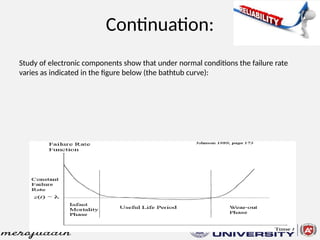
Study of electronic components show that under normal conditions the failure rate
varies as indicated in the figure below (the bathtub curve):
Continuation:
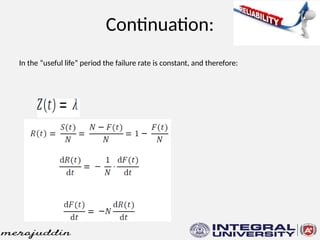
In the “useful life” period the failure rate is constant, and therefore:
Continuation:
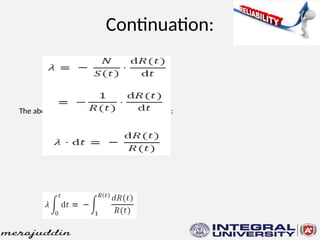
The above expression may be integrated giving:
Continuation:
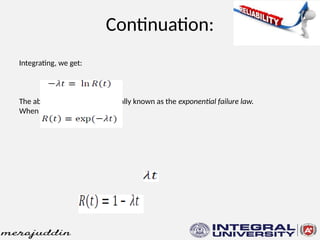
Integrating, we get:
The above relationship is generally known as the exponential failure law.
When the product is small:
Relation between Reliability and Mean-
Time-Between-Failures
Reliability R(t) gives different values for different operating times
More useful to the user is the average time a system will run between failures; this
time is known as the mean-time-between-failures (MTBF)
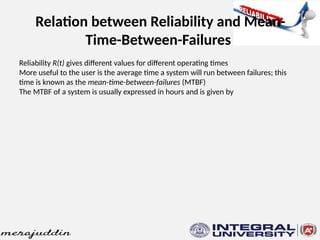
The MTBF of a system is usually expressed in hours and is given by
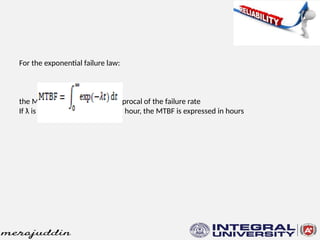
For the exponential failure law:
MTBF = 1/ƛ
the MTBF of a system is the reciprocal of the failure rate
If ƛ is the number of failures per hour, the MTBF is expressed in hours
Example:
We have 4000 components with a failure rate of 0.02% per 1000 hours. Find the
average number of failures per hour and the MTBF.
Average number is failures is given by the:
failure rate × total number components
=
MTBF = = 1250 hrs
R(t) =
Again from the exponential failure law, if
ƛt <<, then ƛt
R(t) =
MTBF =
Example:
A first-generation computer contains 10,000 thermionic valves each with = 0.5% /
(1000 hours). What is the period of 99% reliability?
Maintainability
When a system fails, repair action is normally carried out to restore the system to
operational effectiveness
The probability that a failed system will be restored to working order within a specified
time is called the maintainability of the system
There is therefore a relationship between maintainability and repair rate μ and hence
with mean-time-to-repair (MTTR)
MTTR and μ are always related:
MTTR and μ are related to maintainability M(t) as follows:
Where t is the permissible time constraint for the maintenance action.
In order to design and manufacture a maintainable system, it is necessary to predict
the MTTR for various fault condition that could occur in the system.
The system repair time consists of two separate intervals – passive repair time and
active repair time. The passive repair time is mainly determined by the time taken by
service engineers to travel to the customer site. In many cases the cost of travel time
exceeds the cost of the actual repair.
The active repair time is directly affected by the system design and may be subdivided
as follows:
The time between the occurrence of a failure and the system user becoming aware
that it has occurred.
The time needed to detect a fault and isolate the replaceable component(s)
responsible.
The time needed to replace the faulty component(s).
The time needed to verify that the fault has been removed and the system is fully
operational
Availability
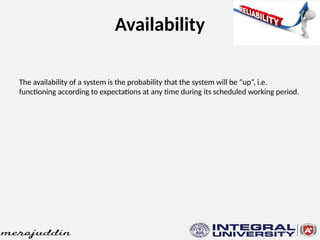
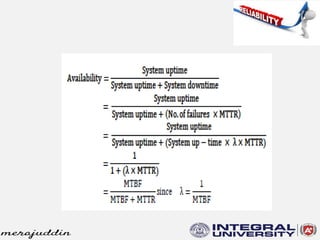
The availability of a system is the probability that the system will be “up”, i.e.
functioning according to expectations at any time during its scheduled working period.
Series and Parallel Systems
The reliability of a system can be derived in terms of the reliabilities or the failure rates
of the subsystems used to build it
Two limiting cases of systems design are frequently met in practice:
1. Systems in which each subsystem must function if the system as a whole is to
function.
2. Systems in which the correct operation of just one subsystem is sufficient for the
system to function satisfactorily. In other words the system consists of redundant
subsystems and will fail only if all subsystems fail.
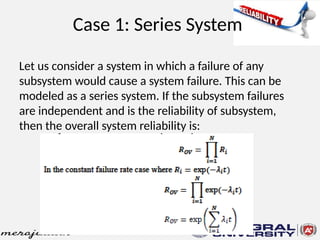
Case 1: Series System
Let us consider a system in which a failure of any
subsystem would cause a system failure. This can be
modeled as a series system. If the subsystem failures
are independent and is the reliability of subsystem,
then the overall system reliability is:
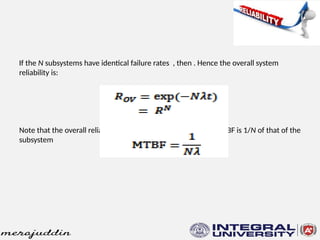
If the N subsystems have identical failure rates , then . Hence the overall system
reliability is:
Note that the overall reliability is decreased N-fold while the MTBF is 1/N of that of the
subsystem
Case 2: Parallel System
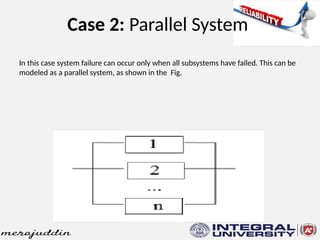
In this case system failure can occur only when all subsystems have failed. This can be
modeled as a parallel system, as shown in the Fig.
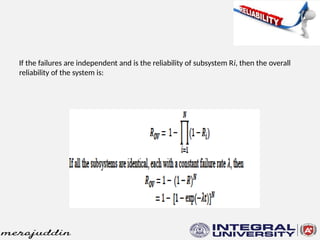
If the failures are independent and is the reliability of subsystem Ri, then the overall
reliability of the system is:
For example if a parallel system consists of two subsystems, then:
Therefore the MTBF of the system is:
In practice a system normally consists of a combination of series and parallel
subsystems. These systems are useful when short-circuits or open-circuits are the
most commonly expected faults
Parallel-to-Series Network
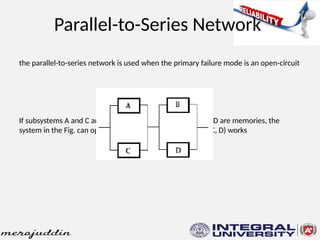
the parallel-to-series network is used when the primary failure mode is an open-circuit
If subsystems A and C are processors and subsystems B and D are memories, the
system in the Fig. can operate if (A, D) or (C, B) or (A, B) or (C, D) works
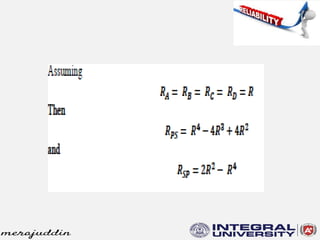
In this situation the reliability of the parallel-to-series system is:
where , , and are the reliabilities of subsystems A, B, C and D respectively
Series-to-Parallel System
series-to-parallel network of is used when the primary mode to is a short circuit
the system of the Fig. can operate only if either (A, B) or (C, D) works
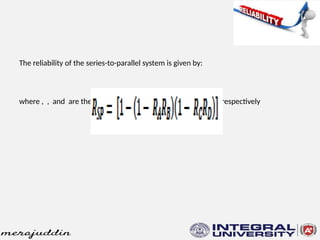
The reliability of the series-to-parallel system is given by:
where , , and are the reliabilities of subsystems A, B, C and D respectively
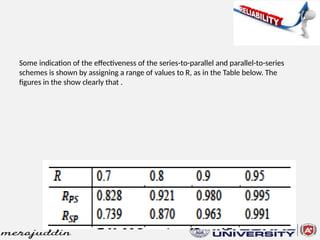
Some indication of the effectiveness of the series-to-parallel and parallel-to-series
schemes is shown by assigning a range of values to R, as in the Table below. The
figures in the show clearly that .
M out of N Systems
An M-of-N system is one which consists of N identical components, with failure
occurring if fewer than M components are still functional
Best-known example - The Triplex (TMR) is three identical components whose outputs
are voted on. This is a 2-of-3 system: as long as a majority of the processors produce
correct results, the system will be functional
Reliability of M out of N Systems
For N identical components, R(t) is the reliability of an individual components. The
reliability of the system is the probability that N-M or fewer components have failed
Consider a TMR - Triple Modular Redundant Cluster which is perhaps the most
important M-of-N system where M=2, N=3 - system is good if at least two components
are operational
A voter picks the majority output but a Voter can fail. Let the Voter reliability be
Rvot(t).
Mr. Merajuddin
(meraj786sh@gmail.com)

reliability Fault Tolerance and Failure Diagnosis

  • 1.
    Basic Concept ofReliability Fault Tolerance and Failure Diagnosis
  • 2.
    Definition Fault is malfunctionor deviation from expected behavior Tolerance as the capacity for enduring Putting the words together, fault tolerance refers to a system's ability to deal with malfunctions.
  • 3.
    Categories of Faults Transientfaults : These occur once and then disappear Intermittent faults : Intermittent faults are characterized by a fault occurring, then vanishing again, then reoccurring, then vanishing Permanent faults : This type of failure is persistent: it continues to exist until the faulty component is repaired or replaced
  • 4.
    Achieving Fault Tolerance Thegeneral approach to building fault tolerant systems is redundancy: Information redundancy seeks to provide fault tolerance through replicating or coding the data Time redundancy achieves fault tolerance by performing an operation several times. Physical redundancy deals with devices, not data. We add extra equipment to enable the system to tolerate the loss of some failed components
  • 5.
    Redundancy and Replication. Withreplication, we have several units operating concurrently and a voting (quorum) system to select the outcome. With redundancy, only one unit is functioning while the redundant units are standing by to fill in in case the unit ceases to work.
  • 6.
    The Definition ofReliability A fundamental problem in estimating reliability is whether a system will function in a prescribed manner in a given environment for a given period of time. This depends on a number of factors: design of the system the parts and components used and the environment Reliability is the probability that the given system will perform its required function under specified conditions for a specified period of time.
  • 7.
    Increasing Reliability employing themethod of worst case design, using high-quality components and imposing strict quality control procedures during the assembly phase An alternative approach to reliable system design is to incorporate “redundancy” (i.e. additional resources) into a system with the aim of masking the effects of faults
  • 8.
    Reliability and theFailure Rate Let N = identical components under “stress conditions” Let S(t) be the number of surviving components Let F(t) be the number of components that have failed Then Reliability(R(t)) = S(t)/N
  • 9.
    Continuation: The probability offailure of the components, also known as the unreliability Q(t), is: Q(t) = F(t)/N Since S(t) + F(t) = N, we must have: R(t) + Q(t) = 1
  • 10.
    Continuation: The failure rate,also known as the “hazard rate”, Z(t) is defined to be the number of failures per unit time compared with the number of surviving components: Z(t) = 1/S(t) * dF(t)/dt
  • 11.
    Continuation: Study of electroniccomponents show that under normal conditions the failure rate varies as indicated in the figure below (the bathtub curve):
  • 12.
    Continuation: In the “usefullife” period the failure rate is constant, and therefore:
  • 13.
    Continuation: The above expressionmay be integrated giving:
  • 14.
    Continuation: Integrating, we get: Theabove relationship is generally known as the exponential failure law. When the product is small:
  • 15.
    Relation between Reliabilityand Mean- Time-Between-Failures Reliability R(t) gives different values for different operating times More useful to the user is the average time a system will run between failures; this time is known as the mean-time-between-failures (MTBF) The MTBF of a system is usually expressed in hours and is given by
  • 16.
    For the exponentialfailure law: MTBF = 1/ƛ the MTBF of a system is the reciprocal of the failure rate If ƛ is the number of failures per hour, the MTBF is expressed in hours
  • 17.
    Example: We have 4000components with a failure rate of 0.02% per 1000 hours. Find the average number of failures per hour and the MTBF.
  • 18.
    Average number isfailures is given by the: failure rate × total number components = MTBF = = 1250 hrs
  • 19.
    R(t) = Again fromthe exponential failure law, if ƛt <<, then ƛt R(t) = MTBF =
  • 20.
    Example: A first-generation computercontains 10,000 thermionic valves each with = 0.5% / (1000 hours). What is the period of 99% reliability?
  • 22.
    Maintainability When a systemfails, repair action is normally carried out to restore the system to operational effectiveness The probability that a failed system will be restored to working order within a specified time is called the maintainability of the system There is therefore a relationship between maintainability and repair rate μ and hence with mean-time-to-repair (MTTR)
  • 23.
    MTTR and μare always related: MTTR and μ are related to maintainability M(t) as follows: Where t is the permissible time constraint for the maintenance action.
  • 24.
    In order todesign and manufacture a maintainable system, it is necessary to predict the MTTR for various fault condition that could occur in the system. The system repair time consists of two separate intervals – passive repair time and active repair time. The passive repair time is mainly determined by the time taken by service engineers to travel to the customer site. In many cases the cost of travel time exceeds the cost of the actual repair.
  • 25.
    The active repairtime is directly affected by the system design and may be subdivided as follows: The time between the occurrence of a failure and the system user becoming aware that it has occurred. The time needed to detect a fault and isolate the replaceable component(s) responsible. The time needed to replace the faulty component(s). The time needed to verify that the fault has been removed and the system is fully operational
  • 26.
    Availability The availability ofa system is the probability that the system will be “up”, i.e. functioning according to expectations at any time during its scheduled working period.
  • 28.
    Series and ParallelSystems The reliability of a system can be derived in terms of the reliabilities or the failure rates of the subsystems used to build it Two limiting cases of systems design are frequently met in practice: 1. Systems in which each subsystem must function if the system as a whole is to function. 2. Systems in which the correct operation of just one subsystem is sufficient for the system to function satisfactorily. In other words the system consists of redundant subsystems and will fail only if all subsystems fail.
  • 29.
    Case 1: SeriesSystem Let us consider a system in which a failure of any subsystem would cause a system failure. This can be modeled as a series system. If the subsystem failures are independent and is the reliability of subsystem, then the overall system reliability is:
  • 30.
    If the Nsubsystems have identical failure rates , then . Hence the overall system reliability is: Note that the overall reliability is decreased N-fold while the MTBF is 1/N of that of the subsystem
  • 31.
    Case 2: ParallelSystem In this case system failure can occur only when all subsystems have failed. This can be modeled as a parallel system, as shown in the Fig.
  • 32.
    If the failuresare independent and is the reliability of subsystem Ri, then the overall reliability of the system is:
  • 33.
    For example ifa parallel system consists of two subsystems, then: Therefore the MTBF of the system is:
  • 34.
    In practice asystem normally consists of a combination of series and parallel subsystems. These systems are useful when short-circuits or open-circuits are the most commonly expected faults
  • 35.
    Parallel-to-Series Network the parallel-to-seriesnetwork is used when the primary failure mode is an open-circuit If subsystems A and C are processors and subsystems B and D are memories, the system in the Fig. can operate if (A, D) or (C, B) or (A, B) or (C, D) works
  • 36.
    In this situationthe reliability of the parallel-to-series system is: where , , and are the reliabilities of subsystems A, B, C and D respectively
  • 37.
    Series-to-Parallel System series-to-parallel networkof is used when the primary mode to is a short circuit the system of the Fig. can operate only if either (A, B) or (C, D) works
  • 38.
    The reliability ofthe series-to-parallel system is given by: where , , and are the reliabilities of subsystems A, B, C and D respectively
  • 40.
    Some indication ofthe effectiveness of the series-to-parallel and parallel-to-series schemes is shown by assigning a range of values to R, as in the Table below. The figures in the show clearly that .
  • 41.
    M out ofN Systems An M-of-N system is one which consists of N identical components, with failure occurring if fewer than M components are still functional Best-known example - The Triplex (TMR) is three identical components whose outputs are voted on. This is a 2-of-3 system: as long as a majority of the processors produce correct results, the system will be functional
  • 42.
    Reliability of Mout of N Systems For N identical components, R(t) is the reliability of an individual components. The reliability of the system is the probability that N-M or fewer components have failed
  • 43.
    Consider a TMR- Triple Modular Redundant Cluster which is perhaps the most important M-of-N system where M=2, N=3 - system is good if at least two components are operational A voter picks the majority output but a Voter can fail. Let the Voter reliability be Rvot(t).
  • 45.