Sentence
   Reported Speech
   Relative Clauses
   Simple Sentence
Compound Sentence
  Complex Sentence
RELATIVE CLAUSES
Relative Clauses
A relative clause is a special kind of
 subordinate clause whose primary function is
 as modifier to a noun or nominal .
Relative Clauses                     as modifiers of nouns


 Thesecretary wrote to [all the members who were
 absent from the meeting].

 [The   film which I needed] is unobtainable.
Relative Clauses                             Who, which, that


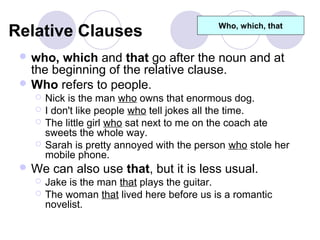
  who,  which and that go after the noun and at
   the beginning of the relative clause.
  Who refers to people.
       Nick is the man who owns that enormous dog.
       I don't like people who tell jokes all the time.
       The little girl who sat next to me on the coach ate
        sweets the whole way.
       Sarah is pretty annoyed with the person who stole her
        mobile phone.
  We can also use that, but it is less usual.
    Jake is the man that plays the guitar.
    The woman that lived here before us is a romantic
     novelist.
Relative Clauses                                 Speaker tags, interrupted


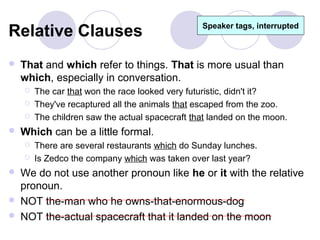
   That and which refer to things. That is more usual than
    which, especially in conversation.
       The car that won the race looked very futuristic, didn't it?
       They've recaptured all the animals that escaped from the zoo.
       The children saw the actual spacecraft that landed on the moon.
   Which can be a little formal.
       There are several restaurants which do Sunday lunches.
       Is Zedco the company which was taken over last year?
   We do not use another pronoun like he or it with the relative
    pronoun.
   NOT the-man who he owns-that-enormous-dog
   NOT the-actual spacecraft that it landed on the moon
Relative Clauses                                      Subject vs. object


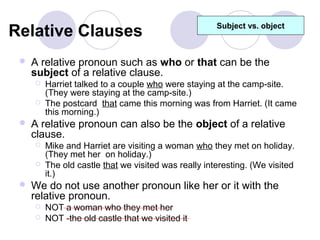
    A relative pronoun such as who or that can be the
     subject of a relative clause.
        Harriet talked to a couple who were staying at the camp-site.
         (They were staying at the camp-site.)
        The postcard that came this morning was from Harriet. (It came
         this morning.)
    A relative pronoun can also be the object of a relative
     clause.
        Mike and Harriet are visiting a woman who they met on holiday.
         (They met her on holiday.)
        The old castle that we visited was really interesting. (We visited
         it.)
    We do not use another pronoun like her or it with the
     relative pronoun.
        NOT a woman who they met her
        NOT -the old castle that we visited it
Relative Clauses                      Leaving out the relative pronoun


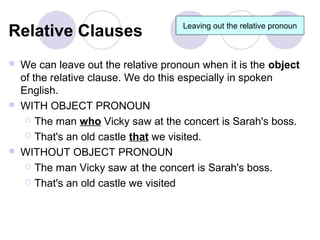
   We can leave out the relative pronoun when it is the object
    of the relative clause. We do this especially in spoken
    English.
   WITH OBJECT PRONOUN
      The man who Vicky saw at the concert is Sarah's boss.

      That's an old castle that we visited.

   WITHOUT OBJECT PRONOUN
      The man Vicky saw at the concert is Sarah's boss.

      That's an old castle we visited
Relative Clauses                              Preposition


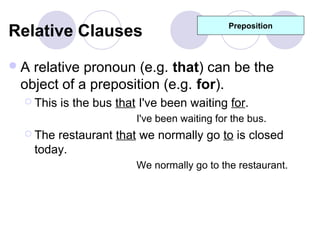
A relative pronoun (e.g. that) can be the
 object of a preposition (e.g. for).
  This   is the bus that I've been waiting for.
                         I've been waiting for the bus.
  The   restaurant that we normally go to is closed
     today.
                         We normally go to the restaurant.
Relative Clauses                       Preposition


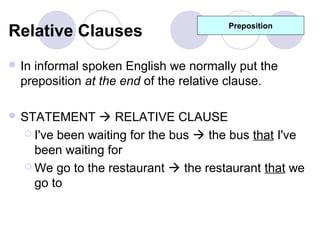
 Ininformal spoken English we normally put the
  preposition at the end of the relative clause.

 STATEMENT     RELATIVE CLAUSE
   I've been waiting for the bus  the bus that I've
    been waiting for
   We go to the restaurant  the restaurant that we
    go to
Relative Clauses                           Leaving out pronouns


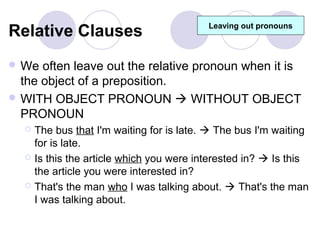
 We  often leave out the relative pronoun when it is
  the object of a preposition.
 WITH OBJECT PRONOUN  WITHOUT OBJECT
  PRONOUN
     The bus that I'm waiting for is late.  The bus I'm waiting
      for is late.
     Is this the article which you were interested in?  Is this
      the article you were interested in?
     That's the man who I was talking about.  That's the man
      I was talking about.
Relative Clauses                                                   What


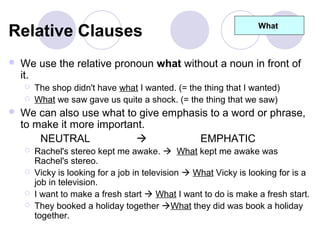
   We use the relative pronoun what without a noun in front of
    it.
       The shop didn't have what I wanted. (= the thing that I wanted)
       What we saw gave us quite a shock. (= the thing that we saw)
   We can also use what to give emphasis to a word or phrase,
    to make it more important.
        NEUTRAL                       EMPHATIC
       Rachel's stereo kept me awake.  What kept me awake was
        Rachel's stereo.
       Vicky is looking for a job in television  What Vicky is looking for is a
        job in television.
       I want to make a fresh start  What I want to do is make a fresh start.
       They booked a holiday together What they did was book a holiday
        together.
Relative pronouns vs.
Relative Clauses                                     relative adverbs


   The relative adverbs where, when and why
       This is the place where the accident happened.
       Do you remember the day when we moved the piano upstairs?
       The reason why Nick came was that he wanted to see Rita.

   We can leave out when or why, or we can use that.
       Do you remember the day (that) we moved the piano upstairs?
       The reason (that) Nick came was that he wanted to see Rita.

   There are also adding clauses with where and when.
       We went to the Riverside Restaurant, where I once had lunch with
        Henry.
       Mark likes to travel at night, when the roads are quiet
Relative Clauses                                A special use of which


 Inan adding clause, we can use which relating to a
  whole sentence, not just to a noun.
      It rained all night, which was good for the garden.
         Here which means 'the fact that it rained all night'.
 Here    are some more examples.
      David helped me clear up, which was very kind of him.
      Sarah had to work late again, which annoyed Mark.
      Tom pushed Nick into the swimming-pool, which seemed to
       amuse everyone.
Relative Clauses                            A preposition at the beginning


Theseexamples are typical of formal English. The preposition
comes at the beginning of the relative clause, before which or
whom.
     Was that the restaurant to which you normally go?
     Electronics is a subject about which I know very little.
     The Sales Manager is the person from whom I obtained the figures.
     Here
We   cannot put a preposition before that or who.
     a subject (that) I know little about
     NOT a subject about that I know little
     the person (who) I got the figures from
     NOT the person from who I got the figures
REPORTED SPEECH
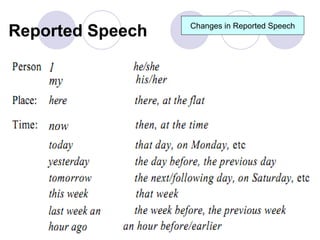
Reported Speech   Changes in Reported Speech
Reported Speech                                Tense Changes


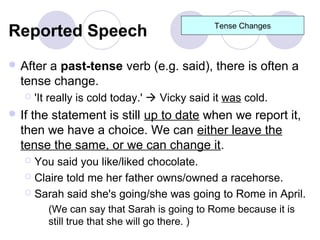
 Aftera past-tense verb (e.g. said), there is often a
  tense change.
      'It really is cold today.'  Vicky said it was cold.
 Ifthe statement is still up to date when we report it,
  then we have a choice. We can either leave the
  tense the same, or we can change it.
    You said you like/liked chocolate.
    Claire told me her father owns/owned a racehorse.

    Sarah said she's going/she was going to Rome in April.

          (We can say that Sarah is going to Rome because it is
          still true that she will go there. )
Reported Speech                                Tense Changes


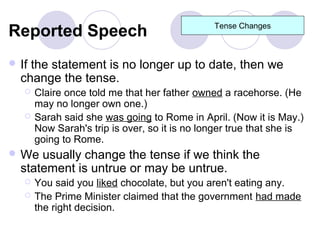
 Ifthe statement is no longer up to date, then we
  change the tense.
      Claire once told me that her father owned a racehorse. (He
       may no longer own one.)
      Sarah said she was going to Rome in April. (Now it is May.)
       Now Sarah's trip is over, so it is no longer true that she is
       going to Rome.
 We  usually change the tense if we think the
  statement is untrue or may be untrue.
      You said you liked chocolate, but you aren't eating any.
      The Prime Minister claimed that the government had made
       the right decision.
Reported Speech                                Reported Question: WH


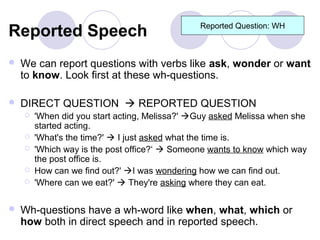
   We can report questions with verbs like ask, wonder or want
    to know. Look first at these wh-questions.

   DIRECT QUESTION  REPORTED QUESTION
       'When did you start acting, Melissa?' Guy asked Melissa when she
        started acting.
       'What's the time?'  I just asked what the time is.
       'Which way is the post office?‘  Someone wants to know which way
        the post office is.
       How can we find out?' I was wondering how we can find out.
       'Where can we eat?'  They're asking where they can eat.

   Wh-questions have a wh-word like when, what, which or
    how both in direct speech and in reported speech.
Reported Speech                        Yes/ No questions


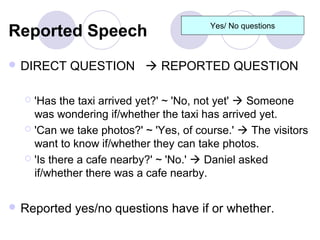
 DIRECT   QUESTION  REPORTED QUESTION

   'Has the taxi arrived yet?' ~ 'No, not yet'  Someone
    was wondering if/whether the taxi has arrived yet.
   'Can we take photos?' ~ 'Yes, of course.'  The visitors
    want to know if/whether they can take photos.
   'Is there a cafe nearby?' ~ 'No.'  Daniel asked
    if/whether there was a cafe nearby.


 Reported   yes/no questions have if or whether.
Reported Speech                            Reported orders and requests


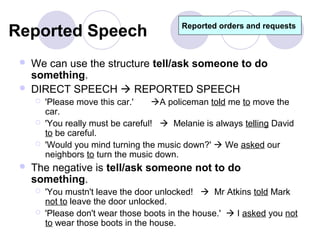
    We can use the structure tell/ask someone to do
     something.
    DIRECT SPEECH  REPORTED SPEECH
        'Please move this car.'    A policeman told me to move the
         car.
        'You really must be careful!  Melanie is always telling David
         to be careful.
        'Would you mind turning the music down?'  We asked our
         neighbors to turn the music down.
    The negative is tell/ask someone not to do
     something.
        'You mustn't leave the door unlocked!  Mr Atkins told Mark
         not to leave the door unlocked.
        'Please don't wear those boots in the house.'  I asked you not
         to wear those boots in the house.
Reported Speech                           Reported orders and requests


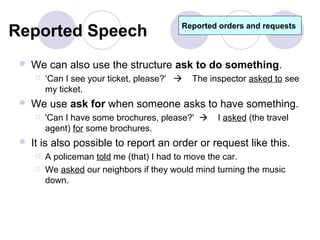
    We can also use the structure ask to do something.
        ‘Can I see your ticket, please?'    The inspector asked to see
         my ticket.
    We use ask for when someone asks to have something.
        'Can I have some brochures, please?'      I asked (the travel
         agent) for some brochures.
    It is also possible to report an order or request like this.
        A policeman told me (that) I had to move the car.
        We asked our neighbors if they would mind turning the music
         down.
Reported offers, suggestions, etc
Reported Speech
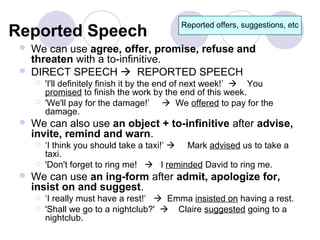
    We can use agree, offer, promise, refuse and
     threaten with a to-infinitive.
    DIRECT SPEECH  REPORTED SPEECH
        'I'll definitely finish it by the end of next week!’  You
         promised to finish the work by the end of this week.
        'We'll pay for the damage!’  We offered to pay for the
         damage.
    We can also use an object + to-infinitive after advise,
     invite, remind and warn.
        ‘I think you should take a taxi!’  Mark advised us to take a
         taxi.
        'Don't forget to ring me!  I reminded David to ring me.
    We can use an ing-form after admit, apologize for,
     insist on and suggest.
        ‘I really must have a rest!’  Emma insisted on having a rest.
        'Shall we go to a nightclub?'  Claire suggested going to a
         nightclub.
Admit that, insist that, etc
Reported Speech
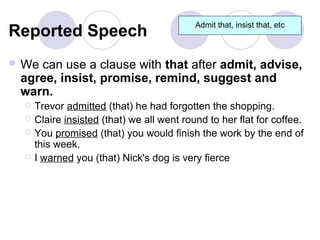
 Wecan use a clause with that after admit, advise,
 agree, insist, promise, remind, suggest and
 warn.
     Trevor admitted (that) he had forgotten the shopping.
     Claire insisted (that) we all went round to her flat for coffee.
     You promised (that) you would finish the work by the end of
      this week.
     I warned you (that) Nick's dog is very fierce
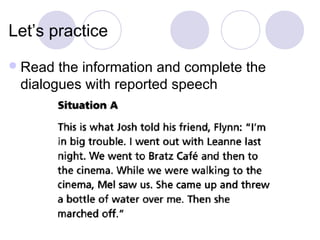
Let’s practice
 Read the information and complete the
 dialogues with reported speech
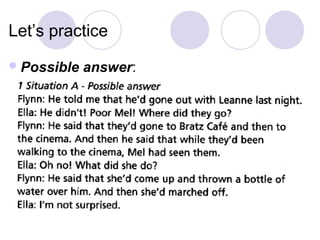
Let’s practice
 Possible   answer:
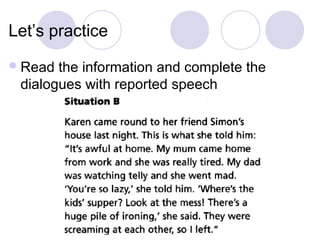
Let’s practice
 Read the information and complete the
 dialogues with reported speech
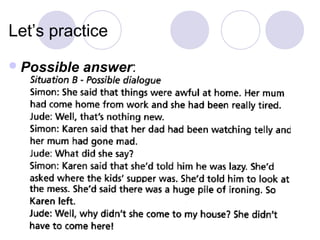
Let’s practice
 Possible   answer:
TYPES OF SENTENCES
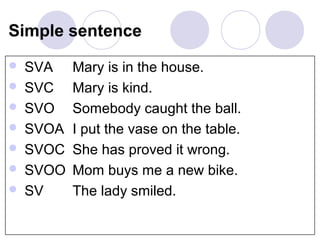
Simple sentence
   SVA    Mary is in the house.
   SVC    Mary is kind.
   SVO    Somebody caught the ball.
   SVOA   I put the vase on the table.
   SVOC   She has proved it wrong.
   SVOO   Mom buys me a new bike.
   SV     The lady smiled.
Let’s practice
 handout:   Sentence structure
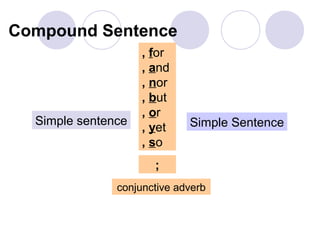
Compound Sentence
                    , for
                    , and
                    , nor
                    , but
                    , or
  Simple sentence            Simple Sentence
                    , yet
                    , so
                      ;
               conjunctive adverb
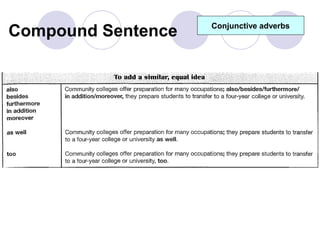
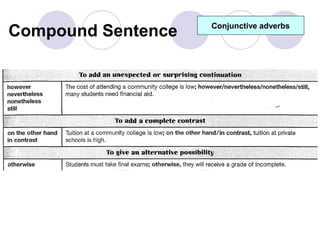
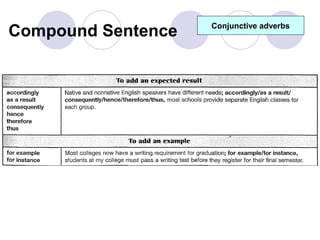
Compound Sentence   Conjunctive adverbs
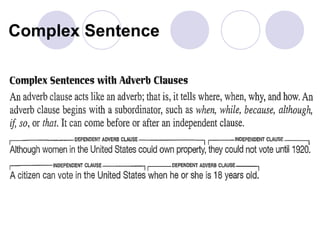
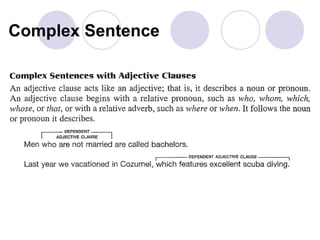
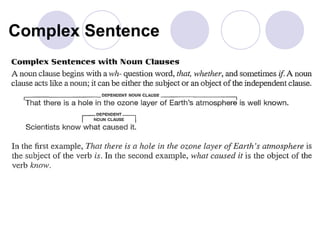
Complex Sentence
A  complex sentence contains one
  independent clause and one or more
  dependent clauses.
 In
   a complex sentence, one idea is generally
  more important than the other one.
 Three  kinds of dependent clauses: adverb,
  adjective, and noun.
Complex Sentence
Complex Sentence
Complex Sentence
Let’s practice
 handout:   Complex sentence
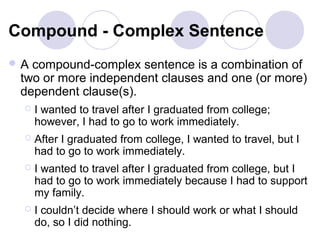
Compound - Complex Sentence
A compound-complex sentence is a combination of
 two or more independent clauses and one (or more)
 dependent clause(s).
    I wanted to travel after I graduated from college;
     however, I had to go to work immediately.
    After I graduated from college, I wanted to travel, but I
     had to go to work immediately.
    I wanted to travel after I graduated from college, but I
     had to go to work immediately because I had to support
     my family.
    I couldn’t decide where I should work or what I should
     do, so I did nothing.
Let’s practice
 handout:   Compound-complex sentence
Homework
 Activities
           and Practice exercises of units 14
  and 31 (Dean’s English Grammar Lessons)

Week 12 sentence types

  • 1.
    Sentence Reported Speech Relative Clauses Simple Sentence Compound Sentence Complex Sentence
  • 2.
  • 3.
    Relative Clauses A relativeclause is a special kind of subordinate clause whose primary function is as modifier to a noun or nominal .
  • 4.
    Relative Clauses as modifiers of nouns  Thesecretary wrote to [all the members who were absent from the meeting].  [The film which I needed] is unobtainable.
  • 5.
    Relative Clauses Who, which, that  who, which and that go after the noun and at the beginning of the relative clause.  Who refers to people.  Nick is the man who owns that enormous dog.  I don't like people who tell jokes all the time.  The little girl who sat next to me on the coach ate sweets the whole way.  Sarah is pretty annoyed with the person who stole her mobile phone.  We can also use that, but it is less usual.  Jake is the man that plays the guitar.  The woman that lived here before us is a romantic novelist.
  • 6.
    Relative Clauses Speaker tags, interrupted  That and which refer to things. That is more usual than which, especially in conversation.  The car that won the race looked very futuristic, didn't it?  They've recaptured all the animals that escaped from the zoo.  The children saw the actual spacecraft that landed on the moon.  Which can be a little formal.  There are several restaurants which do Sunday lunches.  Is Zedco the company which was taken over last year?  We do not use another pronoun like he or it with the relative pronoun.  NOT the-man who he owns-that-enormous-dog  NOT the-actual spacecraft that it landed on the moon
  • 7.
    Relative Clauses Subject vs. object  A relative pronoun such as who or that can be the subject of a relative clause.  Harriet talked to a couple who were staying at the camp-site. (They were staying at the camp-site.)  The postcard that came this morning was from Harriet. (It came this morning.)  A relative pronoun can also be the object of a relative clause.  Mike and Harriet are visiting a woman who they met on holiday. (They met her on holiday.)  The old castle that we visited was really interesting. (We visited it.)  We do not use another pronoun like her or it with the relative pronoun.  NOT a woman who they met her  NOT -the old castle that we visited it
  • 8.
    Relative Clauses Leaving out the relative pronoun  We can leave out the relative pronoun when it is the object of the relative clause. We do this especially in spoken English.  WITH OBJECT PRONOUN  The man who Vicky saw at the concert is Sarah's boss.  That's an old castle that we visited.  WITHOUT OBJECT PRONOUN  The man Vicky saw at the concert is Sarah's boss.  That's an old castle we visited
  • 9.
    Relative Clauses Preposition A relative pronoun (e.g. that) can be the object of a preposition (e.g. for).  This is the bus that I've been waiting for. I've been waiting for the bus.  The restaurant that we normally go to is closed today. We normally go to the restaurant.
  • 10.
    Relative Clauses Preposition  Ininformal spoken English we normally put the preposition at the end of the relative clause.  STATEMENT  RELATIVE CLAUSE  I've been waiting for the bus  the bus that I've been waiting for  We go to the restaurant  the restaurant that we go to
  • 11.
    Relative Clauses Leaving out pronouns  We often leave out the relative pronoun when it is the object of a preposition.  WITH OBJECT PRONOUN  WITHOUT OBJECT PRONOUN  The bus that I'm waiting for is late.  The bus I'm waiting for is late.  Is this the article which you were interested in?  Is this the article you were interested in?  That's the man who I was talking about.  That's the man I was talking about.
  • 12.
    Relative Clauses What  We use the relative pronoun what without a noun in front of it.  The shop didn't have what I wanted. (= the thing that I wanted)  What we saw gave us quite a shock. (= the thing that we saw)  We can also use what to give emphasis to a word or phrase, to make it more important. NEUTRAL  EMPHATIC  Rachel's stereo kept me awake.  What kept me awake was Rachel's stereo.  Vicky is looking for a job in television  What Vicky is looking for is a job in television.  I want to make a fresh start  What I want to do is make a fresh start.  They booked a holiday together What they did was book a holiday together.
  • 13.
    Relative pronouns vs. RelativeClauses relative adverbs  The relative adverbs where, when and why  This is the place where the accident happened.  Do you remember the day when we moved the piano upstairs?  The reason why Nick came was that he wanted to see Rita.  We can leave out when or why, or we can use that.  Do you remember the day (that) we moved the piano upstairs?  The reason (that) Nick came was that he wanted to see Rita.  There are also adding clauses with where and when.  We went to the Riverside Restaurant, where I once had lunch with Henry.  Mark likes to travel at night, when the roads are quiet
  • 14.
    Relative Clauses A special use of which  Inan adding clause, we can use which relating to a whole sentence, not just to a noun.  It rained all night, which was good for the garden. Here which means 'the fact that it rained all night'.  Here are some more examples.  David helped me clear up, which was very kind of him.  Sarah had to work late again, which annoyed Mark.  Tom pushed Nick into the swimming-pool, which seemed to amuse everyone.
  • 15.
    Relative Clauses A preposition at the beginning Theseexamples are typical of formal English. The preposition comes at the beginning of the relative clause, before which or whom.  Was that the restaurant to which you normally go?  Electronics is a subject about which I know very little.  The Sales Manager is the person from whom I obtained the figures.  Here We cannot put a preposition before that or who.  a subject (that) I know little about  NOT a subject about that I know little  the person (who) I got the figures from  NOT the person from who I got the figures
  • 16.
  • 17.
    Reported Speech Changes in Reported Speech
  • 18.
    Reported Speech Tense Changes  Aftera past-tense verb (e.g. said), there is often a tense change.  'It really is cold today.'  Vicky said it was cold.  Ifthe statement is still up to date when we report it, then we have a choice. We can either leave the tense the same, or we can change it.  You said you like/liked chocolate.  Claire told me her father owns/owned a racehorse.  Sarah said she's going/she was going to Rome in April. (We can say that Sarah is going to Rome because it is still true that she will go there. )
  • 19.
    Reported Speech Tense Changes  Ifthe statement is no longer up to date, then we change the tense.  Claire once told me that her father owned a racehorse. (He may no longer own one.)  Sarah said she was going to Rome in April. (Now it is May.) Now Sarah's trip is over, so it is no longer true that she is going to Rome.  We usually change the tense if we think the statement is untrue or may be untrue.  You said you liked chocolate, but you aren't eating any.  The Prime Minister claimed that the government had made the right decision.
  • 20.
    Reported Speech Reported Question: WH  We can report questions with verbs like ask, wonder or want to know. Look first at these wh-questions.  DIRECT QUESTION  REPORTED QUESTION  'When did you start acting, Melissa?' Guy asked Melissa when she started acting.  'What's the time?'  I just asked what the time is.  'Which way is the post office?‘  Someone wants to know which way the post office is.  How can we find out?' I was wondering how we can find out.  'Where can we eat?'  They're asking where they can eat.  Wh-questions have a wh-word like when, what, which or how both in direct speech and in reported speech.
  • 21.
    Reported Speech Yes/ No questions  DIRECT QUESTION  REPORTED QUESTION  'Has the taxi arrived yet?' ~ 'No, not yet'  Someone was wondering if/whether the taxi has arrived yet.  'Can we take photos?' ~ 'Yes, of course.'  The visitors want to know if/whether they can take photos.  'Is there a cafe nearby?' ~ 'No.'  Daniel asked if/whether there was a cafe nearby.  Reported yes/no questions have if or whether.
  • 22.
    Reported Speech Reported orders and requests  We can use the structure tell/ask someone to do something.  DIRECT SPEECH  REPORTED SPEECH  'Please move this car.' A policeman told me to move the car.  'You really must be careful!  Melanie is always telling David to be careful.  'Would you mind turning the music down?'  We asked our neighbors to turn the music down.  The negative is tell/ask someone not to do something.  'You mustn't leave the door unlocked!  Mr Atkins told Mark not to leave the door unlocked.  'Please don't wear those boots in the house.'  I asked you not to wear those boots in the house.
  • 23.
    Reported Speech Reported orders and requests  We can also use the structure ask to do something.  ‘Can I see your ticket, please?'  The inspector asked to see my ticket.  We use ask for when someone asks to have something.  'Can I have some brochures, please?'  I asked (the travel agent) for some brochures.  It is also possible to report an order or request like this.  A policeman told me (that) I had to move the car.  We asked our neighbors if they would mind turning the music down.
  • 24.
    Reported offers, suggestions,etc Reported Speech  We can use agree, offer, promise, refuse and threaten with a to-infinitive.  DIRECT SPEECH  REPORTED SPEECH  'I'll definitely finish it by the end of next week!’  You promised to finish the work by the end of this week.  'We'll pay for the damage!’  We offered to pay for the damage.  We can also use an object + to-infinitive after advise, invite, remind and warn.  ‘I think you should take a taxi!’  Mark advised us to take a taxi.  'Don't forget to ring me!  I reminded David to ring me.  We can use an ing-form after admit, apologize for, insist on and suggest.  ‘I really must have a rest!’  Emma insisted on having a rest.  'Shall we go to a nightclub?'  Claire suggested going to a nightclub.
  • 25.
    Admit that, insistthat, etc Reported Speech  Wecan use a clause with that after admit, advise, agree, insist, promise, remind, suggest and warn.  Trevor admitted (that) he had forgotten the shopping.  Claire insisted (that) we all went round to her flat for coffee.  You promised (that) you would finish the work by the end of this week.  I warned you (that) Nick's dog is very fierce
  • 26.
    Let’s practice  Readthe information and complete the dialogues with reported speech
  • 27.
  • 28.
    Let’s practice  Readthe information and complete the dialogues with reported speech
  • 29.
  • 30.
  • 31.
    Simple sentence  SVA Mary is in the house.  SVC Mary is kind.  SVO Somebody caught the ball.  SVOA I put the vase on the table.  SVOC She has proved it wrong.  SVOO Mom buys me a new bike.  SV The lady smiled.
  • 32.
    Let’s practice  handout: Sentence structure
  • 33.
    Compound Sentence , for , and , nor , but , or Simple sentence Simple Sentence , yet , so ; conjunctive adverb
  • 34.
    Compound Sentence Conjunctive adverbs
  • 35.
    Compound Sentence Conjunctive adverbs
  • 36.
    Compound Sentence Conjunctive adverbs
  • 37.
    Complex Sentence A complex sentence contains one independent clause and one or more dependent clauses.  In a complex sentence, one idea is generally more important than the other one.  Three kinds of dependent clauses: adverb, adjective, and noun.
  • 38.
  • 39.
  • 40.
  • 41.
  • 42.
    Compound - ComplexSentence A compound-complex sentence is a combination of two or more independent clauses and one (or more) dependent clause(s).  I wanted to travel after I graduated from college; however, I had to go to work immediately.  After I graduated from college, I wanted to travel, but I had to go to work immediately.  I wanted to travel after I graduated from college, but I had to go to work immediately because I had to support my family.  I couldn’t decide where I should work or what I should do, so I did nothing.
  • 43.
    Let’s practice  handout: Compound-complex sentence
  • 44.
    Homework  Activities and Practice exercises of units 14 and 31 (Dean’s English Grammar Lessons)