
P R E P A R E D B Y
A N T O H
D E P A R T M E N T O F E N G L I S H
S T X A V I E R ’ S C O L L E G E O F E D U C A T I O N ( A U T O N O M O U S )
P A L A Y A M K O T T A I
T I R U N E L V E L I
I N D I A
T A M I L N A D U
P I N – 6 2 7 0 0 2 .
REGULAR AND IRREGULAR
VERB FORMS
Introduction
 Verb Forms! Verbs are subdivided into two groups,
regular verbs and irregular verbs, on the basis of how
their past tense and past participles are formed.
 In this Power Point, we will learn list of regular verbs
and irregular verbs in English.
Types of Verb Forms
 Regular Verb Form
 Irregular Verb Form
Regular Verb Form
 Most verbs are regular verbs. Regular verbs are
those whose past tense and past participles are
formed by adding a -d or an -ed to the end of the
verb.
Examples
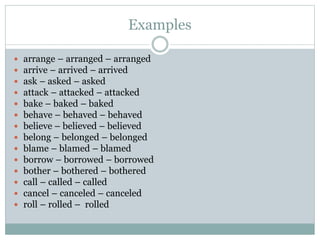
 arrange – arranged – arranged
 arrive – arrived – arrived
 ask – asked – asked
 attack – attacked – attacked
 bake – baked – baked
 behave – behaved – behaved
 believe – believed – believed
 belong – belonged – belonged
 blame – blamed – blamed
 borrow – borrowed – borrowed
 bother – bothered – bothered
 call – called – called
 cancel – canceled – canceled
 roll – rolled – rolled
Irregular Verb Form
 There is no formula to predict how an irregular
verb will form its past-tense and past-participle
forms.
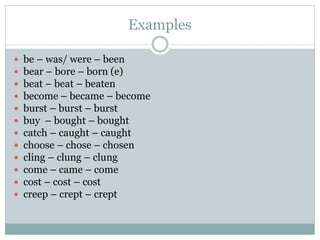
Examples
 be – was/ were – been
 bear – bore – born (e)
 beat – beat – beaten
 become – became – become
 burst – burst – burst
 buy – bought – bought
 catch – caught – caught
 choose – chose – chosen
 cling – clung – clung
 come – came – come
 cost – cost – cost
 creep – crept – crept
THANK YOU