REPORTED SPEECH
AFFIRMATIVE STATEMENTS
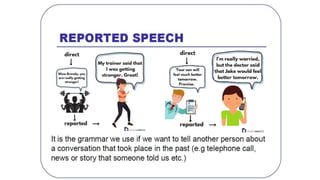
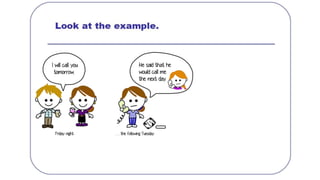
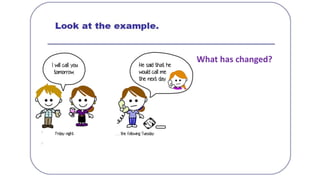
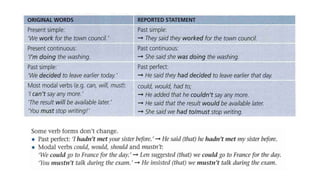
What has changed?
What has changed?
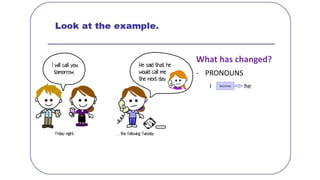
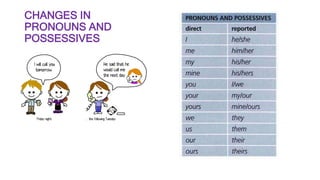
- PRONOUNS
I he
What has changed?
- PRONOUNS
I he
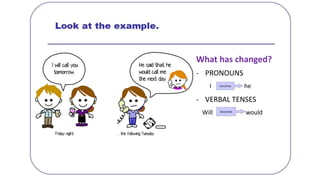
- VERBAL TENSES
Will would
What has changed?
- PRONOUNS
I he
- VERBAL TENSES
Will would
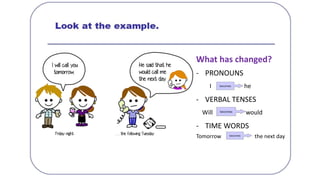
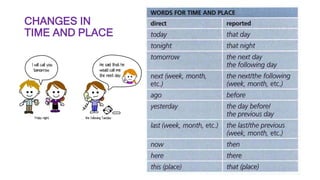
- TIME WORDS
Tomorrow the next day
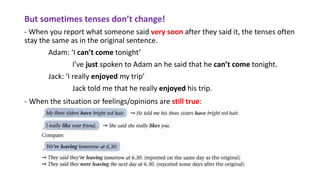
But sometimes tenses don’t change!
- When you report what someone said very soon after they said it, the tenses often
stay the same as in the original sentence.
Adam: ‘I can’t come tonight’
I’ve just spoken to Adam an he said that he can’t come tonight.
Jack: ‘I really enjoyed my trip’
Jack told me that he really enjoyed his trip.
- When the situation or feelings/opinions are still true:
CHANGES IN
PRONOUNS AND
POSSESSIVES
CHANGES IN
TIME AND PLACE
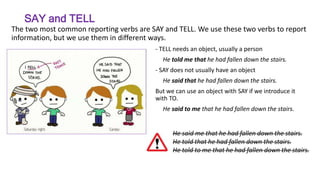
The two most common reporting verbs are SAY and TELL. We use these two verbs to report
information, but we use them in different ways.
- TELL needs an object, usually a person
He told me that he had fallen down the stairs.
- SAY does not usually have an object
He said that he had fallen down the stairs.
But we can use an object with SAY if we introduce it
with TO.
He said to me that he had fallen down the stairs.
SAY and TELL
He said me that he had fallen down the stairs.
He told that he had fallen down the stairs.
He told to me that he had fallen down the stairs.
REPORTED SPEECH
QUESTIONS
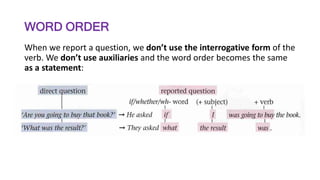
When we report a question, we don’t use the interrogative form of the
verb. We don’t use auxiliaries and the word order becomes the same
as a statement:
WORD ORDER
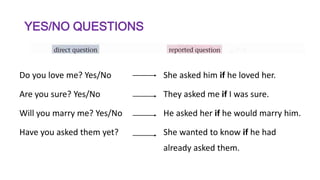
YES/NO QUESTIONS
Do you love me? Yes/No She asked him if he loved her.
Are you sure? Yes/No They asked me if I was sure.
Will you marry me? Yes/No He asked her if he would marry him.
Have you asked them yet? She wanted to know if he had
already asked them.
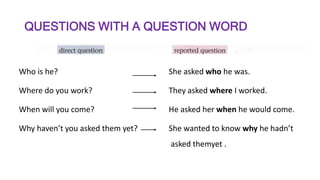
QUESTIONS WITH A QUESTION WORD
Who is he? She asked who he was.
Where do you work? They asked where I worked.
When will you come? He asked her when he would come.
Why haven’t you asked them yet? She wanted to know why he hadn’t
asked themyet .

Reported speech B1

  • 1.
  • 4.
  • 5.
    What has changed? -PRONOUNS I he
  • 6.
    What has changed? -PRONOUNS I he - VERBAL TENSES Will would
  • 7.
    What has changed? -PRONOUNS I he - VERBAL TENSES Will would - TIME WORDS Tomorrow the next day
  • 9.
    But sometimes tensesdon’t change! - When you report what someone said very soon after they said it, the tenses often stay the same as in the original sentence. Adam: ‘I can’t come tonight’ I’ve just spoken to Adam an he said that he can’t come tonight. Jack: ‘I really enjoyed my trip’ Jack told me that he really enjoyed his trip. - When the situation or feelings/opinions are still true:
  • 10.
  • 11.
  • 12.
    The two mostcommon reporting verbs are SAY and TELL. We use these two verbs to report information, but we use them in different ways. - TELL needs an object, usually a person He told me that he had fallen down the stairs. - SAY does not usually have an object He said that he had fallen down the stairs. But we can use an object with SAY if we introduce it with TO. He said to me that he had fallen down the stairs. SAY and TELL He said me that he had fallen down the stairs. He told that he had fallen down the stairs. He told to me that he had fallen down the stairs.
  • 13.
  • 14.
    When we reporta question, we don’t use the interrogative form of the verb. We don’t use auxiliaries and the word order becomes the same as a statement: WORD ORDER
  • 15.
    YES/NO QUESTIONS Do youlove me? Yes/No She asked him if he loved her. Are you sure? Yes/No They asked me if I was sure. Will you marry me? Yes/No He asked her if he would marry him. Have you asked them yet? She wanted to know if he had already asked them.
  • 16.
    QUESTIONS WITH AQUESTION WORD Who is he? She asked who he was. Where do you work? They asked where I worked. When will you come? He asked her when he would come. Why haven’t you asked them yet? She wanted to know why he hadn’t asked themyet .