Unit 12 Relative Clauses Prepared by Miss Jenny Lou C. Sasoy Faculty, UE-EHSD
What is a relative clause? It is a subordinate clause (dependent clause) that describes a noun or a noun phrase in a sentence. EXAMPLE: Richard kept  which I did not accept. the gift
How can RELATIVE CLAUSES be recognized? It contains a subject and a verb. It will begin with a relative pronoun [who, whom, which or that] It functions as an adjective. Richard kept the gift which I did not accept.
TYPES OF  RELATIVE  CLAUSES RESTRICTIVE NON RESTRICTIVE
RESTRICTIVE RELATIVE CLAUSES They answer the questions “what kind” or “which one”. They are NOT set off by commas. EXAMPLE: I like the woman  who lives next door . (If I did not include “who lives next door” then it wouldn’t be clear which woman I mean)
NONRESTRICTIVE RELATIVE CLAUSES They just provide additional information about the noun phrases. They are set off by commas or parentheses. They are often used in defining terms in sentences. EXAMPLE: I live in London,  which has some fantastic parks . (Everybody knows where London is, ‘which has some fantastic parks’ is extra information.)
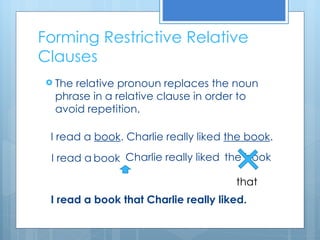
Forming Restrictive Relative Clauses I read a The relative pronoun replaces the noun phrase in a relative clause in order to avoid repetition. I read a  book . Charlie really liked  the book . book Charlie really liked the book that I read a book that Charlie really liked.
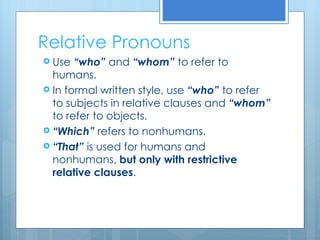
Relative Pronouns Use  “who”  and  “whom”  to refer to humans. In formal written style, use  “who”  to refer to subjects in relative clauses and  “whom”  to refer to objects. “ Which”  refers to nonhumans. “ That”  is used for humans and nonhumans,  but only with restrictive relative clauses .
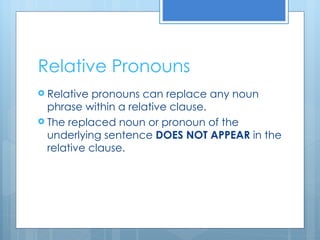
Relative Pronouns Relative pronouns can replace any noun phrase within a relative clause. The replaced noun or pronoun of the underlying sentence  DOES NOT APPEAR  in the relative clause.
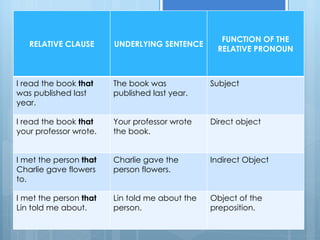
RELATIVE CLAUSE UNDERLYING SENTENCE FUNCTION OF THE RELATIVE PRONOUN I read the book  that  was published last year. The book was published last year. Subject I read the book  that  your professor wrote. Your professor wrote the book. Direct object I met the person  that  Charlie gave flowers to. Charlie gave the person flowers. Indirect Object I met the person  that  Lin told me about. Lin told me about the person. Object of the preposition.

Relative clauses

  • 1.
    Unit 12 RelativeClauses Prepared by Miss Jenny Lou C. Sasoy Faculty, UE-EHSD
  • 2.
    What is arelative clause? It is a subordinate clause (dependent clause) that describes a noun or a noun phrase in a sentence. EXAMPLE: Richard kept which I did not accept. the gift
  • 3.
    How can RELATIVECLAUSES be recognized? It contains a subject and a verb. It will begin with a relative pronoun [who, whom, which or that] It functions as an adjective. Richard kept the gift which I did not accept.
  • 4.
    TYPES OF RELATIVE CLAUSES RESTRICTIVE NON RESTRICTIVE
  • 5.
    RESTRICTIVE RELATIVE CLAUSESThey answer the questions “what kind” or “which one”. They are NOT set off by commas. EXAMPLE: I like the woman who lives next door . (If I did not include “who lives next door” then it wouldn’t be clear which woman I mean)
  • 6.
    NONRESTRICTIVE RELATIVE CLAUSESThey just provide additional information about the noun phrases. They are set off by commas or parentheses. They are often used in defining terms in sentences. EXAMPLE: I live in London, which has some fantastic parks . (Everybody knows where London is, ‘which has some fantastic parks’ is extra information.)
  • 7.
    Forming Restrictive RelativeClauses I read a The relative pronoun replaces the noun phrase in a relative clause in order to avoid repetition. I read a book . Charlie really liked the book . book Charlie really liked the book that I read a book that Charlie really liked.
  • 8.
    Relative Pronouns Use “who” and “whom” to refer to humans. In formal written style, use “who” to refer to subjects in relative clauses and “whom” to refer to objects. “ Which” refers to nonhumans. “ That” is used for humans and nonhumans, but only with restrictive relative clauses .
  • 9.
    Relative Pronouns Relativepronouns can replace any noun phrase within a relative clause. The replaced noun or pronoun of the underlying sentence DOES NOT APPEAR in the relative clause.
  • 10.
    RELATIVE CLAUSE UNDERLYINGSENTENCE FUNCTION OF THE RELATIVE PRONOUN I read the book that was published last year. The book was published last year. Subject I read the book that your professor wrote. Your professor wrote the book. Direct object I met the person that Charlie gave flowers to. Charlie gave the person flowers. Indirect Object I met the person that Lin told me about. Lin told me about the person. Object of the preposition.