COMPOUND SENTENCES BY SUBORDINATION
 
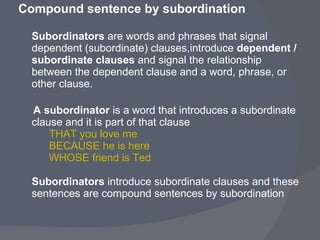
Compound sentence by subordination    Subordinators   are words and phrases that signal dependent (subordinate) clauses,introduce  dependent /subordinate clauses  and signal the relationship between the dependent clause and a word, phrase, or other clause. A subordinator  is a word that introduces a subordinate clause and it is part of that clause THAT you love me BECAUSE he is here WHOSE friend is Ted   Subordinators  introduce subordinate clauses and these sentences are compound sentences by subordination
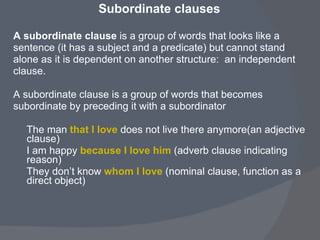
Subordinate clauses   A subordinate clause  is a group of words that looks like a  sentence (it has a subject and a predicate) but cannot stand  alone as it is dependent on another structure:  an independent  clause.   A subordinate clause is a group of words that becomes  subordinate by preceding it with a subordinator   The man  that I love   does not live there anymore(an adjective clause) I am happy  because I love him  (adverb clause indicating reason) They don’t know  whom I love  (nominal clause, function as a direct object)
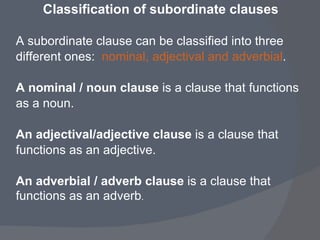
Classification of subordinate clauses   A subordinate clause can be classified into three  different ones:  nominal, adjectival and adverbial . A nominal / noun clause  is a clause that functions as a noun. An adjectival/adjective clause  is a clause that  functions as an adjective.  An adverbial / adverb clause  is a clause that  functions as an adverb .
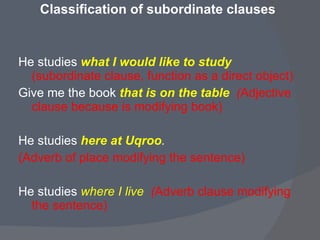
Classification of subordinate clauses  He studies  what I would like to study   (subordinate clause, function as a direct object) Give me the book  that is on the table  ( Adjective clause because is modifying book) He studies  here at Uqroo .  (Adverb of place modifying the sentence) He studies  where I live  ( Adverb clause modifying the sentence)
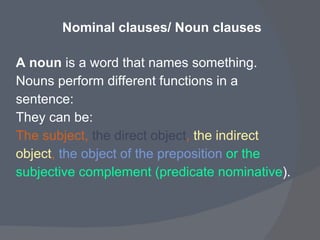
Nominal clauses/ Noun clauses   A noun  is a word that names something.  Nouns perform different functions in a  sentence:  They can be:  The subject,  the direct object ,  the indirect  object ,  the object of the preposition   or the subjective complement (predicate nominative ).  
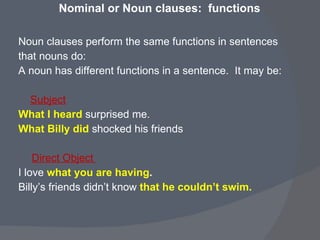
Nominal or Noun clauses:  functions Noun clauses perform the same functions in sentences  that nouns do:  A noun has different functions in a sentence.  It may be: Subject   What I heard   surprised me. What Billy did  shocked his friends Direct Object  I love   what you are having . Billy’s friends didn’t know  that he couldn’t swim.  
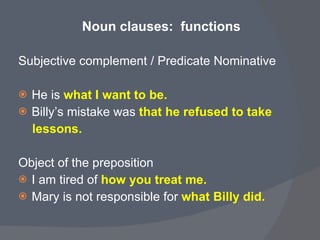
Noun clauses:  functions  Subjective complement / Predicate Nominative  He is   what I want to be. Billy’s mistake was  that he refused to take  lessons.   Object of the preposition  I am tired of   how you treat me. Mary is not responsible for  what Billy did.
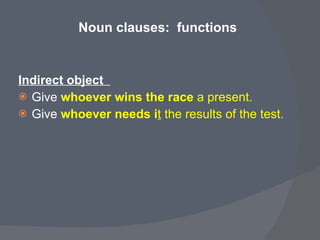
Noun clauses:  functions  Indirect object  Give  whoever wins the race  a present. Give  whoever needs i t  the results of the test.  
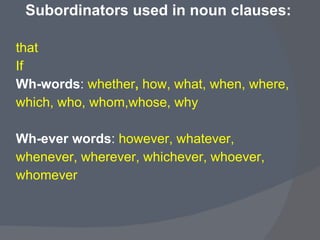
Subordinators used in noun clauses: that If Wh-words :  whether ,  how, what, when, where,  which, who, whom,whose, why Wh-ever words :  however, whatever,  whenever, wherever, whichever, whoever,  whomever
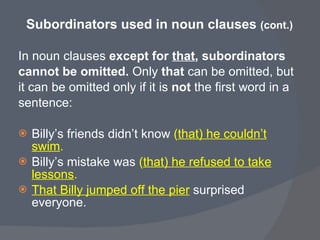
Subordinators used in noun clauses  (cont.) In noun clauses  except for  that , subordinators  cannot be omitted.  Only  that  can be omitted, but  it can be omitted only if it is  not  the first word in a  sentence:  Billy’s friends didn’t know  ( that) he couldn’t swim . Billy’s mistake was  ( that) he refused to take lessons . That Billy jumped off the pier   surprised everyone.
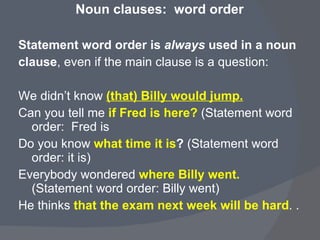
Noun clauses:  word order Statement word order is  always  used in a noun  clause , even if the main clause is a question:  We didn’t know  (that) Billy would jump. Can you tell me  if Fred is here?   (Statement word order:  Fred is Do you know  what time it is ?  (Statement word order: it is)  Everybody wondered  where Billy went.   (Statement word order: Billy went)  He thinks  that the exam next week will be hard . .
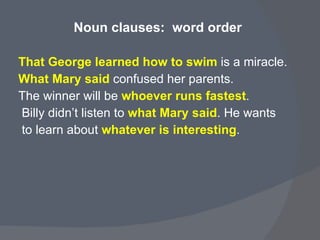
Noun clauses:  word order  That George learned how to swim   is a miracle.  What Mary said  confused her parents.  The winner will be  whoever runs fastest . Billy didn’t listen to  what Mary said . He wants  to learn about  whatever is interesting .
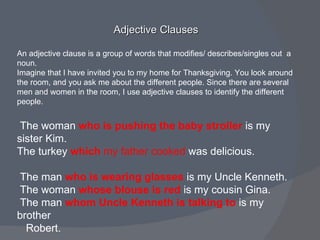
Adjective Clauses  An adjective clause is a group of words that modifies/ describes/singles out  a noun. Imagine that I have invited you to my home for Thanksgiving. You look around the room, and you ask me about the different people. Since there are several men and women in the room, I use adjective clauses to identify the different people. The woman  who is pushing the baby stroller   is my sister Kim. The turkey  which  my father cooked  was delicious. The man  who is wearing glasses   is my Uncle Kenneth. The woman  whose blouse is red   is my cousin Gina. The man  whom Uncle Kenneth is talking to   is my brother  Robert.
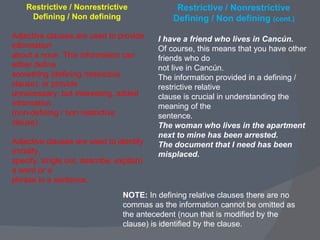
Restrictive / Nonrestrictive  Defining / Non defining  Adjective clauses are used to provide information  about a noun. This information can either define  something (defining /restrictive clause), or provide  unnecessary, but interesting, added information  (non-defining / non restrictive clause).  Adjective clauses are used to identify (modify,  specify, single out, describe, explain) a word or a  phrase in a sentence. Restrictive / Nonrestrictive  Defining / Non defining  (cont.)  I have a friend who lives in Cancún.  Of course, this means that you have other friends who do  not live in Cancún.  The information provided in a defining / restrictive relative  clause is crucial in understanding the meaning of the  sentence.  The woman who lives in the apartment next to mine has been arrested. The document that I need has been misplaced. NOTE:  In defining relative clauses there are no  commas as the information cannot be omitted as  the antecedent (noun that is modified by the  clause) is identified by the clause.
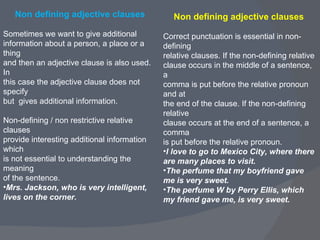
Non defining adjective clauses Sometimes we want to give additional  information about a person, a place or a thing  and then an adjective clause is also used.  In  this case the adjective clause does not specify  but  gives additional information.  Non-defining / non restrictive relative clauses  provide interesting additional information which  is not essential to understanding the meaning  of the sentence.  Mrs. Jackson, who is very intelligent, lives on the corner.   Non defining adjective clauses  Correct punctuation is essential in non-defining  relative clauses. If the non-defining relative  clause occurs in the middle of a sentence, a  comma is put before the relative pronoun and at  the end of the clause. If the non-defining relative  clause occurs at the end of a sentence, a comma  is put before the relative pronoun.  I love to go to Mexico City, where there are many places to visit. The perfume that my boyfriend gave me is very sweet. The perfume W by Perry Ellis, which my friend gave me, is very sweet.

4.4 compound sentence by_subordination

  • 1.
    COMPOUND SENTENCES BYSUBORDINATION
  • 2.
  • 3.
    Compound sentence bysubordination   Subordinators are words and phrases that signal dependent (subordinate) clauses,introduce dependent /subordinate clauses and signal the relationship between the dependent clause and a word, phrase, or other clause. A subordinator is a word that introduces a subordinate clause and it is part of that clause THAT you love me BECAUSE he is here WHOSE friend is Ted   Subordinators introduce subordinate clauses and these sentences are compound sentences by subordination
  • 4.
    Subordinate clauses  A subordinate clause is a group of words that looks like a sentence (it has a subject and a predicate) but cannot stand alone as it is dependent on another structure: an independent clause.   A subordinate clause is a group of words that becomes subordinate by preceding it with a subordinator   The man that I love does not live there anymore(an adjective clause) I am happy because I love him (adverb clause indicating reason) They don’t know whom I love (nominal clause, function as a direct object)
  • 5.
    Classification of subordinateclauses   A subordinate clause can be classified into three different ones: nominal, adjectival and adverbial . A nominal / noun clause is a clause that functions as a noun. An adjectival/adjective clause is a clause that functions as an adjective. An adverbial / adverb clause is a clause that functions as an adverb .
  • 6.
    Classification of subordinateclauses He studies what I would like to study (subordinate clause, function as a direct object) Give me the book that is on the table ( Adjective clause because is modifying book) He studies here at Uqroo . (Adverb of place modifying the sentence) He studies where I live ( Adverb clause modifying the sentence)
  • 7.
    Nominal clauses/ Nounclauses   A noun is a word that names something. Nouns perform different functions in a sentence: They can be: The subject, the direct object , the indirect object , the object of the preposition or the subjective complement (predicate nominative ).  
  • 8.
    Nominal or Nounclauses: functions Noun clauses perform the same functions in sentences that nouns do: A noun has different functions in a sentence. It may be: Subject What I heard surprised me. What Billy did shocked his friends Direct Object I love what you are having . Billy’s friends didn’t know that he couldn’t swim.  
  • 9.
    Noun clauses: functions Subjective complement / Predicate Nominative He is what I want to be. Billy’s mistake was that he refused to take lessons.   Object of the preposition I am tired of how you treat me. Mary is not responsible for what Billy did.
  • 10.
    Noun clauses: functions Indirect object Give whoever wins the race a present. Give whoever needs i t the results of the test.  
  • 11.
    Subordinators used innoun clauses: that If Wh-words : whether , how, what, when, where, which, who, whom,whose, why Wh-ever words : however, whatever, whenever, wherever, whichever, whoever, whomever
  • 12.
    Subordinators used innoun clauses (cont.) In noun clauses except for that , subordinators cannot be omitted. Only that can be omitted, but it can be omitted only if it is not the first word in a sentence: Billy’s friends didn’t know ( that) he couldn’t swim . Billy’s mistake was ( that) he refused to take lessons . That Billy jumped off the pier surprised everyone.
  • 13.
    Noun clauses: word order Statement word order is always used in a noun clause , even if the main clause is a question: We didn’t know (that) Billy would jump. Can you tell me if Fred is here? (Statement word order: Fred is Do you know what time it is ? (Statement word order: it is) Everybody wondered where Billy went. (Statement word order: Billy went) He thinks that the exam next week will be hard . .
  • 14.
    Noun clauses: word order That George learned how to swim is a miracle. What Mary said confused her parents. The winner will be whoever runs fastest . Billy didn’t listen to what Mary said . He wants to learn about whatever is interesting .
  • 15.
    Adjective Clauses An adjective clause is a group of words that modifies/ describes/singles out a noun. Imagine that I have invited you to my home for Thanksgiving. You look around the room, and you ask me about the different people. Since there are several men and women in the room, I use adjective clauses to identify the different people. The woman who is pushing the baby stroller is my sister Kim. The turkey which my father cooked was delicious. The man who is wearing glasses is my Uncle Kenneth. The woman whose blouse is red is my cousin Gina. The man whom Uncle Kenneth is talking to is my brother Robert.
  • 16.
    Restrictive / Nonrestrictive Defining / Non defining Adjective clauses are used to provide information about a noun. This information can either define something (defining /restrictive clause), or provide unnecessary, but interesting, added information (non-defining / non restrictive clause). Adjective clauses are used to identify (modify, specify, single out, describe, explain) a word or a phrase in a sentence. Restrictive / Nonrestrictive Defining / Non defining (cont.) I have a friend who lives in Cancún. Of course, this means that you have other friends who do not live in Cancún. The information provided in a defining / restrictive relative clause is crucial in understanding the meaning of the sentence. The woman who lives in the apartment next to mine has been arrested. The document that I need has been misplaced. NOTE: In defining relative clauses there are no commas as the information cannot be omitted as the antecedent (noun that is modified by the clause) is identified by the clause.
  • 17.
    Non defining adjectiveclauses Sometimes we want to give additional information about a person, a place or a thing and then an adjective clause is also used. In this case the adjective clause does not specify but gives additional information. Non-defining / non restrictive relative clauses provide interesting additional information which is not essential to understanding the meaning of the sentence. Mrs. Jackson, who is very intelligent, lives on the corner. Non defining adjective clauses Correct punctuation is essential in non-defining relative clauses. If the non-defining relative clause occurs in the middle of a sentence, a comma is put before the relative pronoun and at the end of the clause. If the non-defining relative clause occurs at the end of a sentence, a comma is put before the relative pronoun. I love to go to Mexico City, where there are many places to visit. The perfume that my boyfriend gave me is very sweet. The perfume W by Perry Ellis, which my friend gave me, is very sweet.