PRONOUNS
Pronoun is a PART OF A SPEECH WHICH FUNCTIONS AS A
REPLACEMENT FOR A NOUN , NOUN PHRASE OR NOUN CLAUSE
.
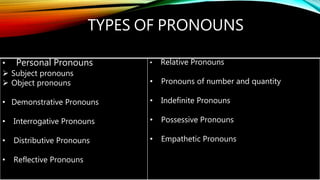
TYPES OF PRONOUNS
• Personal Pronouns
 Subject pronouns
 Object pronouns
• Demonstrative Pronouns
• Interrogative Pronouns
• Distributive Pronouns
• Reflective Pronouns
• Relative Pronouns
• Pronouns of number and quantity
• Indefinite Pronouns
• Possessive Pronouns
• Empathetic Pronouns
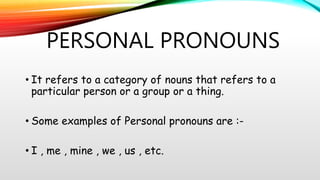
PERSONAL PRONOUNS
• It refers to a category of nouns that refers to a
particular person or a group or a thing.
• Some examples of Personal pronouns are :-
• I , me , mine , we , us , etc.
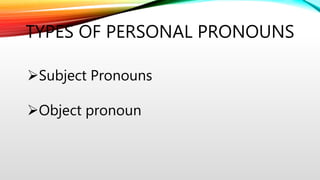
TYPES OF PERSONAL PRONOUNS
Subject Pronouns
Object pronoun
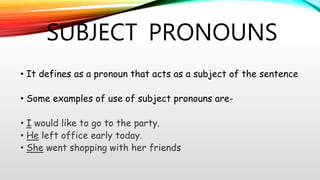
SUBJECT PRONOUNS
• It defines as a pronoun that acts as a subject of the sentence
• Some examples of use of subject pronouns are-
• I would like to go to the party.
• He left office early today.
• She went shopping with her friends
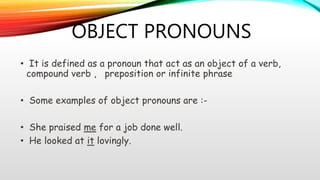
OBJECT PRONOUNS
• It is defined as a pronoun that act as an object of a verb,
compound verb , preposition or infinite phrase
• Some examples of object pronouns are :-
• She praised me for a job done well.
• He looked at it lovingly.
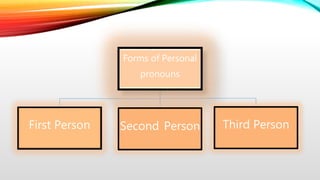
Forms of Personal
pronouns
First Person Second Person Third Person
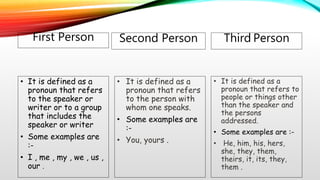
First Person
• It is defined as a
pronoun that refers
to the speaker or
writer or to a group
that includes the
speaker or writer
• Some examples are
:-
• I , me , my , we , us ,
our .
Second Person
• It is defined as a
pronoun that refers
to the person with
whom one speaks.
• Some examples are
:-
• You, yours .
Third Person
• It is defined as a
pronoun that refers to
people or things other
than the speaker and
the persons
addressed.
• Some examples are :-
• He, him, his, hers,
she, they, them,
theirs, it, its, they,
them .
DEMONSTRATIVE PRONOUNS
• It is defined as a pronoun that points to a particular
noun or to the noun it replaces.
• Some examples of Demonstrative Pronouns are:-
• She gifted me that pen.
• These are my pets.
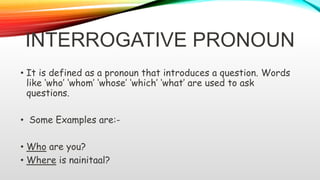
INTERROGATIVE PRONOUN
• It is defined as a pronoun that introduces a question. Words
like ‘who’ ‘whom’ ‘whose’ ‘which’ ‘what’ are used to ask
questions.
• Some Examples are:-
• Who are you?
• Where is nainitaal?
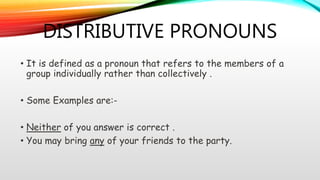
DISTRIBUTIVE PRONOUNS
• It is defined as a pronoun that refers to the members of a
group individually rather than collectively .
• Some Examples are:-
• Neither of you answer is correct .
• You may bring any of your friends to the party.
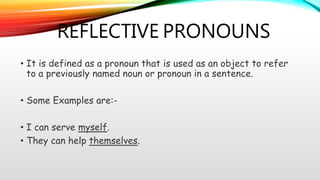
REFLECTIVE PRONOUNS
• It is defined as a pronoun that is used as an object to refer
to a previously named noun or pronoun in a sentence.
• Some Examples are:-
• I can serve myself.
• They can help themselves.
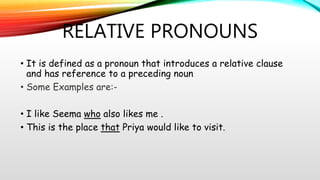
RELATIVE PRONOUNS
• It is defined as a pronoun that introduces a relative clause
and has reference to a preceding noun
• Some Examples are:-
• I like Seema who also likes me .
• This is the place that Priya would like to visit.
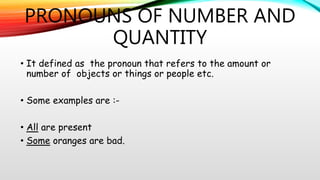
PRONOUNS OF NUMBER AND
QUANTITY
• It defined as the pronoun that refers to the amount or
number of objects or things or people etc.
• Some examples are :-
• All are present
• Some oranges are bad.
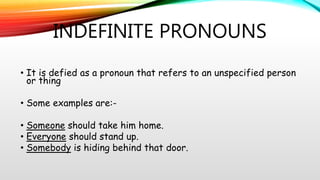
INDEFINITE PRONOUNS
• It is defied as a pronoun that refers to an unspecified person
or thing
• Some examples are:-
• Someone should take him home.
• Everyone should stand up.
• Somebody is hiding behind that door.
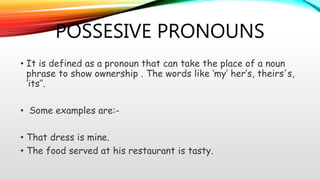
POSSESIVE PRONOUNS
• It is defined as a pronoun that can take the place of a noun
phrase to show ownership . The words like ‘my’ her’s, theirs's,
‘its’’.
• Some examples are:-
• That dress is mine.
• The food served at his restaurant is tasty.
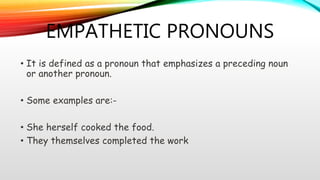
EMPATHETIC PRONOUNS
• It is defined as a pronoun that emphasizes a preceding noun
or another pronoun.
• Some examples are:-
• She herself cooked the food.
• They themselves completed the work
THANK YOU

Pronouns and its types

  • 1.
    PRONOUNS Pronoun is aPART OF A SPEECH WHICH FUNCTIONS AS A REPLACEMENT FOR A NOUN , NOUN PHRASE OR NOUN CLAUSE .
  • 2.
    TYPES OF PRONOUNS •Personal Pronouns  Subject pronouns  Object pronouns • Demonstrative Pronouns • Interrogative Pronouns • Distributive Pronouns • Reflective Pronouns • Relative Pronouns • Pronouns of number and quantity • Indefinite Pronouns • Possessive Pronouns • Empathetic Pronouns
  • 3.
    PERSONAL PRONOUNS • Itrefers to a category of nouns that refers to a particular person or a group or a thing. • Some examples of Personal pronouns are :- • I , me , mine , we , us , etc.
  • 4.
    TYPES OF PERSONALPRONOUNS Subject Pronouns Object pronoun
  • 5.
    SUBJECT PRONOUNS • Itdefines as a pronoun that acts as a subject of the sentence • Some examples of use of subject pronouns are- • I would like to go to the party. • He left office early today. • She went shopping with her friends
  • 6.
    OBJECT PRONOUNS • Itis defined as a pronoun that act as an object of a verb, compound verb , preposition or infinite phrase • Some examples of object pronouns are :- • She praised me for a job done well. • He looked at it lovingly.
  • 7.
    Forms of Personal pronouns FirstPerson Second Person Third Person
  • 8.
    First Person • Itis defined as a pronoun that refers to the speaker or writer or to a group that includes the speaker or writer • Some examples are :- • I , me , my , we , us , our . Second Person • It is defined as a pronoun that refers to the person with whom one speaks. • Some examples are :- • You, yours . Third Person • It is defined as a pronoun that refers to people or things other than the speaker and the persons addressed. • Some examples are :- • He, him, his, hers, she, they, them, theirs, it, its, they, them .
  • 9.
    DEMONSTRATIVE PRONOUNS • Itis defined as a pronoun that points to a particular noun or to the noun it replaces. • Some examples of Demonstrative Pronouns are:- • She gifted me that pen. • These are my pets.
  • 10.
    INTERROGATIVE PRONOUN • Itis defined as a pronoun that introduces a question. Words like ‘who’ ‘whom’ ‘whose’ ‘which’ ‘what’ are used to ask questions. • Some Examples are:- • Who are you? • Where is nainitaal?
  • 11.
    DISTRIBUTIVE PRONOUNS • Itis defined as a pronoun that refers to the members of a group individually rather than collectively . • Some Examples are:- • Neither of you answer is correct . • You may bring any of your friends to the party.
  • 12.
    REFLECTIVE PRONOUNS • Itis defined as a pronoun that is used as an object to refer to a previously named noun or pronoun in a sentence. • Some Examples are:- • I can serve myself. • They can help themselves.
  • 13.
    RELATIVE PRONOUNS • Itis defined as a pronoun that introduces a relative clause and has reference to a preceding noun • Some Examples are:- • I like Seema who also likes me . • This is the place that Priya would like to visit.
  • 14.
    PRONOUNS OF NUMBERAND QUANTITY • It defined as the pronoun that refers to the amount or number of objects or things or people etc. • Some examples are :- • All are present • Some oranges are bad.
  • 15.
    INDEFINITE PRONOUNS • Itis defied as a pronoun that refers to an unspecified person or thing • Some examples are:- • Someone should take him home. • Everyone should stand up. • Somebody is hiding behind that door.
  • 16.
    POSSESIVE PRONOUNS • Itis defined as a pronoun that can take the place of a noun phrase to show ownership . The words like ‘my’ her’s, theirs's, ‘its’’. • Some examples are:- • That dress is mine. • The food served at his restaurant is tasty.
  • 17.
    EMPATHETIC PRONOUNS • Itis defined as a pronoun that emphasizes a preceding noun or another pronoun. • Some examples are:- • She herself cooked the food. • They themselves completed the work
  • 18.