Focusing on the
climb ahead
Third-party governance
and risk management
Extended enterprise risk managment global survey 2018
A renewed focus on enhancing extended enterprise
risk management maturity has emerged in the last
year amid increasing perceptions of dependence
on third-parties, although moving up the maturity
curve has been slower than expected.
Our survey has identified six key areas of focus for most organizations:
Inherent risk and maturity
Business case and investment
Centralized control
Technology platforms
Sub-contractor risk
Organizational imperatives and accountability
Amid an increase in the inherent risk of dependence on third-parties,
organizations are tackling EERM with a renewed focus and investment,
although at a slower pace than expected.
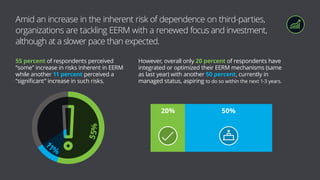
55 percent of respondents perceived
“some” increase in risks inherent in EERM
while another 11 percent perceived a
“significant” increase in such risks.
55%
1
1%
However, overall only 20 percent of respondents have
integrated or optimized their EERM mechanisms (same
as last year) with another 50 percent, currently in
managed status, aspiring to do so within the next 1-3 years.
20% 50%
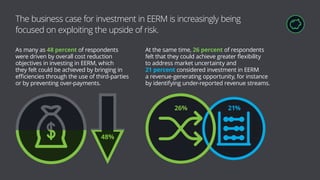
The business case for investment in EERM is increasingly being
focused on exploiting the upside of risk.
As many as 48 percent of respondents
were driven by overall cost reduction
objectives in investing in EERM, which
they felt could be achieved by bringing in
efficiencies through the use of third-parties
or by preventing over-payments.
48%
At the same time, 26 percent of respondents
felt that they could achieve greater flexibility
to address market uncertainty and
21 percent considered investment in EERM
a revenue-generating opportunity, for instance
by identifying under‑reported revenue streams.
21%26%
Organizations are scaling back on decentralized roles and processes for
EERM. There is also an increasing desire to explore market utility models.
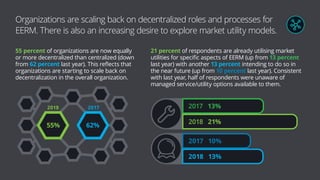
55 percent of organizations are now equally
or more decentralized than centralized (down
from 62 percent last year). This reflects that
organizations are starting to scale back on
decentralization in the overall organization.
62%
2017
55%
2018
21 percent of respondents are already utilising market
utilities for specific aspects of EERM (up from 13 percent
last year) with another 13 percent intending to do so in
the near future (up from 10 percent last year). Consistent
with last year, half of respondents were unaware of
managed service/utility options available to them.
2017 13%
2018 21%
2017 10%
2018 13%
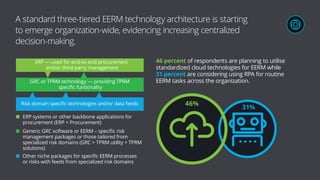
A standard three-tiered EERM technology architecture is starting
to emerge organization-wide, evidencing increasing centralized
decision-making.
46%
31%
46 percent of respondents are planning to utilise
standardized cloud technologies for EERM while
31 percent are considering using RPA for routine
EERM tasks across the organization.
Other niche packages for specific EERM processes
or risks with feeds from specialized risk domains
ERP systems or other backbone applications for
procurement (ERP + Procurement)
Generic GRC software or EERM – specific risk
management packages or those tailored from
specialized risk domains (GRC + TPRM utility + TPRM
solutions)
ERP — used for end-to-end procurement
and/or third-party management
GRC or TPRM technology — providing TPRM
specific funtionality
Risk domain specific technologies and/or data feeds
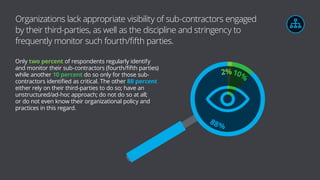
Organizations lack appropriate visibility of sub-contractors engaged
by their third-parties, as well as the discipline and stringency to
frequently monitor such fourth/fifth parties.
Only two percent of respondents regularly identify
and monitor their sub-contractors (fourth/fifth parties)
while another 10 percent do so only for those sub-
contractors identified as critical. The other 88 percent
either rely on their third-parties to do so; have an
unstructured/ad-hoc approach; do not do so at all;
or do not even know their organizational policy and
practices in this regard.
10%
88%
2%
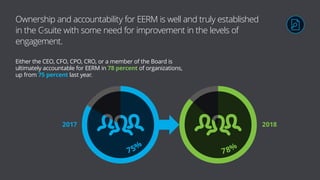
Ownership and accountability for EERM is well and truly established
in the C-suite with some need for improvement in the levels of
engagement.
2017 2018
75%
78%
Either the CEO, CFO, CPO, CRO, or a member of the Board is
ultimately accountable for EERM in 78 percent of organizations,
up from 75 percent last year.
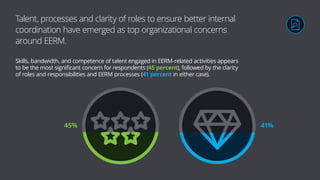
Talent, processes and clarity of roles to ensure better internal
coordination have emerged as top organizational concerns
around EERM.
Skills, bandwidth, and competence of talent engaged in EERM-related activities appears
to be the most significant concern for respondents (45 percent), followed by the clarity
of roles and responsibilities and EERM processes (41 percent in either case).
45% 41%
Contacts
Kristian Park
EMEA Leader, Extended
Enterprise Risk Management,
Global Risk Advisory
+44 20 7303 4110
Mark Bethell
Director, Extended Enterprise
Risk Management,
Deloitte LLP
+44 20 7007 5913
Danny Griffiths
Director, Extended Enterprise
Risk Management,
Deloitte LLP
+44 20 7007 9296
Sanjoy Sen
Head of Research and Eminence,
Extended Enterprise Risk Management,
Deloitte LLP
+44 121 695 5044
Deloitte refers to one or more of Deloitte Touche Tohmatsu Limited (“DTTL”), its global network of member firms and their related entities. DTTL (also referred to as “Deloitte Global”) and each of
its member firms are legally separate and independent entities. DTTL does not provide services to clients. Please see www.deloitte.com/about to learn more.
Deloitte is a leading global provider of audit and assurance, consulting, financial advisory, risk advisory, tax and related services. Our network of member firms in more than 150 countries and
territories serves four out of five Fortune Global 500®
companies. Learn how Deloitte’s approximately 264,000 people make an impact that matters at www.deloitte.com.
This communication contains general information only, and none of Deloitte Touche Tohmatsu Limited, its member firms or their related entities (collectively, the “Deloitte network”) is, by means
of this communication, rendering professional advice or services. Before making any decision or taking any action that may affect your finances or your business, you should consult a qualified
professional adviser. No entity in the Deloitte network shall be responsible for any loss whatsoever sustained by any person who relies on this communication.​
© 2018. For information, contact Deloitte Touche Tohmatsu Limited.
Designed and produced by The Creative Studio at Deloitte, London. J14519

Third-party Governance and Risk Management - 2018

  • 1.
    Focusing on the climbahead Third-party governance and risk management Extended enterprise risk managment global survey 2018
  • 2.
    A renewed focuson enhancing extended enterprise risk management maturity has emerged in the last year amid increasing perceptions of dependence on third-parties, although moving up the maturity curve has been slower than expected.
  • 3.
    Our survey hasidentified six key areas of focus for most organizations: Inherent risk and maturity Business case and investment Centralized control Technology platforms Sub-contractor risk Organizational imperatives and accountability
  • 4.
    Amid an increasein the inherent risk of dependence on third-parties, organizations are tackling EERM with a renewed focus and investment, although at a slower pace than expected. 55 percent of respondents perceived “some” increase in risks inherent in EERM while another 11 percent perceived a “significant” increase in such risks. 55% 1 1% However, overall only 20 percent of respondents have integrated or optimized their EERM mechanisms (same as last year) with another 50 percent, currently in managed status, aspiring to do so within the next 1-3 years. 20% 50%
  • 5.
    The business casefor investment in EERM is increasingly being focused on exploiting the upside of risk. As many as 48 percent of respondents were driven by overall cost reduction objectives in investing in EERM, which they felt could be achieved by bringing in efficiencies through the use of third-parties or by preventing over-payments. 48% At the same time, 26 percent of respondents felt that they could achieve greater flexibility to address market uncertainty and 21 percent considered investment in EERM a revenue-generating opportunity, for instance by identifying under‑reported revenue streams. 21%26%
  • 6.
    Organizations are scalingback on decentralized roles and processes for EERM. There is also an increasing desire to explore market utility models. 55 percent of organizations are now equally or more decentralized than centralized (down from 62 percent last year). This reflects that organizations are starting to scale back on decentralization in the overall organization. 62% 2017 55% 2018 21 percent of respondents are already utilising market utilities for specific aspects of EERM (up from 13 percent last year) with another 13 percent intending to do so in the near future (up from 10 percent last year). Consistent with last year, half of respondents were unaware of managed service/utility options available to them. 2017 13% 2018 21% 2017 10% 2018 13%
  • 7.
    A standard three-tieredEERM technology architecture is starting to emerge organization-wide, evidencing increasing centralized decision-making. 46% 31% 46 percent of respondents are planning to utilise standardized cloud technologies for EERM while 31 percent are considering using RPA for routine EERM tasks across the organization. Other niche packages for specific EERM processes or risks with feeds from specialized risk domains ERP systems or other backbone applications for procurement (ERP + Procurement) Generic GRC software or EERM – specific risk management packages or those tailored from specialized risk domains (GRC + TPRM utility + TPRM solutions) ERP — used for end-to-end procurement and/or third-party management GRC or TPRM technology — providing TPRM specific funtionality Risk domain specific technologies and/or data feeds
  • 8.
    Organizations lack appropriatevisibility of sub-contractors engaged by their third-parties, as well as the discipline and stringency to frequently monitor such fourth/fifth parties. Only two percent of respondents regularly identify and monitor their sub-contractors (fourth/fifth parties) while another 10 percent do so only for those sub- contractors identified as critical. The other 88 percent either rely on their third-parties to do so; have an unstructured/ad-hoc approach; do not do so at all; or do not even know their organizational policy and practices in this regard. 10% 88% 2%
  • 9.
    Ownership and accountabilityfor EERM is well and truly established in the C-suite with some need for improvement in the levels of engagement. 2017 2018 75% 78% Either the CEO, CFO, CPO, CRO, or a member of the Board is ultimately accountable for EERM in 78 percent of organizations, up from 75 percent last year.
  • 10.
    Talent, processes andclarity of roles to ensure better internal coordination have emerged as top organizational concerns around EERM. Skills, bandwidth, and competence of talent engaged in EERM-related activities appears to be the most significant concern for respondents (45 percent), followed by the clarity of roles and responsibilities and EERM processes (41 percent in either case). 45% 41%
  • 11.
    Contacts Kristian Park EMEA Leader,Extended Enterprise Risk Management, Global Risk Advisory +44 20 7303 4110 Mark Bethell Director, Extended Enterprise Risk Management, Deloitte LLP +44 20 7007 5913 Danny Griffiths Director, Extended Enterprise Risk Management, Deloitte LLP +44 20 7007 9296 Sanjoy Sen Head of Research and Eminence, Extended Enterprise Risk Management, Deloitte LLP +44 121 695 5044
  • 12.
    Deloitte refers toone or more of Deloitte Touche Tohmatsu Limited (“DTTL”), its global network of member firms and their related entities. DTTL (also referred to as “Deloitte Global”) and each of its member firms are legally separate and independent entities. DTTL does not provide services to clients. Please see www.deloitte.com/about to learn more. Deloitte is a leading global provider of audit and assurance, consulting, financial advisory, risk advisory, tax and related services. Our network of member firms in more than 150 countries and territories serves four out of five Fortune Global 500® companies. Learn how Deloitte’s approximately 264,000 people make an impact that matters at www.deloitte.com. This communication contains general information only, and none of Deloitte Touche Tohmatsu Limited, its member firms or their related entities (collectively, the “Deloitte network”) is, by means of this communication, rendering professional advice or services. Before making any decision or taking any action that may affect your finances or your business, you should consult a qualified professional adviser. No entity in the Deloitte network shall be responsible for any loss whatsoever sustained by any person who relies on this communication.​ © 2018. For information, contact Deloitte Touche Tohmatsu Limited. Designed and produced by The Creative Studio at Deloitte, London. J14519