Enterprise Data Architecture
Identifying and preserving the most valuable resource in a Financial Services organization
May, 2012
A DATA STRATEGY SERIES CASE STUDY By DAN WILCOMB | Axis Information Architect
When business-critical information resides on desktops, and the share price
sinks or soars on data-driven decisions, it’s time to get serious about data
architecture. It doesn’t happen on it’s own…it takes strategic vision, cogent
planning, and a strong ability to execute.
www.axistechnologyllc.com Boston | Dallas | Charlotte | New York
The goal of the 12-week engagement was to provide a strategic view of the client’s future
state information supply chain, and a customized set of well-defined projects needed to
achieve that goal. The guiding principles behind the roadmap were the integrity and
consistency of information, cost efficiency of the solution, and consensus among stakeholders.
The solution needed to address fundamental issues of data ambiguity and lack of consistent
usage, as well as high dependence on manual entry and assembly of information and
commensurate undocumented processes.
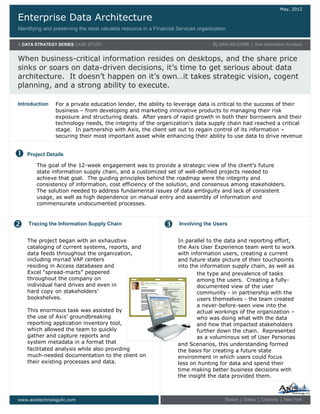
including myriad VAP centers
residing in Access databases and
Excel “spread-marts” peppered
throughout the company on
individual hard drives and even in
hard copy on stakeholders’
bookshelves.
This enormous task was assisted by
the use of Axis’ groundbreaking
reporting application inventory tool,
which allowed the team to quickly
gather and capture reports and
system metadata in a format that


For a private education lender, the ability to leverage data is critical to the success of their
business – from developing and marketing innovative products to managing their risk
exposure and structuring deals. After years of rapid growth in both their borrowers and their
technology needs, the integrity of the organization’s data supply chain had reached a critical
stage. In partnership with Axis, the client set out to regain control of its information –
securing their most important asset while enhancing their ability to use data to drive revenue
growth.
Introduction
Tracing the Information Supply Chain
Project Details
 Involving the Users
the type and prevalence of tasks
among the users. Creating a fully-
documented view of the user
community - in partnership with the
users themselves - the team created
a never-before-seen view into the
actual workings of the organization –
who was doing what with the data
and how that impacted stakeholders
further down the chain. Represented
as a voluminous set of User Personas
In parallel to the data and reporting effort,
the Axis User Experience team went to work
with information users, creating a current
and future state picture of their touchpoints
into the information supply chain, as well as
and Scenarios, this understanding formed
the basis for creating a future state
environment in which users could focus
less on hunting for data and spend their
time making better business decisions with
the insight the data provided them.
The project began with an exhaustive
cataloging of current systems, reports, and
data feeds throughout the organization,
facilitated analysis while also providing
much-needed documentation to the client on
their existing processes and data.
Enterprise Data Architecture
A DATA STRATEGY SERIES CASE STUDY By DAN WILCOMB | Axis Information Architect
…identifying and preserving the most valuable company resource
www.axistechnologyllc.com Boston | Dallas | Charlotte | New York

The strategy effort was a stunning success for Axis and our client partners, culminating in
enthusiastic support from the Executive Operating Committee and the CEO of the company.
As of the date of this case study, two foundational projects are underway to resolve key data
ambiguity and management challenges in preparation for warehousing, masking, and
analytics efforts in the 2007 portion of the roadmap. The strategy effort has resulted in an
In Closing
Defining Information Challenges
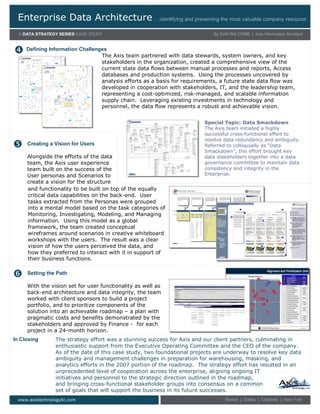
The Axis team partnered with data stewards, system owners, and key
stakeholders in the organization, created a comprehensive view of the
current state data flows between manual processes and reports, Access
databases and production systems. Using the processes uncovered by
analysis efforts as a basis for requirements, a future state data flow was
developed in cooperation with stakeholders, IT, and the leadership team,
representing a cost-optimized, risk-managed, and scalable information
supply chain. Leveraging existing investments in technology and
personnel, the data flow represents a robust and achievable vision.
 Setting the Path
With the vision set for user functionality as well as
back-end architecture and data integrity, the team
worked with client sponsors to build a project
portfolio, and to prioritize components of the
solution into an achievable roadmap – a plan with
pragmatic costs and benefits demonstrated by the
stakeholders and approved by Finance - for each
project in a 24-month horizon.
unprecedented level of cooperation across the enterprise, aligning ongoing IT
initiatives and personnel to the strategic direction outlined in the roadmap,
and bringing cross-functional stakeholder groups into consensus on a common
set of goals that will support the business in its future successes.
 Creating a Vision for Users
Alongside the efforts of the data
team, the Axis user experience
team built on the success of the
User personas and Scenarios to
create a vision for the structure
Special Topic: Data Smackdown
The Axis team initiated a highly
successful cross-functional effort to
resolve data redundancy and ambiguity.
Referred to colloquially as “Data
Smackdown”, this effort brought key
data stakeholders together into a data
governance committee to maintain data
consistency and integrity in the
Enterprise.
and functionality to be built on top of the equally
critical data capabilities on the back-end. User
tasks extracted from the Personas were grouped
into a mental model based on the task categories of
Monitoring, Investigating, Modeling, and Managing
information. Using this model as a global
framework, the team created conceptual
wireframes around scenarios in creative whiteboard
workshops with the users. The result was a clear
vision of how the users perceived the data, and
how they preferred to interact with it in support of
their business functions.

Enterprise Data Architecture

  • 1.
    Enterprise Data Architecture Identifyingand preserving the most valuable resource in a Financial Services organization May, 2012 A DATA STRATEGY SERIES CASE STUDY By DAN WILCOMB | Axis Information Architect When business-critical information resides on desktops, and the share price sinks or soars on data-driven decisions, it’s time to get serious about data architecture. It doesn’t happen on it’s own…it takes strategic vision, cogent planning, and a strong ability to execute. www.axistechnologyllc.com Boston | Dallas | Charlotte | New York The goal of the 12-week engagement was to provide a strategic view of the client’s future state information supply chain, and a customized set of well-defined projects needed to achieve that goal. The guiding principles behind the roadmap were the integrity and consistency of information, cost efficiency of the solution, and consensus among stakeholders. The solution needed to address fundamental issues of data ambiguity and lack of consistent usage, as well as high dependence on manual entry and assembly of information and commensurate undocumented processes. including myriad VAP centers residing in Access databases and Excel “spread-marts” peppered throughout the company on individual hard drives and even in hard copy on stakeholders’ bookshelves. This enormous task was assisted by the use of Axis’ groundbreaking reporting application inventory tool, which allowed the team to quickly gather and capture reports and system metadata in a format that   For a private education lender, the ability to leverage data is critical to the success of their business – from developing and marketing innovative products to managing their risk exposure and structuring deals. After years of rapid growth in both their borrowers and their technology needs, the integrity of the organization’s data supply chain had reached a critical stage. In partnership with Axis, the client set out to regain control of its information – securing their most important asset while enhancing their ability to use data to drive revenue growth. Introduction Tracing the Information Supply Chain Project Details  Involving the Users the type and prevalence of tasks among the users. Creating a fully- documented view of the user community - in partnership with the users themselves - the team created a never-before-seen view into the actual workings of the organization – who was doing what with the data and how that impacted stakeholders further down the chain. Represented as a voluminous set of User Personas In parallel to the data and reporting effort, the Axis User Experience team went to work with information users, creating a current and future state picture of their touchpoints into the information supply chain, as well as and Scenarios, this understanding formed the basis for creating a future state environment in which users could focus less on hunting for data and spend their time making better business decisions with the insight the data provided them. The project began with an exhaustive cataloging of current systems, reports, and data feeds throughout the organization, facilitated analysis while also providing much-needed documentation to the client on their existing processes and data.
  • 2.
    Enterprise Data Architecture ADATA STRATEGY SERIES CASE STUDY By DAN WILCOMB | Axis Information Architect …identifying and preserving the most valuable company resource www.axistechnologyllc.com Boston | Dallas | Charlotte | New York  The strategy effort was a stunning success for Axis and our client partners, culminating in enthusiastic support from the Executive Operating Committee and the CEO of the company. As of the date of this case study, two foundational projects are underway to resolve key data ambiguity and management challenges in preparation for warehousing, masking, and analytics efforts in the 2007 portion of the roadmap. The strategy effort has resulted in an In Closing Defining Information Challenges The Axis team partnered with data stewards, system owners, and key stakeholders in the organization, created a comprehensive view of the current state data flows between manual processes and reports, Access databases and production systems. Using the processes uncovered by analysis efforts as a basis for requirements, a future state data flow was developed in cooperation with stakeholders, IT, and the leadership team, representing a cost-optimized, risk-managed, and scalable information supply chain. Leveraging existing investments in technology and personnel, the data flow represents a robust and achievable vision.  Setting the Path With the vision set for user functionality as well as back-end architecture and data integrity, the team worked with client sponsors to build a project portfolio, and to prioritize components of the solution into an achievable roadmap – a plan with pragmatic costs and benefits demonstrated by the stakeholders and approved by Finance - for each project in a 24-month horizon. unprecedented level of cooperation across the enterprise, aligning ongoing IT initiatives and personnel to the strategic direction outlined in the roadmap, and bringing cross-functional stakeholder groups into consensus on a common set of goals that will support the business in its future successes.  Creating a Vision for Users Alongside the efforts of the data team, the Axis user experience team built on the success of the User personas and Scenarios to create a vision for the structure Special Topic: Data Smackdown The Axis team initiated a highly successful cross-functional effort to resolve data redundancy and ambiguity. Referred to colloquially as “Data Smackdown”, this effort brought key data stakeholders together into a data governance committee to maintain data consistency and integrity in the Enterprise. and functionality to be built on top of the equally critical data capabilities on the back-end. User tasks extracted from the Personas were grouped into a mental model based on the task categories of Monitoring, Investigating, Modeling, and Managing information. Using this model as a global framework, the team created conceptual wireframes around scenarios in creative whiteboard workshops with the users. The result was a clear vision of how the users perceived the data, and how they preferred to interact with it in support of their business functions.