1 
December 11, 2014 
Copyright 2014©, All rights reserved, 3W Partners LLC 
Scott Roller
2 
 Principal & Founder – 3W Partners LLC 
 25 Years – Fortune 500 Companies 
• Telecom 
• Financial Services 
 Leadership Roles in 
• Global Vendor Management 
• Ops / Strategy / Re-engineering 
• Outsourcing / Training 
 TL9001 (“ISO for telecom”) 
• Certified Lead Auditor 
Audited by… 
Regulators 
Gov’t Entities 
Ratings Agencies 
Others 
OCC, OTS, CFPB 
Fannie, Freddie, GAO 
Moody’s, Fitch, S&P 
ISO, Accounting firms
3 
Third-Party Oversight & Governance (TPOG) 
Brief History 
 Why the intense focus on vendors? 
 What led us here? 
Changing Landscape 
 Financial Crisis ~2008 
 Vendor management Prior to… and Now 
 Heightened regulator focus areas 
What Regulators Expect 
 12 Key Dimensions 
 Good resources to self-educate 
Technology & Tools 
 Increase you chances of success
4 
Financial Crisis 2008 
Prior to the Crisis 
Vendor focus very limited: 
• Business continuity 
• Financial strength 
• Credit risk 
Activities were outsourced 
• Unfortunately, so was 
vendor responsibility and 
accountability 
Post-mortem 
Vendors seen as a major 
contributing factor to the 
crisis 
Inadequate oversight from 
financial institutions 
Resulted in massive fraud and consumer distress 
Hidden risks when relationships are not managed closely
5 
Regulatory Response to the Financial Crisis 
Regulators have a renewed focus on third-party 
oversight 
OCC 
CFPB 
Federal Reserve Board 
FDIC 
NCUA 
Considerable Attention 
 Institutions must bear responsibility for supplier misdeeds 
• Numerous “casualties” already 
 Major focus on consumer interaction with vendors 
 Enterprise-wide engagement, especially executives 
 Push for independent reviews 
Will focus on 12 Key Dimensions today
6 
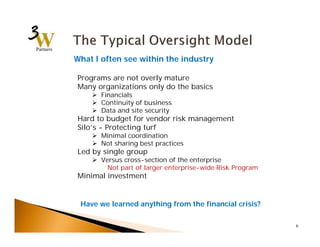
What I often see within the industry 
Programs are not overly mature 
Many organizations only do the basics 
 Financials 
 Continuity of business 
 Data and site security 
Hard to budget for vendor risk management 
Silo’s - Protecting turf 
 Minimal coordination 
 Not sharing best practices 
Led by single group 
 Versus cross-section of the enterprise 
Not part of larger enterprise-wide Risk Program 
Minimal investment 
Have we learned anything from the financial crisis?
7 
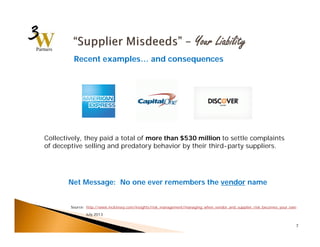
Recent examples… and consequences 
Collectively, they paid a total of more than $530 million to settle complaints 
of deceptive selling and predatory behavior by their third-party suppliers. 
Net Message: No one ever remembers the vendor name 
Source: http://www.mckinsey.com/insights/risk_management/managing_when_vendor_and_supplier_risk_becomes_your_own 
July 2013
8 
OCC 
CFPB 
Federal Reserve Board 
FDIC 
NCUA 
On Third-Party Oversight & Governance 
OCC Bulletin 2013-29 
• OCC Bulletin 2001-47 
• OCC Bulletin 2002-16: Foreign-Based Third-Party Service Providers 
Bulletin 2012-03 Service Providers 
SR 13-19 Guidance on Managing Outsourcing Risk 
• SR 00-4 (SUP): Outsourcing of Information Technology and Transaction 
• Processing 
Letter: Guidance For Managing Third-Party Risk 
• FDIC Compliance Manual, December 2012 
• FIL-44-2008: Guidance for Managing Third-Party Risk 
• FIL-50-2001: Bank Technology Bulletin: Technology Outsourcing 
Information Documents 
Supervisory Letter No.: 07-01 
Fortunately, expectations resemble one another
9 
These cover most regulatory expectations 
Risk Classification 
Due Diligence 
On-Boarding 
Contracts 
Compliance 
Audits 
MIS / Reporting 
Scorecards 
Annual Certifications 
Complaint Handling 
Escalations 
Governance 
Execute these well… satisfy your regulator(s)
10 
For effective third-party oversight 
Risk Classification 
 Risk-based segmentation 
 Scope and intensity of oversight is defined here 
 Must consider risks to… 
• Legal & Regulatory 
• Reputation 
• Sensitivity of data 
• Process complexity 
• Customer interface/impact 
• Public or private vendor 
Other Considerations 
• Domestic 
• Offshore 
• Core Bank Function 
• Non-Core 
• Number of similar suppliers 
• Percent of volume handled 
• Strategic (High) 
• Major (Med) 
• Basic (Low)
11 
Due Diligence 
 Assess the process of how suppliers are… 
• Sought 
• Vetted 
• Selected (and retained) 
 Consider vendor questionnaire and evaluation 
matrix 
On-Boarding 
 Have a plan to implement the vendor relationship 
• Technology, telecom, recruit, train (including compliance), etc. 
 Critical: System Entitlements 
• Limit vendor access to only what is “required” 
• Have a revocation process 
o Consider revoking within 24-hours of leaving
12 
Contracts 
 Regulators have specific expectations regarding vendor contracts 
 Examples of often-overlooked clauses: 
• Use of subcontractors 
• Termination for default 
• Compliance with laws 
• Privacy policy (sensitive info) 
• Electronic Transportable Media 
• Right to audit 
• Licensing 
• Indemnification 
• Notification of complaints 
• Handling of media inquiries 
• Service level monitoring 
• Limitation of liability 
• GSA “Excluded Party List” 
• HUD’s “Limited Denial of Participation” 
What is required of you … 
Is also required of ALL members of your “supply chain.” 
Make it contractual.
13 
Compliance 
 Identify all relevant compliance requirements and document how 
requirements are being met 
 Regulatory updates and change management process effectiveness 
• Flow down to vendors (operations, contracts, scorecards, etc.) 
Audits 
 Do your vendors... 
• “Say what they do?” (via Policy & Procedure Manual) 
• “Do what they say?” (can vendors demonstrate it?) 
 Have an audit schedule and comprehensive plan 
 Ensure risks are documented and controls are in place. 
Risk Classification 
• Strategic (High) 
• Major (Med) 
• Basic (Low) 
“Potential” Audit Frequency 
• Twice per year 
• Once per year 
• Every other year
14 
MIS / Reporting 
 You need timely and effective reporting in all supplier relationships. 
 Demonstrate you have sufficient visibility and control. 
Hard to achieve safety and soundness without robust reporting 
Scorecards 
 Identify key performance indicators (KPI)s, track and report on them. 
 Document vendor improvement plans. 
• Drive accountability. 
 Regular reviews. 
• Evidence of follow-up and actions 
o Warning notices 
o Training, certification 
o Volume adjustments 
o Expanded or decreased scope of work
15 
Annual Certifications 
 Re-certify vendors annually. 
No more 
• Financials 
• Licensing 
• Insurance 
• Data security 
• Capacity / Staffing 
• SLA performance 
• Process reviews 
• Compliance 
• Customer impact 
• Fees & incentives 
• Use of subcontractors 
• Training (especially compliance) 
• Business continuity 
• Audit results 
• Complaints 
• Media attention 
• Pending litigation 
• Mergers & Acquisitions 
• Ownership changes 
• Compensation practices 
 Keeping up with all changes: Yours, vendors, regulators, etc. 
• Assessing the impacts annually, at minimum. 
Very labor intensive dimension 
Due Diligence
16 
Complaint Handling 
 Requires an effective method of capturing, responding to and 
resolving complaints. 
• Especially where suppliers are involved. 
 Complaint source and severity: Major, Moderate, Minor. 
 Linkage of root cause back to the operation. 
 Report to senior leadership. 
Escalations 
Define your future reactions 
 When supplier problems arise, must have effective identification, 
escalation and management of issues. 
 Escalate to appropriate levels. Special review committee? 
 Examples: 
• Bad press 
• Multiple system outages 
• Multiple complaints 
• SLAs repeatedly not met 
• Downgraded financials 
• Fraud event 
• Audit findings
17 
Governance 
 Senior executive and/or Board Member engagement 
• “Fingerprints everywhere” 
o Drive and approve policy 
o Monitor vendor platform (via regular readouts) 
At-will access to vendor results 
o Sign-off on vendor selection and recertification (and action/exit) 
o Audit trail of their engagement 
 Proposed: Two Tier Governance Model 
Executive 
Committee 
Operations 
Committee 
Drive Vendor… 
• Performance / Quality 
• Control & Compliance 
• Risk & Change Mgmt. 
• Audits 
• Volume Allocations 
• Contingency plans 
Sets “TONE at the TOP” 
• Strategic Alignment 
• Risk appetite 
• Policy 
• Verify adequate oversight 
• Ask questions 
• Approve, Suspend & Terminate
Extremely useful when managing vendors and risks 
 Centralized repository; Security 
 Portal for easy access 
 Clear, actionable management reports and well-designed workflow 
systems 
• Essential for accountability across the institution 
 Measure your level of dependence on critical suppliers 
Build vs. Buy 
 Building a new third-party risk application from scratch is a big 
undertaking; 
• So too is enhancing a current risk tool to perform new functions 
 Consider “off-the-shelf” workflow and risk-management tools 
18
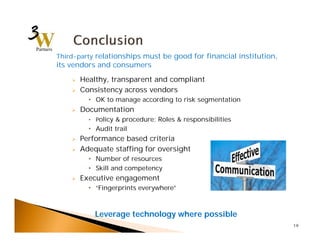
 Healthy, transparent and compliant 
 Consistency across vendors 
• OK to manage according to risk segmentation 
 Documentation 
• Policy & procedure; Roles & responsibilities 
• Audit trail 
 Performance based criteria 
 Adequate staffing for oversight 
• Number of resources 
• Skill and competency 
 Executive engagement 
• “Fingerprints everywhere” 
19 
Third-party relationships must be good for financial institution, 
its vendors and consumers 
Leverage technology where possible
20 
For a copy of today’s presentation… 
Scott Roller 
Principal / Founder 
3W Partners LLC 
scott@3Wpartners.net 
636.448.3713 cell 
www.3Wpartners.net

Third-Party Oversight & Governance

  • 1.
    1 December 11,2014 Copyright 2014©, All rights reserved, 3W Partners LLC Scott Roller
  • 2.
    2  Principal& Founder – 3W Partners LLC  25 Years – Fortune 500 Companies • Telecom • Financial Services  Leadership Roles in • Global Vendor Management • Ops / Strategy / Re-engineering • Outsourcing / Training  TL9001 (“ISO for telecom”) • Certified Lead Auditor Audited by… Regulators Gov’t Entities Ratings Agencies Others OCC, OTS, CFPB Fannie, Freddie, GAO Moody’s, Fitch, S&P ISO, Accounting firms
  • 3.
    3 Third-Party Oversight& Governance (TPOG) Brief History  Why the intense focus on vendors?  What led us here? Changing Landscape  Financial Crisis ~2008  Vendor management Prior to… and Now  Heightened regulator focus areas What Regulators Expect  12 Key Dimensions  Good resources to self-educate Technology & Tools  Increase you chances of success
  • 4.
    4 Financial Crisis2008 Prior to the Crisis Vendor focus very limited: • Business continuity • Financial strength • Credit risk Activities were outsourced • Unfortunately, so was vendor responsibility and accountability Post-mortem Vendors seen as a major contributing factor to the crisis Inadequate oversight from financial institutions Resulted in massive fraud and consumer distress Hidden risks when relationships are not managed closely
  • 5.
    5 Regulatory Responseto the Financial Crisis Regulators have a renewed focus on third-party oversight OCC CFPB Federal Reserve Board FDIC NCUA Considerable Attention  Institutions must bear responsibility for supplier misdeeds • Numerous “casualties” already  Major focus on consumer interaction with vendors  Enterprise-wide engagement, especially executives  Push for independent reviews Will focus on 12 Key Dimensions today
  • 6.
    6 What Ioften see within the industry Programs are not overly mature Many organizations only do the basics  Financials  Continuity of business  Data and site security Hard to budget for vendor risk management Silo’s - Protecting turf  Minimal coordination  Not sharing best practices Led by single group  Versus cross-section of the enterprise Not part of larger enterprise-wide Risk Program Minimal investment Have we learned anything from the financial crisis?
  • 7.
    7 Recent examples…and consequences Collectively, they paid a total of more than $530 million to settle complaints of deceptive selling and predatory behavior by their third-party suppliers. Net Message: No one ever remembers the vendor name Source: http://www.mckinsey.com/insights/risk_management/managing_when_vendor_and_supplier_risk_becomes_your_own July 2013
  • 8.
    8 OCC CFPB Federal Reserve Board FDIC NCUA On Third-Party Oversight & Governance OCC Bulletin 2013-29 • OCC Bulletin 2001-47 • OCC Bulletin 2002-16: Foreign-Based Third-Party Service Providers Bulletin 2012-03 Service Providers SR 13-19 Guidance on Managing Outsourcing Risk • SR 00-4 (SUP): Outsourcing of Information Technology and Transaction • Processing Letter: Guidance For Managing Third-Party Risk • FDIC Compliance Manual, December 2012 • FIL-44-2008: Guidance for Managing Third-Party Risk • FIL-50-2001: Bank Technology Bulletin: Technology Outsourcing Information Documents Supervisory Letter No.: 07-01 Fortunately, expectations resemble one another
  • 9.
    9 These covermost regulatory expectations Risk Classification Due Diligence On-Boarding Contracts Compliance Audits MIS / Reporting Scorecards Annual Certifications Complaint Handling Escalations Governance Execute these well… satisfy your regulator(s)
  • 10.
    10 For effectivethird-party oversight Risk Classification  Risk-based segmentation  Scope and intensity of oversight is defined here  Must consider risks to… • Legal & Regulatory • Reputation • Sensitivity of data • Process complexity • Customer interface/impact • Public or private vendor Other Considerations • Domestic • Offshore • Core Bank Function • Non-Core • Number of similar suppliers • Percent of volume handled • Strategic (High) • Major (Med) • Basic (Low)
  • 11.
    11 Due Diligence  Assess the process of how suppliers are… • Sought • Vetted • Selected (and retained)  Consider vendor questionnaire and evaluation matrix On-Boarding  Have a plan to implement the vendor relationship • Technology, telecom, recruit, train (including compliance), etc.  Critical: System Entitlements • Limit vendor access to only what is “required” • Have a revocation process o Consider revoking within 24-hours of leaving
  • 12.
    12 Contracts Regulators have specific expectations regarding vendor contracts  Examples of often-overlooked clauses: • Use of subcontractors • Termination for default • Compliance with laws • Privacy policy (sensitive info) • Electronic Transportable Media • Right to audit • Licensing • Indemnification • Notification of complaints • Handling of media inquiries • Service level monitoring • Limitation of liability • GSA “Excluded Party List” • HUD’s “Limited Denial of Participation” What is required of you … Is also required of ALL members of your “supply chain.” Make it contractual.
  • 13.
    13 Compliance Identify all relevant compliance requirements and document how requirements are being met  Regulatory updates and change management process effectiveness • Flow down to vendors (operations, contracts, scorecards, etc.) Audits  Do your vendors... • “Say what they do?” (via Policy & Procedure Manual) • “Do what they say?” (can vendors demonstrate it?)  Have an audit schedule and comprehensive plan  Ensure risks are documented and controls are in place. Risk Classification • Strategic (High) • Major (Med) • Basic (Low) “Potential” Audit Frequency • Twice per year • Once per year • Every other year
  • 14.
    14 MIS /Reporting  You need timely and effective reporting in all supplier relationships.  Demonstrate you have sufficient visibility and control. Hard to achieve safety and soundness without robust reporting Scorecards  Identify key performance indicators (KPI)s, track and report on them.  Document vendor improvement plans. • Drive accountability.  Regular reviews. • Evidence of follow-up and actions o Warning notices o Training, certification o Volume adjustments o Expanded or decreased scope of work
  • 15.
    15 Annual Certifications  Re-certify vendors annually. No more • Financials • Licensing • Insurance • Data security • Capacity / Staffing • SLA performance • Process reviews • Compliance • Customer impact • Fees & incentives • Use of subcontractors • Training (especially compliance) • Business continuity • Audit results • Complaints • Media attention • Pending litigation • Mergers & Acquisitions • Ownership changes • Compensation practices  Keeping up with all changes: Yours, vendors, regulators, etc. • Assessing the impacts annually, at minimum. Very labor intensive dimension Due Diligence
  • 16.
    16 Complaint Handling  Requires an effective method of capturing, responding to and resolving complaints. • Especially where suppliers are involved.  Complaint source and severity: Major, Moderate, Minor.  Linkage of root cause back to the operation.  Report to senior leadership. Escalations Define your future reactions  When supplier problems arise, must have effective identification, escalation and management of issues.  Escalate to appropriate levels. Special review committee?  Examples: • Bad press • Multiple system outages • Multiple complaints • SLAs repeatedly not met • Downgraded financials • Fraud event • Audit findings
  • 17.
    17 Governance Senior executive and/or Board Member engagement • “Fingerprints everywhere” o Drive and approve policy o Monitor vendor platform (via regular readouts) At-will access to vendor results o Sign-off on vendor selection and recertification (and action/exit) o Audit trail of their engagement  Proposed: Two Tier Governance Model Executive Committee Operations Committee Drive Vendor… • Performance / Quality • Control & Compliance • Risk & Change Mgmt. • Audits • Volume Allocations • Contingency plans Sets “TONE at the TOP” • Strategic Alignment • Risk appetite • Policy • Verify adequate oversight • Ask questions • Approve, Suspend & Terminate
  • 18.
    Extremely useful whenmanaging vendors and risks  Centralized repository; Security  Portal for easy access  Clear, actionable management reports and well-designed workflow systems • Essential for accountability across the institution  Measure your level of dependence on critical suppliers Build vs. Buy  Building a new third-party risk application from scratch is a big undertaking; • So too is enhancing a current risk tool to perform new functions  Consider “off-the-shelf” workflow and risk-management tools 18
  • 19.
     Healthy, transparentand compliant  Consistency across vendors • OK to manage according to risk segmentation  Documentation • Policy & procedure; Roles & responsibilities • Audit trail  Performance based criteria  Adequate staffing for oversight • Number of resources • Skill and competency  Executive engagement • “Fingerprints everywhere” 19 Third-party relationships must be good for financial institution, its vendors and consumers Leverage technology where possible
  • 20.
    20 For acopy of today’s presentation… Scott Roller Principal / Founder 3W Partners LLC scott@3Wpartners.net 636.448.3713 cell www.3Wpartners.net