•
•
•
•
•
•
•
•
•



Turn Enterprise Data Challenges into Opportunities
Meet Regulatory Standards and Leverage Compliance Data for a Competitive Edge
June 2015
17
Agenda
• Introduction
• Industry Data Challenges
• AML Data as an example
• Data Architecture Design & Implementation Approach
• Beyond Compliance - what is the value proposition?
18
Introduction
 Regulators have increased scrutiny on the financial services industry-fines
have been in the millions
 The financial services industry is focusing considerable time and expense on
capturing data to meet regulatory requirements
 Clients have often addressed these data challenges as one-off projects with
the objective to comply with a single regulation
 We recommend implementation of a data program focused on a flexible data
architecture that can be leveraged for revenue and competitive advantage
19
Industry Data Challenges
 Regulatory burden – regulations will change and are unpredictable
 Disparate data – fragment and functional silos
– Data quality collection from different system results in different levels of quality
– Inconsistent and duplicate data across source systems
– SME domain knowledge is not also available
 Limited Master Data
– Lack full understanding of client relationships
– Unable to report financials by ultimate parent (top customers)
– Unable to report financials by customer
– Limited ability to identify cross-sell / up-sell opportunities
 Inefficiencies in risk management/reporting
 Inability to view complete risk exposure
 Structured and unstructured data makes normalization difficult
Challenges common to everybody in the industry
20
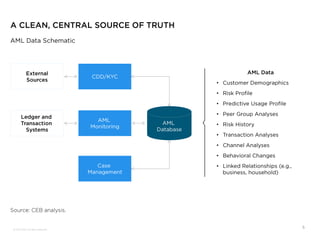
Anti Money Laundering (AML) Data an
Example
21
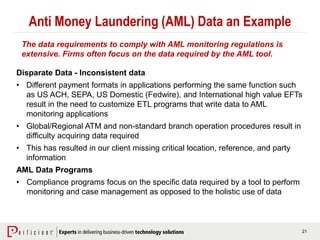
Anti Money Laundering (AML) Data an Example
Disparate Data - Inconsistent data
• Different payment formats in applications performing the same function such
as US ACH, SEPA, US Domestic (Fedwire), and International high value EFTs
result in the need to customize ETL programs that write data to AML
monitoring applications
• Global/Regional ATM and non-standard branch operation procedures result in
difficulty acquiring data required
• This has resulted in our client missing critical location, reference, and party
information
AML Data Programs
• Compliance programs focus on the specific data required by a tool to perform
monitoring and case management as opposed to the holistic use of data
The data requirements to comply with AML monitoring regulations is
extensive. Firms often focus on the data required by the AML tool.
22
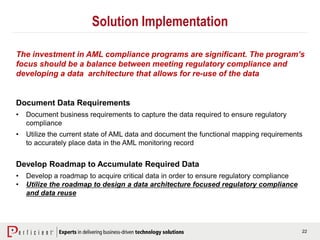
Solution Implementation
Document Data Requirements
• Document business requirements to capture the data required to ensure regulatory
compliance
• Utilize the current state of AML data and document the functional mapping requirements
to accurately place data in the AML monitoring record
Develop Roadmap to Accumulate Required Data
• Develop a roadmap to acquire critical data in order to ensure regulatory compliance
• Utilize the roadmap to design a data architecture focused regulatory compliance
and data reuse
The investment in AML compliance programs are significant. The program’s
focus should be a balance between meeting regulatory compliance and
developing a data architecture that allows for re-use of the data
23
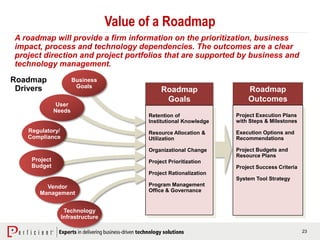
Value of a Roadmap
Roadmap
Outcomes
Project Execution Plans
with Steps & Milestones
Execution Options and
Recommendations
Project Budgets and
Resource Plans
Project Success Criteria
System Tool Strategy
Business
Goals
User
Needs
Regulatory/
Compliance
Project
Budget
Vendor
Management
Technology
Infrastructure
Roadmap
Drivers Roadmap
Goals
Retention of
Institutional Knowledge
Resource Allocation &
Utilization
Organizational Change
Project Prioritization
Project Rationalization
Program Management
Office & Governance
A roadmap will provide a firm information on the prioritization, business
impact, process and technology dependencies. The outcomes are a clear
project direction and project portfolios that are supported by business and
technology management.
24
Design and Implementation Approach
25
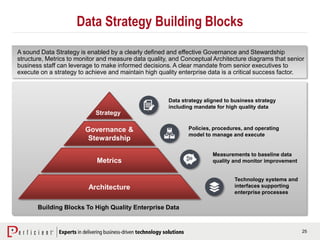
Data Strategy Building Blocks
Building Blocks To High Quality Enterprise Data
Governance &
Stewardship
Metrics
Architecture
Strategy
A sound Data Strategy is enabled by a clearly defined and effective Governance and Stewardship
structure, Metrics to monitor and measure data quality, and Conceptual Architecture diagrams that senior
business staff can leverage to make informed decisions. A clear mandate from senior executives to
execute on a strategy to achieve and maintain high quality enterprise data is a critical success factor.
Technology systems and
interfaces supporting
enterprise processes
Measurements to baseline data
quality and monitor improvement
Policies, procedures, and operating
model to manage and execute
Data strategy aligned to business strategy
including mandate for high quality data
26
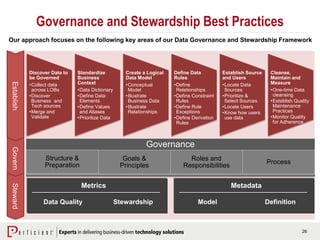
Governance and Stewardship Best Practices
Discover Data to
be Governed
•Collect data
across LOBs
•Discover
Business and
Tech sources
•Merge and
Validate
Standardize
Business
Context
•Data Dictionary
•Define Data
Elements
•Define Values
and Aliases
•Prioritize Data
Create a Logical
Data Model
•Conceptual
Model
•Illustrate
Business Data
•Illustrate
Relationships
Define Data
Rules
•Define
Relationships
•Define Constraint
Rules
•Define Rule
Exceptions
•Define Derivation
Rules
Establish Source
and Users
•Locate Data
Sources
•Prioritize &
Select Sources
•Locate Users
•Know how users
use data
Cleanse,
Maintain and
Measure
•One-time Data
cleansing
•Establish Quality
Maintenance
Practices
•Monitor Quality
for Adherence
Governance
Structure &
Preparation
Goals &
Principles
Roles and
Responsibilities
Process
Our approach focuses on the following key areas of our Data Governance and Stewardship Framework
EstablishGovernSteward
Metrics
Data Quality Stewardship
Metadata
Model Definition
27
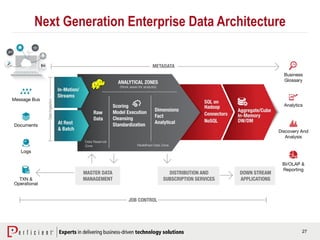
Next Generation Enterprise Data Architecture
28
Leveraging Data for Revenue and
Competitive Advantage
29
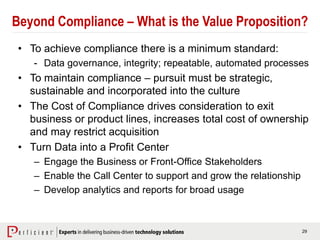
Beyond Compliance – What is the Value Proposition?
• To achieve compliance there is a minimum standard:
- Data governance, integrity; repeatable, automated processes
• To maintain compliance – pursuit must be strategic,
sustainable and incorporated into the culture
• The Cost of Compliance drives consideration to exit
business or product lines, increases total cost of ownership
and may restrict acquisition
• Turn Data into a Profit Center
– Engage the Business or Front-Office Stakeholders
– Enable the Call Center to support and grow the relationship
– Develop analytics and reports for broad usage
30
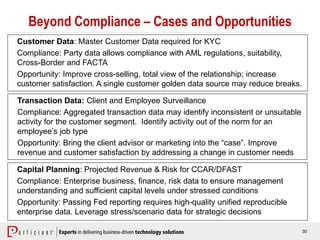
Beyond Compliance – Cases and Opportunities
Customer Data: Master Customer Data required for KYC
Compliance: Party data allows compliance with AML regulations, suitability,
Cross-Border and FACTA
Opportunity: Improve cross-selling, total view of the relationship; increase
customer satisfaction. A single customer golden data source may reduce breaks.
Transaction Data: Client and Employee Surveillance
Compliance: Aggregated transaction data may identify inconsistent or unsuitable
activity for the customer segment. Identify activity out of the norm for an
employee’s job type
Opportunity: Bring the client advisor or marketing into the “case”. Improve
revenue and customer satisfaction by addressing a change in customer needs
Capital Planning: Projected Revenue & Risk for CCAR/DFAST
Compliance: Enterprise business, finance, risk data to ensure management
understanding and sufficient capital levels under stressed conditions
Opportunity: Passing Fed reporting requires high-quality unified reproducible
enterprise data. Leverage stress/scenario data for strategic decisions
31
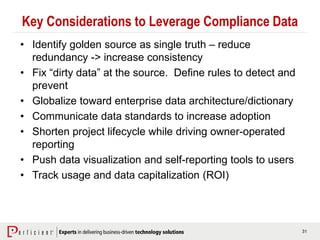
Key Considerations to Leverage Compliance Data
• Identify golden source as single truth – reduce
redundancy -> increase consistency
• Fix “dirty data” at the source. Define rules to detect and
prevent
• Globalize toward enterprise data architecture/dictionary
• Communicate data standards to increase adoption
• Shorten project lifecycle while driving owner-operated
reporting
• Push data visualization and self-reporting tools to users
• Track usage and data capitalization (ROI)

Leveraging Data in Financial Services to Meet Regulatory Requirements and Create Competitive Advantage

  • 5.
  • 15.
  • 16.
    Turn Enterprise DataChallenges into Opportunities Meet Regulatory Standards and Leverage Compliance Data for a Competitive Edge June 2015
  • 17.
    17 Agenda • Introduction • IndustryData Challenges • AML Data as an example • Data Architecture Design & Implementation Approach • Beyond Compliance - what is the value proposition?
  • 18.
    18 Introduction  Regulators haveincreased scrutiny on the financial services industry-fines have been in the millions  The financial services industry is focusing considerable time and expense on capturing data to meet regulatory requirements  Clients have often addressed these data challenges as one-off projects with the objective to comply with a single regulation  We recommend implementation of a data program focused on a flexible data architecture that can be leveraged for revenue and competitive advantage
  • 19.
    19 Industry Data Challenges Regulatory burden – regulations will change and are unpredictable  Disparate data – fragment and functional silos – Data quality collection from different system results in different levels of quality – Inconsistent and duplicate data across source systems – SME domain knowledge is not also available  Limited Master Data – Lack full understanding of client relationships – Unable to report financials by ultimate parent (top customers) – Unable to report financials by customer – Limited ability to identify cross-sell / up-sell opportunities  Inefficiencies in risk management/reporting  Inability to view complete risk exposure  Structured and unstructured data makes normalization difficult Challenges common to everybody in the industry
  • 20.
    20 Anti Money Laundering(AML) Data an Example
  • 21.
    21 Anti Money Laundering(AML) Data an Example Disparate Data - Inconsistent data • Different payment formats in applications performing the same function such as US ACH, SEPA, US Domestic (Fedwire), and International high value EFTs result in the need to customize ETL programs that write data to AML monitoring applications • Global/Regional ATM and non-standard branch operation procedures result in difficulty acquiring data required • This has resulted in our client missing critical location, reference, and party information AML Data Programs • Compliance programs focus on the specific data required by a tool to perform monitoring and case management as opposed to the holistic use of data The data requirements to comply with AML monitoring regulations is extensive. Firms often focus on the data required by the AML tool.
  • 22.
    22 Solution Implementation Document DataRequirements • Document business requirements to capture the data required to ensure regulatory compliance • Utilize the current state of AML data and document the functional mapping requirements to accurately place data in the AML monitoring record Develop Roadmap to Accumulate Required Data • Develop a roadmap to acquire critical data in order to ensure regulatory compliance • Utilize the roadmap to design a data architecture focused regulatory compliance and data reuse The investment in AML compliance programs are significant. The program’s focus should be a balance between meeting regulatory compliance and developing a data architecture that allows for re-use of the data
  • 23.
    23 Value of aRoadmap Roadmap Outcomes Project Execution Plans with Steps & Milestones Execution Options and Recommendations Project Budgets and Resource Plans Project Success Criteria System Tool Strategy Business Goals User Needs Regulatory/ Compliance Project Budget Vendor Management Technology Infrastructure Roadmap Drivers Roadmap Goals Retention of Institutional Knowledge Resource Allocation & Utilization Organizational Change Project Prioritization Project Rationalization Program Management Office & Governance A roadmap will provide a firm information on the prioritization, business impact, process and technology dependencies. The outcomes are a clear project direction and project portfolios that are supported by business and technology management.
  • 24.
  • 25.
    25 Data Strategy BuildingBlocks Building Blocks To High Quality Enterprise Data Governance & Stewardship Metrics Architecture Strategy A sound Data Strategy is enabled by a clearly defined and effective Governance and Stewardship structure, Metrics to monitor and measure data quality, and Conceptual Architecture diagrams that senior business staff can leverage to make informed decisions. A clear mandate from senior executives to execute on a strategy to achieve and maintain high quality enterprise data is a critical success factor. Technology systems and interfaces supporting enterprise processes Measurements to baseline data quality and monitor improvement Policies, procedures, and operating model to manage and execute Data strategy aligned to business strategy including mandate for high quality data
  • 26.
    26 Governance and StewardshipBest Practices Discover Data to be Governed •Collect data across LOBs •Discover Business and Tech sources •Merge and Validate Standardize Business Context •Data Dictionary •Define Data Elements •Define Values and Aliases •Prioritize Data Create a Logical Data Model •Conceptual Model •Illustrate Business Data •Illustrate Relationships Define Data Rules •Define Relationships •Define Constraint Rules •Define Rule Exceptions •Define Derivation Rules Establish Source and Users •Locate Data Sources •Prioritize & Select Sources •Locate Users •Know how users use data Cleanse, Maintain and Measure •One-time Data cleansing •Establish Quality Maintenance Practices •Monitor Quality for Adherence Governance Structure & Preparation Goals & Principles Roles and Responsibilities Process Our approach focuses on the following key areas of our Data Governance and Stewardship Framework EstablishGovernSteward Metrics Data Quality Stewardship Metadata Model Definition
  • 27.
  • 28.
    28 Leveraging Data forRevenue and Competitive Advantage
  • 29.
    29 Beyond Compliance –What is the Value Proposition? • To achieve compliance there is a minimum standard: - Data governance, integrity; repeatable, automated processes • To maintain compliance – pursuit must be strategic, sustainable and incorporated into the culture • The Cost of Compliance drives consideration to exit business or product lines, increases total cost of ownership and may restrict acquisition • Turn Data into a Profit Center – Engage the Business or Front-Office Stakeholders – Enable the Call Center to support and grow the relationship – Develop analytics and reports for broad usage
  • 30.
    30 Beyond Compliance –Cases and Opportunities Customer Data: Master Customer Data required for KYC Compliance: Party data allows compliance with AML regulations, suitability, Cross-Border and FACTA Opportunity: Improve cross-selling, total view of the relationship; increase customer satisfaction. A single customer golden data source may reduce breaks. Transaction Data: Client and Employee Surveillance Compliance: Aggregated transaction data may identify inconsistent or unsuitable activity for the customer segment. Identify activity out of the norm for an employee’s job type Opportunity: Bring the client advisor or marketing into the “case”. Improve revenue and customer satisfaction by addressing a change in customer needs Capital Planning: Projected Revenue & Risk for CCAR/DFAST Compliance: Enterprise business, finance, risk data to ensure management understanding and sufficient capital levels under stressed conditions Opportunity: Passing Fed reporting requires high-quality unified reproducible enterprise data. Leverage stress/scenario data for strategic decisions
  • 31.
    31 Key Considerations toLeverage Compliance Data • Identify golden source as single truth – reduce redundancy -> increase consistency • Fix “dirty data” at the source. Define rules to detect and prevent • Globalize toward enterprise data architecture/dictionary • Communicate data standards to increase adoption • Shorten project lifecycle while driving owner-operated reporting • Push data visualization and self-reporting tools to users • Track usage and data capitalization (ROI)