COMPUTER - AIDED
FORMULATION DEVELOPMENT
PREPARED BY – Ms. SHRUTI TYAGI
M. Pharm: Pharmaceutics
Lecturer in Pharmacy (B.S. Anangpuria Institute of Pharmacy)
POINTS TO BE CONSIDERED -
• Concept of optimization.
• Parameters of optimization, Factorial design.
• Use of computers in optimization.
• Optimization of various Drug products and pharmaceutical
processes.
• Legal Protection of Innovative Uses of Computers in R&D.
• Ethics of Computing in Pharmaceutical Research.
• Computers in Market analysis.
Concept of optimization
Optimization has been defined as the implementation of schematic
approaches to achieve the best combination of product and/or process
characteristics under a given set of conditions.
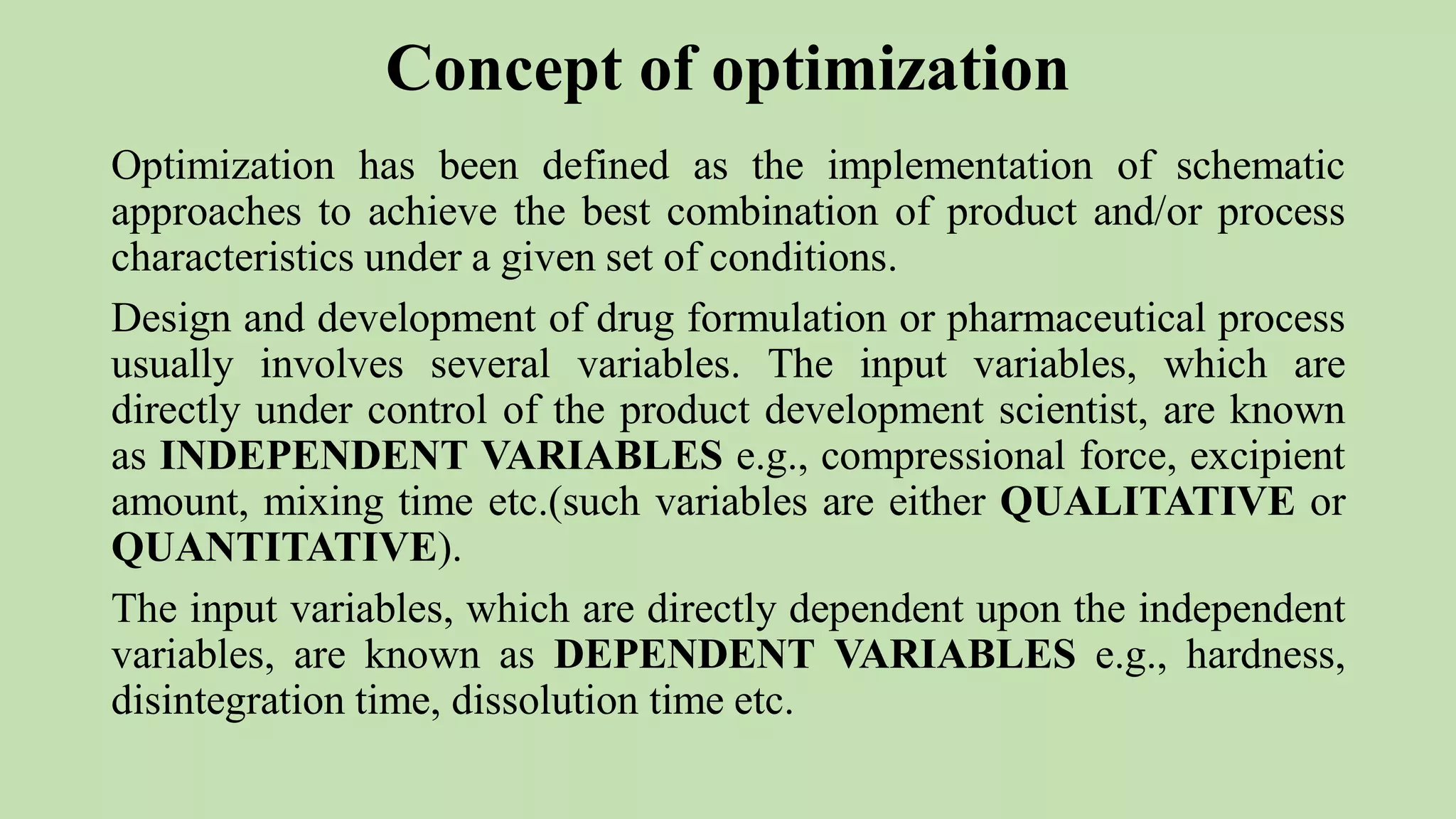
Design and development of drug formulation or pharmaceutical process
usually involves several variables. The input variables, which are
directly under control of the product development scientist, are known
as INDEPENDENT VARIABLES e.g., compressional force, excipient
amount, mixing time etc.(such variables are either QUALITATIVE or
QUANTITATIVE).
The input variables, which are directly dependent upon the independent
variables, are known as DEPENDENT VARIABLES e.g., hardness,
disintegration time, dissolution time etc.
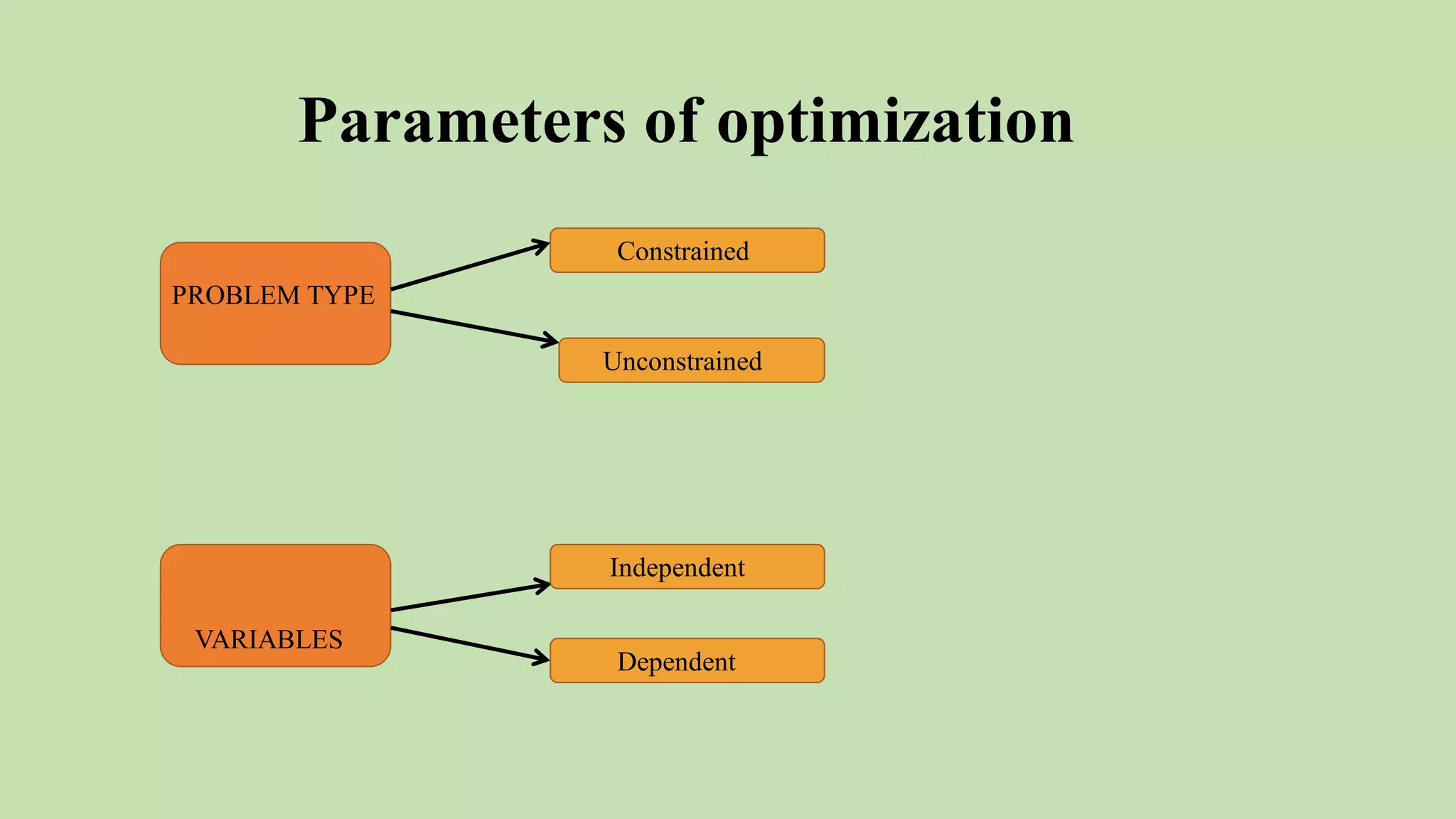
Parameters of optimization
PROBLEM TYPE
Constrained
Unconstrained
VARIABLES
Independent
Dependent
EXAMPLES OF PARAMETERS OF OPTIMIZATION
1. Problem Types
Constrained: Making hardest tablet which disintegrates within 20 min
Unconstrained: Making hardest tablet
2.Variables
Independent: Mixing time for a given process step, Granulating time
Dependent: Particle size of vesicles, hardness of the tablet
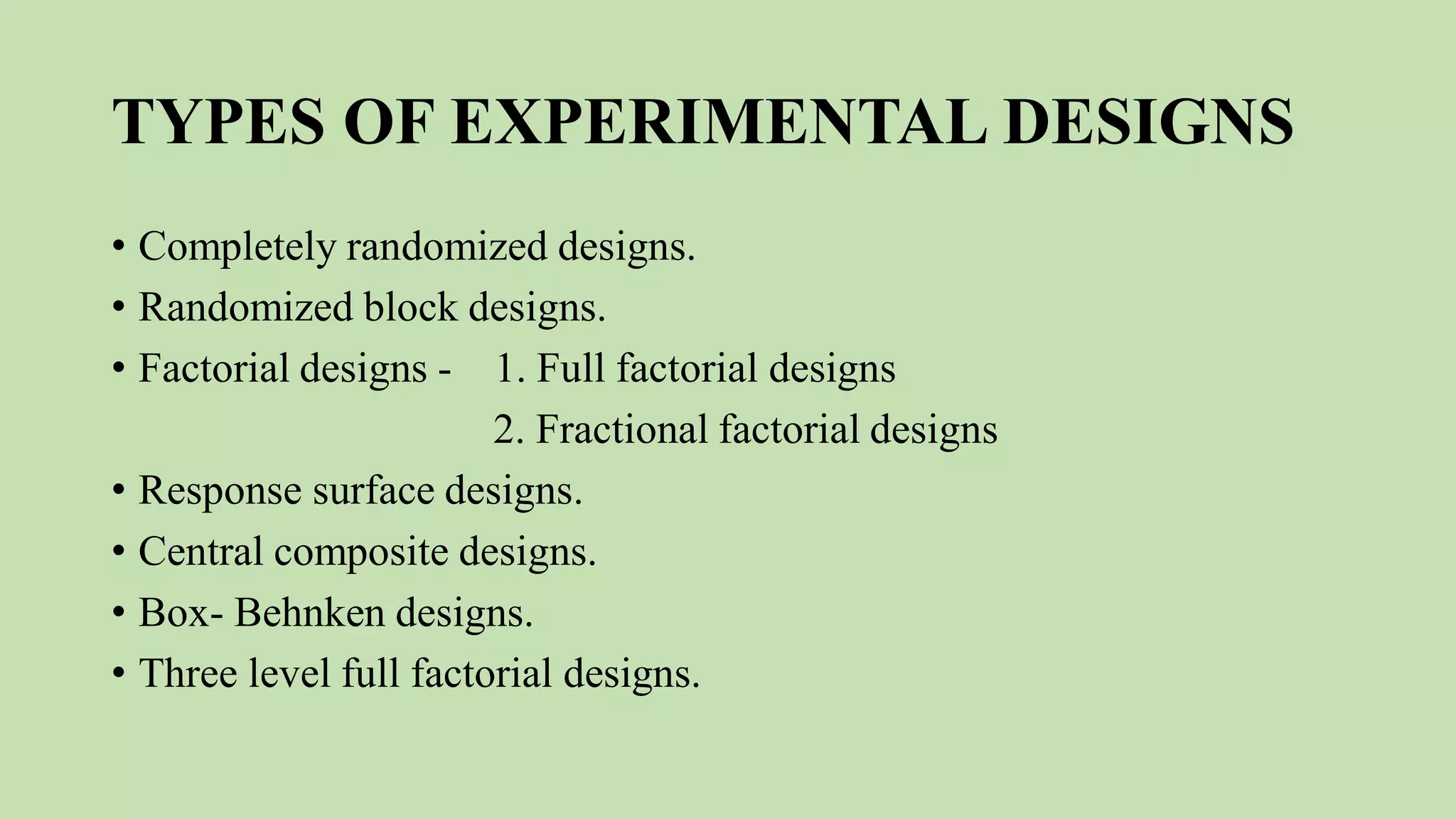
TYPES OF EXPERIMENTAL DESIGNS
• Completely randomized designs.
• Randomized block designs.
• Factorial designs - 1. Full factorial designs
2. Fractional factorial designs
• Response surface designs.
• Central composite designs.
• Box- Behnken designs.
• Three level full factorial designs.
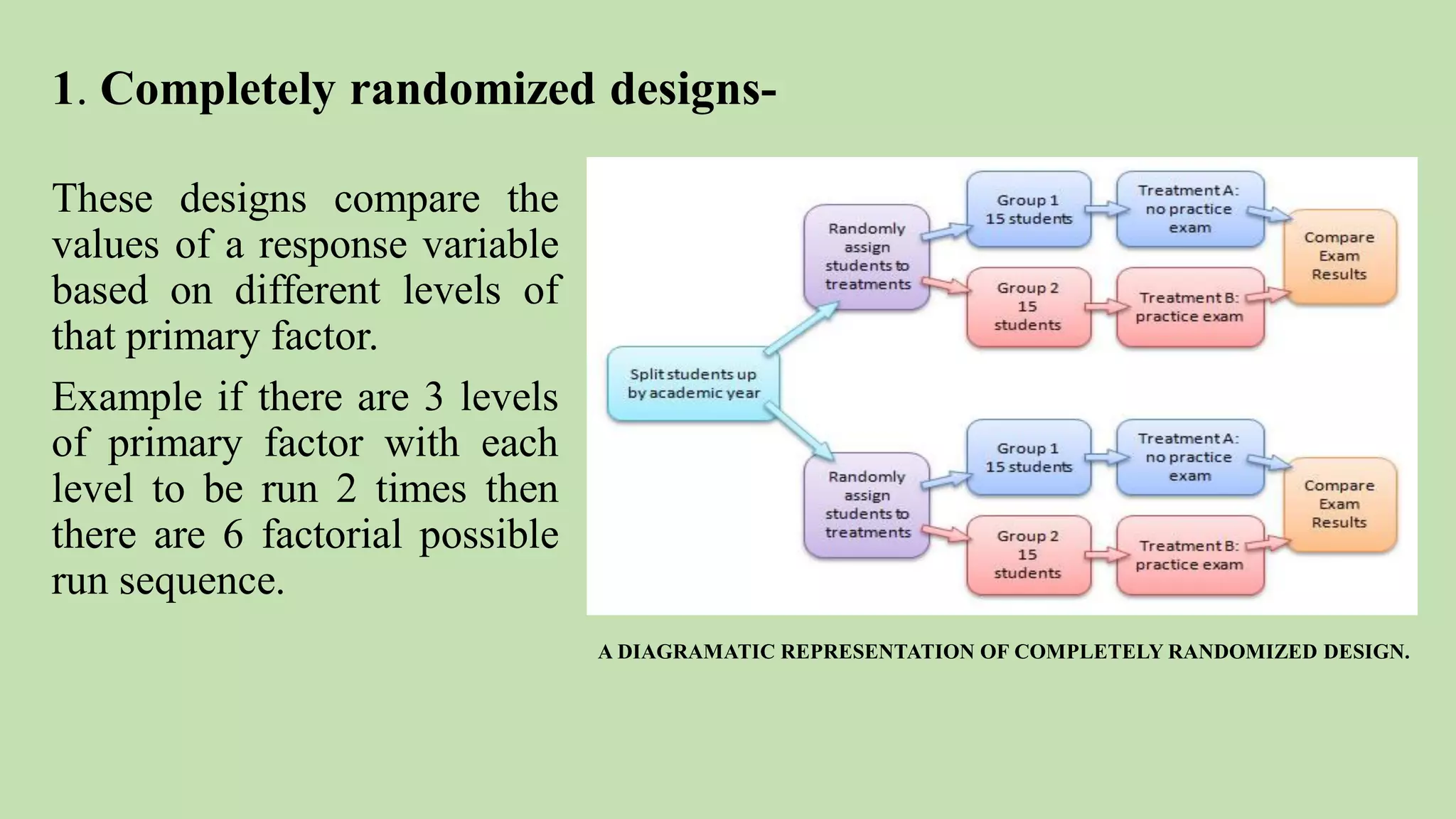
These designs compare the
values of a response variable
based on different levels of
that primary factor.
Example if there are 3 levels
of primary factor with each
level to be run 2 times then
there are 6 factorial possible
run sequence.
1. Completely randomized designs-
A DIAGRAMATIC REPRESENTATION OF COMPLETELY RANDOMIZED DESIGN.
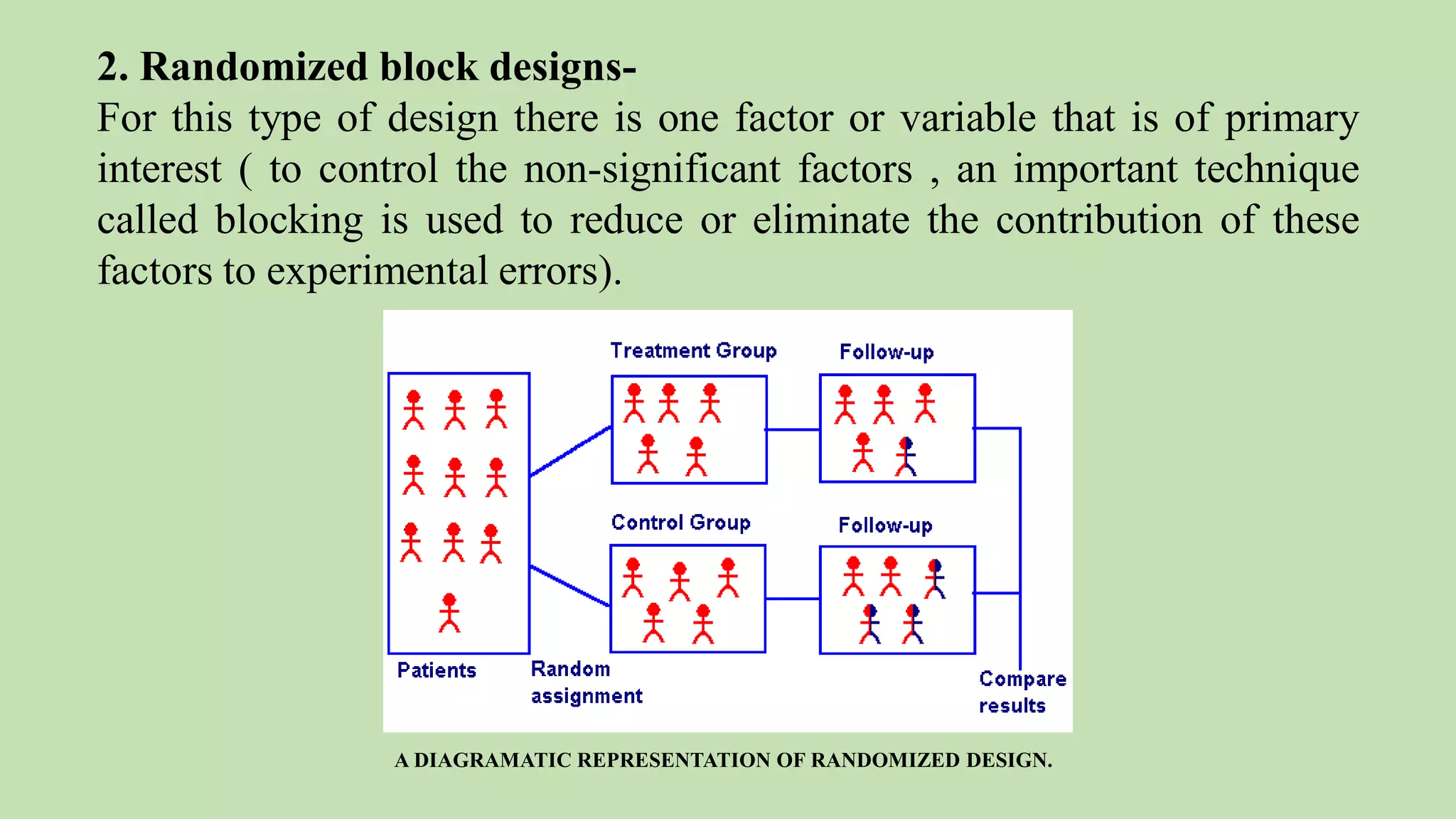
2. Randomized block designs-
For this type of design there is one factor or variable that is of primary
interest ( to control the non-significant factors , an important technique
called blocking is used to reduce or eliminate the contribution of these
factors to experimental errors).
A DIAGRAMATIC REPRESENTATION OF RANDOMIZED DESIGN.
3. Factorial Designs-
These are the designs of choice for simultaneous determination
of the effects of several factors and there interactions.
Symbols to donate levels are-
(1)- when both the variables are in low concentrations.
(a)- one low variable and second high variable.
(b)- one high variable and second low variable.
(ab)- when both the variables are in high concentrations.
For instance- factorial designs are optimal to determine the
effect of pressure and lubricant on the hardness of tablet.
Other example is, effect of disintegrant and lubricant
concentration on tablet dissolution.
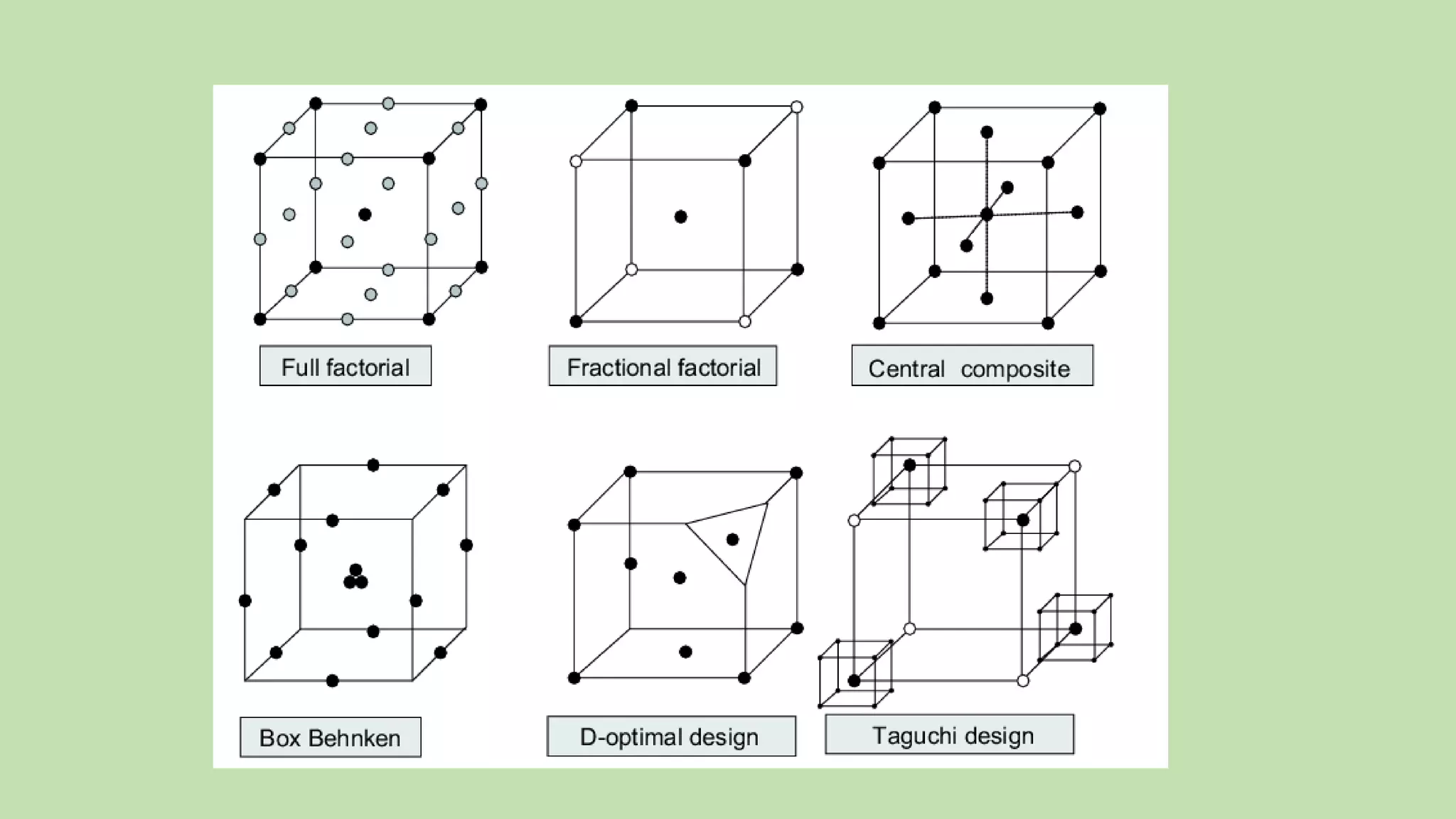
A) Full Factorial designs- used for small set of factors.
B) Fractional designs- used to examine multiple factors efficiently with fewer
runs than corresponding full factorial designs.
Types of fractional factorial designs:-
• Homogeneous fractional factorial designs- used when large number of
factors must be screened.
• Mixed level fractional factorial designs- used when variety of factors need to
be evaluated for main effects and higher level interactions can be assumed to
be negligible, objective is to generate a design for one variable, A, at 2 levels
and another , X, at 3 levels, mixed and evaluated.
• Box-Hunter design
• Plackett- Burman design
• Tiguchi
• Latin- Square
4. Response surface designs-
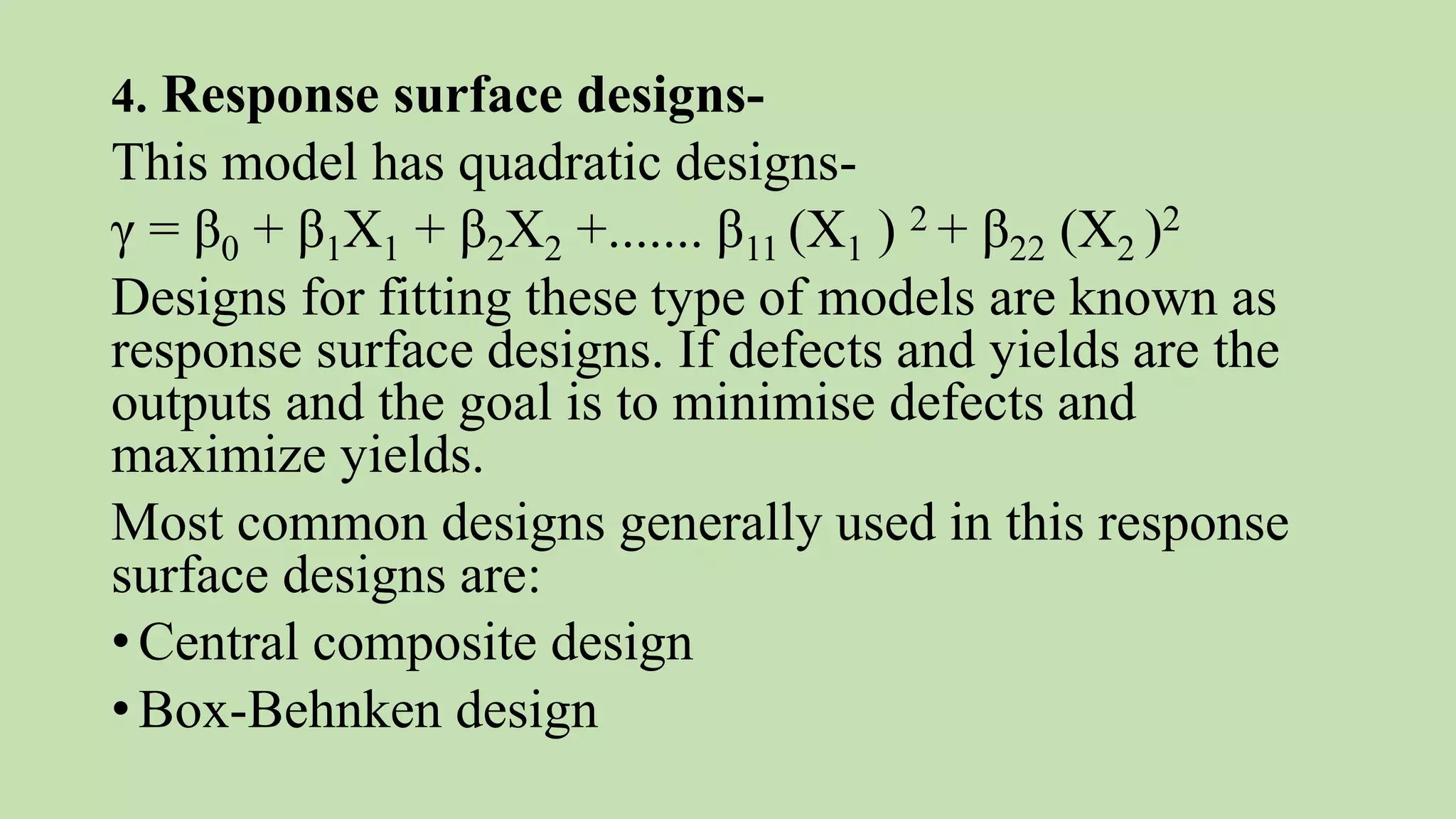
This model has quadratic designs-
γ = β0 + β1X1 + β2X2 +....... β11 (X1 ) 2 + β22 (X2 )2
Designs for fitting these type of models are known as
response surface designs. If defects and yields are the
outputs and the goal is to minimise defects and
maximize yields.
Most common designs generally used in this response
surface designs are:
•Central composite design
•Box-Behnken design
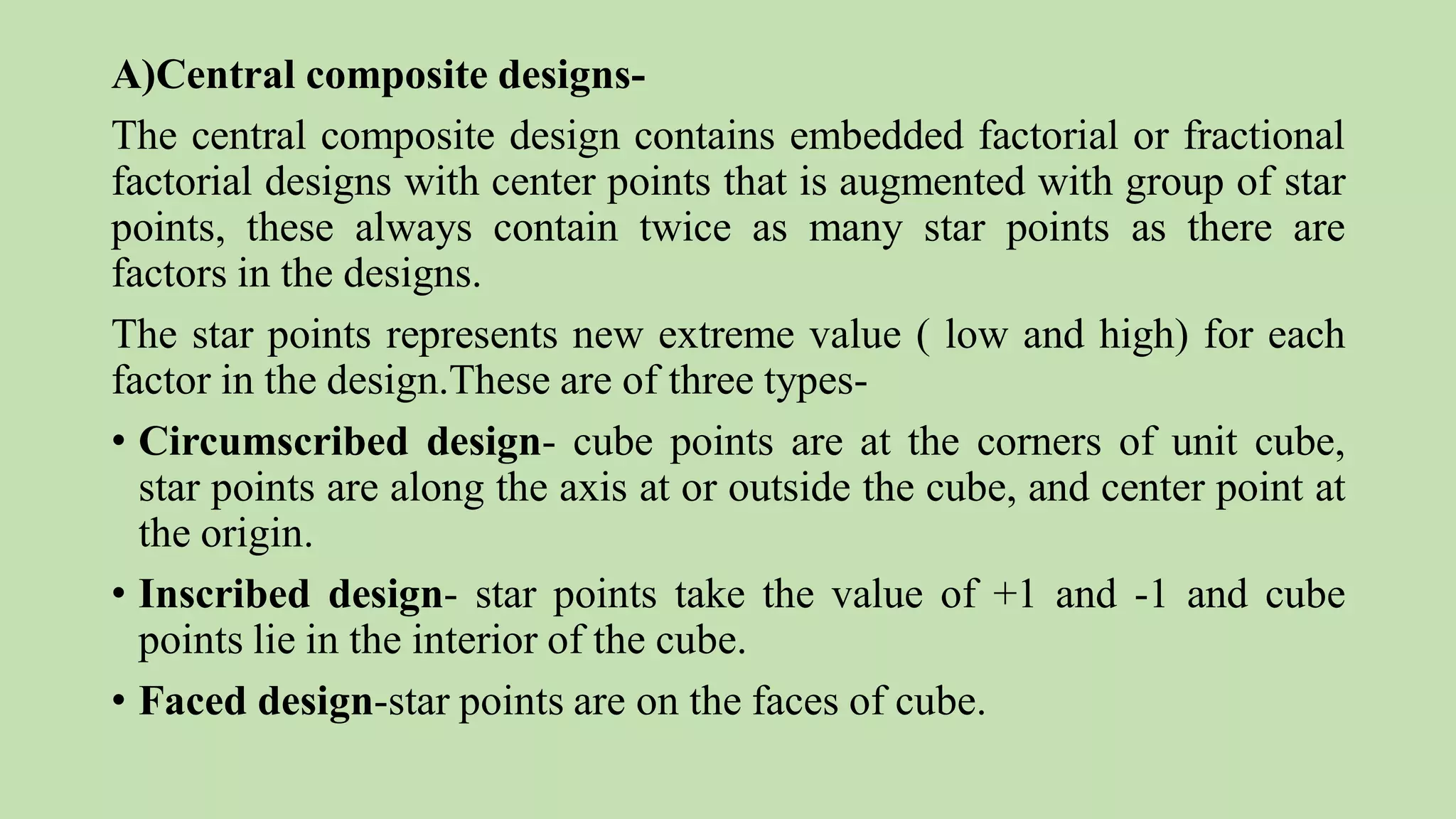
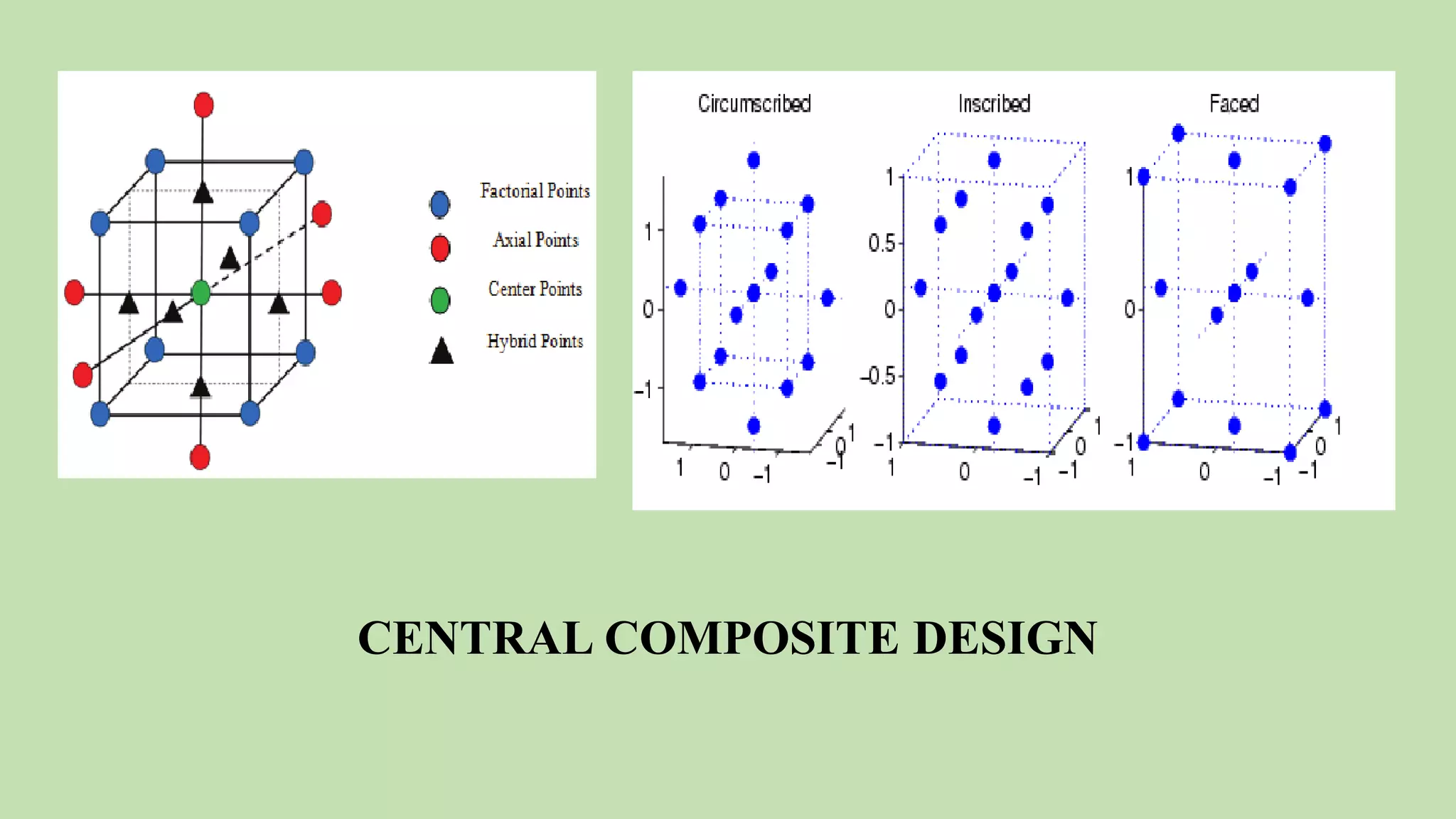
A)Central composite designs-
The central composite design contains embedded factorial or fractional
factorial designs with center points that is augmented with group of star
points, these always contain twice as many star points as there are
factors in the designs.
The star points represents new extreme value ( low and high) for each
factor in the design.These are of three types-
• Circumscribed design- cube points are at the corners of unit cube,
star points are along the axis at or outside the cube, and center point at
the origin.
• Inscribed design- star points take the value of +1 and -1 and cube
points lie in the interior of the cube.
• Faced design-star points are on the faces of cube.
CENTRAL COMPOSITE DESIGN
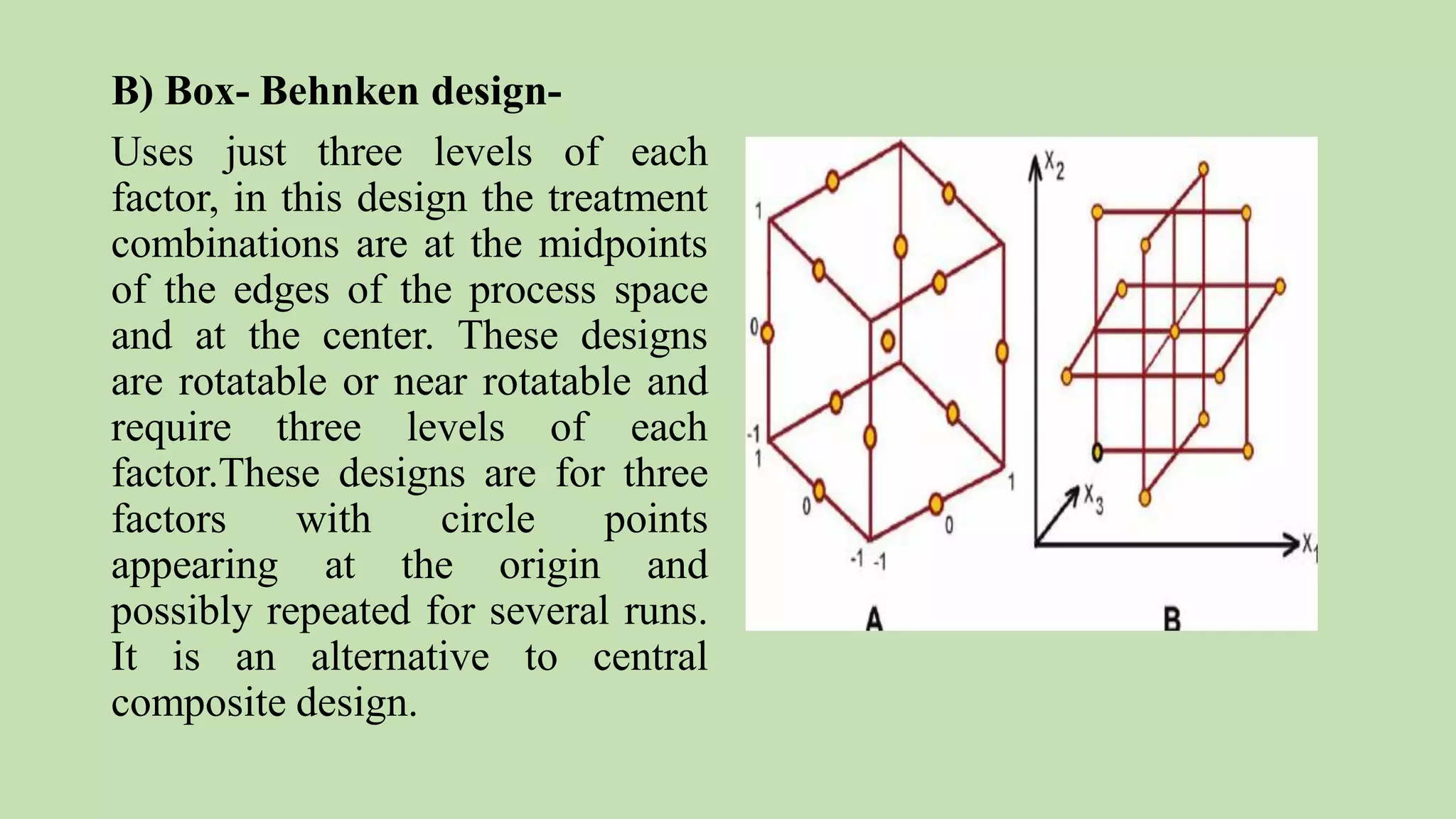
B) Box- Behnken design-
Uses just three levels of each
factor, in this design the treatment
combinations are at the midpoints
of the edges of the process space
and at the center. These designs
are rotatable or near rotatable and
require three levels of each
factor.These designs are for three
factors with circle points
appearing at the origin and
possibly repeated for several runs.
It is an alternative to central
composite design.
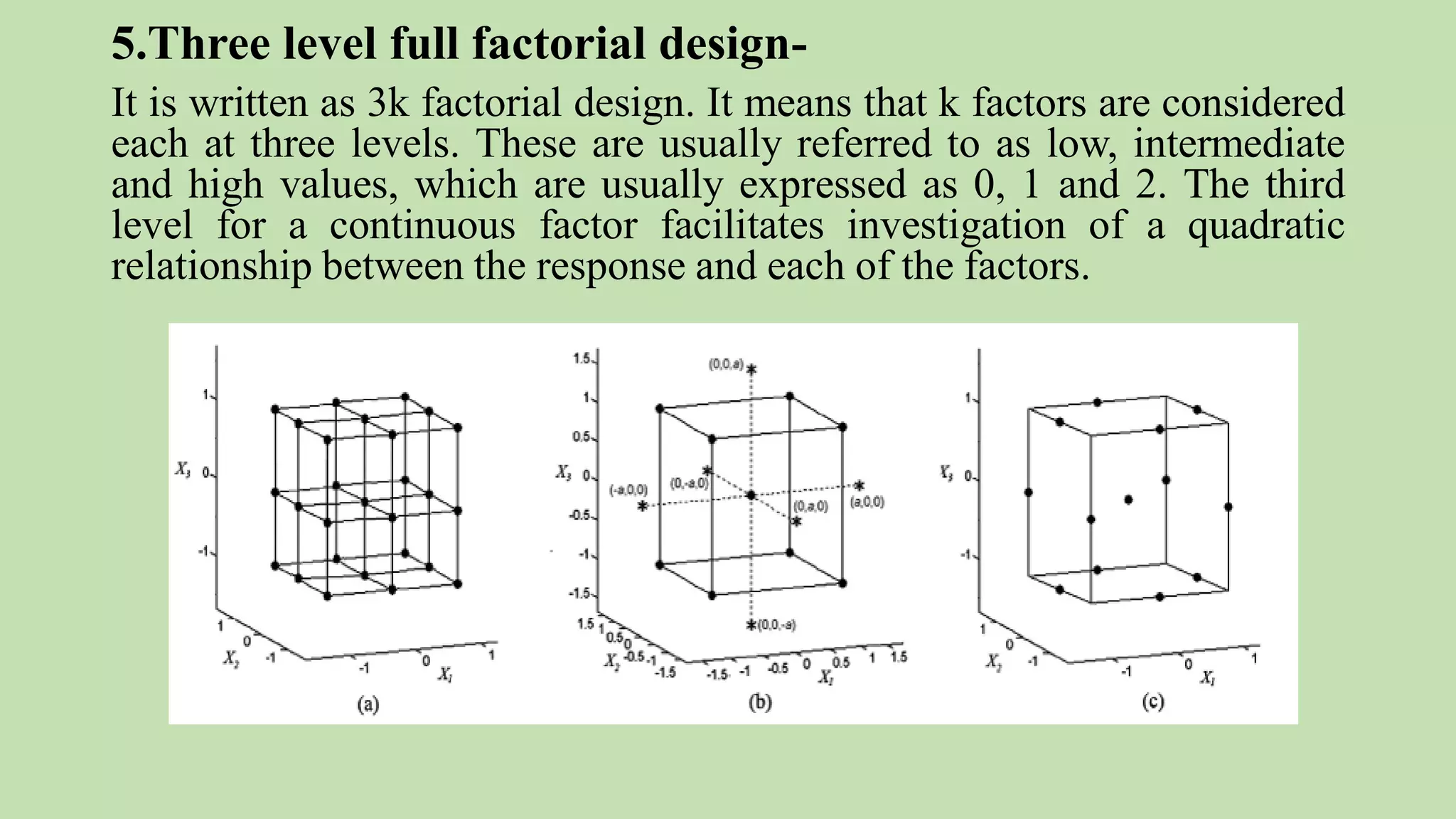
5.Three level full factorial design-
It is written as 3k factorial design. It means that k factors are considered
each at three levels. These are usually referred to as low, intermediate
and high values, which are usually expressed as 0, 1 and 2. The third
level for a continuous factor facilitates investigation of a quadratic
relationship between the response and each of the factors.
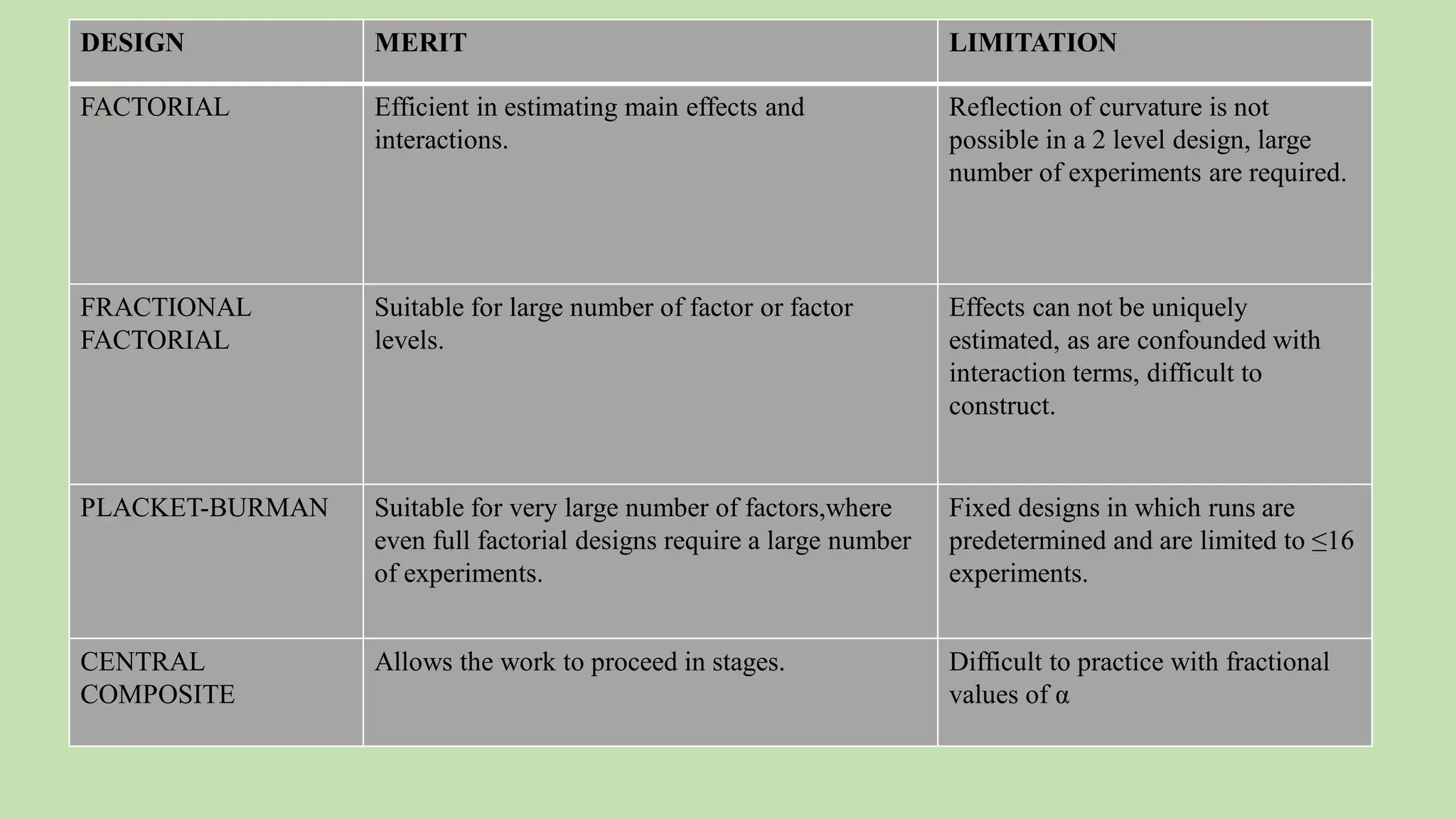
DESIGN MERIT LIMITATION
FACTORIAL Efficient in estimating main effects and
interactions.
Reflection of curvature is not
possible in a 2 level design, large
number of experiments are required.
FRACTIONAL
FACTORIAL
Suitable for large number of factor or factor
levels.
Effects can not be uniquely
estimated, as are confounded with
interaction terms, difficult to
construct.
PLACKET-BURMAN Suitable for very large number of factors,where
even full factorial designs require a large number
of experiments.
Fixed designs in which runs are
predetermined and are limited to ≤16
experiments.
CENTRAL
COMPOSITE
Allows the work to proceed in stages. Difficult to practice with fractional
values of α
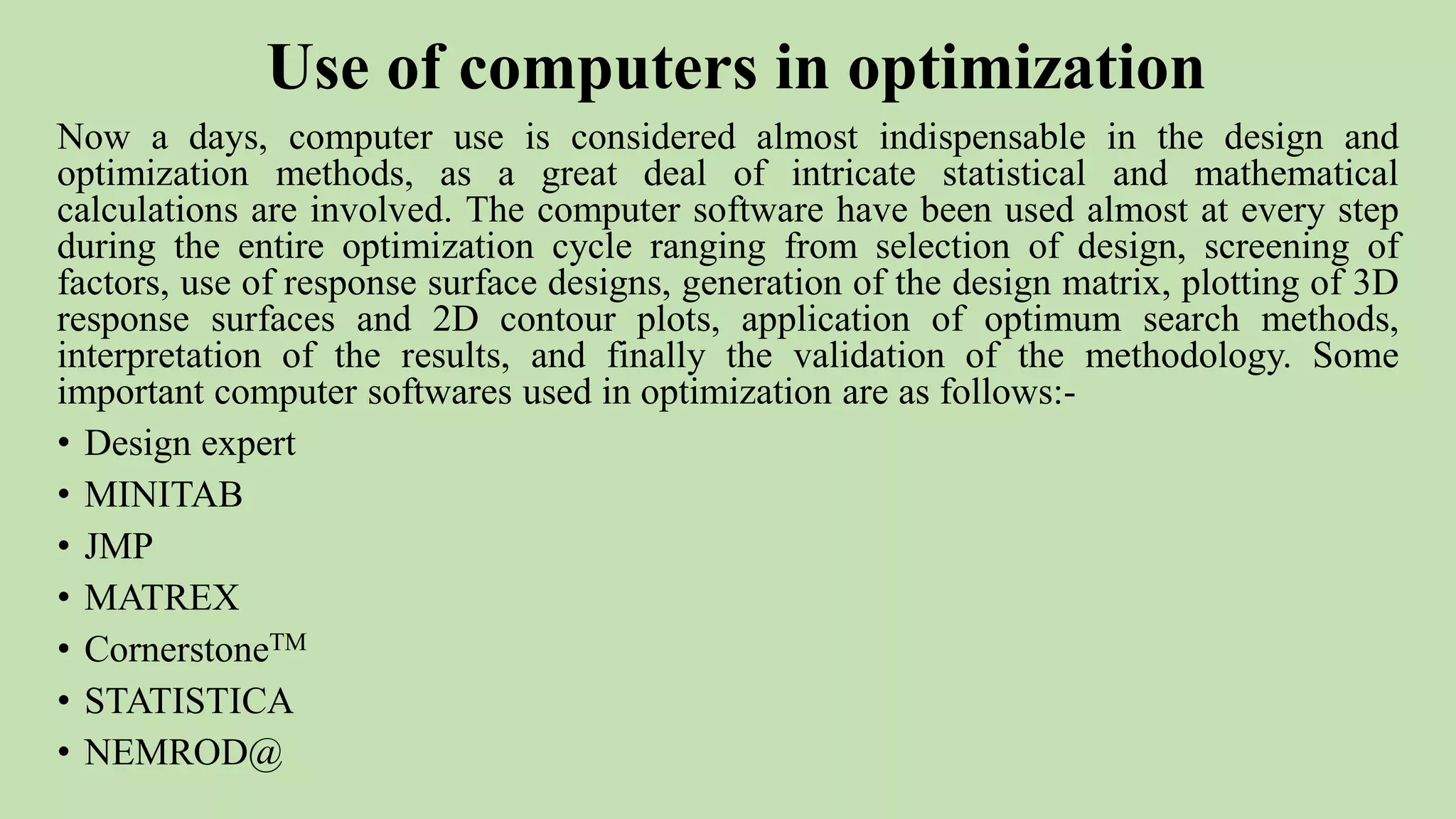
Use of computers in optimization
Now a days, computer use is considered almost indispensable in the design and
optimization methods, as a great deal of intricate statistical and mathematical
calculations are involved. The computer software have been used almost at every step
during the entire optimization cycle ranging from selection of design, screening of
factors, use of response surface designs, generation of the design matrix, plotting of 3D
response surfaces and 2D contour plots, application of optimum search methods,
interpretation of the results, and finally the validation of the methodology. Some
important computer softwares used in optimization are as follows:-
• Design expert
• MINITAB
• JMP
• MATREX
• CornerstoneTM
• STATISTICA
• NEMROD@
Optimization of various Drug products and
pharmaceutical processes
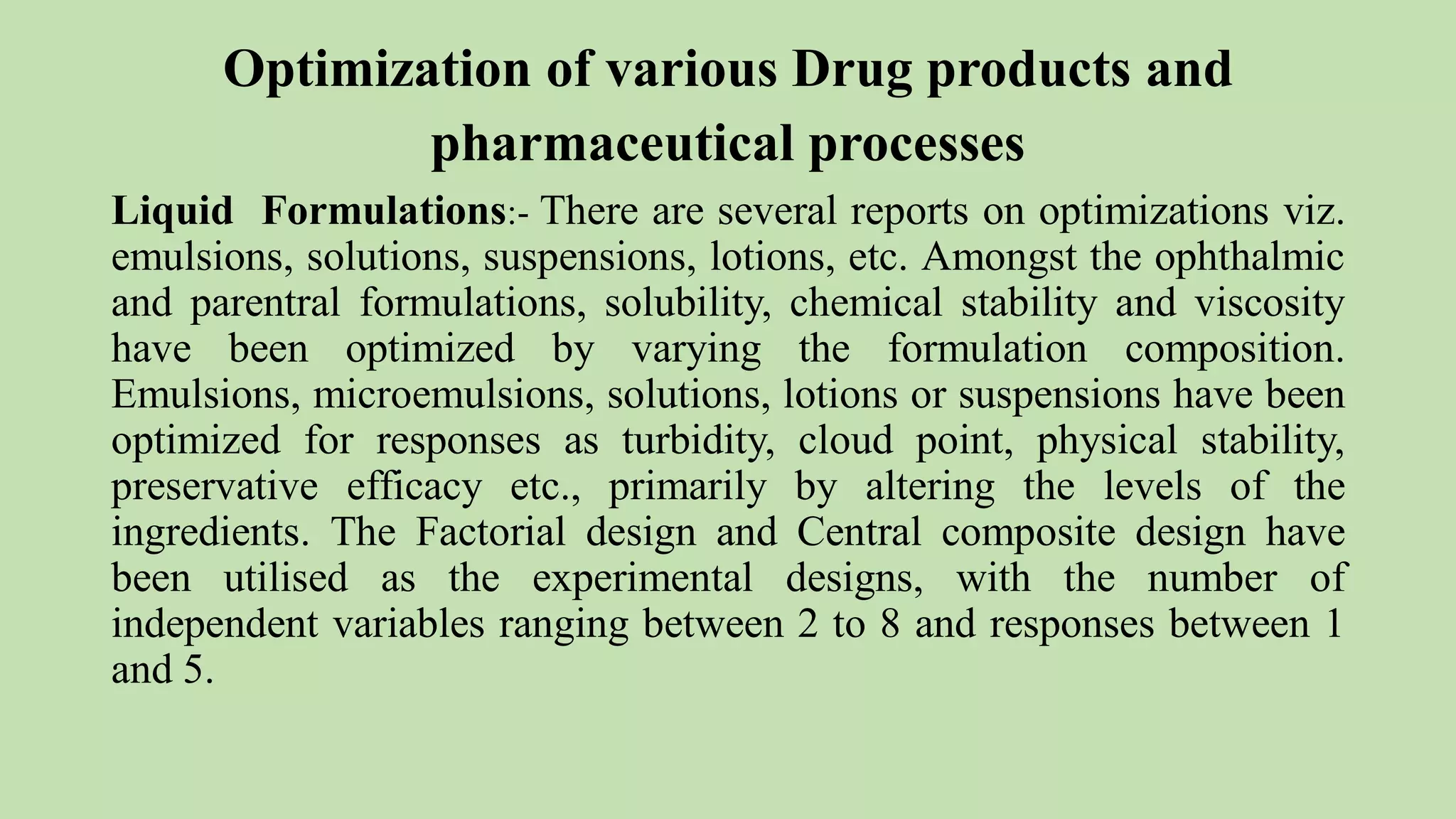
Liquid Formulations:- There are several reports on optimizations viz.
emulsions, solutions, suspensions, lotions, etc. Amongst the ophthalmic
and parentral formulations, solubility, chemical stability and viscosity
have been optimized by varying the formulation composition.
Emulsions, microemulsions, solutions, lotions or suspensions have been
optimized for responses as turbidity, cloud point, physical stability,
preservative efficacy etc., primarily by altering the levels of the
ingredients. The Factorial design and Central composite design have
been utilised as the experimental designs, with the number of
independent variables ranging between 2 to 8 and responses between 1
and 5.
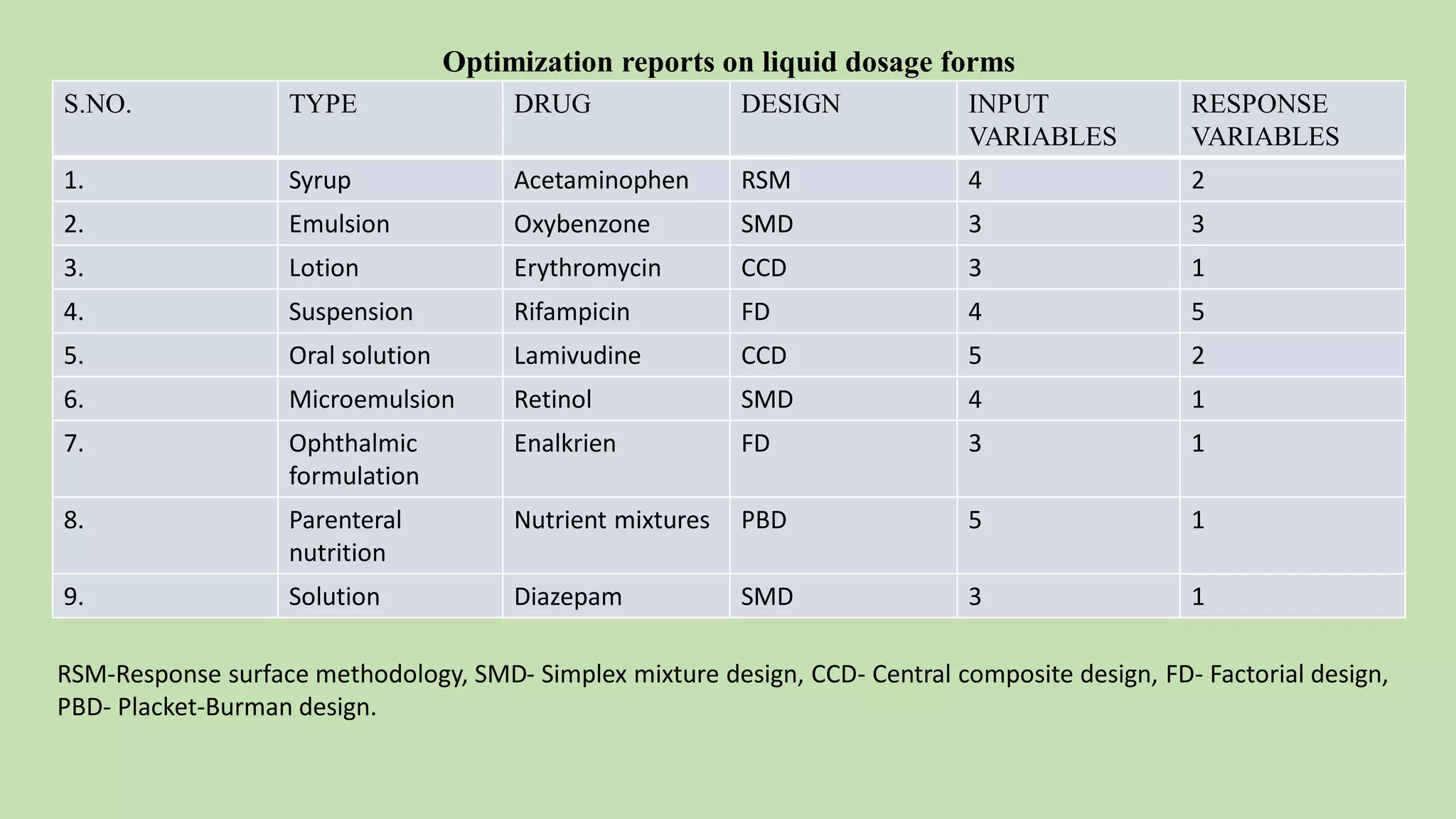
S.NO. TYPE DRUG DESIGN INPUT
VARIABLES
RESPONSE
VARIABLES
1. Syrup Acetaminophen RSM 4 2
2. Emulsion Oxybenzone SMD 3 3
3. Lotion Erythromycin CCD 3 1
4. Suspension Rifampicin FD 4 5
5. Oral solution Lamivudine CCD 5 2
6. Microemulsion Retinol SMD 4 1
7. Ophthalmic
formulation
Enalkrien FD 3 1
8. Parenteral
nutrition
Nutrient mixtures PBD 5 1
9. Solution Diazepam SMD 3 1
Optimization reports on liquid dosage forms
RSM-Response surface methodology, SMD- Simplex mixture design, CCD- Central composite design, FD- Factorial design,
PBD- Placket-Burman design.
The various novel and innovative uses of computers plays a vital role in
drug formulation and development, these uses of computers in the
research and development sector can be protected legally through
intellectual property rights. Intellectual property rights seek to protect
knowledge derived from research and development especially by firms
involved in collaborations with others to ensure that the knowledge is not
expropriated by their potential partners. The lack of intellectual property
rights reduces the bargaining power of collaboration partners and
increase costs of information for such partners. The existence of
protective mechanisms over intellectual assets is essential to enhance the
competitiveness of organisations especially those working on R&D
related issues as well as to attract potential investors.
Legal Protection of Innovative Uses of Computers in
Research and Development
Ethics of Computing in Pharmaceutical Research
Computer ethics is a part of practical philosophy concerned with how
computing professionals should make decisions regarding professional and
social conduct. Margaret Anne Pierce, a professor in the Department of
Mathematics and Computers at Georgia Southern University has categorized
the ethical decisions related to computer technology and usage into three
primary influences:
• The individual's own personal code.
• Any informal code of ethical conduct that exists in the work place.
• Exposure to formal codes of ethics.
Privacy is one of the major issues that has emerged since the internet has
become part of many aspects of daily life. Internet users hand over personal
information in order to sign up or register for services without realizing that
they are potentially setting themselves up for invasions of privacy.
Identifying issues
Identifying ethical issues as they arise, as well as defining how to deal with
them, has traditionally been problematic. In solving problems relating to
ethical issues, Michael Davis proposed a unique problem-solving method. In
Davis's model, the ethical problem is stated, facts are checked, and a list of
options is generated by considering relevant factors relating to the problem.
The actual action taken is influenced by specific ethical standards.
Ethical standards
Various national and international professional societies and organizations
have produced code of ethics documents to give basic behavioral guidelines
to computing professionals and users. They include:
1.Association for Computing Machinery
ACM Code of Ethics and Professional Conduct
2. Australian Computer Society
• ACS Code of Ethics
• ACS Code of Professional Conduct
3. British Computer Society
• BCS Code of Conduct
• Code of Good Practice (retired May 2011)
• Computer Ethics Institute
• Ten Commandments of Computer Ethics marri
4. IEEE
• IEEE Code of Ethics
• IEEE Code of Conduct
5. League of Professional System Administrators
• The System Administrators' Code of Ethics
Computers in Market analysis
A market analysis studies the attractiveness and the dynamics of a
special market within a special industry. It is part of the industry
analysis and thus in turn of the global environmental analysis.
Through all of these analyses, the strengths, weaknesses,
opportunities and threats (SWOT) of a company can be identified.
Finally, with the help of a SWOT analysis, adequate business
strategies of a company will be defined. The market analysis is also
known as a documented investigation of a market that is used to
inform a firm's planning activities, particularly around decisions of
inventory, purchase, work force expansion/contraction, facility
expansion, purchases of capital equipment, promotional activities,
and many other aspects of a company.
References
1. Bhupinder Singh, R.K.Gupta and Naveen Ahuja, “Computer
assisted optimization of pharmaceutical formulations and
processes”, page no. 273-318.
2. Nazura Abdul Manap, Rohimi Bin Shapiee, Pardis
Moslemzedah Tehrani and Ahmad Azam bin Mohd. Shariff,
“Protecting R&D Inventions through Intellectual Property
Rights”: Journal of Intellectual Property Rights:Vol 21, March
2016, pp 110-116.
3. Pharmaceutical Optimization by G.T.Kulkarni.
THANK YOU

Computer aided formulation development

  • 1.
    COMPUTER - AIDED FORMULATIONDEVELOPMENT PREPARED BY – Ms. SHRUTI TYAGI M. Pharm: Pharmaceutics Lecturer in Pharmacy (B.S. Anangpuria Institute of Pharmacy)
  • 2.
    POINTS TO BECONSIDERED - • Concept of optimization. • Parameters of optimization, Factorial design. • Use of computers in optimization. • Optimization of various Drug products and pharmaceutical processes. • Legal Protection of Innovative Uses of Computers in R&D. • Ethics of Computing in Pharmaceutical Research. • Computers in Market analysis.
  • 3.
    Concept of optimization Optimizationhas been defined as the implementation of schematic approaches to achieve the best combination of product and/or process characteristics under a given set of conditions. Design and development of drug formulation or pharmaceutical process usually involves several variables. The input variables, which are directly under control of the product development scientist, are known as INDEPENDENT VARIABLES e.g., compressional force, excipient amount, mixing time etc.(such variables are either QUALITATIVE or QUANTITATIVE). The input variables, which are directly dependent upon the independent variables, are known as DEPENDENT VARIABLES e.g., hardness, disintegration time, dissolution time etc.
  • 4.
    Parameters of optimization PROBLEMTYPE Constrained Unconstrained VARIABLES Independent Dependent
  • 5.
    EXAMPLES OF PARAMETERSOF OPTIMIZATION 1. Problem Types Constrained: Making hardest tablet which disintegrates within 20 min Unconstrained: Making hardest tablet 2.Variables Independent: Mixing time for a given process step, Granulating time Dependent: Particle size of vesicles, hardness of the tablet
  • 6.
    TYPES OF EXPERIMENTALDESIGNS • Completely randomized designs. • Randomized block designs. • Factorial designs - 1. Full factorial designs 2. Fractional factorial designs • Response surface designs. • Central composite designs. • Box- Behnken designs. • Three level full factorial designs.
  • 7.
    These designs comparethe values of a response variable based on different levels of that primary factor. Example if there are 3 levels of primary factor with each level to be run 2 times then there are 6 factorial possible run sequence. 1. Completely randomized designs- A DIAGRAMATIC REPRESENTATION OF COMPLETELY RANDOMIZED DESIGN.
  • 8.
    2. Randomized blockdesigns- For this type of design there is one factor or variable that is of primary interest ( to control the non-significant factors , an important technique called blocking is used to reduce or eliminate the contribution of these factors to experimental errors). A DIAGRAMATIC REPRESENTATION OF RANDOMIZED DESIGN.
  • 9.
    3. Factorial Designs- Theseare the designs of choice for simultaneous determination of the effects of several factors and there interactions. Symbols to donate levels are- (1)- when both the variables are in low concentrations. (a)- one low variable and second high variable. (b)- one high variable and second low variable. (ab)- when both the variables are in high concentrations. For instance- factorial designs are optimal to determine the effect of pressure and lubricant on the hardness of tablet. Other example is, effect of disintegrant and lubricant concentration on tablet dissolution.
  • 10.
    A) Full Factorialdesigns- used for small set of factors. B) Fractional designs- used to examine multiple factors efficiently with fewer runs than corresponding full factorial designs. Types of fractional factorial designs:- • Homogeneous fractional factorial designs- used when large number of factors must be screened. • Mixed level fractional factorial designs- used when variety of factors need to be evaluated for main effects and higher level interactions can be assumed to be negligible, objective is to generate a design for one variable, A, at 2 levels and another , X, at 3 levels, mixed and evaluated. • Box-Hunter design • Plackett- Burman design • Tiguchi • Latin- Square
  • 12.
    4. Response surfacedesigns- This model has quadratic designs- γ = β0 + β1X1 + β2X2 +....... β11 (X1 ) 2 + β22 (X2 )2 Designs for fitting these type of models are known as response surface designs. If defects and yields are the outputs and the goal is to minimise defects and maximize yields. Most common designs generally used in this response surface designs are: •Central composite design •Box-Behnken design
  • 13.
    A)Central composite designs- Thecentral composite design contains embedded factorial or fractional factorial designs with center points that is augmented with group of star points, these always contain twice as many star points as there are factors in the designs. The star points represents new extreme value ( low and high) for each factor in the design.These are of three types- • Circumscribed design- cube points are at the corners of unit cube, star points are along the axis at or outside the cube, and center point at the origin. • Inscribed design- star points take the value of +1 and -1 and cube points lie in the interior of the cube. • Faced design-star points are on the faces of cube.
  • 14.
  • 15.
    B) Box- Behnkendesign- Uses just three levels of each factor, in this design the treatment combinations are at the midpoints of the edges of the process space and at the center. These designs are rotatable or near rotatable and require three levels of each factor.These designs are for three factors with circle points appearing at the origin and possibly repeated for several runs. It is an alternative to central composite design.
  • 16.
    5.Three level fullfactorial design- It is written as 3k factorial design. It means that k factors are considered each at three levels. These are usually referred to as low, intermediate and high values, which are usually expressed as 0, 1 and 2. The third level for a continuous factor facilitates investigation of a quadratic relationship between the response and each of the factors.
  • 17.
    DESIGN MERIT LIMITATION FACTORIALEfficient in estimating main effects and interactions. Reflection of curvature is not possible in a 2 level design, large number of experiments are required. FRACTIONAL FACTORIAL Suitable for large number of factor or factor levels. Effects can not be uniquely estimated, as are confounded with interaction terms, difficult to construct. PLACKET-BURMAN Suitable for very large number of factors,where even full factorial designs require a large number of experiments. Fixed designs in which runs are predetermined and are limited to ≤16 experiments. CENTRAL COMPOSITE Allows the work to proceed in stages. Difficult to practice with fractional values of α
  • 18.
    Use of computersin optimization Now a days, computer use is considered almost indispensable in the design and optimization methods, as a great deal of intricate statistical and mathematical calculations are involved. The computer software have been used almost at every step during the entire optimization cycle ranging from selection of design, screening of factors, use of response surface designs, generation of the design matrix, plotting of 3D response surfaces and 2D contour plots, application of optimum search methods, interpretation of the results, and finally the validation of the methodology. Some important computer softwares used in optimization are as follows:- • Design expert • MINITAB • JMP • MATREX • CornerstoneTM • STATISTICA • NEMROD@
  • 19.
    Optimization of variousDrug products and pharmaceutical processes Liquid Formulations:- There are several reports on optimizations viz. emulsions, solutions, suspensions, lotions, etc. Amongst the ophthalmic and parentral formulations, solubility, chemical stability and viscosity have been optimized by varying the formulation composition. Emulsions, microemulsions, solutions, lotions or suspensions have been optimized for responses as turbidity, cloud point, physical stability, preservative efficacy etc., primarily by altering the levels of the ingredients. The Factorial design and Central composite design have been utilised as the experimental designs, with the number of independent variables ranging between 2 to 8 and responses between 1 and 5.
  • 20.
    S.NO. TYPE DRUGDESIGN INPUT VARIABLES RESPONSE VARIABLES 1. Syrup Acetaminophen RSM 4 2 2. Emulsion Oxybenzone SMD 3 3 3. Lotion Erythromycin CCD 3 1 4. Suspension Rifampicin FD 4 5 5. Oral solution Lamivudine CCD 5 2 6. Microemulsion Retinol SMD 4 1 7. Ophthalmic formulation Enalkrien FD 3 1 8. Parenteral nutrition Nutrient mixtures PBD 5 1 9. Solution Diazepam SMD 3 1 Optimization reports on liquid dosage forms RSM-Response surface methodology, SMD- Simplex mixture design, CCD- Central composite design, FD- Factorial design, PBD- Placket-Burman design.
  • 21.
    The various noveland innovative uses of computers plays a vital role in drug formulation and development, these uses of computers in the research and development sector can be protected legally through intellectual property rights. Intellectual property rights seek to protect knowledge derived from research and development especially by firms involved in collaborations with others to ensure that the knowledge is not expropriated by their potential partners. The lack of intellectual property rights reduces the bargaining power of collaboration partners and increase costs of information for such partners. The existence of protective mechanisms over intellectual assets is essential to enhance the competitiveness of organisations especially those working on R&D related issues as well as to attract potential investors. Legal Protection of Innovative Uses of Computers in Research and Development
  • 22.
    Ethics of Computingin Pharmaceutical Research Computer ethics is a part of practical philosophy concerned with how computing professionals should make decisions regarding professional and social conduct. Margaret Anne Pierce, a professor in the Department of Mathematics and Computers at Georgia Southern University has categorized the ethical decisions related to computer technology and usage into three primary influences: • The individual's own personal code. • Any informal code of ethical conduct that exists in the work place. • Exposure to formal codes of ethics. Privacy is one of the major issues that has emerged since the internet has become part of many aspects of daily life. Internet users hand over personal information in order to sign up or register for services without realizing that they are potentially setting themselves up for invasions of privacy.
  • 23.
    Identifying issues Identifying ethicalissues as they arise, as well as defining how to deal with them, has traditionally been problematic. In solving problems relating to ethical issues, Michael Davis proposed a unique problem-solving method. In Davis's model, the ethical problem is stated, facts are checked, and a list of options is generated by considering relevant factors relating to the problem. The actual action taken is influenced by specific ethical standards. Ethical standards Various national and international professional societies and organizations have produced code of ethics documents to give basic behavioral guidelines to computing professionals and users. They include: 1.Association for Computing Machinery ACM Code of Ethics and Professional Conduct
  • 24.
    2. Australian ComputerSociety • ACS Code of Ethics • ACS Code of Professional Conduct 3. British Computer Society • BCS Code of Conduct • Code of Good Practice (retired May 2011) • Computer Ethics Institute • Ten Commandments of Computer Ethics marri 4. IEEE • IEEE Code of Ethics • IEEE Code of Conduct 5. League of Professional System Administrators • The System Administrators' Code of Ethics
  • 25.
    Computers in Marketanalysis A market analysis studies the attractiveness and the dynamics of a special market within a special industry. It is part of the industry analysis and thus in turn of the global environmental analysis. Through all of these analyses, the strengths, weaknesses, opportunities and threats (SWOT) of a company can be identified. Finally, with the help of a SWOT analysis, adequate business strategies of a company will be defined. The market analysis is also known as a documented investigation of a market that is used to inform a firm's planning activities, particularly around decisions of inventory, purchase, work force expansion/contraction, facility expansion, purchases of capital equipment, promotional activities, and many other aspects of a company.
  • 26.
    References 1. Bhupinder Singh,R.K.Gupta and Naveen Ahuja, “Computer assisted optimization of pharmaceutical formulations and processes”, page no. 273-318. 2. Nazura Abdul Manap, Rohimi Bin Shapiee, Pardis Moslemzedah Tehrani and Ahmad Azam bin Mohd. Shariff, “Protecting R&D Inventions through Intellectual Property Rights”: Journal of Intellectual Property Rights:Vol 21, March 2016, pp 110-116. 3. Pharmaceutical Optimization by G.T.Kulkarni.
  • 27.