SPECIAL SENSES
DR. NABEEL BEERAN
MBBS, MD
13/03/2020
1
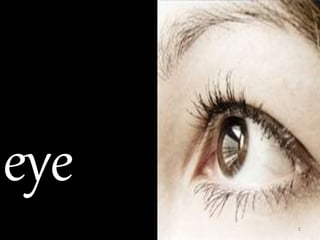
eye
2
Specific Learning Objectives
At the end of this class, student should be able to:
• Appreciate the functional anatomy of eye.
• List the layers of sclera, cornea and retina and
mention their functions.
• Understand the role of choroid, ciliary body and
iris in visual function.
• Differentiate between rods and cones.
• Explain the composition, formation, drainage
and functions of aqueous humor.
• Give the significance of intra ocular pressure.
3
• EYE has 2 major parts:
1. Optical system
Helps to focus and form an image on the
receptor cells- light rays fall.
2. Neural system
Transmits optical signal in the form of
action potential along the optic nerve to visual
cortex.
4
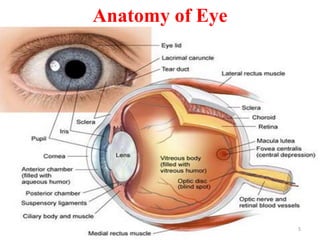
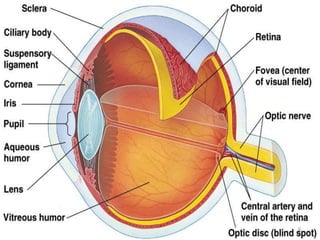
Anatomy of Eye
5
6
The wall of the eyeball is composed of 3 layers:
• Outer fibrous coat
• Middle vascular layer
• Inner nervous coat
Interior of the eyeball is divided into 3 spaces:
• Anterior chamber
• Posterior chamber
• Posterior cavity
7
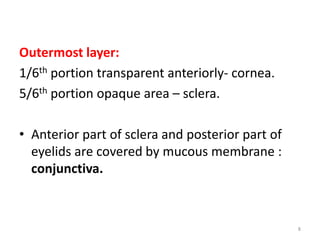
Outermost layer:
1/6th portion transparent anteriorly- cornea.
5/6th portion opaque area – sclera.
• Anterior part of sclera and posterior part of
eyelids are covered by mucous membrane :
conjunctiva.
8
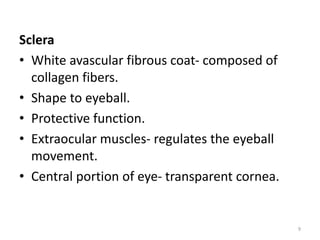
Sclera
• White avascular fibrous coat- composed of
collagen fibers.
• Shape to eyeball.
• Protective function.
• Extraocular muscles- regulates the eyeball
movement.
• Central portion of eye- transparent cornea.
9
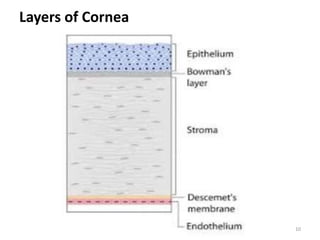
Layers of Cornea
10
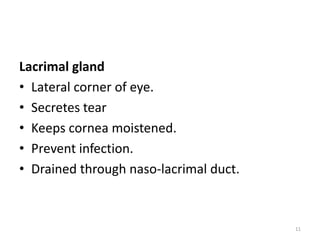
Lacrimal gland
• Lateral corner of eye.
• Secretes tear
• Keeps cornea moistened.
• Prevent infection.
• Drained through naso-lacrimal duct.
11
Middle vascular area:
The middle layer surrounds the eyeball completely
except for a small opening in front known as the
pupil.
Comprises 3 structures:
1. Choroid
2. Ciliary body
3. Iris
12
Choroid
• Posterior 2/3rd of eyeball.
• Nourishes blood vessels.
• Nourishes structure of eyeball.
• Front thickened portion- ciliary body- absorb
extra amount of light.
Ciliary body
• 2 parts: ciliary muscle and ciliary processes.
• Attached to suspensory ligament at one end.
• Other end- crystalline lens.
13
Iris
• Thin, pigmented, circular, contractile diaphragm that
hangs over the anterior surface of the lens.
• Colour to the eye.
• Central aperture- pupil- light enters the eye.
• 2 types of smooth muscle: Circular (sphincter pupillae)
and radial (dilator pupillae).
• Accommodation for near vision.
Functions:
• Regulates intensity of light.
• Absorbs extra amount of light.
• Prevents entry of light through periphery of lens.
• Increases the depth of focus by constriction of pupil. 14
Inner most layer:
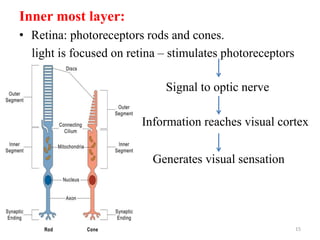
• Retina: photoreceptors rods and cones.
light is focused on retina – stimulates photoreceptors
Signal to optic nerve
Information reaches visual cortex
Generates visual sensation
15
16
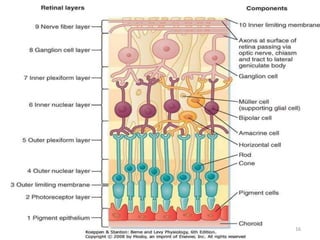
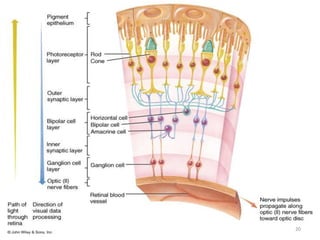
Layers of Retina
1. Pigmented epithelium
2. Layers of rods and cones
3. External limiting membrane
4. Outer nuclear layer
5. Outer synaptic layer
6. Inner nuclear layer
7. Inner synaptic layer
8. Ganglion cell layer
9. Optic nerve
10. Internal limiting membrane
17
Outer pigmented epithelial layer:
• Rich in melanocytes.
• Prevents scattering of light
• Phagocytosis
• Storage of vitamin A
18
• Rods and cones- Photoreceptors.
• Each rod and cone is divided into outer
segment, inner segment and a synaptic zone.
• Rods: thin, rod- like appearance.
• Cones: conical outer segment.
19
20
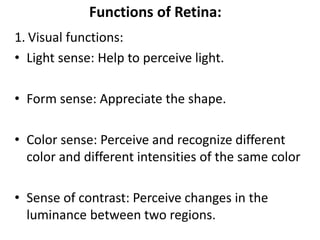
Functions of Retina:
1. Visual functions:
• Light sense: Help to perceive light.
• Form sense: Appreciate the shape.
• Color sense: Perceive and recognize different
color and different intensities of the same color
• Sense of contrast: Perceive changes in the
luminance between two regions.
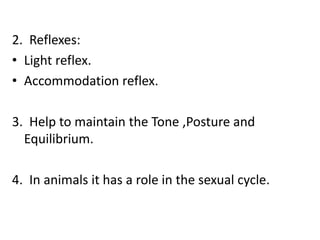
2. Reflexes:
• Light reflex.
• Accommodation reflex.
3. Help to maintain the Tone ,Posture and
Equilibrium.
4. In animals it has a role in the sexual cycle.
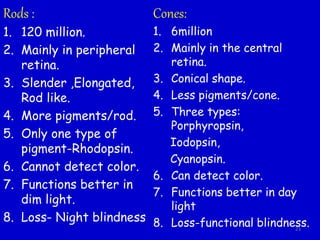
Rods :
1. 120 million.
2. Mainly in peripheral
retina.
3. Slender ,Elongated,
Rod like.
4. More pigments/rod.
5. Only one type of
pigment-Rhodopsin.
6. Cannot detect color.
7. Functions better in
dim light.
8. Loss- Night blindness
Cones:
1. 6million
2. Mainly in the central
retina.
3. Conical shape.
4. Less pigments/cone.
5. Three types:
Porphyropsin,
Iodopsin,
Cyanopsin.
6. Can detect color.
7. Functions better in day
light
8. Loss-functional blindness.23
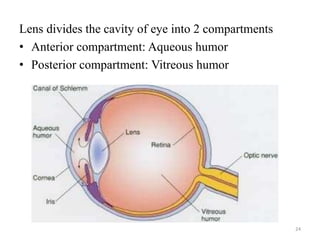
Lens divides the cavity of eye into 2 compartments
• Anterior compartment: Aqueous humor
• Posterior compartment: Vitreous humor
24
Fluids in the eye:
• Aqueous Humor
• Vitreous Humor
25
26
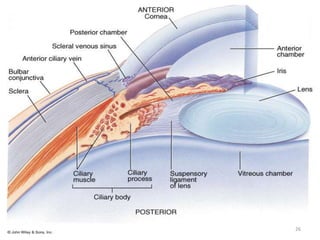
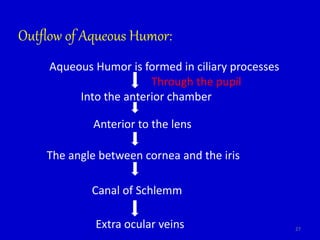
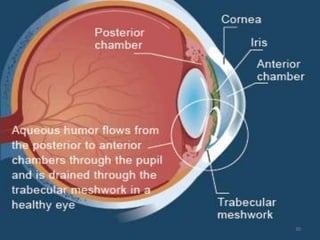
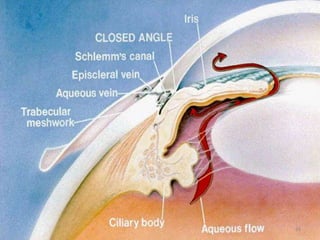
Outflow of Aqueous Humor:
Aqueous Humor is formed in ciliary processes
Into the anterior chamber
Through the pupil
Anterior to the lens
The angle between cornea and the iris
Canal of Schlemm
Extra ocular veins 27
Functions of Aqueous Humor:
• Provides nutrition to all the avascular
structures of the eye.
• Maintain the intraocular pressure.
• Maintain the shape of the eye.
• Acts as a refractive medium
28
Functions of vitreous humor:
• Prevent the wall of eyeball from
collapsing.
• It maintain the intraocular pressure and
keep the intraocular structures in
position.
• Acts as a refractive medium.
29
30
Glucoma/Ocular Hypertension:
• Pressure increase to 60-70 mm of Hg.
• Normal :15mm of Hg (12-20mm of Hg)
• Pressure above 25-30 mm of Hg can
cause blindness if maintained for long
duration.
Causes:
• Blockage of canal of Schlemm
• Excessive production of the fluid
31
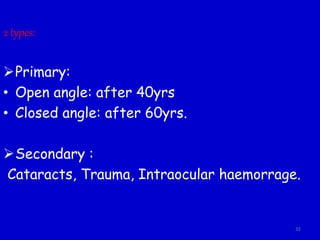
2 types:
Primary:
• Open angle: after 40yrs
• Closed angle: after 60yrs.
Secondary :
Cataracts, Trauma, Intraocular haemorrage.
32
33
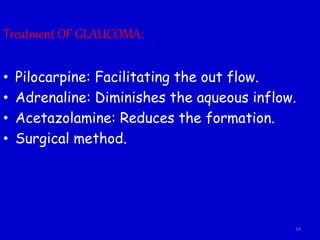
Treatment OF GLAUCOMA:
• Pilocarpine: Facilitating the out flow.
• Adrenaline: Diminishes the aqueous inflow.
• Acetazolamine: Reduces the formation.
• Surgical method.
34
References
1. Review of Medical Physiology by Ganong
24th edition
2. Textbook of Medical Physiology by Guyton
and Hall 13th edition
3. Textbook of Medical Physiology by G.K.Pal
35
THANK YOU

EYE

  • 1.
    SPECIAL SENSES DR. NABEELBEERAN MBBS, MD 13/03/2020 1
  • 2.
  • 3.
    Specific Learning Objectives Atthe end of this class, student should be able to: • Appreciate the functional anatomy of eye. • List the layers of sclera, cornea and retina and mention their functions. • Understand the role of choroid, ciliary body and iris in visual function. • Differentiate between rods and cones. • Explain the composition, formation, drainage and functions of aqueous humor. • Give the significance of intra ocular pressure. 3
  • 4.
    • EYE has2 major parts: 1. Optical system Helps to focus and form an image on the receptor cells- light rays fall. 2. Neural system Transmits optical signal in the form of action potential along the optic nerve to visual cortex. 4
  • 5.
  • 6.
  • 7.
    The wall ofthe eyeball is composed of 3 layers: • Outer fibrous coat • Middle vascular layer • Inner nervous coat Interior of the eyeball is divided into 3 spaces: • Anterior chamber • Posterior chamber • Posterior cavity 7
  • 8.
    Outermost layer: 1/6th portiontransparent anteriorly- cornea. 5/6th portion opaque area – sclera. • Anterior part of sclera and posterior part of eyelids are covered by mucous membrane : conjunctiva. 8
  • 9.
    Sclera • White avascularfibrous coat- composed of collagen fibers. • Shape to eyeball. • Protective function. • Extraocular muscles- regulates the eyeball movement. • Central portion of eye- transparent cornea. 9
  • 10.
  • 11.
    Lacrimal gland • Lateralcorner of eye. • Secretes tear • Keeps cornea moistened. • Prevent infection. • Drained through naso-lacrimal duct. 11
  • 12.
    Middle vascular area: Themiddle layer surrounds the eyeball completely except for a small opening in front known as the pupil. Comprises 3 structures: 1. Choroid 2. Ciliary body 3. Iris 12
  • 13.
    Choroid • Posterior 2/3rdof eyeball. • Nourishes blood vessels. • Nourishes structure of eyeball. • Front thickened portion- ciliary body- absorb extra amount of light. Ciliary body • 2 parts: ciliary muscle and ciliary processes. • Attached to suspensory ligament at one end. • Other end- crystalline lens. 13
  • 14.
    Iris • Thin, pigmented,circular, contractile diaphragm that hangs over the anterior surface of the lens. • Colour to the eye. • Central aperture- pupil- light enters the eye. • 2 types of smooth muscle: Circular (sphincter pupillae) and radial (dilator pupillae). • Accommodation for near vision. Functions: • Regulates intensity of light. • Absorbs extra amount of light. • Prevents entry of light through periphery of lens. • Increases the depth of focus by constriction of pupil. 14
  • 15.
    Inner most layer: •Retina: photoreceptors rods and cones. light is focused on retina – stimulates photoreceptors Signal to optic nerve Information reaches visual cortex Generates visual sensation 15
  • 16.
  • 17.
    Layers of Retina 1.Pigmented epithelium 2. Layers of rods and cones 3. External limiting membrane 4. Outer nuclear layer 5. Outer synaptic layer 6. Inner nuclear layer 7. Inner synaptic layer 8. Ganglion cell layer 9. Optic nerve 10. Internal limiting membrane 17
  • 18.
    Outer pigmented epitheliallayer: • Rich in melanocytes. • Prevents scattering of light • Phagocytosis • Storage of vitamin A 18
  • 19.
    • Rods andcones- Photoreceptors. • Each rod and cone is divided into outer segment, inner segment and a synaptic zone. • Rods: thin, rod- like appearance. • Cones: conical outer segment. 19
  • 20.
  • 21.
    Functions of Retina: 1.Visual functions: • Light sense: Help to perceive light. • Form sense: Appreciate the shape. • Color sense: Perceive and recognize different color and different intensities of the same color • Sense of contrast: Perceive changes in the luminance between two regions.
  • 22.
    2. Reflexes: • Lightreflex. • Accommodation reflex. 3. Help to maintain the Tone ,Posture and Equilibrium. 4. In animals it has a role in the sexual cycle.
  • 23.
    Rods : 1. 120million. 2. Mainly in peripheral retina. 3. Slender ,Elongated, Rod like. 4. More pigments/rod. 5. Only one type of pigment-Rhodopsin. 6. Cannot detect color. 7. Functions better in dim light. 8. Loss- Night blindness Cones: 1. 6million 2. Mainly in the central retina. 3. Conical shape. 4. Less pigments/cone. 5. Three types: Porphyropsin, Iodopsin, Cyanopsin. 6. Can detect color. 7. Functions better in day light 8. Loss-functional blindness.23
  • 24.
    Lens divides thecavity of eye into 2 compartments • Anterior compartment: Aqueous humor • Posterior compartment: Vitreous humor 24
  • 25.
    Fluids in theeye: • Aqueous Humor • Vitreous Humor 25
  • 26.
  • 27.
    Outflow of AqueousHumor: Aqueous Humor is formed in ciliary processes Into the anterior chamber Through the pupil Anterior to the lens The angle between cornea and the iris Canal of Schlemm Extra ocular veins 27
  • 28.
    Functions of AqueousHumor: • Provides nutrition to all the avascular structures of the eye. • Maintain the intraocular pressure. • Maintain the shape of the eye. • Acts as a refractive medium 28
  • 29.
    Functions of vitreoushumor: • Prevent the wall of eyeball from collapsing. • It maintain the intraocular pressure and keep the intraocular structures in position. • Acts as a refractive medium. 29
  • 30.
  • 31.
    Glucoma/Ocular Hypertension: • Pressureincrease to 60-70 mm of Hg. • Normal :15mm of Hg (12-20mm of Hg) • Pressure above 25-30 mm of Hg can cause blindness if maintained for long duration. Causes: • Blockage of canal of Schlemm • Excessive production of the fluid 31
  • 32.
    2 types: Primary: • Openangle: after 40yrs • Closed angle: after 60yrs. Secondary : Cataracts, Trauma, Intraocular haemorrage. 32
  • 33.
  • 34.
    Treatment OF GLAUCOMA: •Pilocarpine: Facilitating the out flow. • Adrenaline: Diminishes the aqueous inflow. • Acetazolamine: Reduces the formation. • Surgical method. 34
  • 35.
    References 1. Review ofMedical Physiology by Ganong 24th edition 2. Textbook of Medical Physiology by Guyton and Hall 13th edition 3. Textbook of Medical Physiology by G.K.Pal 35
  • 36.