1
Recap Lecture 4
Regular expression of EVEN-EVEN language,
Difference between a* + b* and (a+b)*,
Equivalent regular expressions; sum, product
and closure of regular expressions; regular
languages, finite languages are regular,
introduction to finite automaton, definition of FA,
transition table, transition diagram.
2
Note
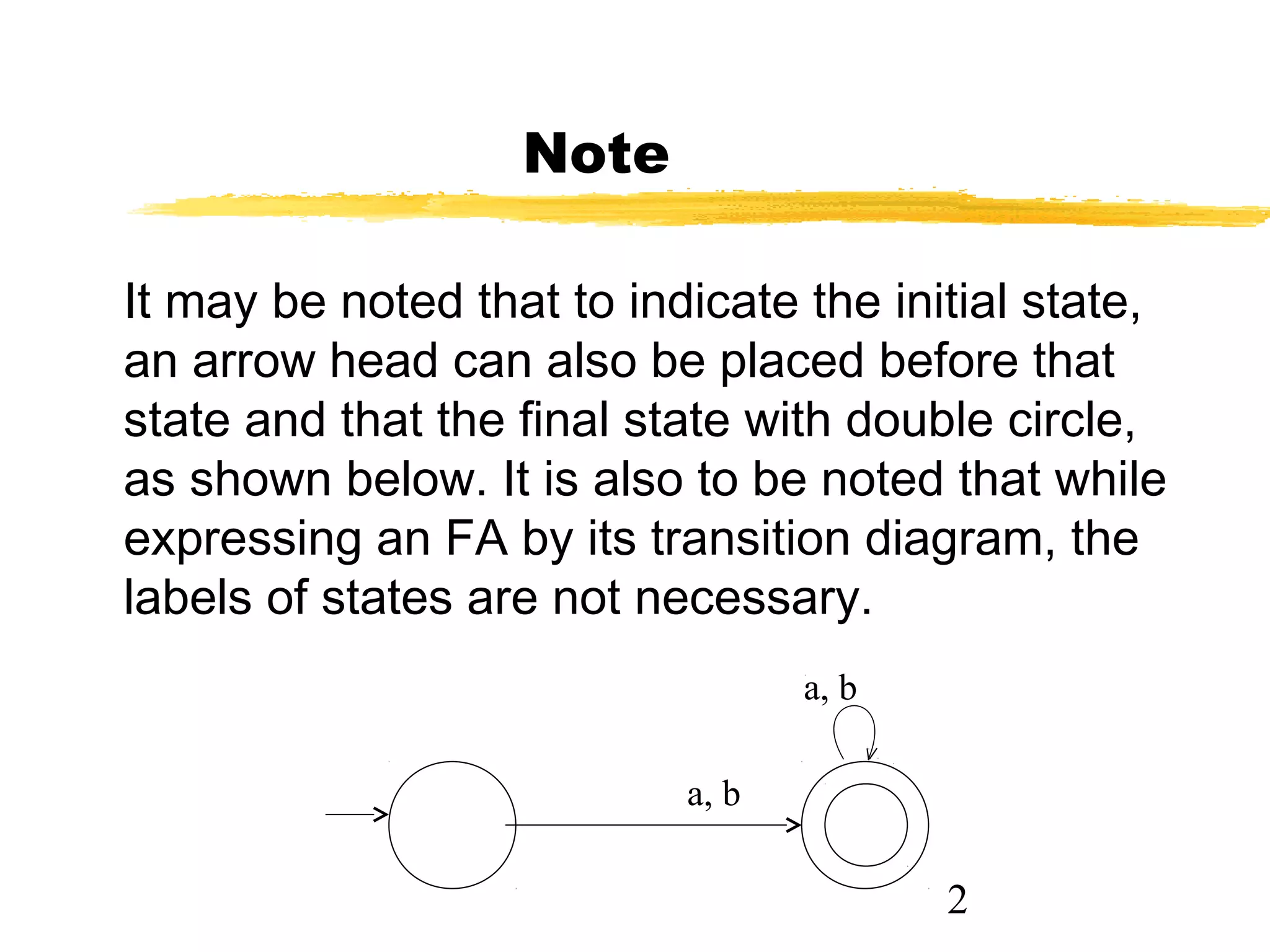
It may be noted that to indicate the initial state,
an arrow head can also be placed before that
state and that the final state with double circle,
as shown below. It is also to be noted that while
expressing an FA by its transition diagram, the
labels of states are not necessary.
a, b
a, b
3
Example
Σ = {a,b}
States: x, y, where x is both initial and final
state.
Transitions:
1.At state x reading a or b go to state y.
2.At state y reading a or b go to state x.
4
Example Continued …
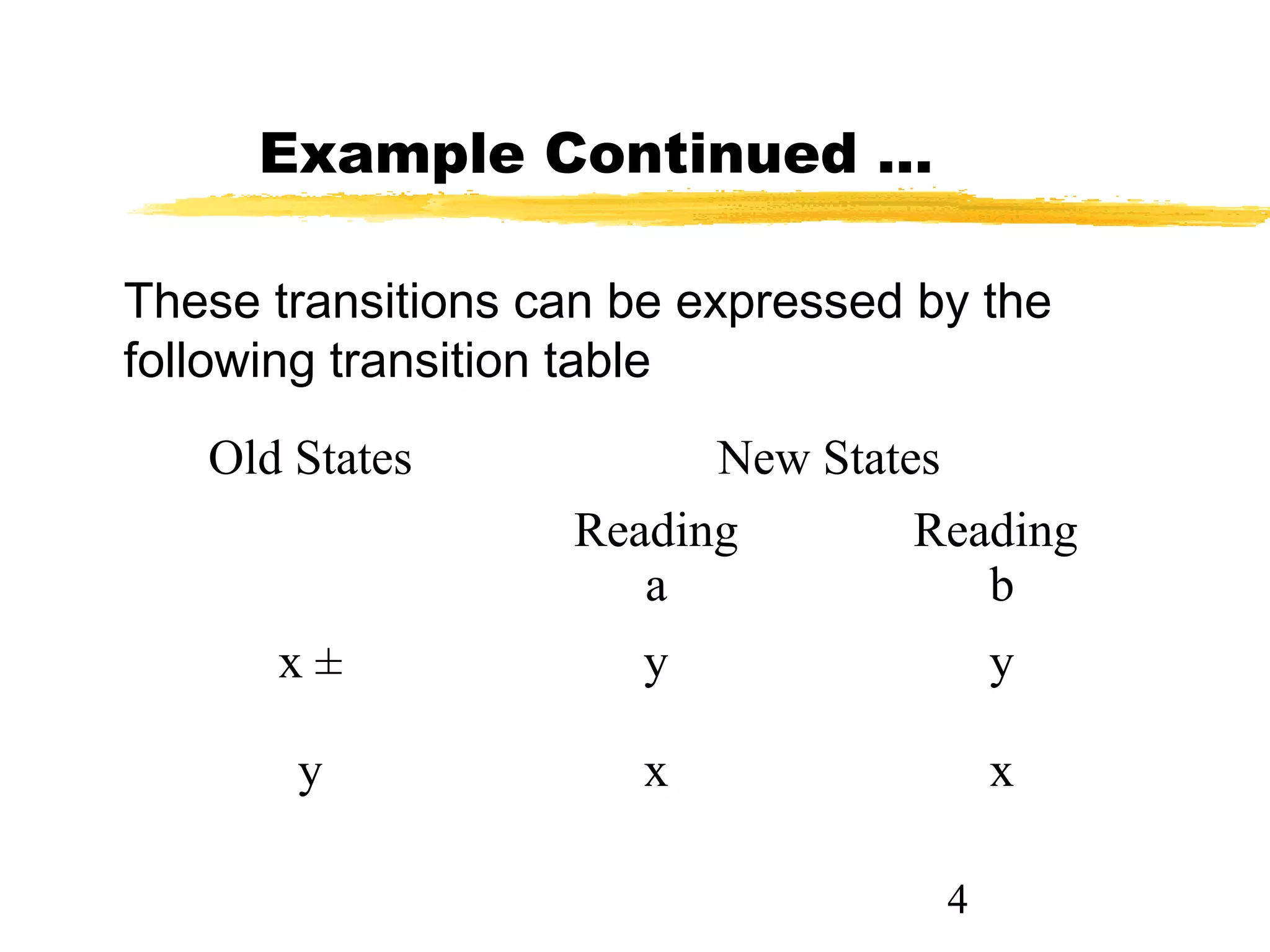
These transitions can be expressed by the
following transition table
Old States New States
Reading
a
Reading
b
x ± y y
y x x
5
Example Continued …
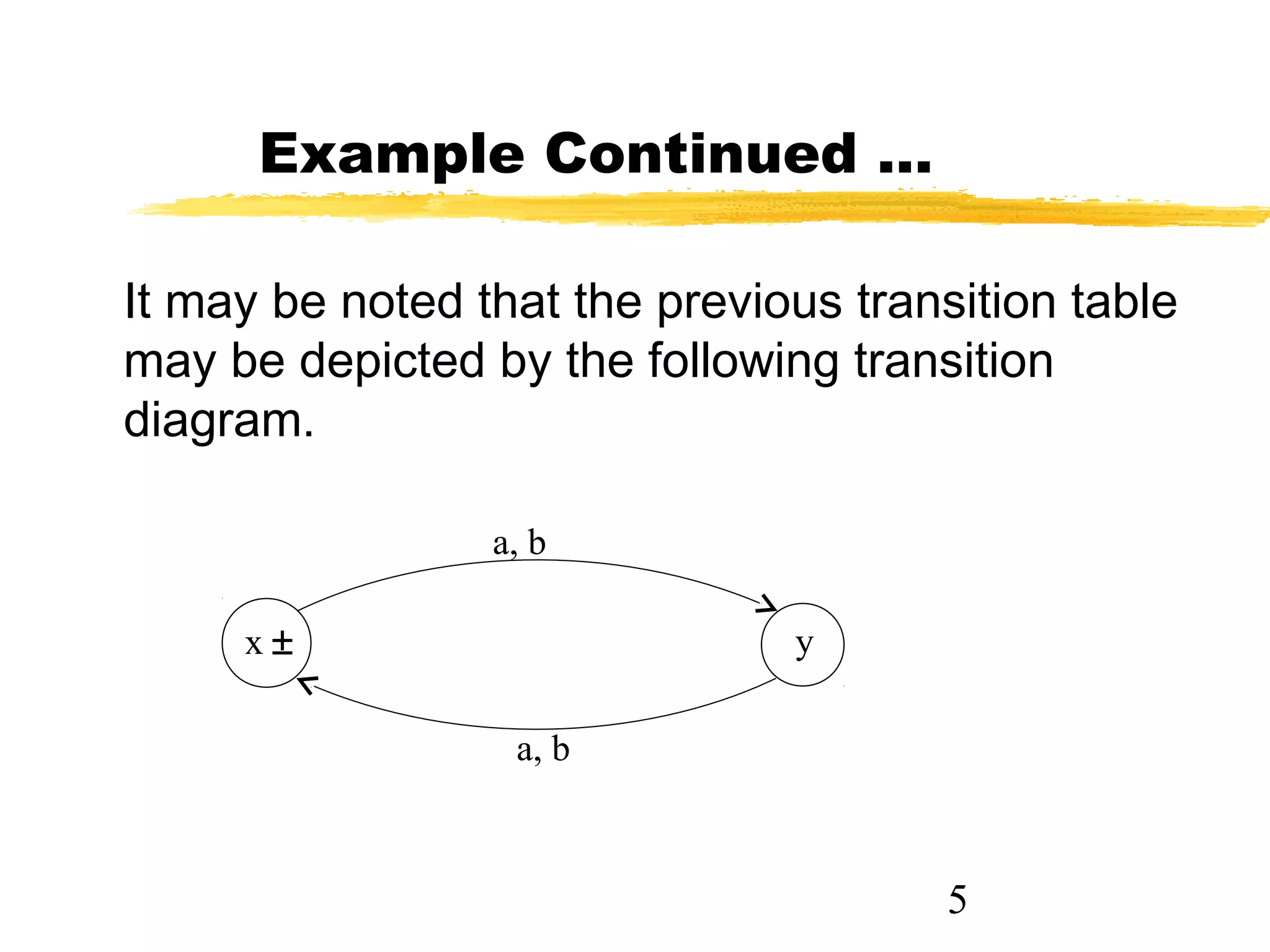
It may be noted that the previous transition table
may be depicted by the following transition
diagram.
y
a, b
x ±
a, b
6
Example Continued …
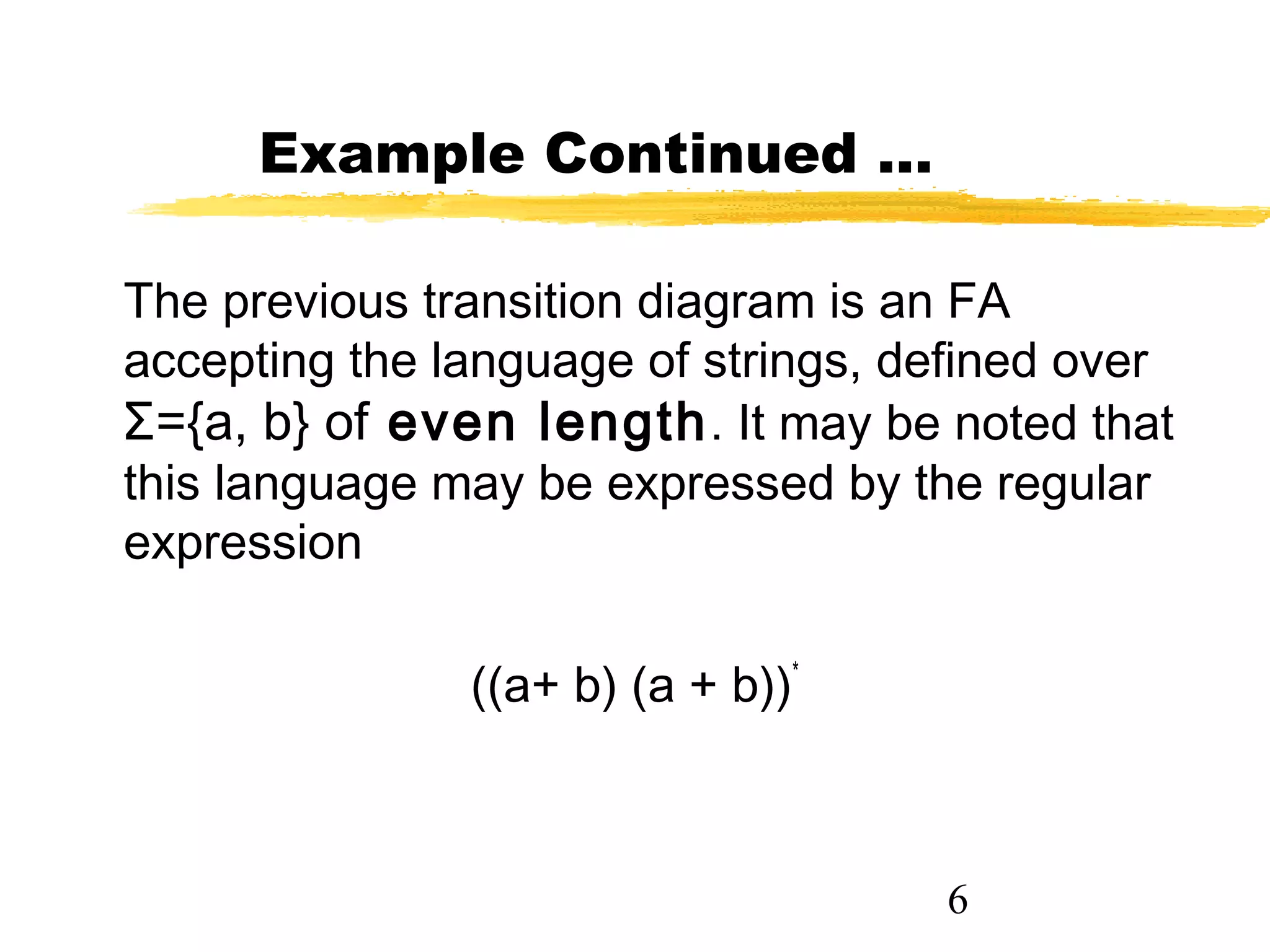
The previous transition diagram is an FA
accepting the language of strings, defined over
Σ={a, b} of even length. It may be noted that
this language may be expressed by the regular
expression
((a+ b) (a + b))*
7
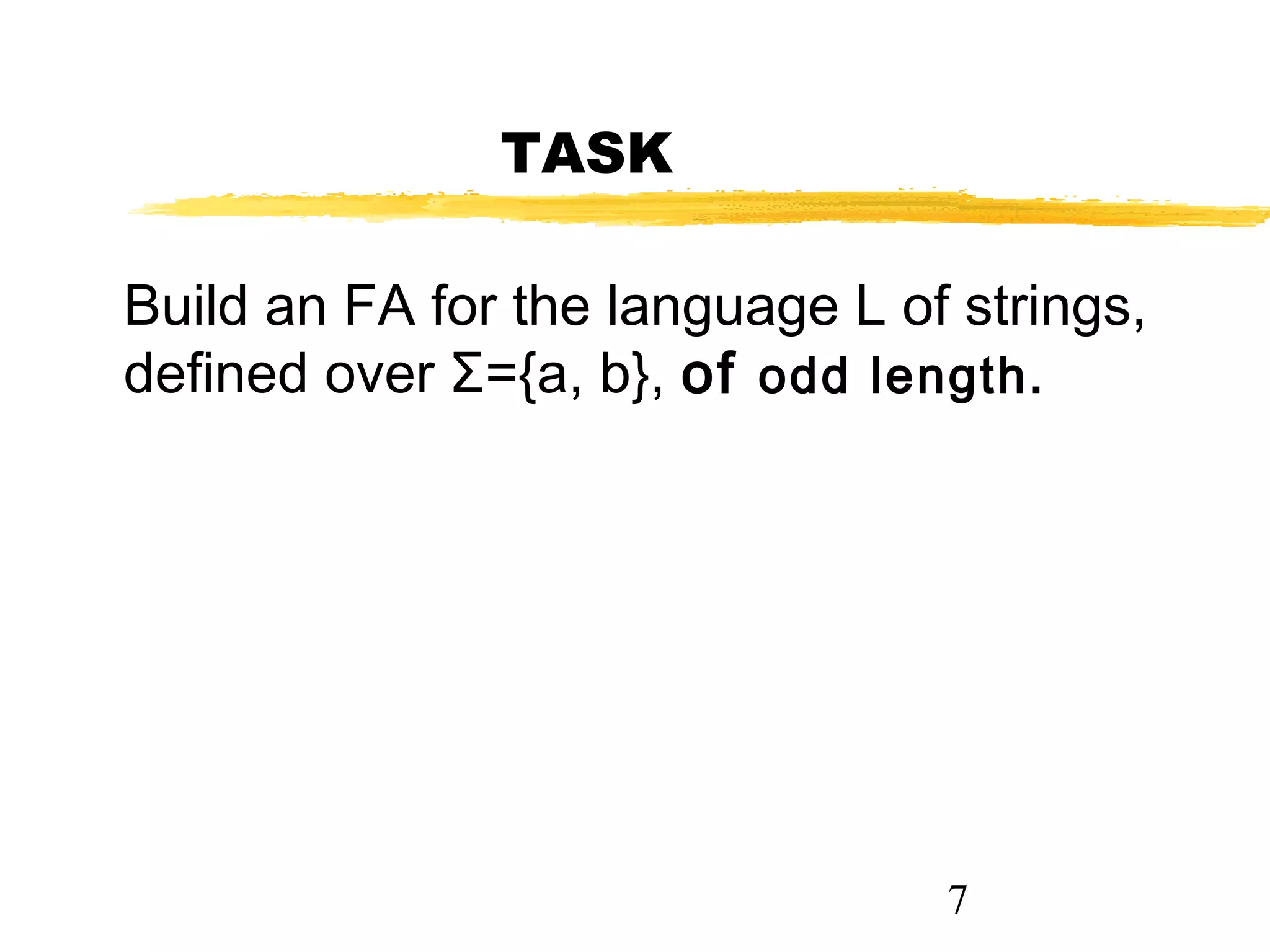
TASK
Build an FA for the language L of strings,
defined over Σ={a, b}, of odd length.
8
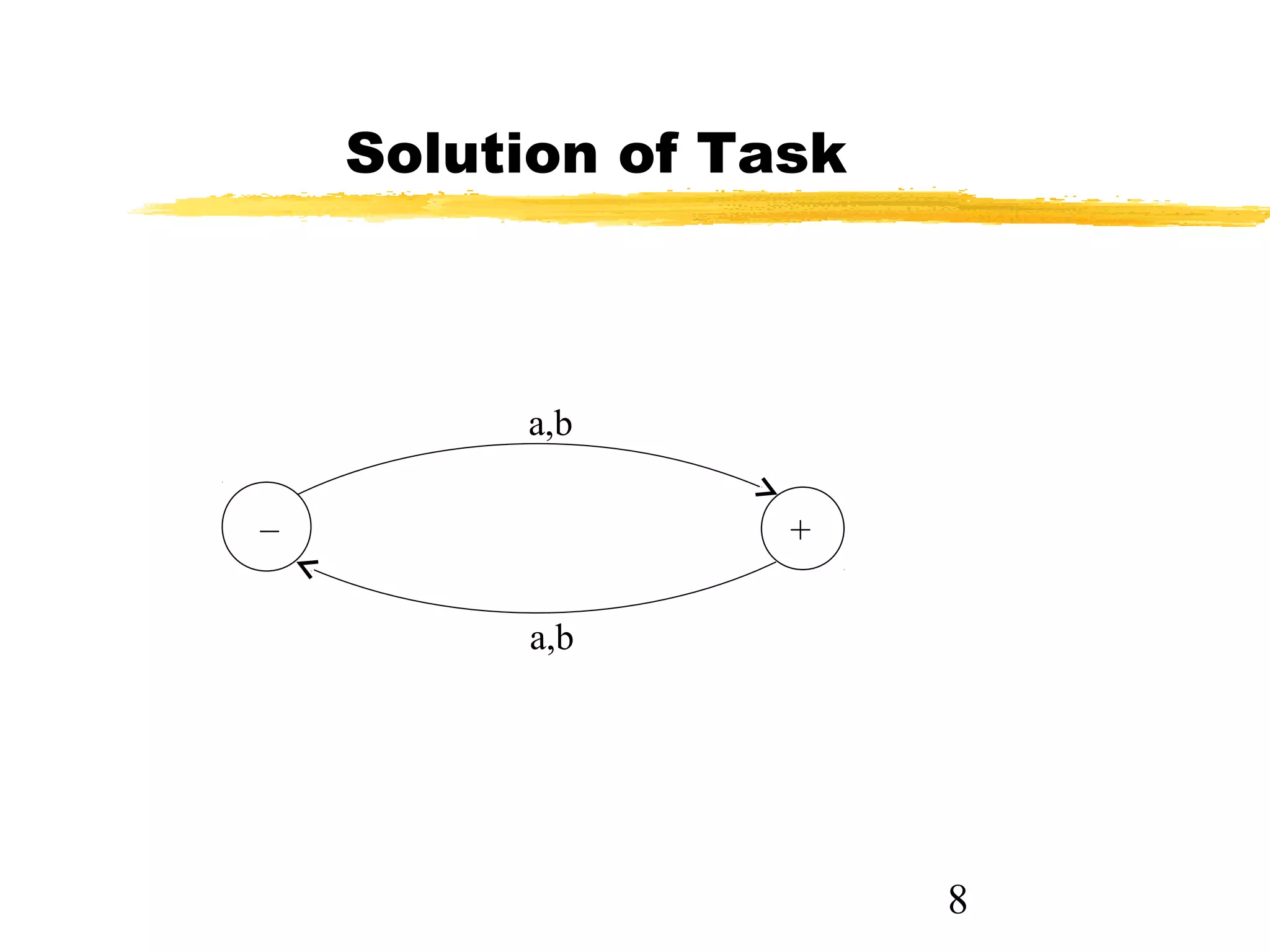
Solution of Task
+
a,b
–
a,b
9
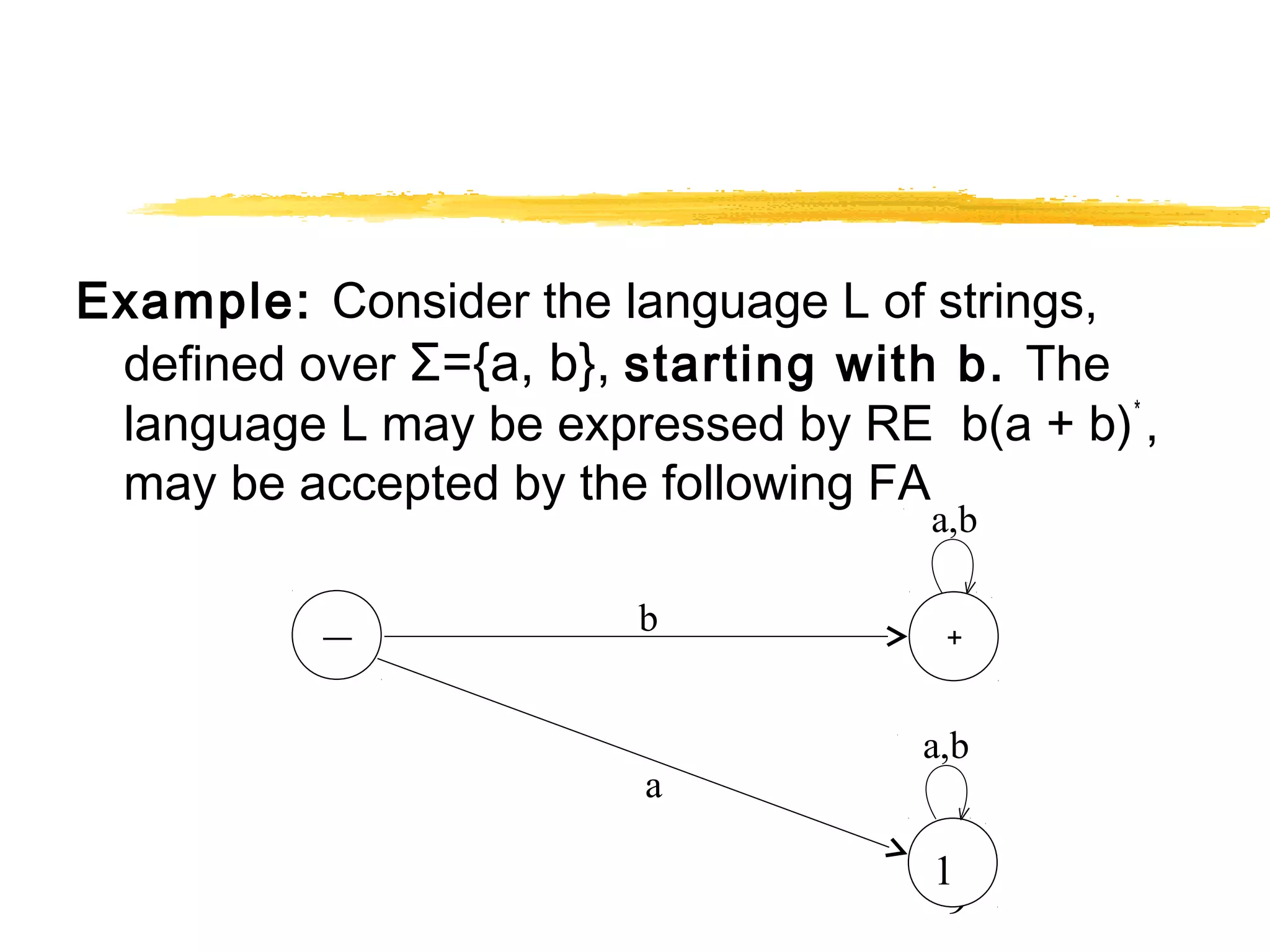
Example: Consider the language L of strings,
defined over Σ={a, b}, starting with b. The
language L may be expressed by RE b(a + b)*
,
may be accepted by the following FA
a,b
a,b
b
a
–– +
1
10
Example:
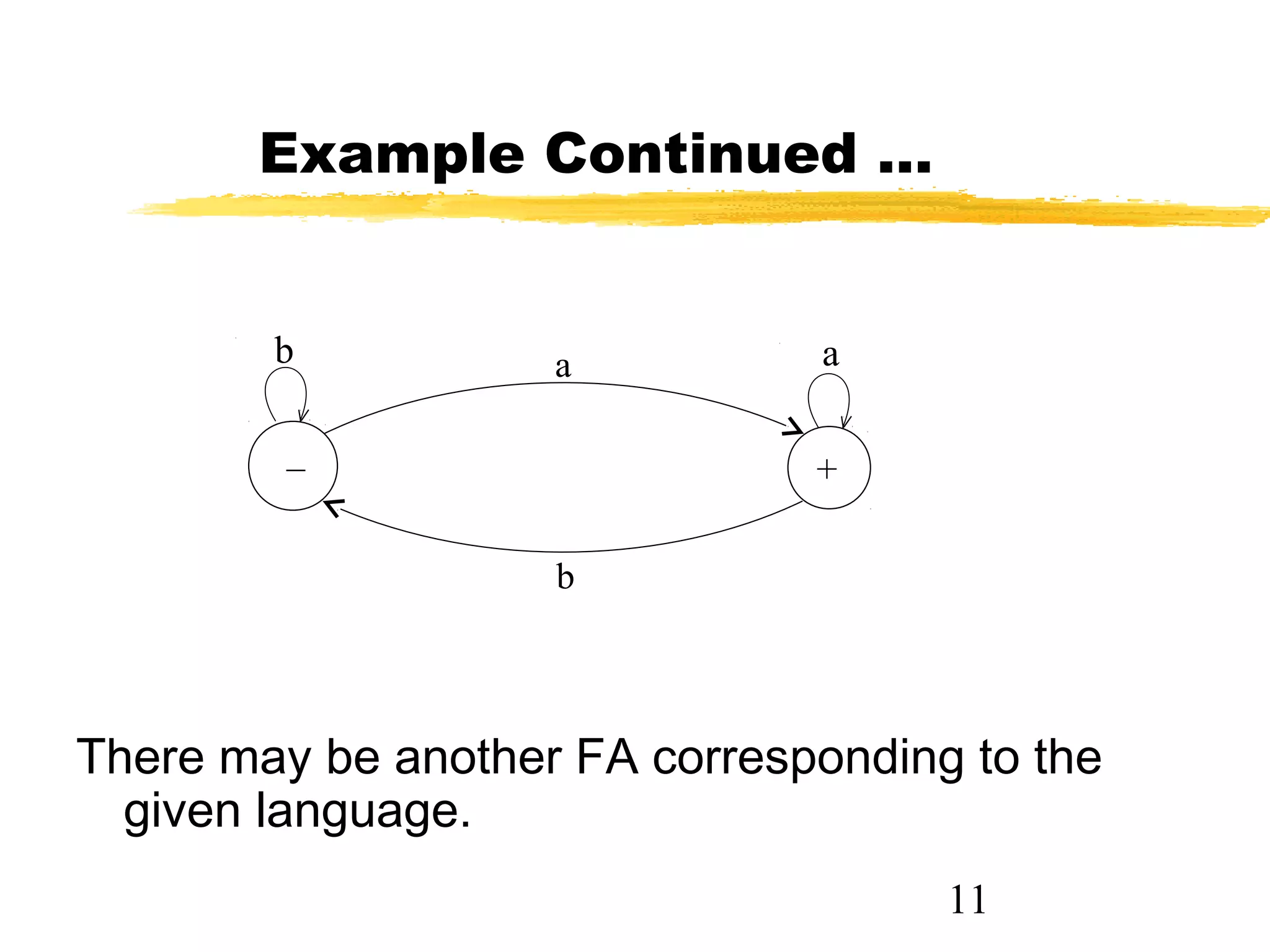
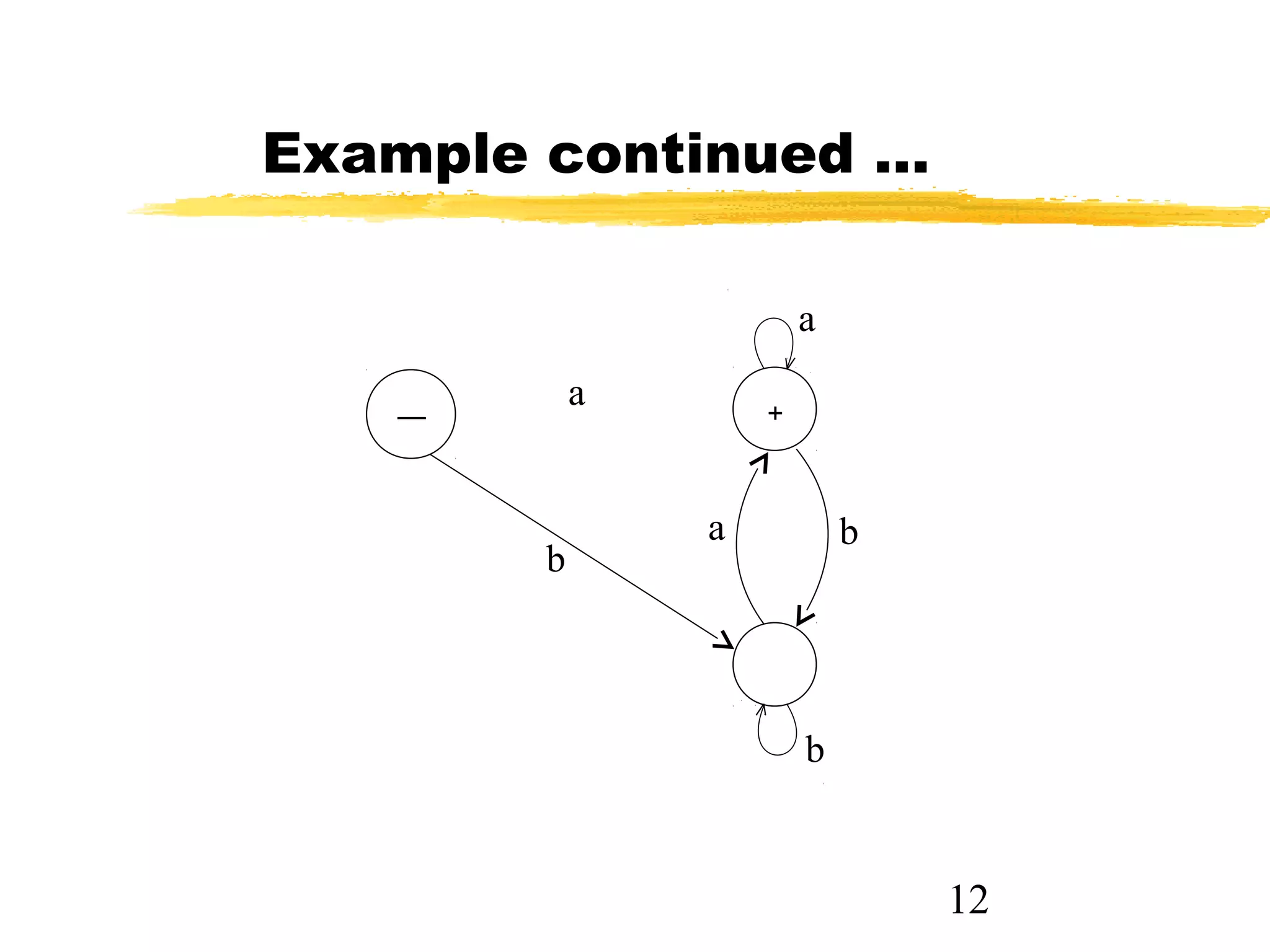
Consider the language L of strings, defined
over Σ={a, b}, ending in a. The language L
may be expressed by RE
(a+b)*
a
This language may be accepted by the following
FA
11
Example Continued …
There may be another FA corresponding to the
given language.
ab
+
b
–
a
12
Example continued …
a
b
b
ba
+
a
––
13
Note
It may be noted that corresponding to a given
language there may be more than one FA
accepting that language, but for a given FA
there is a unique language accepted by that FA.
14
Note
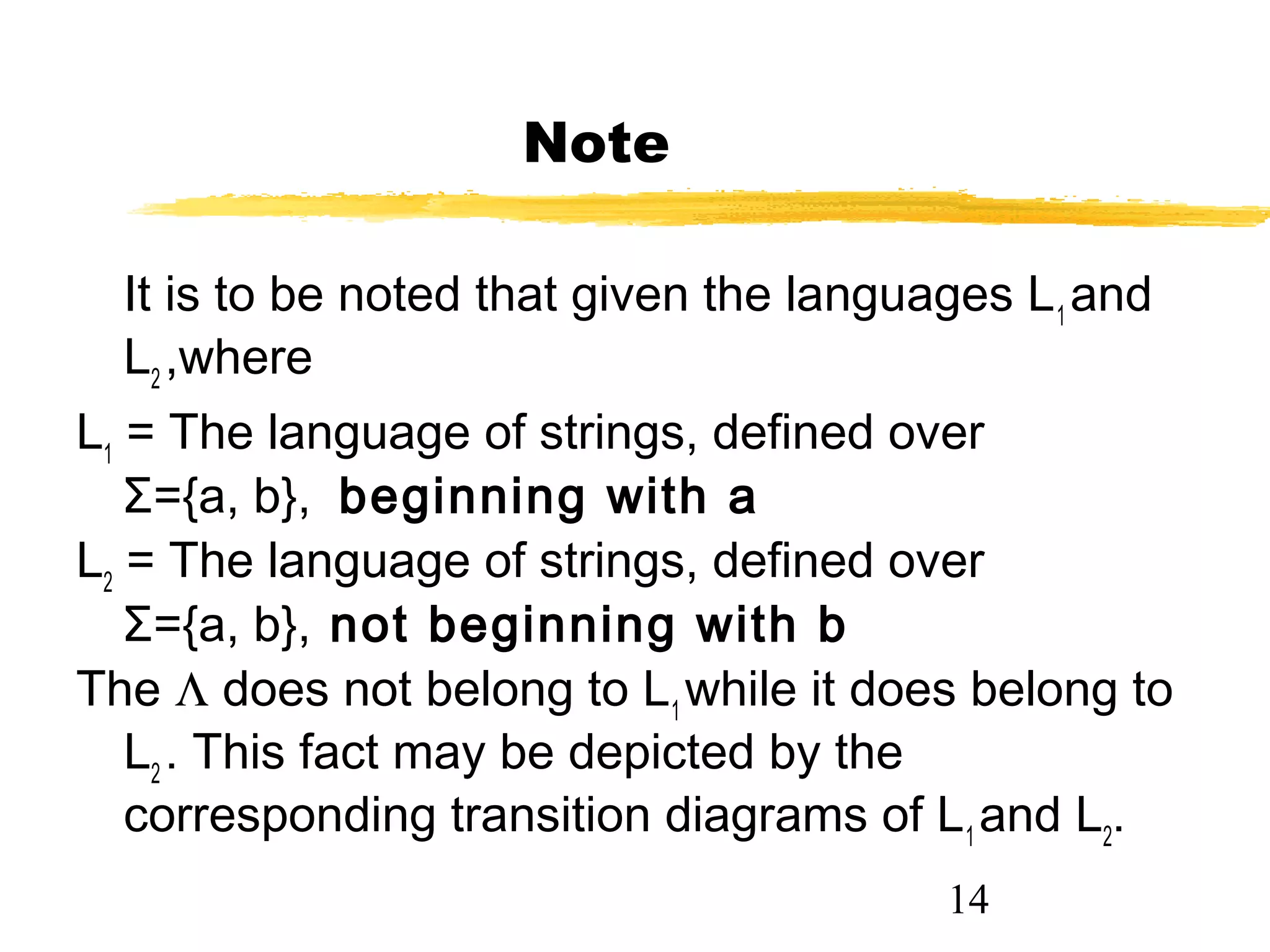
It is to be noted that given the languages L1
and
L2
,where
L1
= The language of strings, defined over
Σ={a, b}, beginning with a
L2
= The language of strings, defined over
Σ={a, b}, not beginning with b
The Λ does not belong to L1
while it does belong to
L2
. This fact may be depicted by the
corresponding transition diagrams of L1
and L2
.
15
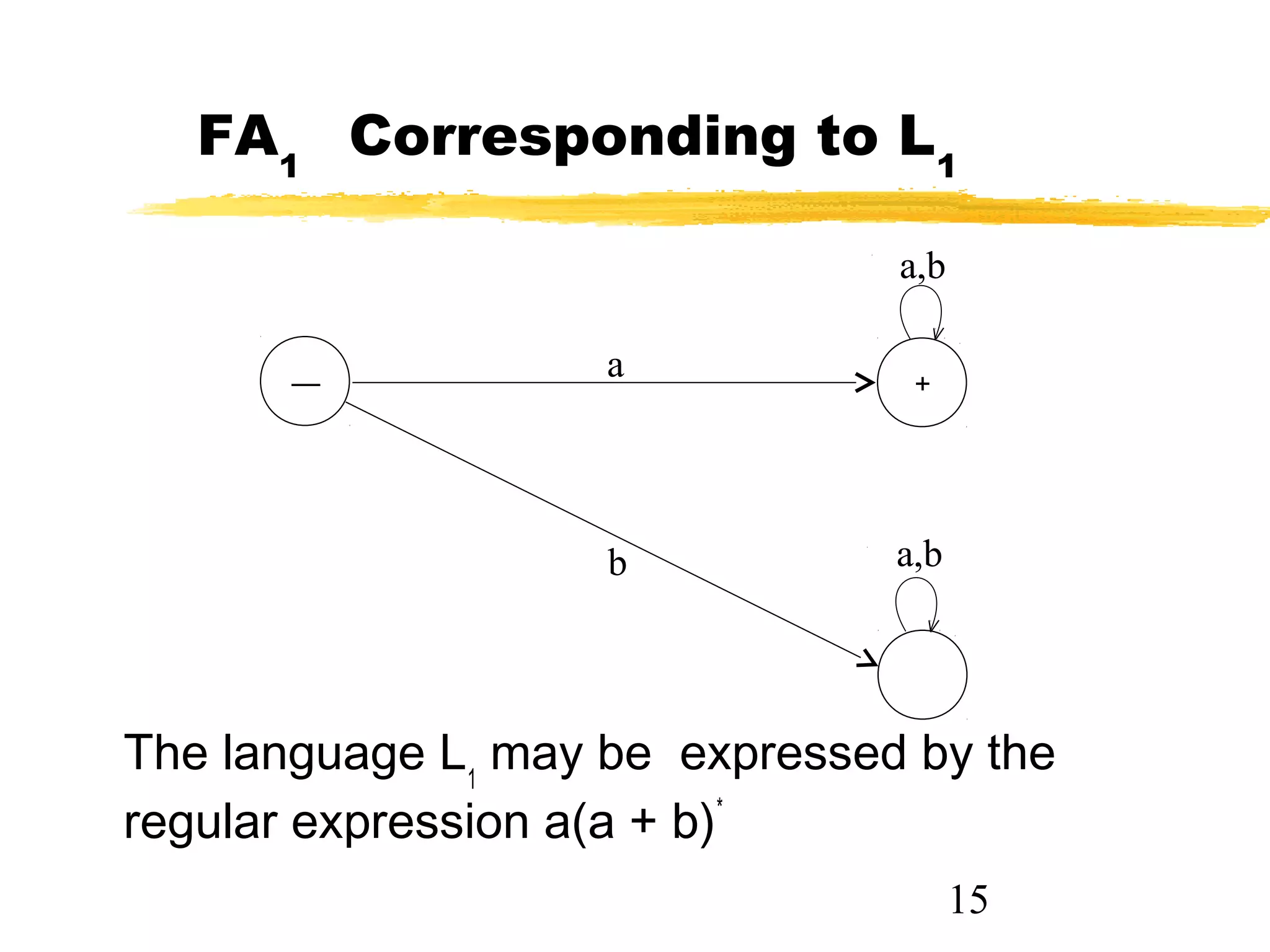
FA1
Corresponding to L1
The language L1
may be expressed by the
regular expression a(a + b)*
a,b
a
b a,b
–– +
16
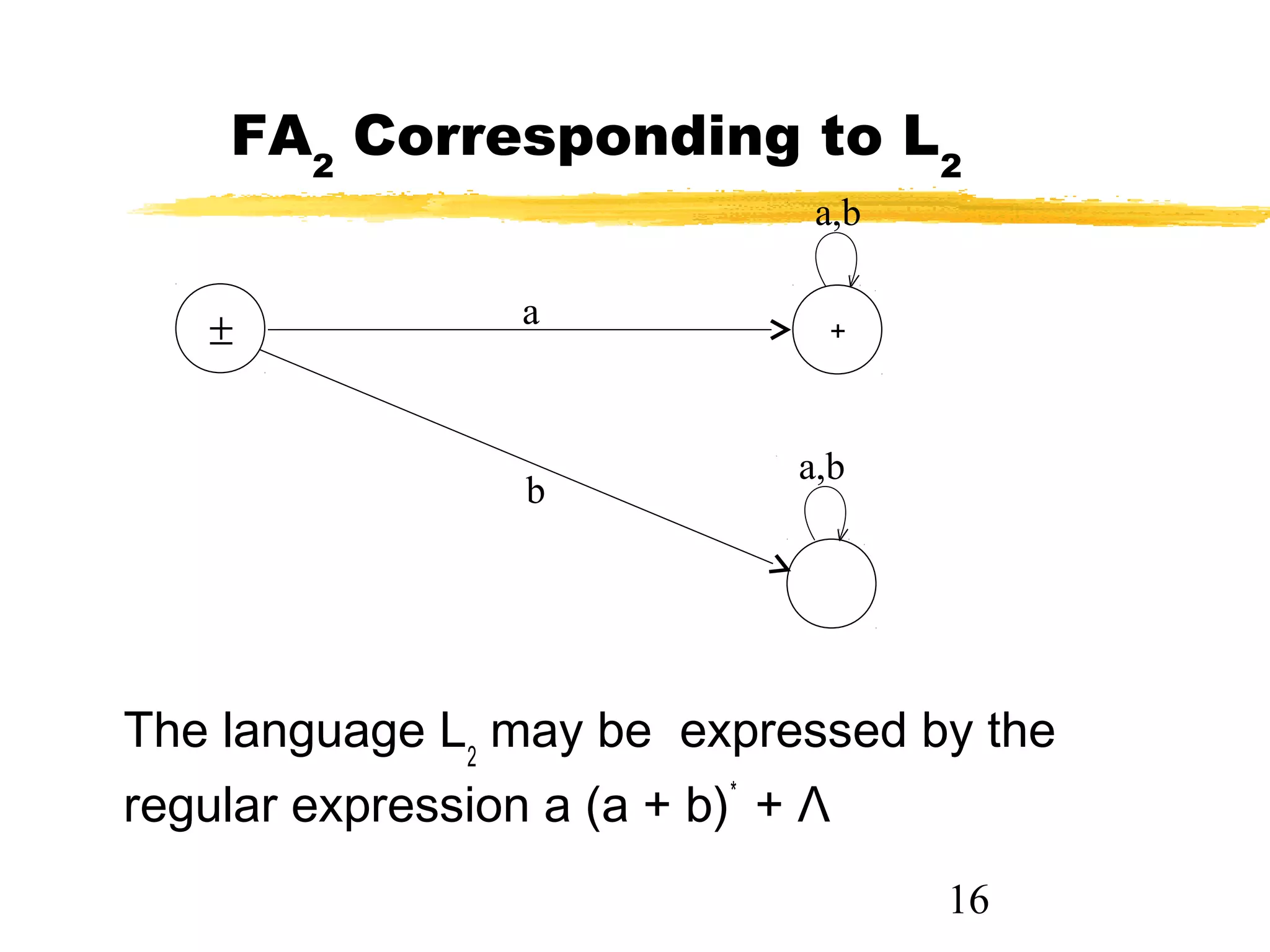
FA2
Corresponding to L2
The language L2
may be expressed by the
regular expression a (a + b)*
+ Λ
a,b
a,b
a
b
± +
17
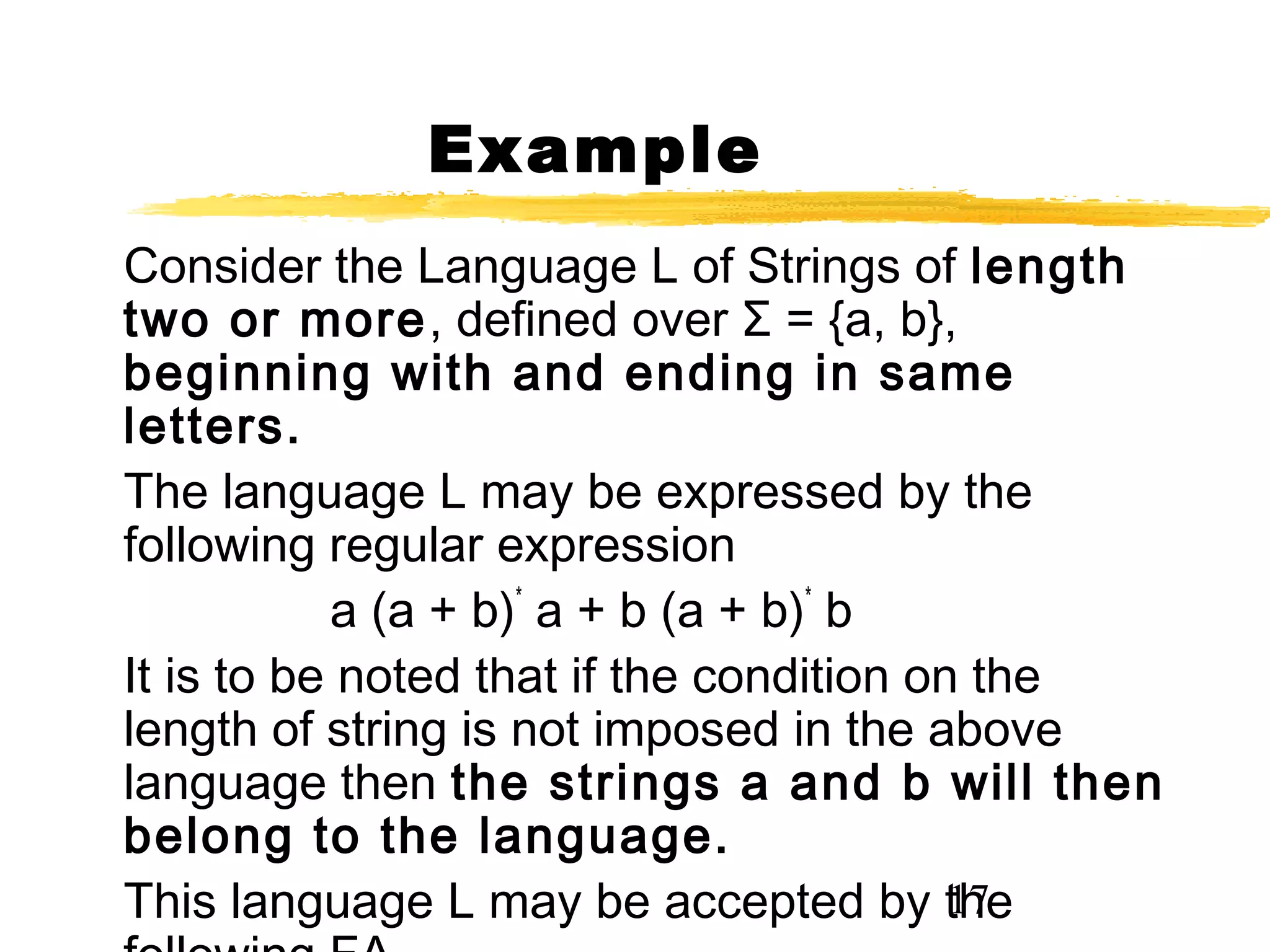
Example
Consider the Language L of Strings of length
two or more, defined over Σ = {a, b},
beginning with and ending in same
letters.
The language L may be expressed by the
following regular expression
a (a + b)*
a + b (a + b)*
b
It is to be noted that if the condition on the
length of string is not imposed in the above
language then the strings a and b will then
belong to the language.
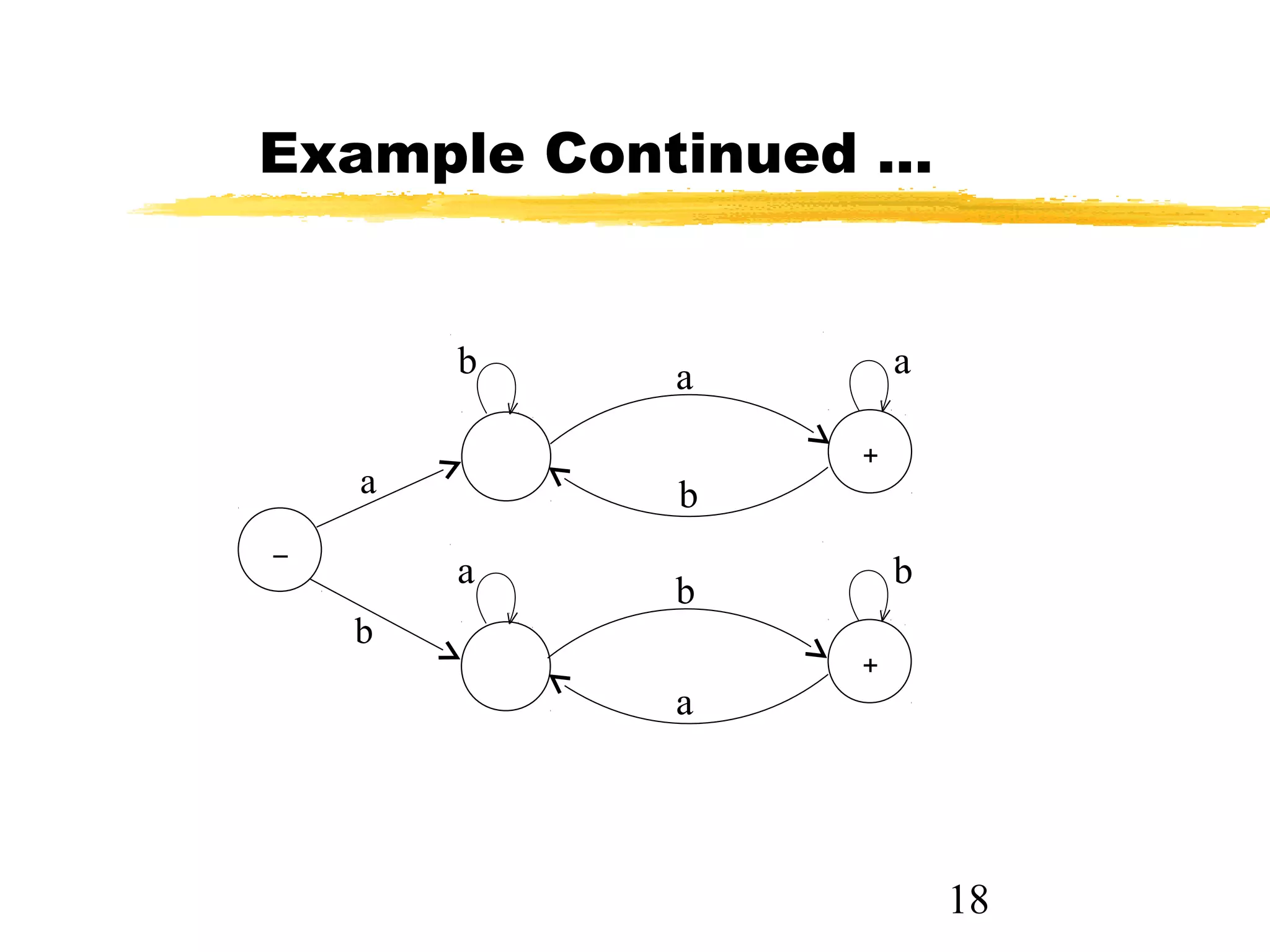
This language L may be accepted by the
18
Example Continued …
b
a
a
b
+
ab
b
a
+
b
a–
19
Task
Build an FA accepting the Language L of
Strings, defined over Σ = {a, b}, beginning
with and ending in same letters.
20
Summing Up
Different notations of transition diagrams,
languages of strings of even length, Odd
length, starting with b, ending in a,
beginning with b, not beginning with b,
beginning and ending in same letters;

Lesson 05

  • 1.
    1 Recap Lecture 4 Regularexpression of EVEN-EVEN language, Difference between a* + b* and (a+b)*, Equivalent regular expressions; sum, product and closure of regular expressions; regular languages, finite languages are regular, introduction to finite automaton, definition of FA, transition table, transition diagram.
  • 2.
    2 Note It may benoted that to indicate the initial state, an arrow head can also be placed before that state and that the final state with double circle, as shown below. It is also to be noted that while expressing an FA by its transition diagram, the labels of states are not necessary. a, b a, b
  • 3.
    3 Example Σ = {a,b} States:x, y, where x is both initial and final state. Transitions: 1.At state x reading a or b go to state y. 2.At state y reading a or b go to state x.
  • 4.
    4 Example Continued … Thesetransitions can be expressed by the following transition table Old States New States Reading a Reading b x ± y y y x x
  • 5.
    5 Example Continued … Itmay be noted that the previous transition table may be depicted by the following transition diagram. y a, b x ± a, b
  • 6.
    6 Example Continued … Theprevious transition diagram is an FA accepting the language of strings, defined over Σ={a, b} of even length. It may be noted that this language may be expressed by the regular expression ((a+ b) (a + b))*
  • 7.
    7 TASK Build an FAfor the language L of strings, defined over Σ={a, b}, of odd length.
  • 8.
  • 9.
    9 Example: Consider thelanguage L of strings, defined over Σ={a, b}, starting with b. The language L may be expressed by RE b(a + b)* , may be accepted by the following FA a,b a,b b a –– + 1
  • 10.
    10 Example: Consider the languageL of strings, defined over Σ={a, b}, ending in a. The language L may be expressed by RE (a+b)* a This language may be accepted by the following FA
  • 11.
    11 Example Continued … Theremay be another FA corresponding to the given language. ab + b – a
  • 12.
  • 13.
    13 Note It may benoted that corresponding to a given language there may be more than one FA accepting that language, but for a given FA there is a unique language accepted by that FA.
  • 14.
    14 Note It is tobe noted that given the languages L1 and L2 ,where L1 = The language of strings, defined over Σ={a, b}, beginning with a L2 = The language of strings, defined over Σ={a, b}, not beginning with b The Λ does not belong to L1 while it does belong to L2 . This fact may be depicted by the corresponding transition diagrams of L1 and L2 .
  • 15.
    15 FA1 Corresponding to L1 Thelanguage L1 may be expressed by the regular expression a(a + b)* a,b a b a,b –– +
  • 16.
    16 FA2 Corresponding to L2 Thelanguage L2 may be expressed by the regular expression a (a + b)* + Λ a,b a,b a b ± +
  • 17.
    17 Example Consider the LanguageL of Strings of length two or more, defined over Σ = {a, b}, beginning with and ending in same letters. The language L may be expressed by the following regular expression a (a + b)* a + b (a + b)* b It is to be noted that if the condition on the length of string is not imposed in the above language then the strings a and b will then belong to the language. This language L may be accepted by the
  • 18.
  • 19.
    19 Task Build an FAaccepting the Language L of Strings, defined over Σ = {a, b}, beginning with and ending in same letters.
  • 20.
    20 Summing Up Different notationsof transition diagrams, languages of strings of even length, Odd length, starting with b, ending in a, beginning with b, not beginning with b, beginning and ending in same letters;