1
Regular Expressions
Reading: Chapter 3
2
Regular Expressions vs. Finite
Automata
 Offers a declarative way to express the pattern of any
string we want to accept
 E.g., 01*+ 10*
 Automata => more machine-like
< input: string , output: [accept/reject] >
 Regular expressions => more program syntax-like
 Unix environments heavily use regular expressions
 E.g., bash shell, grep, vi & other editors, sed
 Perl scripting – good for string processing
 Lexical analyzers such as Lex or Flex
3
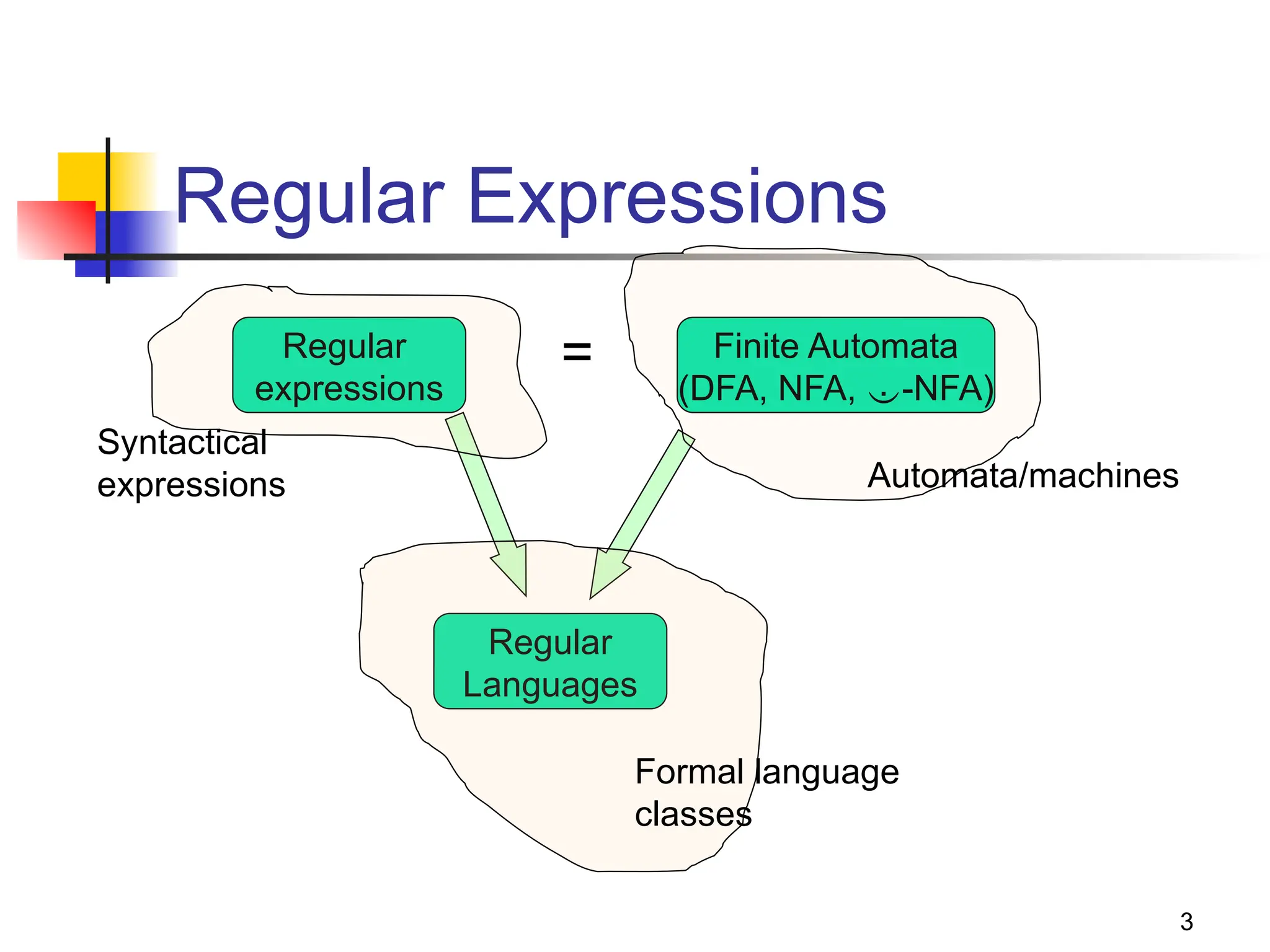
Regular Expressions
Regular
expressions
Finite Automata
(DFA, NFA, -NFA)
Regular
Languages
=
Automata/machines
Syntactical
expressions
Formal language
classes
4
Language Operators
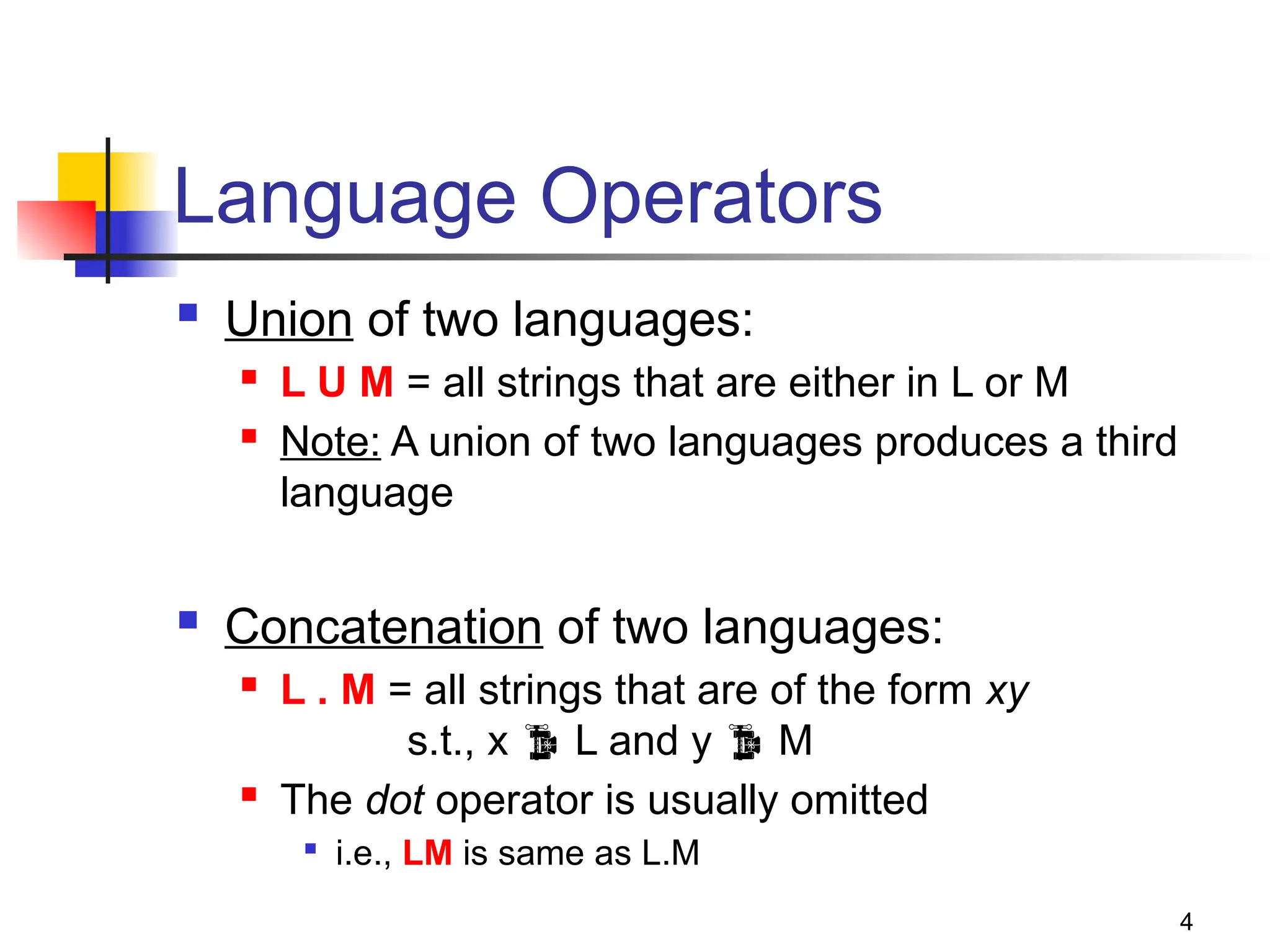
 Union of two languages:
 L U M = all strings that are either in L or M
 Note: A union of two languages produces a third
language
 Concatenation of two languages:
 L . M = all strings that are of the form xy
s.t., x  L and y  M
 The dot operator is usually omitted

i.e., LM is same as L.M
5
Kleene Closure (the * operator)
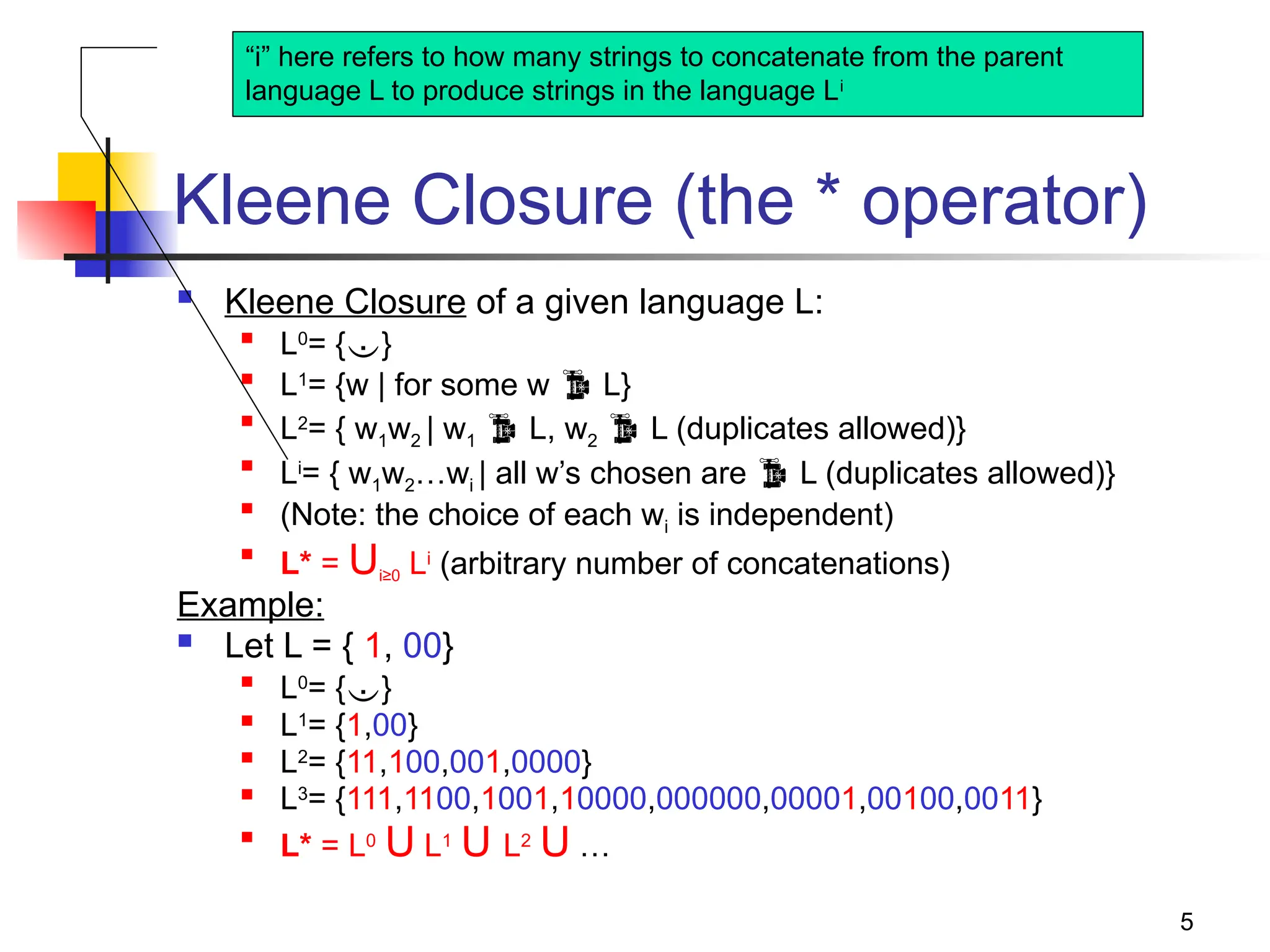
 Kleene Closure of a given language L:

L0
= {}

L1
= {w | for some w  L}

L2
= { w1w2 | w1  L, w2  L (duplicates allowed)}

Li
= { w1w2…wi | all w’s chosen are  L (duplicates allowed)}

(Note: the choice of each wi is independent)

L* = Ui≥0 Li
(arbitrary number of concatenations)
Example:
 Let L = { 1, 00}

L0
= {}

L1
= {1,00}

L2
= {11,100,001,0000}
 L3
= {111,1100,1001,10000,000000,00001,00100,0011}

L* = L0
U L1
U L2
U …
“i” here refers to how many strings to concatenate from the parent
language L to produce strings in the language Li
6
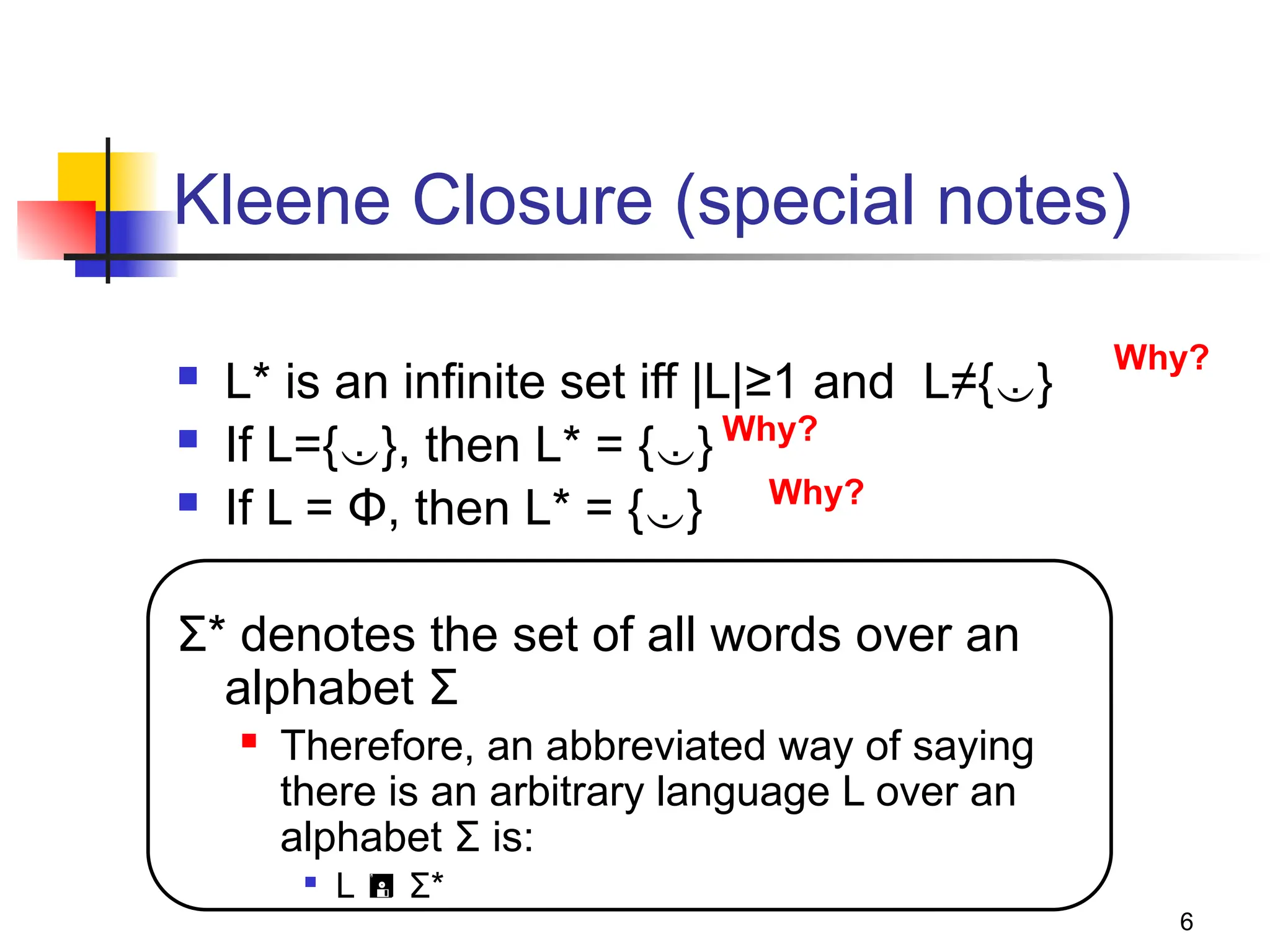
Kleene Closure (special notes)
 L* is an infinite set iff |L|≥1 and L≠{}
 If L={}, then L* = {}
 If L = Φ, then L* = {}
Σ* denotes the set of all words over an
alphabet Σ
 Therefore, an abbreviated way of saying
there is an arbitrary language L over an
alphabet Σ is:

L  Σ*
Why?
Why?
Why?
7
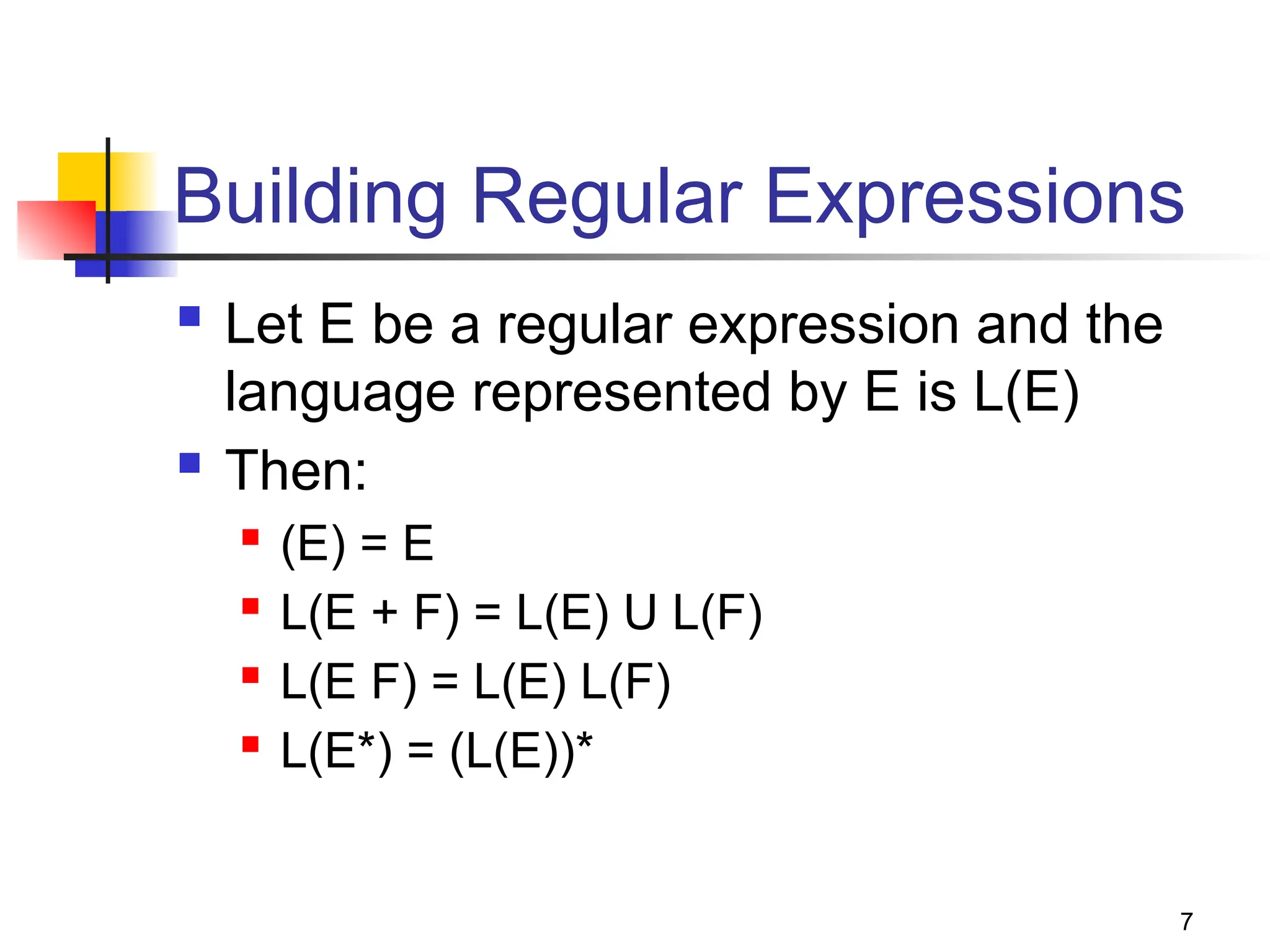
Building Regular Expressions
 Let E be a regular expression and the
language represented by E is L(E)
 Then:
 (E) = E
 L(E + F) = L(E) U L(F)
 L(E F) = L(E) L(F)
 L(E*) = (L(E))*
8
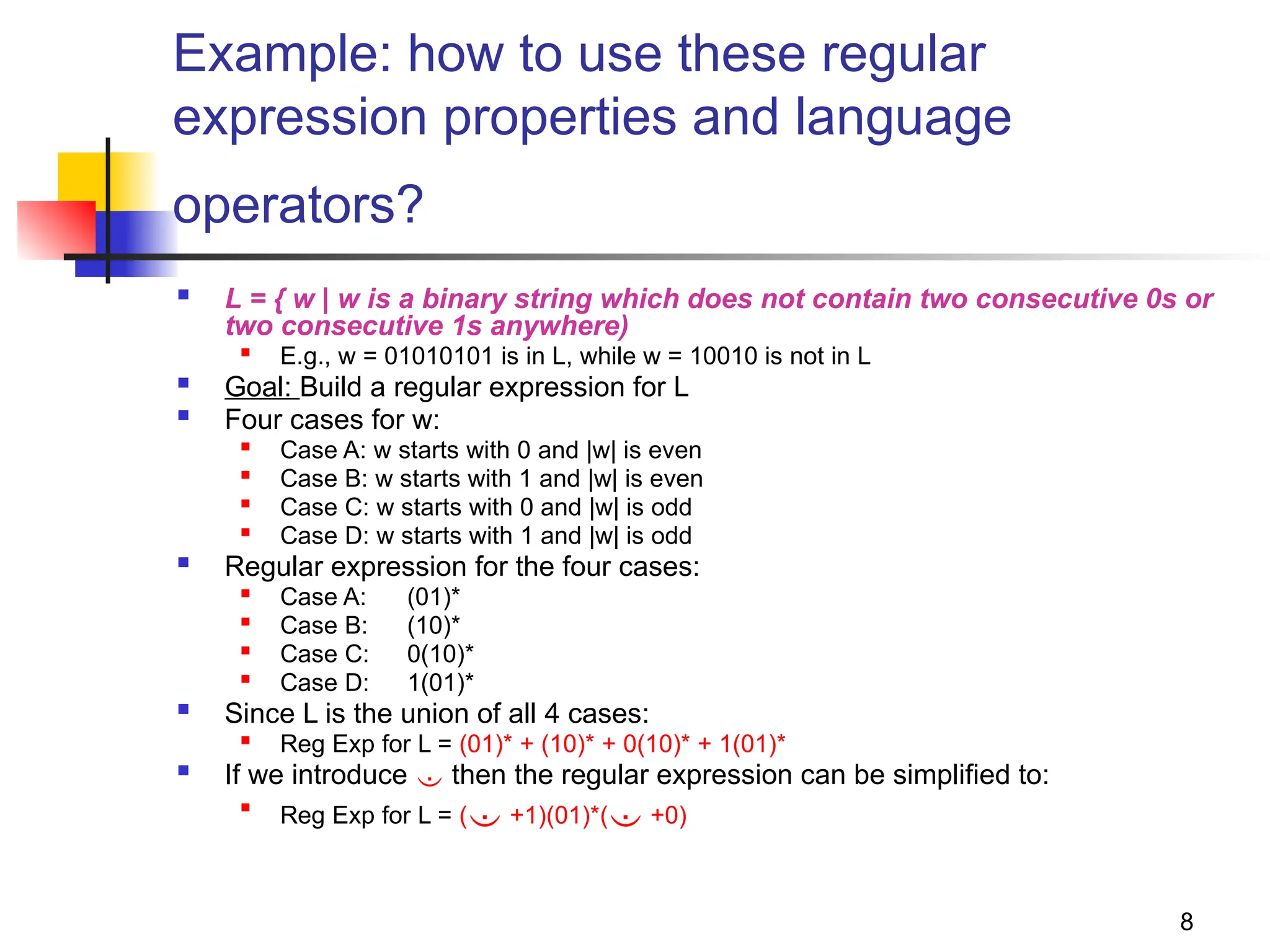
Example: how to use these regular
expression properties and language
operators?
 L = { w | w is a binary string which does not contain two consecutive 0s or
two consecutive 1s anywhere)

E.g., w = 01010101 is in L, while w = 10010 is not in L
 Goal: Build a regular expression for L
 Four cases for w:

Case A: w starts with 0 and |w| is even

Case B: w starts with 1 and |w| is even

Case C: w starts with 0 and |w| is odd

Case D: w starts with 1 and |w| is odd
 Regular expression for the four cases:

Case A: (01)*

Case B: (10)*
 Case C: 0(10)*

Case D: 1(01)*
 Since L is the union of all 4 cases:

Reg Exp for L = (01)* + (10)* + 0(10)* + 1(01)*
 If we introduce  then the regular expression can be simplified to:

Reg Exp for L = ( +1)(01)*( +0)
9
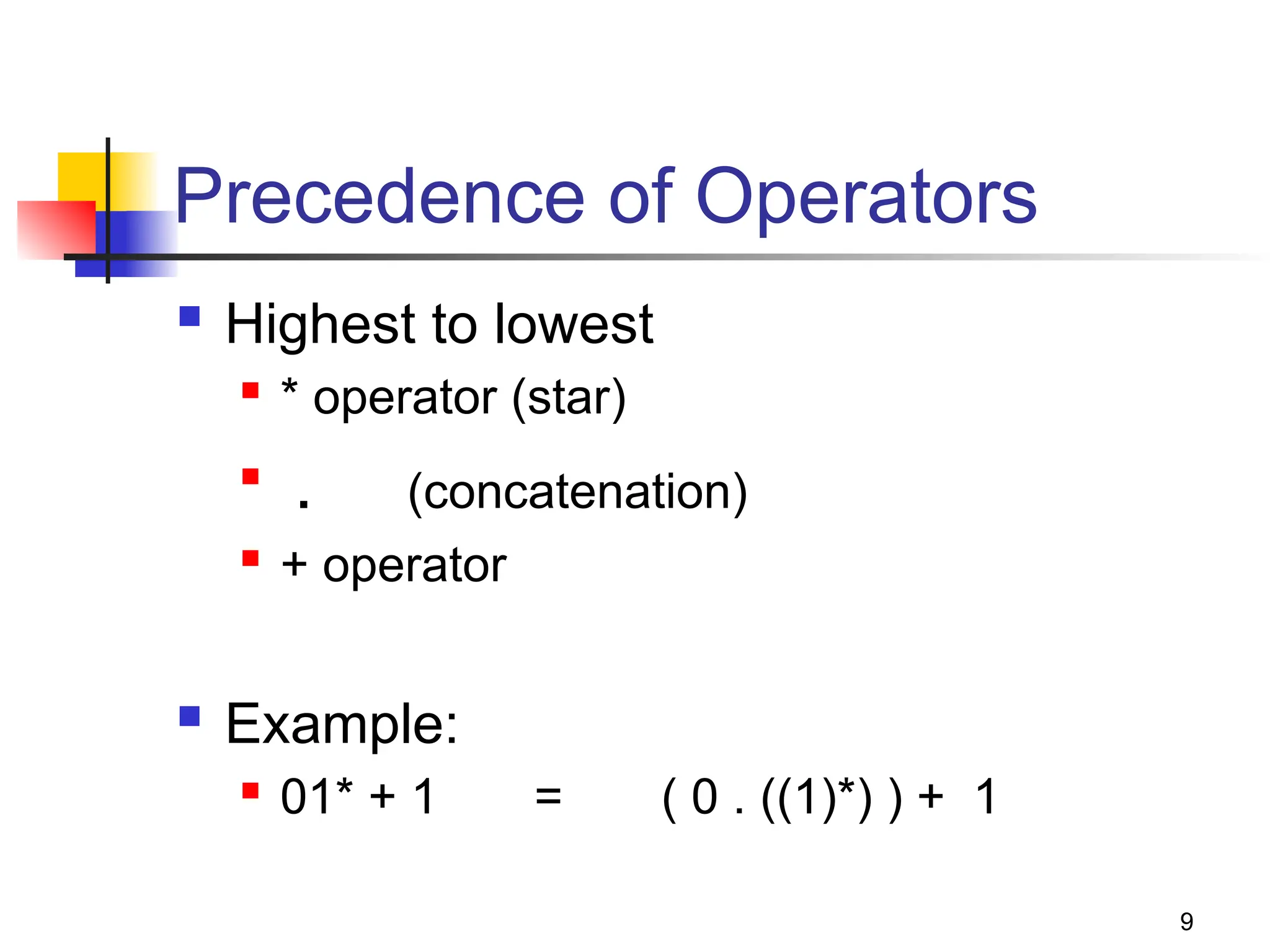
Precedence of Operators
 Highest to lowest
 * operator (star)

. (concatenation)
 + operator
 Example:
 01* + 1 = ( 0 . ((1)*) ) + 1
10
Finite Automata (FA) & Regular
Expressions (Reg Ex)
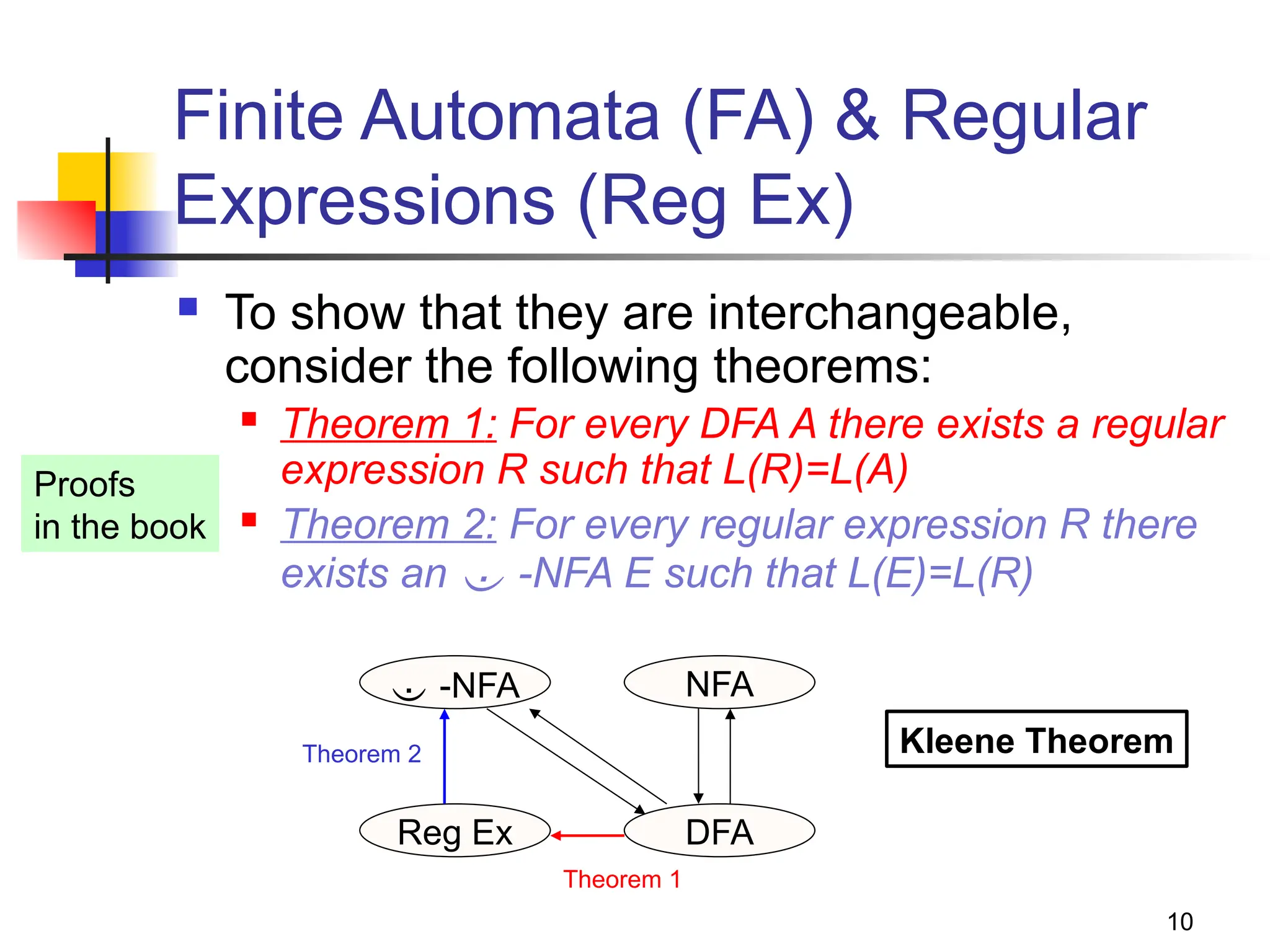
 To show that they are interchangeable,
consider the following theorems:
 Theorem 1: For every DFA A there exists a regular
expression R such that L(R)=L(A)
 Theorem 2: For every regular expression R there
exists an  -NFA E such that L(E)=L(R)
 -NFA NFA
DFA
Reg Ex
Theorem 2
Theorem 1
Proofs
in the book
Kleene Theorem
11
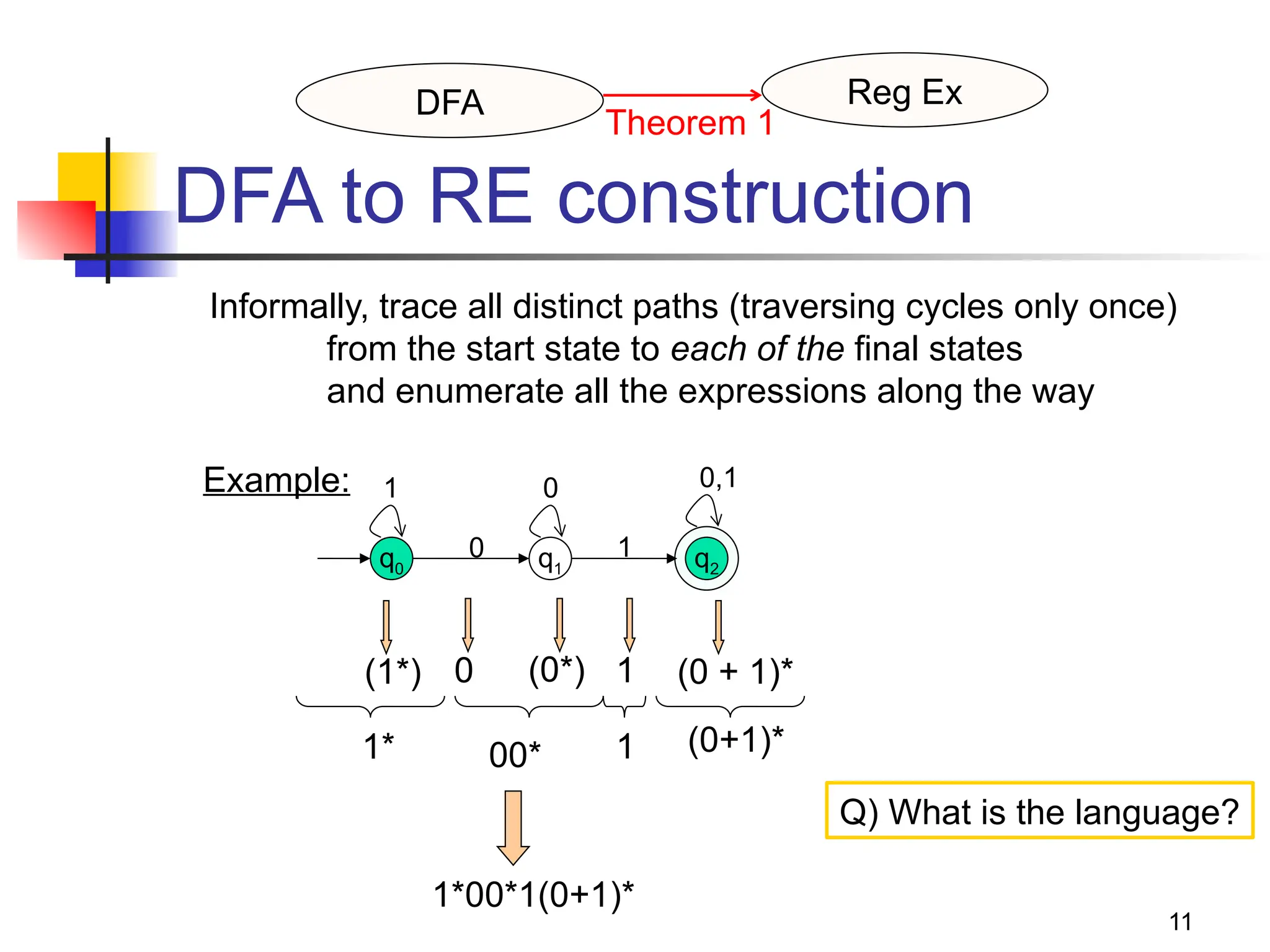
DFA to RE construction
Reg Ex
DFA
Theorem 1
Example:
q0 q1 q2
0 1
1 0 0,1
(1*) 0 (0*) 1 (0 + 1)*
Informally, trace all distinct paths (traversing cycles only once)
from the start state to each of the final states
and enumerate all the expressions along the way
1*00*1(0+1)*
00*
1* 1 (0+1)*
Q) What is the language?
12
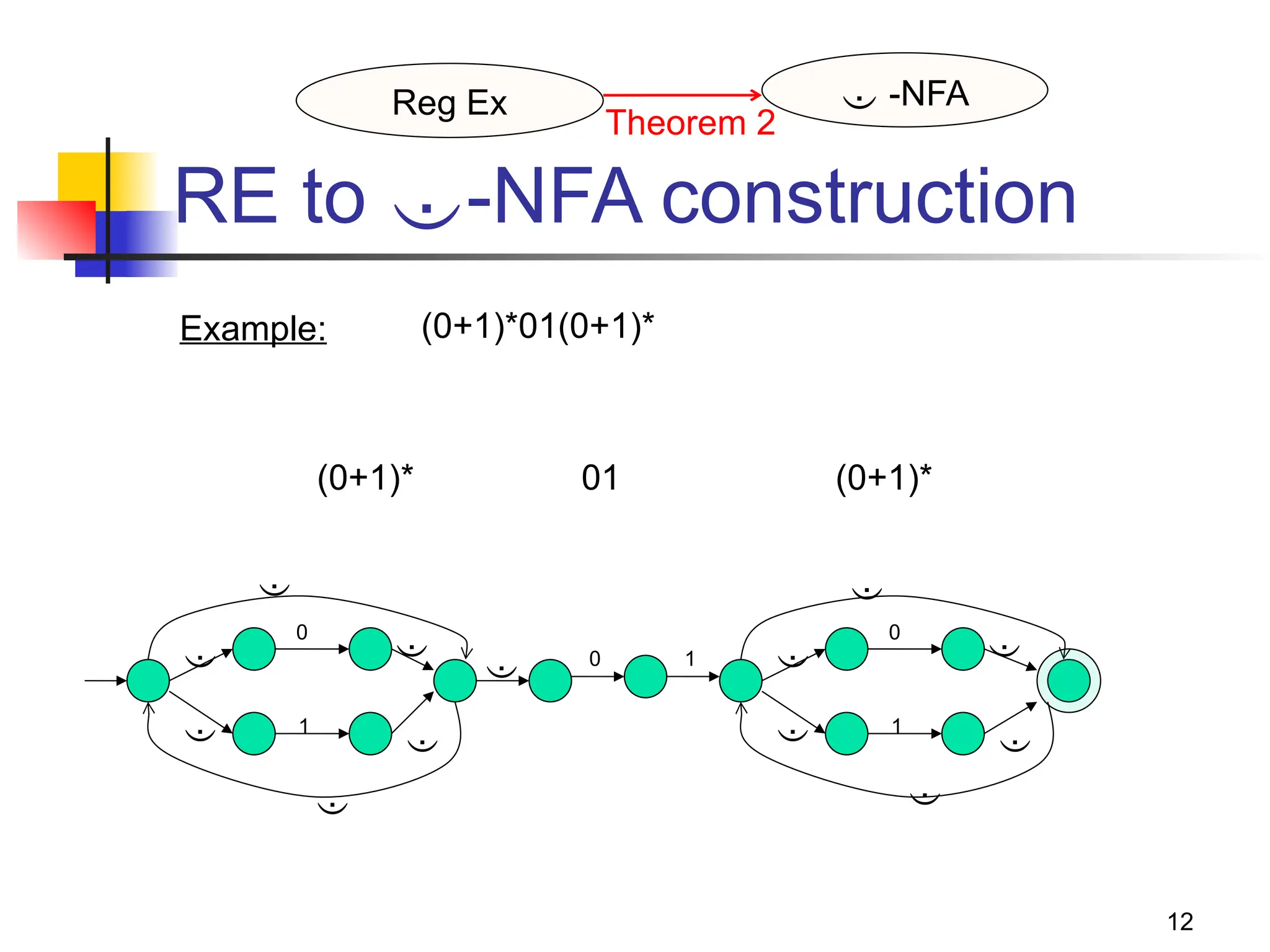
RE to -NFA construction
 -NFA
Reg Ex
Theorem 2
Example: (0+1)*01(0+1)*
0
1






 0 1
0
1






(0+1)* 01 (0+1)*
13
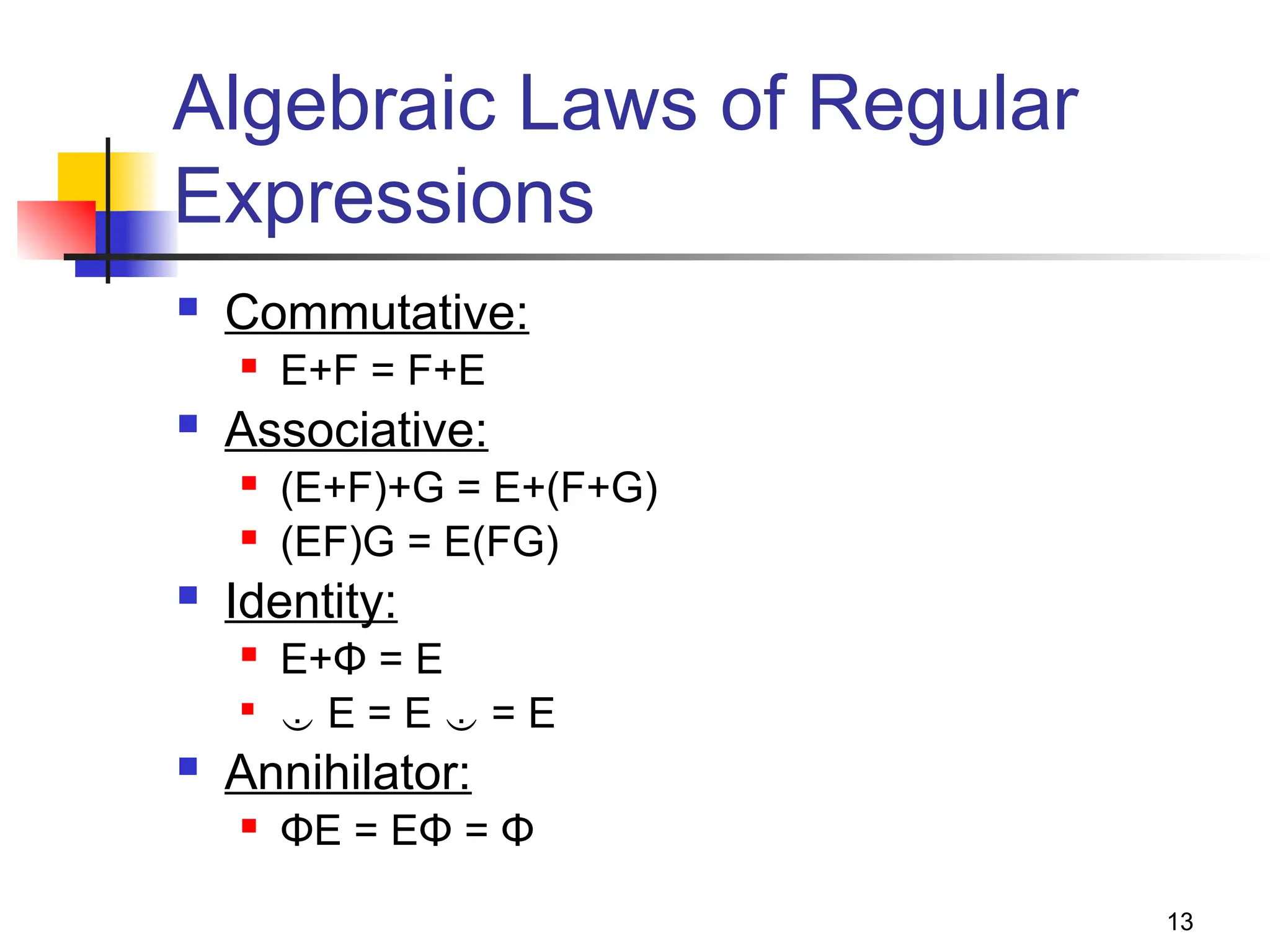
Algebraic Laws of Regular
Expressions
 Commutative:
 E+F = F+E
 Associative:
 (E+F)+G = E+(F+G)
 (EF)G = E(FG)
 Identity:
 E+Φ = E

 E = E  = E
 Annihilator:
 ΦE = EΦ = Φ
14
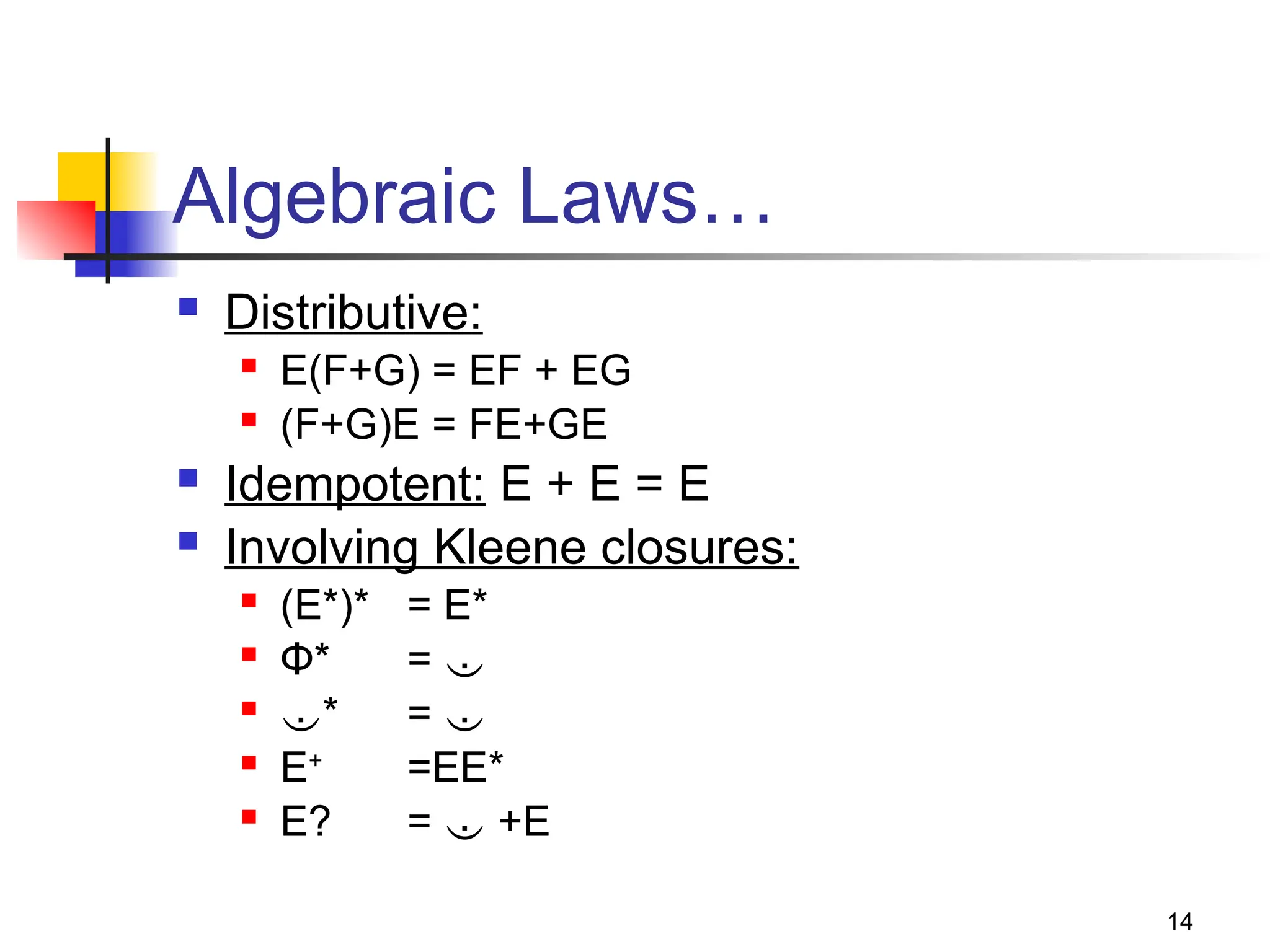
Algebraic Laws…
 Distributive:
 E(F+G) = EF + EG
 (F+G)E = FE+GE
 Idempotent: E + E = E
 Involving Kleene closures:
 (E*)* = E*
 Φ* = 
 * = 
 E+
=EE*
 E? =  +E
15
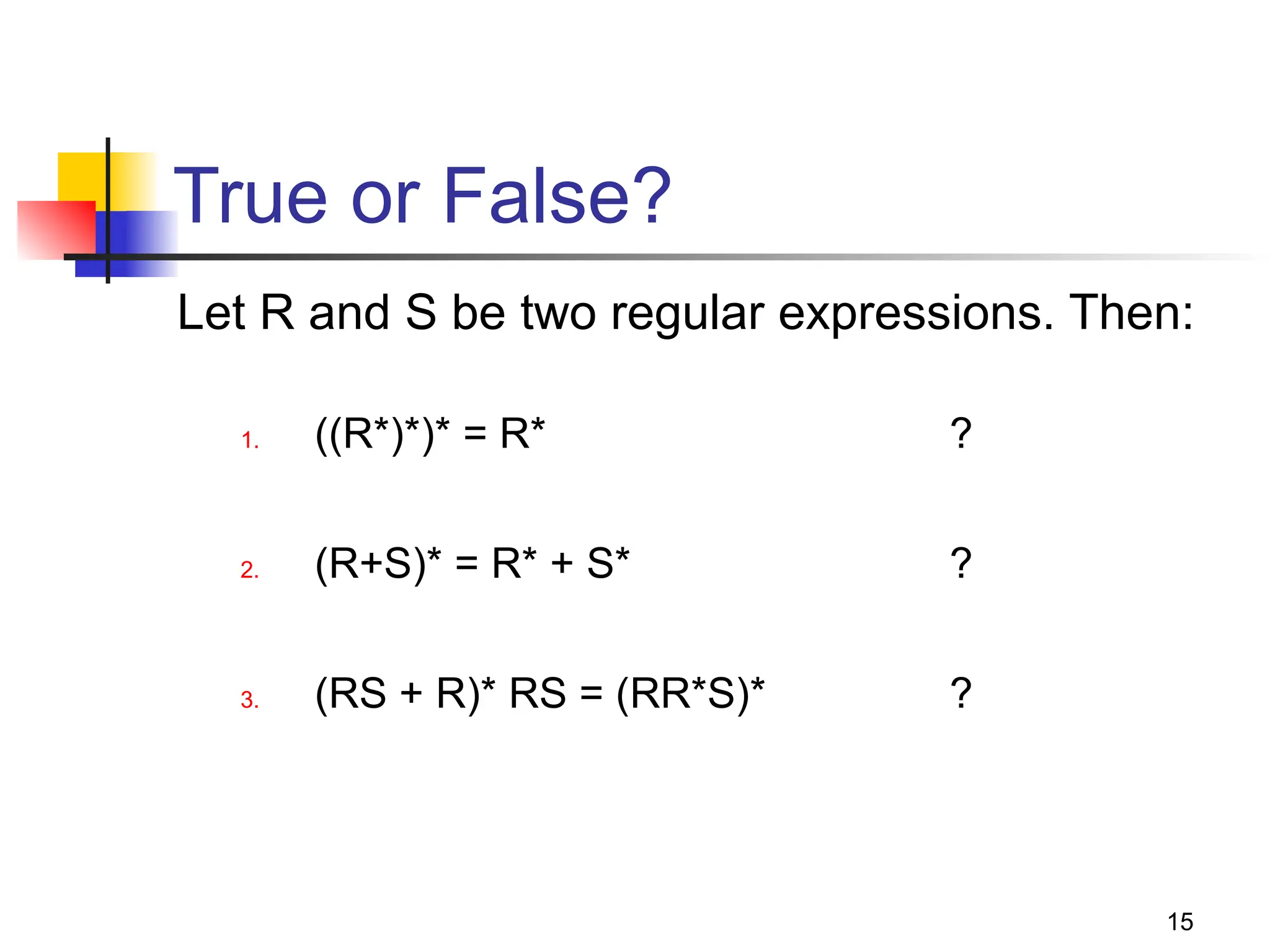
True or False?
Let R and S be two regular expressions. Then:
1. ((R*)*)* = R* ?
2. (R+S)* = R* + S* ?
3. (RS + R)* RS = (RR*S)* ?
16
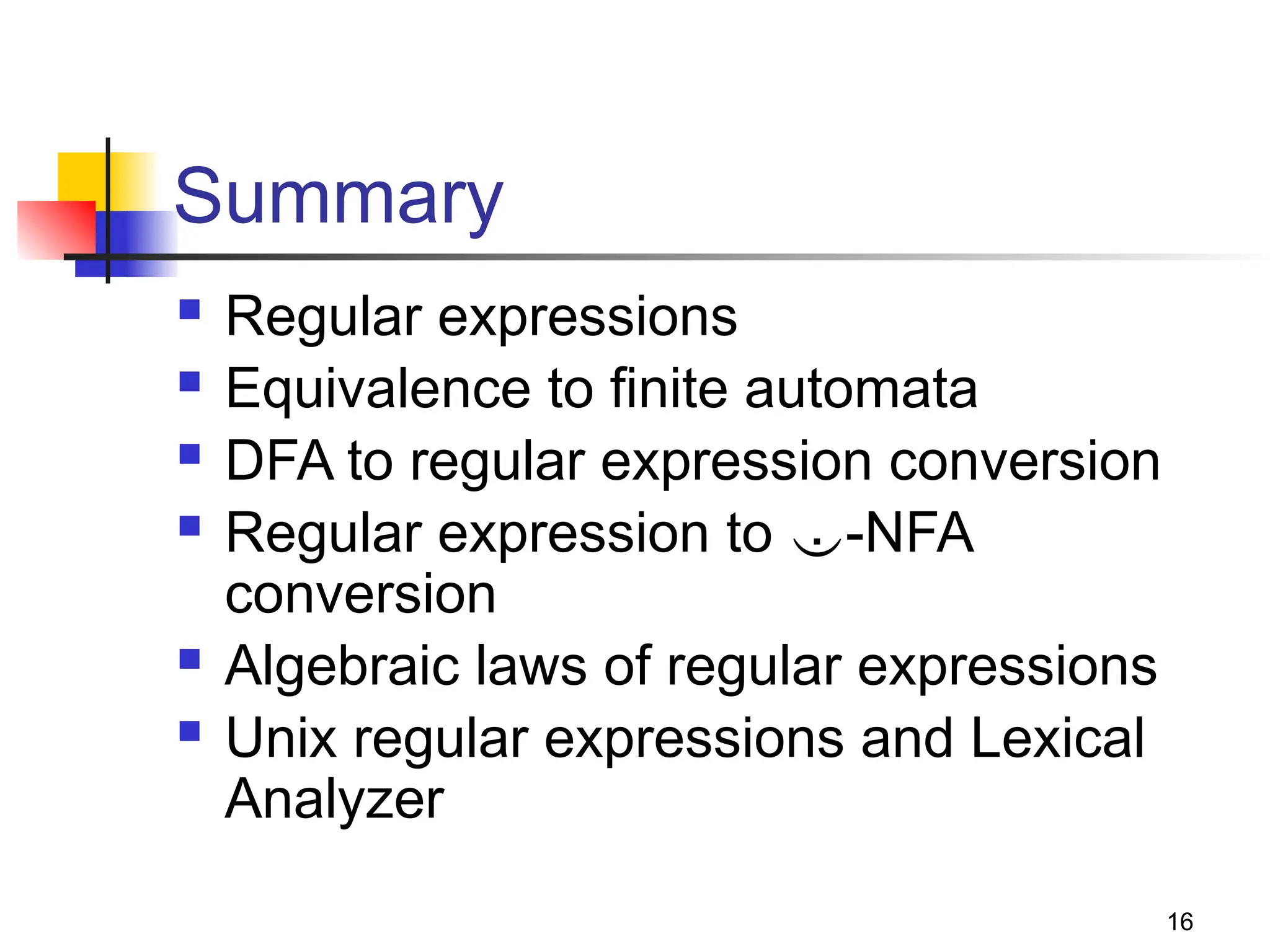
Summary
 Regular expressions
 Equivalence to finite automata
 DFA to regular expression conversion
 Regular expression to -NFA
conversion
 Algebraic laws of regular expressions
 Unix regular expressions and Lexical
Analyzer

AUTOMATA AUTOMATA Automata4Chapter3.pptx

  • 1.
  • 2.
    2 Regular Expressions vs.Finite Automata  Offers a declarative way to express the pattern of any string we want to accept  E.g., 01*+ 10*  Automata => more machine-like < input: string , output: [accept/reject] >  Regular expressions => more program syntax-like  Unix environments heavily use regular expressions  E.g., bash shell, grep, vi & other editors, sed  Perl scripting – good for string processing  Lexical analyzers such as Lex or Flex
  • 3.
    3 Regular Expressions Regular expressions Finite Automata (DFA,NFA, -NFA) Regular Languages = Automata/machines Syntactical expressions Formal language classes
  • 4.
    4 Language Operators  Unionof two languages:  L U M = all strings that are either in L or M  Note: A union of two languages produces a third language  Concatenation of two languages:  L . M = all strings that are of the form xy s.t., x  L and y  M  The dot operator is usually omitted  i.e., LM is same as L.M
  • 5.
    5 Kleene Closure (the* operator)  Kleene Closure of a given language L:  L0 = {}  L1 = {w | for some w  L}  L2 = { w1w2 | w1  L, w2  L (duplicates allowed)}  Li = { w1w2…wi | all w’s chosen are  L (duplicates allowed)}  (Note: the choice of each wi is independent)  L* = Ui≥0 Li (arbitrary number of concatenations) Example:  Let L = { 1, 00}  L0 = {}  L1 = {1,00}  L2 = {11,100,001,0000}  L3 = {111,1100,1001,10000,000000,00001,00100,0011}  L* = L0 U L1 U L2 U … “i” here refers to how many strings to concatenate from the parent language L to produce strings in the language Li
  • 6.
    6 Kleene Closure (specialnotes)  L* is an infinite set iff |L|≥1 and L≠{}  If L={}, then L* = {}  If L = Φ, then L* = {} Σ* denotes the set of all words over an alphabet Σ  Therefore, an abbreviated way of saying there is an arbitrary language L over an alphabet Σ is:  L  Σ* Why? Why? Why?
  • 7.
    7 Building Regular Expressions Let E be a regular expression and the language represented by E is L(E)  Then:  (E) = E  L(E + F) = L(E) U L(F)  L(E F) = L(E) L(F)  L(E*) = (L(E))*
  • 8.
    8 Example: how touse these regular expression properties and language operators?  L = { w | w is a binary string which does not contain two consecutive 0s or two consecutive 1s anywhere)  E.g., w = 01010101 is in L, while w = 10010 is not in L  Goal: Build a regular expression for L  Four cases for w:  Case A: w starts with 0 and |w| is even  Case B: w starts with 1 and |w| is even  Case C: w starts with 0 and |w| is odd  Case D: w starts with 1 and |w| is odd  Regular expression for the four cases:  Case A: (01)*  Case B: (10)*  Case C: 0(10)*  Case D: 1(01)*  Since L is the union of all 4 cases:  Reg Exp for L = (01)* + (10)* + 0(10)* + 1(01)*  If we introduce  then the regular expression can be simplified to:  Reg Exp for L = ( +1)(01)*( +0)
  • 9.
    9 Precedence of Operators Highest to lowest  * operator (star)  . (concatenation)  + operator  Example:  01* + 1 = ( 0 . ((1)*) ) + 1
  • 10.
    10 Finite Automata (FA)& Regular Expressions (Reg Ex)  To show that they are interchangeable, consider the following theorems:  Theorem 1: For every DFA A there exists a regular expression R such that L(R)=L(A)  Theorem 2: For every regular expression R there exists an  -NFA E such that L(E)=L(R)  -NFA NFA DFA Reg Ex Theorem 2 Theorem 1 Proofs in the book Kleene Theorem
  • 11.
    11 DFA to REconstruction Reg Ex DFA Theorem 1 Example: q0 q1 q2 0 1 1 0 0,1 (1*) 0 (0*) 1 (0 + 1)* Informally, trace all distinct paths (traversing cycles only once) from the start state to each of the final states and enumerate all the expressions along the way 1*00*1(0+1)* 00* 1* 1 (0+1)* Q) What is the language?
  • 12.
    12 RE to -NFAconstruction  -NFA Reg Ex Theorem 2 Example: (0+1)*01(0+1)* 0 1        0 1 0 1       (0+1)* 01 (0+1)*
  • 13.
    13 Algebraic Laws ofRegular Expressions  Commutative:  E+F = F+E  Associative:  (E+F)+G = E+(F+G)  (EF)G = E(FG)  Identity:  E+Φ = E   E = E  = E  Annihilator:  ΦE = EΦ = Φ
  • 14.
    14 Algebraic Laws…  Distributive: E(F+G) = EF + EG  (F+G)E = FE+GE  Idempotent: E + E = E  Involving Kleene closures:  (E*)* = E*  Φ* =   * =   E+ =EE*  E? =  +E
  • 15.
    15 True or False? LetR and S be two regular expressions. Then: 1. ((R*)*)* = R* ? 2. (R+S)* = R* + S* ? 3. (RS + R)* RS = (RR*S)* ?
  • 16.
    16 Summary  Regular expressions Equivalence to finite automata  DFA to regular expression conversion  Regular expression to -NFA conversion  Algebraic laws of regular expressions  Unix regular expressions and Lexical Analyzer