Active Content-Based
Crowdsourcing Task
Selection
Piyush Bansal, Carsten Eickhoff, Thomas Hofmann
ETH Zurich
1
Outline
● Past work
○ Exploiting Document content for vote aggregation
● Ongoing extensions
○ Crowdsourcing in extreme budget constraints.
○ Information theoretic approaches
○ Experiments and results
○ Conclusion
2
State of the Art
● Crowdsourced relevance assessment cheap and effective
● Quality control via redundancy yields strong performance
● Untapped source of information: document content
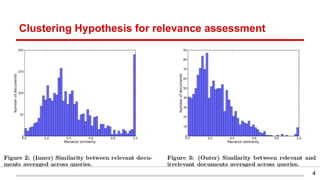
● Key idea: Locality of relevance
Davtyan et al. 2015: Exploiting Document Content for Efficient Aggregation of Crowdsourcing Votes
3
●
Clustering Hypothesis for relevance assessment
4
Methods
● (informal) Problem statement: Given a set of relevance assessments,
how accurately can we infer the relevance of unjudged Web pages?
○ Solution ideas:
■ Assign same relevance assessment label as nearest neighbor.
■ Borrow relevance assessments from <n> nearest neighbors and
then assign the majority label.
■ Smooth expected relevance across similarity space (KDE, GPs)
○ Baseline:
■ Majority Voting for label aggregation, and coin toss for unjudged
Web pages.
5
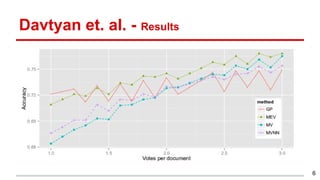
Davtyan et. al. - Results
6
Motivation for our work
Consider the task of search relevance assessment
● Extremely budget-constrained scenario
● Can only ask humans to rate a few Web pages per query
● In previous figure: Number of votes < 1
7
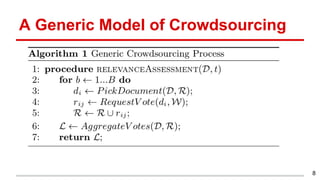
A Generic Model of Crowdsourcing
8
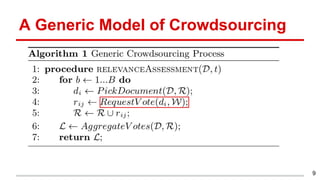
A Generic Model of Crowdsourcing
9
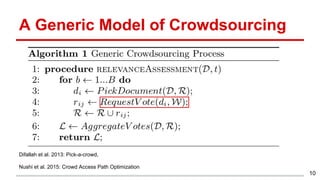
A Generic Model of Crowdsourcing
Difallah et al. 2013: Pick-a-crowd,
Nushi et al. 2015: Crowd Access Path Optimization
10
A Generic Model of Crowdsourcing
11
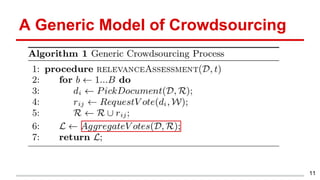
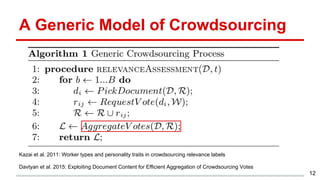
A Generic Model of Crowdsourcing
12
Kazai et al. 2011: Worker types and personality traits in crowdsourcing relevance labels
Davtyan et al. 2015: Exploiting Document Content for Efficient Aggregation of Crowdsourcing Votes
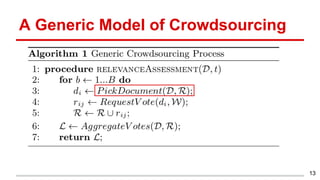
A Generic Model of Crowdsourcing
13
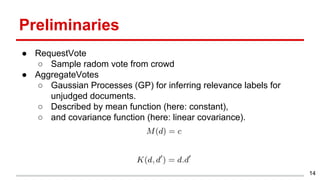
Preliminaries
● RequestVote
○ Sample radom vote from crowd
● AggregateVotes
○ Gaussian Processes (GP) for inferring relevance labels for
unjudged documents.
○ Described by mean function (here: constant),
○ and covariance function (here: linear covariance).
14
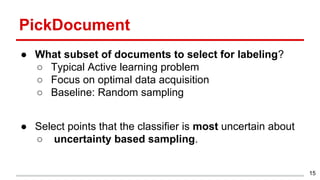
PickDocument
● What subset of documents to select for labeling?
○ Typical Active learning problem
○ Focus on optimal data acquisition
○ Baseline: Random sampling
● Select points that the classifier is most uncertain about
○ uncertainty based sampling.
15
Solution
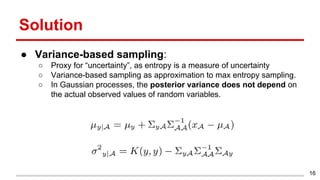
● Variance-based sampling:
○ Proxy for “uncertainty”, as entropy is a measure of uncertainty
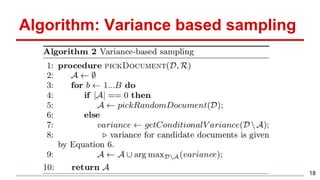
○ Variance-based sampling as approximation to max entropy sampling.
○ In Gaussian processes, the posterior variance does not depend on
the actual observed values of random variables.
16
Solution
● Selecting points that maximise variance is NP complete2
● However, this criterion is “submodular"
○ Submodularity (informally): In mathematics, a submodular set function (also
known as a submodular function) is a set function whose value, informally, has the
property that the difference in the incremental value of the function that a single element
makes when added to an input set decreases as the size of the input set increases.
○ However, due to Nemhauser (1978), an approximate solution (1 - 1/e)
OPT to this is achieved via a greedy algorithm.
2 Krause et al. 2008: Near-optimal sensor placements in Gaussian processes
3 Nemhauser et al. 1978: An analysis of approximations for maximizing submodular set functions
17
Algorithm: Variance based sampling
18
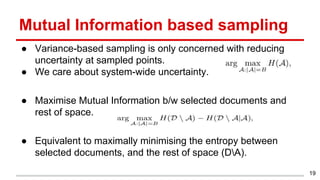
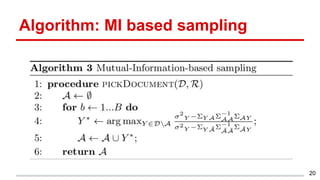
Mutual Information based sampling
● Variance-based sampling is only concerned with reducing
uncertainty at sampled points.
● We care about system-wide uncertainty.
● Maximise Mutual Information b/w selected documents and
rest of space.
● Equivalent to maximally minimising the entropy between
selected documents, and the rest of space (DA).
19
Algorithm: MI based sampling
20
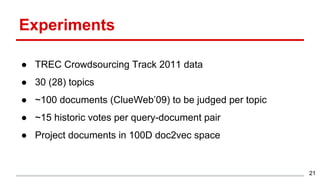
Experiments
● TREC Crowdsourcing Track 2011 data
● 30 (28) topics
● ~100 documents (ClueWeb’09) to be judged per topic
● ~15 historic votes per query-document pair
● Project documents in 100D doc2vec space
21
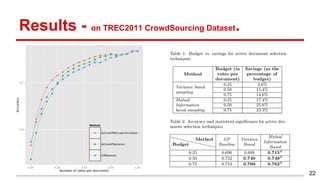
Results - on TREC2011 CrowdSourcing Dataset.
22
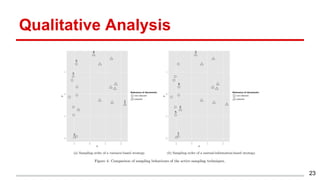
Qualitative Analysis
23
Conclusions
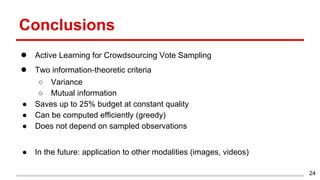
● Active Learning for Crowdsourcing Vote Sampling
● Two information-theoretic criteria
○ Variance
○ Mutual information
● Saves up to 25% budget at constant quality
● Can be computed efficiently (greedy)
● Does not depend on sampled observations
● In the future: application to other modalities (images, videos)
24
Thank you!
Questions?
25

Active Content-Based Crowdsourcing Task Selection

  • 1.
    Active Content-Based Crowdsourcing Task Selection PiyushBansal, Carsten Eickhoff, Thomas Hofmann ETH Zurich 1
  • 2.
    Outline ● Past work ○Exploiting Document content for vote aggregation ● Ongoing extensions ○ Crowdsourcing in extreme budget constraints. ○ Information theoretic approaches ○ Experiments and results ○ Conclusion 2
  • 3.
    State of theArt ● Crowdsourced relevance assessment cheap and effective ● Quality control via redundancy yields strong performance ● Untapped source of information: document content ● Key idea: Locality of relevance Davtyan et al. 2015: Exploiting Document Content for Efficient Aggregation of Crowdsourcing Votes 3
  • 4.
    ● Clustering Hypothesis forrelevance assessment 4
  • 5.
    Methods ● (informal) Problemstatement: Given a set of relevance assessments, how accurately can we infer the relevance of unjudged Web pages? ○ Solution ideas: ■ Assign same relevance assessment label as nearest neighbor. ■ Borrow relevance assessments from <n> nearest neighbors and then assign the majority label. ■ Smooth expected relevance across similarity space (KDE, GPs) ○ Baseline: ■ Majority Voting for label aggregation, and coin toss for unjudged Web pages. 5
  • 6.
    Davtyan et. al.- Results 6
  • 7.
    Motivation for ourwork Consider the task of search relevance assessment ● Extremely budget-constrained scenario ● Can only ask humans to rate a few Web pages per query ● In previous figure: Number of votes < 1 7
  • 8.
    A Generic Modelof Crowdsourcing 8
  • 9.
    A Generic Modelof Crowdsourcing 9
  • 10.
    A Generic Modelof Crowdsourcing Difallah et al. 2013: Pick-a-crowd, Nushi et al. 2015: Crowd Access Path Optimization 10
  • 11.
    A Generic Modelof Crowdsourcing 11
  • 12.
    A Generic Modelof Crowdsourcing 12 Kazai et al. 2011: Worker types and personality traits in crowdsourcing relevance labels Davtyan et al. 2015: Exploiting Document Content for Efficient Aggregation of Crowdsourcing Votes
  • 13.
    A Generic Modelof Crowdsourcing 13
  • 14.
    Preliminaries ● RequestVote ○ Sampleradom vote from crowd ● AggregateVotes ○ Gaussian Processes (GP) for inferring relevance labels for unjudged documents. ○ Described by mean function (here: constant), ○ and covariance function (here: linear covariance). 14
  • 15.
    PickDocument ● What subsetof documents to select for labeling? ○ Typical Active learning problem ○ Focus on optimal data acquisition ○ Baseline: Random sampling ● Select points that the classifier is most uncertain about ○ uncertainty based sampling. 15
  • 16.
    Solution ● Variance-based sampling: ○Proxy for “uncertainty”, as entropy is a measure of uncertainty ○ Variance-based sampling as approximation to max entropy sampling. ○ In Gaussian processes, the posterior variance does not depend on the actual observed values of random variables. 16
  • 17.
    Solution ● Selecting pointsthat maximise variance is NP complete2 ● However, this criterion is “submodular" ○ Submodularity (informally): In mathematics, a submodular set function (also known as a submodular function) is a set function whose value, informally, has the property that the difference in the incremental value of the function that a single element makes when added to an input set decreases as the size of the input set increases. ○ However, due to Nemhauser (1978), an approximate solution (1 - 1/e) OPT to this is achieved via a greedy algorithm. 2 Krause et al. 2008: Near-optimal sensor placements in Gaussian processes 3 Nemhauser et al. 1978: An analysis of approximations for maximizing submodular set functions 17
  • 18.
  • 19.
    Mutual Information basedsampling ● Variance-based sampling is only concerned with reducing uncertainty at sampled points. ● We care about system-wide uncertainty. ● Maximise Mutual Information b/w selected documents and rest of space. ● Equivalent to maximally minimising the entropy between selected documents, and the rest of space (DA). 19
  • 20.
  • 21.
    Experiments ● TREC CrowdsourcingTrack 2011 data ● 30 (28) topics ● ~100 documents (ClueWeb’09) to be judged per topic ● ~15 historic votes per query-document pair ● Project documents in 100D doc2vec space 21
  • 22.
    Results - onTREC2011 CrowdSourcing Dataset. 22
  • 23.
  • 24.
    Conclusions ● Active Learningfor Crowdsourcing Vote Sampling ● Two information-theoretic criteria ○ Variance ○ Mutual information ● Saves up to 25% budget at constant quality ● Can be computed efficiently (greedy) ● Does not depend on sampled observations ● In the future: application to other modalities (images, videos) 24
  • 25.