Fast Deterministic Algorithms
                            for Matrix Completion Problems


                                          Tasuku Soma

                             Research Institute for Mathematical Sciences,
                                              Kyoto Univ.


Tasuku Soma (Kyoto Univ.)             Fast Matrix Completion Algorithms      1 / 29
1   Introduction

2   Matrix Completion by Rank-One Matrices

3   Application to Network Coding

4   Mixed Skew-Symmetric Matrix Completion

5   Skew-Symmetric Matrix Completion by Rank-Two Skew-Symmetric
    Matrices

6   Conclusion


    Tasuku Soma (Kyoto Univ.)   Fast Matrix Completion Algorithms   2 / 29
1   Introduction

2   Matrix Completion by Rank-One Matrices

3   Application to Network Coding

4   Mixed Skew-Symmetric Matrix Completion

5   Skew-Symmetric Matrix Completion by Rank-Two Skew-Symmetric
    Matrices

6   Conclusion


    Tasuku Soma (Kyoto Univ.)   Fast Matrix Completion Algorithms   3 / 29
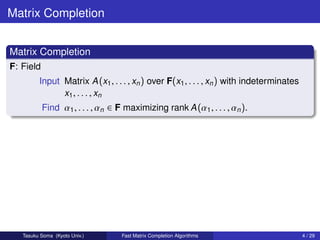
Matrix Completion


Matrix Completion
F: Field
         Input Matrix A (x1 , . . . , xn ) over F(x1 , . . . , xn ) with indeterminates
               x1 , . . . , xn
           Find α1 , . . . , αn ∈ F maximizing rank A (α1 , . . . , αn ).


   Tasuku Soma (Kyoto Univ.)       Fast Matrix Completion Algorithms                      4 / 29
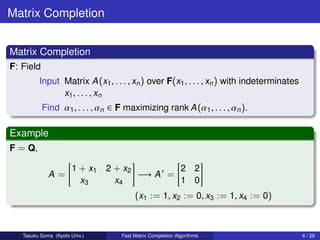
Matrix Completion


Matrix Completion
F: Field
         Input Matrix A (x1 , . . . , xn ) over F(x1 , . . . , xn ) with indeterminates
               x1 , . . . , xn
           Find α1 , . . . , αn ∈ F maximizing rank A (α1 , . . . , αn ).

Example
F = Q,

                      1 + x1   2 + x2        2 2
             A=                       −→ A =
                        x3       x4          1 0
                                        (x1 := 1, x2 := 0, x3 := 1, x4 := 0)


   Tasuku Soma (Kyoto Univ.)       Fast Matrix Completion Algorithms                      4 / 29
Backgrounds

A variety of combinatorial optimization problems can be formulated by
matrices with indeterminates:
     Maximum matching,
     Structural rigidity,
     Network coding, etc.


   Tasuku Soma (Kyoto Univ.)   Fast Matrix Completion Algorithms        5 / 29
Backgrounds

A variety of combinatorial optimization problems can be formulated by
matrices with indeterminates:
     Maximum matching,
     Structural rigidity,
     Network coding, etc.


Previous Works
     Matrix completion for general matrices is solvable in polynomial time
     by a randomized algorithm if the field is sufficiently large.
     Deterministic algorithms are known only for special matrices
     (cf. polynomial identity testing)
     NP hard over a general field.


   Tasuku Soma (Kyoto Univ.)   Fast Matrix Completion Algorithms         5 / 29
Our Results


Our Results
Deterministic polynomial time algorithms for the following matrix
completion problems:
     Matrix completion by rank-one matrices
                               — a faster algorithm than the previous one
     Mixed skew-symmetric matrix completion
                     — the first deterministic polynomial time algorithm
     Skew-symmetric matrix completion by
     rank-two skew-symmetric matrices
                      — the first deterministic polynomial time algorithm


   Tasuku Soma (Kyoto Univ.)   Fast Matrix Completion Algorithms       6 / 29
Our Results


Our Results
Deterministic polynomial time algorithms for the following matrix
completion problems:
     Matrix completion by rank-one matrices
                               — a faster algorithm than the previous one
     Mixed skew-symmetric matrix completion
                     — the first deterministic polynomial time algorithm
     Skew-symmetric matrix completion by
     rank-two skew-symmetric matrices
                      — the first deterministic polynomial time algorithm


They are working over an arbitrary field!


   Tasuku Soma (Kyoto Univ.)   Fast Matrix Completion Algorithms       6 / 29
1   Introduction

2   Matrix Completion by Rank-One Matrices

3   Application to Network Coding

4   Mixed Skew-Symmetric Matrix Completion

5   Skew-Symmetric Matrix Completion by Rank-Two Skew-Symmetric
    Matrices

6   Conclusion


    Tasuku Soma (Kyoto Univ.)   Fast Matrix Completion Algorithms   7 / 29
Problem Definition


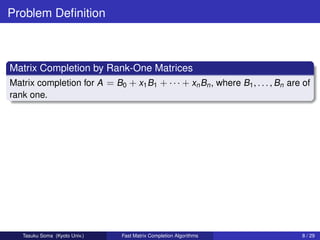
Matrix Completion by Rank-One Matrices
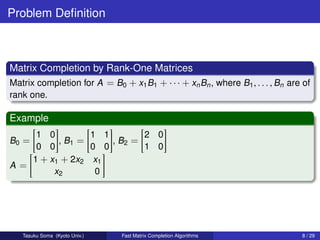
Matrix completion for A = B0 + x1 B1 + · · · + xn Bn , where B1 , . . . , Bn are of
rank one.


   Tasuku Soma (Kyoto Univ.)   Fast Matrix Completion Algorithms                8 / 29
Problem Definition


Matrix Completion by Rank-One Matrices
Matrix completion for A = B0 + x1 B1 + · · · + xn Bn , where B1 , . . . , Bn are of
rank one.

Example
    1 0         1 1        2 0
B0 =     , B1 =     , B2 =
    0 0         0 0        1 0
   1 + x1 + 2x2 x1
A=
        x2       0


   Tasuku Soma (Kyoto Univ.)   Fast Matrix Completion Algorithms                8 / 29
Previous Works

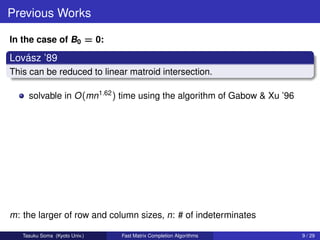
In the case of B0 = 0:

   ´
Lovasz ’89
This can be reduced to linear matroid intersection.

     solvable in O (mn1.62 ) time using the algorithm of Gabow & Xu ’96


m: the larger of row and column sizes, n: # of indeterminates

   Tasuku Soma (Kyoto Univ.)   Fast Matrix Completion Algorithms          9 / 29
Previous Works

In the case of B0 = 0:

   ´
Lovasz ’89
This can be reduced to linear matroid intersection.

     solvable in O (mn1.62 ) time using the algorithm of Gabow & Xu ’96

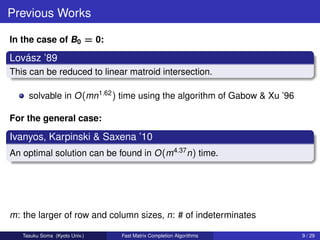
For the general case:

Ivanyos, Karpinski & Saxena ’10
An optimal solution can be found in O (m4.37 n) time.


m: the larger of row and column sizes, n: # of indeterminates

   Tasuku Soma (Kyoto Univ.)   Fast Matrix Completion Algorithms          9 / 29
Previous Works

In the case of B0 = 0:

   ´
Lovasz ’89
This can be reduced to linear matroid intersection.

     solvable in O (mn1.62 ) time using the algorithm of Gabow & Xu ’96

For the general case:

Ivanyos, Karpinski & Saxena ’10
An optimal solution can be found in O (m4.37 n) time.

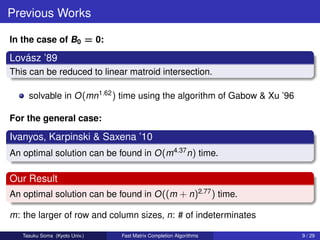
Our Result
An optimal solution can be found in O ((m + n)2.77 ) time.

m: the larger of row and column sizes, n: # of indeterminates

   Tasuku Soma (Kyoto Univ.)   Fast Matrix Completion Algorithms          9 / 29
Idea

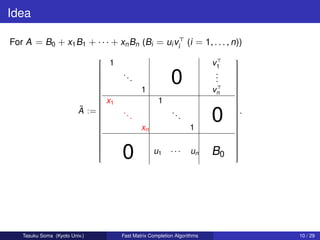
For A = B0 + x1 B1 + · · · + xn Bn (Bi = ui vi (i = 1, . . . , n))

                               1                                        v1
                                                                             
                                                                              
                                     ..                                   .
                                                                             
                                                          0               .
                              
                                                                             
                                                                              
                                          .                               .
                              
                              
                                                                             
                                                                              
                                                                              
                              
                              
                                                                             
                                                                              
                                                                              
                                                                             
                              
                              
                              
                                             1                          vn   
                                                                              
                                                                              
                                                                              
                              
                               x1                                            
                                                    1
                              
                                                                             
                                                                              
                                                                              
                                                                             
                         ˜ :=       ..                   ..                  .
                                                                             
                         A
                                                                         0
                                                                             
                                          .                    .
                              
                              
                                                                             
                                                                              
                                                                              
                              
                              
                                                                             
                                                                              
                                                                              
                                              xn                   1
                              
                              
                                                                             
                                                                              
                                                                              
                              
                              
                                                                             
                                                                              
                                                                              
                              
                              
                                                                             
                                                                              
                                                                              
                                                                             
                                     0
                                                                             
                                                                         B0
                                                                             
                                                   u1     ···      un
                              
                              
                                                                             
                                                                              
                                                                              
                                                                             


   Tasuku Soma (Kyoto Univ.)         Fast Matrix Completion Algorithms             10 / 29
Idea

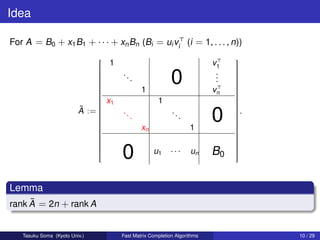
For A = B0 + x1 B1 + · · · + xn Bn (Bi = ui vi (i = 1, . . . , n))

                               1                                        v1
                                                                             
                                                                              
                                     ..                                   .
                                                                             
                                                          0               .
                              
                                                                             
                                                                              
                                          .                               .
                              
                              
                                                                             
                                                                              
                                                                              
                              
                              
                                                                             
                                                                              
                                                                              
                                                                             
                              
                              
                              
                                             1                          vn   
                                                                              
                                                                              
                                                                              
                              
                               x1                                            
                                                    1
                              
                                                                             
                                                                              
                                                                              
                                                                             
                         ˜ :=       ..                   ..                  .
                                                                             
                         A
                                                                         0
                                                                             
                                          .                    .
                              
                              
                                                                             
                                                                              
                                                                              
                              
                              
                                                                             
                                                                              
                                                                              
                                              xn                   1
                              
                              
                                                                             
                                                                              
                                                                              
                              
                              
                                                                             
                                                                              
                                                                              
                              
                              
                                                                             
                                                                              
                                                                              
                                                                             
                                     0
                                                                             
                                                                         B0
                                                                             
                                                   u1     ···      un
                              
                              
                                                                             
                                                                              
                                                                              
                                                                             


Lemma
     ˜
rank A = 2n + rank A


   Tasuku Soma (Kyoto Univ.)         Fast Matrix Completion Algorithms             10 / 29
Algorithm


                                        ˜ ˜
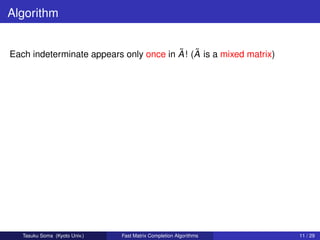
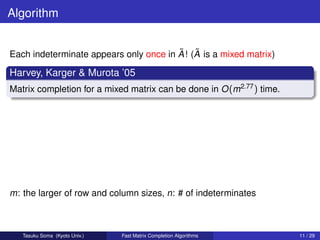
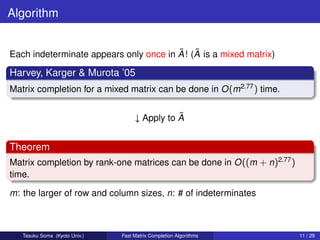
Each indeterminate appears only once in A ! (A is a mixed matrix)


   Tasuku Soma (Kyoto Univ.)   Fast Matrix Completion Algorithms    11 / 29
Algorithm


                                        ˜ ˜
Each indeterminate appears only once in A ! (A is a mixed matrix)

Harvey, Karger & Murota ’05
Matrix completion for a mixed matrix can be done in O (m2.77 ) time.


m: the larger of row and column sizes, n: # of indeterminates


   Tasuku Soma (Kyoto Univ.)   Fast Matrix Completion Algorithms       11 / 29
Algorithm


                                        ˜ ˜
Each indeterminate appears only once in A ! (A is a mixed matrix)

Harvey, Karger & Murota ’05
Matrix completion for a mixed matrix can be done in O (m2.77 ) time.

                                               ˜
                                    ↓ Apply to A


Theorem
Matrix completion by rank-one matrices can be done in O ((m + n)2.77 )
time.

m: the larger of row and column sizes, n: # of indeterminates


   Tasuku Soma (Kyoto Univ.)   Fast Matrix Completion Algorithms         11 / 29
Min-Max Theorem


Theorem
For A = B0 + x1 B1 + · · · + xn Bn ,

           max{rank A : x1 , . . . , xn }
                                     0            [vj : j      J]
               = min rank                                              : J ⊆ {1, . . . , n} .
                               [uj : j ∈ J ]             B0


   Tasuku Soma (Kyoto Univ.)       Fast Matrix Completion Algorithms                            12 / 29
Min-Max Theorem


Theorem
For A = B0 + x1 B1 + · · · + xn Bn ,

           max{rank A : x1 , . . . , xn }
                                      0            [vj : j      J]
               = min rank                                                 : J ⊆ {1, . . . , n} .
                                [uj : j ∈ J ]             B0

                ´
Corollary (Lovasz ’89)
If B0 = 0, then

             max{rank A : x1 , . . . , xn }
                 = min{dim uj : j ∈ J + dim vj : j                      J : J ⊆ {1, . . . , n}}


   Tasuku Soma (Kyoto Univ.)        Fast Matrix Completion Algorithms                              12 / 29
Simultaneous Matrix Completion by Rank-One Matrices


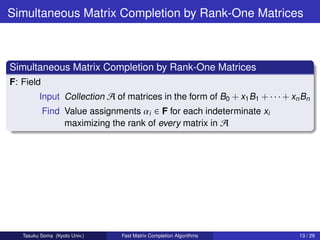
Simultaneous Matrix Completion by Rank-One Matrices
F: Field
         Input Collection A of matrices in the form of B0 + x1 B1 + · · · + xn Bn
           Find Value assignments αi ∈ F for each indeterminate xi
                maximizing the rank of every matrix in A


   Tasuku Soma (Kyoto Univ.)   Fast Matrix Completion Algorithms              13 / 29
Simultaneous Matrix Completion by Rank-One Matrices


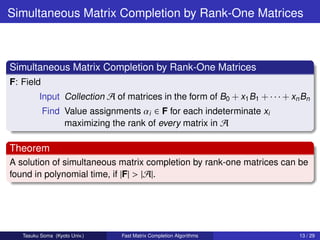
Simultaneous Matrix Completion by Rank-One Matrices
F: Field
         Input Collection A of matrices in the form of B0 + x1 B1 + · · · + xn Bn
           Find Value assignments αi ∈ F for each indeterminate xi
                maximizing the rank of every matrix in A

Theorem
A solution of simultaneous matrix completion by rank-one matrices can be
found in polynomial time, if |F| > |A|.


   Tasuku Soma (Kyoto Univ.)   Fast Matrix Completion Algorithms              13 / 29
1   Introduction

2   Matrix Completion by Rank-One Matrices

3   Application to Network Coding

4   Mixed Skew-Symmetric Matrix Completion

5   Skew-Symmetric Matrix Completion by Rank-Two Skew-Symmetric
    Matrices

6   Conclusion


    Tasuku Soma (Kyoto Univ.)   Fast Matrix Completion Algorithms   14 / 29
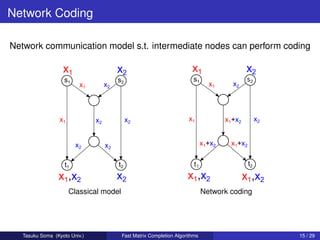
Network Coding

Network communication model s.t. intermediate nodes can perform coding


                     Classical model                                       Network coding


   Tasuku Soma (Kyoto Univ.)           Fast Matrix Completion Algorithms                    15 / 29
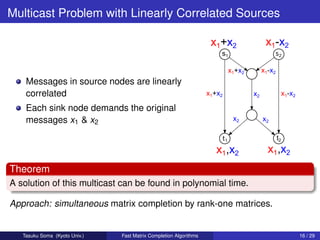
Multicast Problem with Linearly Correlated Sources


    Messages in source nodes are linearly
    correlated
    Each sink node demands the original
    messages x1 & x2


Theorem
A solution of this multicast can be found in polynomial time.

Approach: simultaneous matrix completion by rank-one matrices.


   Tasuku Soma (Kyoto Univ.)   Fast Matrix Completion Algorithms   16 / 29
1   Introduction

2   Matrix Completion by Rank-One Matrices

3   Application to Network Coding

4   Mixed Skew-Symmetric Matrix Completion

5   Skew-Symmetric Matrix Completion by Rank-Two Skew-Symmetric
    Matrices

6   Conclusion


    Tasuku Soma (Kyoto Univ.)   Fast Matrix Completion Algorithms   17 / 29
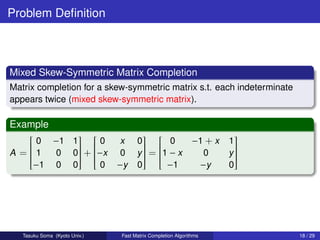
Problem Definition


Mixed Skew-Symmetric Matrix Completion
Matrix completion for a skew-symmetric matrix s.t. each indeterminate
appears twice (mixed skew-symmetric matrix).

Example
                                      
    0 −1 1  0
   
           
                  x 0  0
                         
                                −1 + x 1
                                           
A =1   0 0 + −x 0 y  = 1 − x   0    y
   
           
                       
                                         
                                           
   
   
           
                       
                                         
                                           
    −1 0 0
            
                 0 −y 0
                         
                             −1    −y
                                           
                                         0


   Tasuku Soma (Kyoto Univ.)   Fast Matrix Completion Algorithms        18 / 29
Our Result


There were no algorithms for this problem, but we can compute the rank.

Murota ’03 (←Geelen, Iwata & Murota ’03)
The rank of an m × m mixed skew-symmetric matrix can be computed in
O (m4 ) time.


   Tasuku Soma (Kyoto Univ.)   Fast Matrix Completion Algorithms      19 / 29
Our Result


There were no algorithms for this problem, but we can compute the rank.

Murota ’03 (←Geelen, Iwata & Murota ’03)
The rank of an m × m mixed skew-symmetric matrix can be computed in
O (m4 ) time.

Our Result
Matrix completion for an m × m mixed skew-symmetric matrix can be done
in O (m4 ) time.


   Tasuku Soma (Kyoto Univ.)   Fast Matrix Completion Algorithms      19 / 29
Rank of Mixed Skew-Symmetric Matrix


Lemma (Murota ’03)
For an m × m mixed skew-symmetric matrix A = Q + T
(Q: constant part, T : indeterminates part),

        rank A = max |FQ       FT | : both Q [FQ ], T [FT ] are nonsingular


    RHS is linear delta-covering.
    Optimal FQ and FT can be found in O (m4 )
    time (Geelen, Iwata & Murota ’03).


   Tasuku Soma (Kyoto Univ.)   Fast Matrix Completion Algorithms              20 / 29
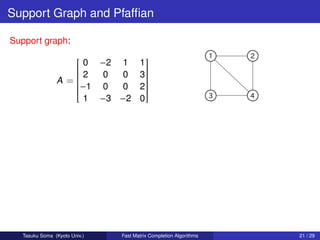
Support Graph and Pfaffian

Support graph:

                    0 −2 1
                                        
                                     1
                   
                   2                   
                        0  0          3
                   
                                       
                                        
                A =
                                       
                                        
                   −1 0
                   
                   
                   
                          0          2
                                        
                                        
                                        
                                        
                                       
                     1 −3 −2          0


   Tasuku Soma (Kyoto Univ.)   Fast Matrix Completion Algorithms   21 / 29
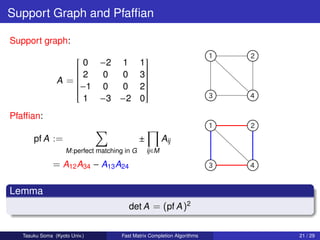
Support Graph and Pfaffian

Support graph:

                    0 −2 1
                                               
                                              1
                   
                   2                            
                        0  0                   3
                   
                                                
                                                 
                A =
                                                
                                                 
                   −1 0
                   
                   
                   
                          0                   2
                                                 
                                                 
                                                 
                                                 
                                                
                     1 −3 −2                   0
Pfaffian:

       pf A :=                                 ±           Aij
                    M :perfect matching in G       ij ∈M

               = A12 A34 − A13 A24

Lemma
                                         det A = (pf A )2


   Tasuku Soma (Kyoto Univ.)          Fast Matrix Completion Algorithms   21 / 29
Sketch of Algorithm


Algorithm
 1: Find an optimal solution FQ and FT for linear delta-covering.
 2: Find a perfect matching M in the support graph of T [FT ].


      Tasuku Soma (Kyoto Univ.)   Fast Matrix Completion Algorithms   22 / 29
Sketch of Algorithm


Algorithm
 1:    Find an optimal solution FQ and FT for linear delta-covering.
 2:    Find a perfect matching M in the support graph of T [FT ].
 3:    for each ij ∈ M do
 4:      Substitute α to Tij so that Q [FQ ∪ {i , j }] will be nonsingular after
         substitution.
 5:      FQ := FQ ∪ {i , j }
 6:    end for


      Tasuku Soma (Kyoto Univ.)   Fast Matrix Completion Algorithms                22 / 29
Sketch of Algorithm


Algorithm
 1:    Find an optimal solution FQ and FT for linear delta-covering.
 2:    Find a perfect matching M in the support graph of T [FT ].
 3:    for each ij ∈ M do
 4:      Substitute α to Tij so that Q [FQ ∪ {i , j }] will be nonsingular after
         substitution.
 5:      FQ := FQ ∪ {i , j }
 6:    end for
 7:    Substitute 0 to the rest of indeterminates
 8:    return the resulting matrix


      Tasuku Soma (Kyoto Univ.)   Fast Matrix Completion Algorithms                22 / 29
Sketch of Algorithm
How can we find α s.t. Q [FQ ∪ {i , j }] will be nonsingular?


                   A =Q +T


   Tasuku Soma (Kyoto Univ.)   Fast Matrix Completion Algorithms   23 / 29
Sketch of Algorithm
How can we find α s.t. Q [FQ ∪ {i , j }] will be nonsingular?


                   A =Q +T                                         A =Q +T


   Tasuku Soma (Kyoto Univ.)   Fast Matrix Completion Algorithms             23 / 29
Sketch of Algorithm
How can we find α s.t. Q [FQ ∪ {i , j }] will be nonsingular?


                   A =Q +T                                               A =Q +T


Lemma
Q : modified matrix of Q as Qij := Qij + α, Qji := Qji − α

                   pf Q [FQ ∪ {i , j }] = pf Q [FQ ∪ {i , j }] ± α · pf Q [FQ ]

   Tasuku Soma (Kyoto Univ.)         Fast Matrix Completion Algorithms             23 / 29
Sketch of Algorithm

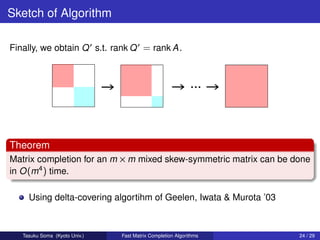
Finally, we obtain Q s.t. rank Q = rank A .


Theorem
Matrix completion for an m × m mixed skew-symmetric matrix can be done
in O (m4 ) time.

     Using delta-covering algortihm of Geelen, Iwata & Murota ’03


   Tasuku Soma (Kyoto Univ.)   Fast Matrix Completion Algorithms    24 / 29
1   Introduction

2   Matrix Completion by Rank-One Matrices

3   Application to Network Coding

4   Mixed Skew-Symmetric Matrix Completion

5   Skew-Symmetric Matrix Completion by Rank-Two Skew-Symmetric
    Matrices

6   Conclusion


    Tasuku Soma (Kyoto Univ.)   Fast Matrix Completion Algorithms   25 / 29
Problem Definition


Skew-Symmetric Matrix Completion by Rank-Two Skew-Symmetric
Matrices
Matrix completion for A = B0 + x1 B1 + · · · + xn Bn ,
where B0 is skew-symmetric and B1 , . . . , Bn are rank-two skew-symmteric


   Tasuku Soma (Kyoto Univ.)   Fast Matrix Completion Algorithms        26 / 29
Our Result

In the case of B0 = 0:

   ´
Lovasz ’89
This can be reduced to linear matroid parity.

     solvable in O (m3 n) time using the algorithm of Gabow & Stallman ’86.


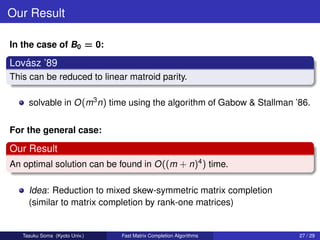
   Tasuku Soma (Kyoto Univ.)   Fast Matrix Completion Algorithms        27 / 29
Our Result

In the case of B0 = 0:

   ´
Lovasz ’89
This can be reduced to linear matroid parity.

     solvable in O (m3 n) time using the algorithm of Gabow & Stallman ’86.


For the general case:

Our Result
An optimal solution can be found in O ((m + n)4 ) time.

     Idea: Reduction to mixed skew-symmetric matrix completion
     (similar to matrix completion by rank-one matrices)


   Tasuku Soma (Kyoto Univ.)   Fast Matrix Completion Algorithms        27 / 29
1   Introduction

2   Matrix Completion by Rank-One Matrices

3   Application to Network Coding

4   Mixed Skew-Symmetric Matrix Completion

5   Skew-Symmetric Matrix Completion by Rank-Two Skew-Symmetric
    Matrices

6   Conclusion


    Tasuku Soma (Kyoto Univ.)   Fast Matrix Completion Algorithms   28 / 29
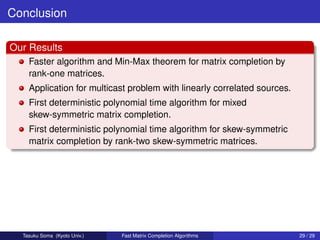
Conclusion

Our Results
    Faster algorithm and Min-Max theorem for matrix completion by
    rank-one matrices.
    Application for multicast problem with linearly correlated sources.
    First deterministic polynomial time algorithm for mixed
    skew-symmetric matrix completion.
    First deterministic polynomial time algorithm for skew-symmetric
    matrix completion by rank-two skew-symmetric matrices.


  Tasuku Soma (Kyoto Univ.)   Fast Matrix Completion Algorithms           29 / 29
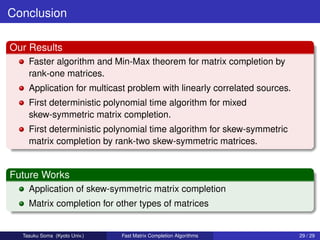
Conclusion

Our Results
    Faster algorithm and Min-Max theorem for matrix completion by
    rank-one matrices.
    Application for multicast problem with linearly correlated sources.
    First deterministic polynomial time algorithm for mixed
    skew-symmetric matrix completion.
    First deterministic polynomial time algorithm for skew-symmetric
    matrix completion by rank-two skew-symmetric matrices.


Future Works
    Application of skew-symmetric matrix completion
    Matrix completion for other types of matrices


  Tasuku Soma (Kyoto Univ.)   Fast Matrix Completion Algorithms           29 / 29

Fast Deterministic Algorithms for Matrix Completion Problems

  • 1.
    Fast Deterministic Algorithms for Matrix Completion Problems Tasuku Soma Research Institute for Mathematical Sciences, Kyoto Univ. Tasuku Soma (Kyoto Univ.) Fast Matrix Completion Algorithms 1 / 29
  • 2.
    1 Introduction 2 Matrix Completion by Rank-One Matrices 3 Application to Network Coding 4 Mixed Skew-Symmetric Matrix Completion 5 Skew-Symmetric Matrix Completion by Rank-Two Skew-Symmetric Matrices 6 Conclusion Tasuku Soma (Kyoto Univ.) Fast Matrix Completion Algorithms 2 / 29
  • 3.
    1 Introduction 2 Matrix Completion by Rank-One Matrices 3 Application to Network Coding 4 Mixed Skew-Symmetric Matrix Completion 5 Skew-Symmetric Matrix Completion by Rank-Two Skew-Symmetric Matrices 6 Conclusion Tasuku Soma (Kyoto Univ.) Fast Matrix Completion Algorithms 3 / 29
  • 4.
    Matrix Completion Matrix Completion F:Field Input Matrix A (x1 , . . . , xn ) over F(x1 , . . . , xn ) with indeterminates x1 , . . . , xn Find α1 , . . . , αn ∈ F maximizing rank A (α1 , . . . , αn ). Tasuku Soma (Kyoto Univ.) Fast Matrix Completion Algorithms 4 / 29
  • 5.
    Matrix Completion Matrix Completion F:Field Input Matrix A (x1 , . . . , xn ) over F(x1 , . . . , xn ) with indeterminates x1 , . . . , xn Find α1 , . . . , αn ∈ F maximizing rank A (α1 , . . . , αn ). Example F = Q, 1 + x1 2 + x2 2 2 A= −→ A = x3 x4 1 0 (x1 := 1, x2 := 0, x3 := 1, x4 := 0) Tasuku Soma (Kyoto Univ.) Fast Matrix Completion Algorithms 4 / 29
  • 6.
    Backgrounds A variety ofcombinatorial optimization problems can be formulated by matrices with indeterminates: Maximum matching, Structural rigidity, Network coding, etc. Tasuku Soma (Kyoto Univ.) Fast Matrix Completion Algorithms 5 / 29
  • 7.
    Backgrounds A variety ofcombinatorial optimization problems can be formulated by matrices with indeterminates: Maximum matching, Structural rigidity, Network coding, etc. Previous Works Matrix completion for general matrices is solvable in polynomial time by a randomized algorithm if the field is sufficiently large. Deterministic algorithms are known only for special matrices (cf. polynomial identity testing) NP hard over a general field. Tasuku Soma (Kyoto Univ.) Fast Matrix Completion Algorithms 5 / 29
  • 8.
    Our Results Our Results Deterministicpolynomial time algorithms for the following matrix completion problems: Matrix completion by rank-one matrices — a faster algorithm than the previous one Mixed skew-symmetric matrix completion — the first deterministic polynomial time algorithm Skew-symmetric matrix completion by rank-two skew-symmetric matrices — the first deterministic polynomial time algorithm Tasuku Soma (Kyoto Univ.) Fast Matrix Completion Algorithms 6 / 29
  • 9.
    Our Results Our Results Deterministicpolynomial time algorithms for the following matrix completion problems: Matrix completion by rank-one matrices — a faster algorithm than the previous one Mixed skew-symmetric matrix completion — the first deterministic polynomial time algorithm Skew-symmetric matrix completion by rank-two skew-symmetric matrices — the first deterministic polynomial time algorithm They are working over an arbitrary field! Tasuku Soma (Kyoto Univ.) Fast Matrix Completion Algorithms 6 / 29
  • 10.
    1 Introduction 2 Matrix Completion by Rank-One Matrices 3 Application to Network Coding 4 Mixed Skew-Symmetric Matrix Completion 5 Skew-Symmetric Matrix Completion by Rank-Two Skew-Symmetric Matrices 6 Conclusion Tasuku Soma (Kyoto Univ.) Fast Matrix Completion Algorithms 7 / 29
  • 11.
    Problem Definition Matrix Completionby Rank-One Matrices Matrix completion for A = B0 + x1 B1 + · · · + xn Bn , where B1 , . . . , Bn are of rank one. Tasuku Soma (Kyoto Univ.) Fast Matrix Completion Algorithms 8 / 29
  • 12.
    Problem Definition Matrix Completionby Rank-One Matrices Matrix completion for A = B0 + x1 B1 + · · · + xn Bn , where B1 , . . . , Bn are of rank one. Example 1 0 1 1 2 0 B0 = , B1 = , B2 = 0 0 0 0 1 0 1 + x1 + 2x2 x1 A= x2 0 Tasuku Soma (Kyoto Univ.) Fast Matrix Completion Algorithms 8 / 29
  • 13.
    Previous Works In thecase of B0 = 0: ´ Lovasz ’89 This can be reduced to linear matroid intersection. solvable in O (mn1.62 ) time using the algorithm of Gabow & Xu ’96 m: the larger of row and column sizes, n: # of indeterminates Tasuku Soma (Kyoto Univ.) Fast Matrix Completion Algorithms 9 / 29
  • 14.
    Previous Works In thecase of B0 = 0: ´ Lovasz ’89 This can be reduced to linear matroid intersection. solvable in O (mn1.62 ) time using the algorithm of Gabow & Xu ’96 For the general case: Ivanyos, Karpinski & Saxena ’10 An optimal solution can be found in O (m4.37 n) time. m: the larger of row and column sizes, n: # of indeterminates Tasuku Soma (Kyoto Univ.) Fast Matrix Completion Algorithms 9 / 29
  • 15.
    Previous Works In thecase of B0 = 0: ´ Lovasz ’89 This can be reduced to linear matroid intersection. solvable in O (mn1.62 ) time using the algorithm of Gabow & Xu ’96 For the general case: Ivanyos, Karpinski & Saxena ’10 An optimal solution can be found in O (m4.37 n) time. Our Result An optimal solution can be found in O ((m + n)2.77 ) time. m: the larger of row and column sizes, n: # of indeterminates Tasuku Soma (Kyoto Univ.) Fast Matrix Completion Algorithms 9 / 29
  • 16.
    Idea For A =B0 + x1 B1 + · · · + xn Bn (Bi = ui vi (i = 1, . . . , n))  1 v1    .. .   0 .     . .                   1 vn       x1  1        ˜ :=  .. .. .   A 0   . .             xn 1                     0   B0   u1 ··· un         Tasuku Soma (Kyoto Univ.) Fast Matrix Completion Algorithms 10 / 29
  • 17.
    Idea For A =B0 + x1 B1 + · · · + xn Bn (Bi = ui vi (i = 1, . . . , n))  1 v1    .. .   0 .     . .                   1 vn       x1  1        ˜ :=  .. .. .   A 0   . .             xn 1                     0   B0   u1 ··· un         Lemma ˜ rank A = 2n + rank A Tasuku Soma (Kyoto Univ.) Fast Matrix Completion Algorithms 10 / 29
  • 18.
    Algorithm ˜ ˜ Each indeterminate appears only once in A ! (A is a mixed matrix) Tasuku Soma (Kyoto Univ.) Fast Matrix Completion Algorithms 11 / 29
  • 19.
    Algorithm ˜ ˜ Each indeterminate appears only once in A ! (A is a mixed matrix) Harvey, Karger & Murota ’05 Matrix completion for a mixed matrix can be done in O (m2.77 ) time. m: the larger of row and column sizes, n: # of indeterminates Tasuku Soma (Kyoto Univ.) Fast Matrix Completion Algorithms 11 / 29
  • 20.
    Algorithm ˜ ˜ Each indeterminate appears only once in A ! (A is a mixed matrix) Harvey, Karger & Murota ’05 Matrix completion for a mixed matrix can be done in O (m2.77 ) time. ˜ ↓ Apply to A Theorem Matrix completion by rank-one matrices can be done in O ((m + n)2.77 ) time. m: the larger of row and column sizes, n: # of indeterminates Tasuku Soma (Kyoto Univ.) Fast Matrix Completion Algorithms 11 / 29
  • 21.
    Min-Max Theorem Theorem For A= B0 + x1 B1 + · · · + xn Bn , max{rank A : x1 , . . . , xn } 0 [vj : j J] = min rank : J ⊆ {1, . . . , n} . [uj : j ∈ J ] B0 Tasuku Soma (Kyoto Univ.) Fast Matrix Completion Algorithms 12 / 29
  • 22.
    Min-Max Theorem Theorem For A= B0 + x1 B1 + · · · + xn Bn , max{rank A : x1 , . . . , xn } 0 [vj : j J] = min rank : J ⊆ {1, . . . , n} . [uj : j ∈ J ] B0 ´ Corollary (Lovasz ’89) If B0 = 0, then max{rank A : x1 , . . . , xn } = min{dim uj : j ∈ J + dim vj : j J : J ⊆ {1, . . . , n}} Tasuku Soma (Kyoto Univ.) Fast Matrix Completion Algorithms 12 / 29
  • 23.
    Simultaneous Matrix Completionby Rank-One Matrices Simultaneous Matrix Completion by Rank-One Matrices F: Field Input Collection A of matrices in the form of B0 + x1 B1 + · · · + xn Bn Find Value assignments αi ∈ F for each indeterminate xi maximizing the rank of every matrix in A Tasuku Soma (Kyoto Univ.) Fast Matrix Completion Algorithms 13 / 29
  • 24.
    Simultaneous Matrix Completionby Rank-One Matrices Simultaneous Matrix Completion by Rank-One Matrices F: Field Input Collection A of matrices in the form of B0 + x1 B1 + · · · + xn Bn Find Value assignments αi ∈ F for each indeterminate xi maximizing the rank of every matrix in A Theorem A solution of simultaneous matrix completion by rank-one matrices can be found in polynomial time, if |F| > |A|. Tasuku Soma (Kyoto Univ.) Fast Matrix Completion Algorithms 13 / 29
  • 25.
    1 Introduction 2 Matrix Completion by Rank-One Matrices 3 Application to Network Coding 4 Mixed Skew-Symmetric Matrix Completion 5 Skew-Symmetric Matrix Completion by Rank-Two Skew-Symmetric Matrices 6 Conclusion Tasuku Soma (Kyoto Univ.) Fast Matrix Completion Algorithms 14 / 29
  • 26.
    Network Coding Network communicationmodel s.t. intermediate nodes can perform coding Classical model Network coding Tasuku Soma (Kyoto Univ.) Fast Matrix Completion Algorithms 15 / 29
  • 27.
    Multicast Problem withLinearly Correlated Sources Messages in source nodes are linearly correlated Each sink node demands the original messages x1 & x2 Theorem A solution of this multicast can be found in polynomial time. Approach: simultaneous matrix completion by rank-one matrices. Tasuku Soma (Kyoto Univ.) Fast Matrix Completion Algorithms 16 / 29
  • 28.
    1 Introduction 2 Matrix Completion by Rank-One Matrices 3 Application to Network Coding 4 Mixed Skew-Symmetric Matrix Completion 5 Skew-Symmetric Matrix Completion by Rank-Two Skew-Symmetric Matrices 6 Conclusion Tasuku Soma (Kyoto Univ.) Fast Matrix Completion Algorithms 17 / 29
  • 29.
    Problem Definition Mixed Skew-SymmetricMatrix Completion Matrix completion for a skew-symmetric matrix s.t. each indeterminate appears twice (mixed skew-symmetric matrix). Example        0 −1 1  0       x 0  0     −1 + x 1  A =1 0 0 + −x 0 y  = 1 − x 0 y                          −1 0 0   0 −y 0   −1 −y  0 Tasuku Soma (Kyoto Univ.) Fast Matrix Completion Algorithms 18 / 29
  • 30.
    Our Result There wereno algorithms for this problem, but we can compute the rank. Murota ’03 (←Geelen, Iwata & Murota ’03) The rank of an m × m mixed skew-symmetric matrix can be computed in O (m4 ) time. Tasuku Soma (Kyoto Univ.) Fast Matrix Completion Algorithms 19 / 29
  • 31.
    Our Result There wereno algorithms for this problem, but we can compute the rank. Murota ’03 (←Geelen, Iwata & Murota ’03) The rank of an m × m mixed skew-symmetric matrix can be computed in O (m4 ) time. Our Result Matrix completion for an m × m mixed skew-symmetric matrix can be done in O (m4 ) time. Tasuku Soma (Kyoto Univ.) Fast Matrix Completion Algorithms 19 / 29
  • 32.
    Rank of MixedSkew-Symmetric Matrix Lemma (Murota ’03) For an m × m mixed skew-symmetric matrix A = Q + T (Q: constant part, T : indeterminates part), rank A = max |FQ FT | : both Q [FQ ], T [FT ] are nonsingular RHS is linear delta-covering. Optimal FQ and FT can be found in O (m4 ) time (Geelen, Iwata & Murota ’03). Tasuku Soma (Kyoto Univ.) Fast Matrix Completion Algorithms 20 / 29
  • 33.
    Support Graph andPfaffian Support graph:  0 −2 1    1  2  0 0 3     A =    −1 0     0 2       1 −3 −2 0 Tasuku Soma (Kyoto Univ.) Fast Matrix Completion Algorithms 21 / 29
  • 34.
    Support Graph andPfaffian Support graph:  0 −2 1    1  2  0 0 3     A =    −1 0     0 2       1 −3 −2 0 Pfaffian: pf A := ± Aij M :perfect matching in G ij ∈M = A12 A34 − A13 A24 Lemma det A = (pf A )2 Tasuku Soma (Kyoto Univ.) Fast Matrix Completion Algorithms 21 / 29
  • 35.
    Sketch of Algorithm Algorithm 1: Find an optimal solution FQ and FT for linear delta-covering. 2: Find a perfect matching M in the support graph of T [FT ]. Tasuku Soma (Kyoto Univ.) Fast Matrix Completion Algorithms 22 / 29
  • 36.
    Sketch of Algorithm Algorithm 1: Find an optimal solution FQ and FT for linear delta-covering. 2: Find a perfect matching M in the support graph of T [FT ]. 3: for each ij ∈ M do 4: Substitute α to Tij so that Q [FQ ∪ {i , j }] will be nonsingular after substitution. 5: FQ := FQ ∪ {i , j } 6: end for Tasuku Soma (Kyoto Univ.) Fast Matrix Completion Algorithms 22 / 29
  • 37.
    Sketch of Algorithm Algorithm 1: Find an optimal solution FQ and FT for linear delta-covering. 2: Find a perfect matching M in the support graph of T [FT ]. 3: for each ij ∈ M do 4: Substitute α to Tij so that Q [FQ ∪ {i , j }] will be nonsingular after substitution. 5: FQ := FQ ∪ {i , j } 6: end for 7: Substitute 0 to the rest of indeterminates 8: return the resulting matrix Tasuku Soma (Kyoto Univ.) Fast Matrix Completion Algorithms 22 / 29
  • 38.
    Sketch of Algorithm Howcan we find α s.t. Q [FQ ∪ {i , j }] will be nonsingular? A =Q +T Tasuku Soma (Kyoto Univ.) Fast Matrix Completion Algorithms 23 / 29
  • 39.
    Sketch of Algorithm Howcan we find α s.t. Q [FQ ∪ {i , j }] will be nonsingular? A =Q +T A =Q +T Tasuku Soma (Kyoto Univ.) Fast Matrix Completion Algorithms 23 / 29
  • 40.
    Sketch of Algorithm Howcan we find α s.t. Q [FQ ∪ {i , j }] will be nonsingular? A =Q +T A =Q +T Lemma Q : modified matrix of Q as Qij := Qij + α, Qji := Qji − α pf Q [FQ ∪ {i , j }] = pf Q [FQ ∪ {i , j }] ± α · pf Q [FQ ] Tasuku Soma (Kyoto Univ.) Fast Matrix Completion Algorithms 23 / 29
  • 41.
    Sketch of Algorithm Finally,we obtain Q s.t. rank Q = rank A . Theorem Matrix completion for an m × m mixed skew-symmetric matrix can be done in O (m4 ) time. Using delta-covering algortihm of Geelen, Iwata & Murota ’03 Tasuku Soma (Kyoto Univ.) Fast Matrix Completion Algorithms 24 / 29
  • 42.
    1 Introduction 2 Matrix Completion by Rank-One Matrices 3 Application to Network Coding 4 Mixed Skew-Symmetric Matrix Completion 5 Skew-Symmetric Matrix Completion by Rank-Two Skew-Symmetric Matrices 6 Conclusion Tasuku Soma (Kyoto Univ.) Fast Matrix Completion Algorithms 25 / 29
  • 43.
    Problem Definition Skew-Symmetric MatrixCompletion by Rank-Two Skew-Symmetric Matrices Matrix completion for A = B0 + x1 B1 + · · · + xn Bn , where B0 is skew-symmetric and B1 , . . . , Bn are rank-two skew-symmteric Tasuku Soma (Kyoto Univ.) Fast Matrix Completion Algorithms 26 / 29
  • 44.
    Our Result In thecase of B0 = 0: ´ Lovasz ’89 This can be reduced to linear matroid parity. solvable in O (m3 n) time using the algorithm of Gabow & Stallman ’86. Tasuku Soma (Kyoto Univ.) Fast Matrix Completion Algorithms 27 / 29
  • 45.
    Our Result In thecase of B0 = 0: ´ Lovasz ’89 This can be reduced to linear matroid parity. solvable in O (m3 n) time using the algorithm of Gabow & Stallman ’86. For the general case: Our Result An optimal solution can be found in O ((m + n)4 ) time. Idea: Reduction to mixed skew-symmetric matrix completion (similar to matrix completion by rank-one matrices) Tasuku Soma (Kyoto Univ.) Fast Matrix Completion Algorithms 27 / 29
  • 46.
    1 Introduction 2 Matrix Completion by Rank-One Matrices 3 Application to Network Coding 4 Mixed Skew-Symmetric Matrix Completion 5 Skew-Symmetric Matrix Completion by Rank-Two Skew-Symmetric Matrices 6 Conclusion Tasuku Soma (Kyoto Univ.) Fast Matrix Completion Algorithms 28 / 29
  • 47.
    Conclusion Our Results Faster algorithm and Min-Max theorem for matrix completion by rank-one matrices. Application for multicast problem with linearly correlated sources. First deterministic polynomial time algorithm for mixed skew-symmetric matrix completion. First deterministic polynomial time algorithm for skew-symmetric matrix completion by rank-two skew-symmetric matrices. Tasuku Soma (Kyoto Univ.) Fast Matrix Completion Algorithms 29 / 29
  • 48.
    Conclusion Our Results Faster algorithm and Min-Max theorem for matrix completion by rank-one matrices. Application for multicast problem with linearly correlated sources. First deterministic polynomial time algorithm for mixed skew-symmetric matrix completion. First deterministic polynomial time algorithm for skew-symmetric matrix completion by rank-two skew-symmetric matrices. Future Works Application of skew-symmetric matrix completion Matrix completion for other types of matrices Tasuku Soma (Kyoto Univ.) Fast Matrix Completion Algorithms 29 / 29