REGENERATIVE ABILITIES
IN VARIOUS ANIMALS
CONTENTS
 Regeneration in invertebrates
 Nematodes
 Arthropods
 Regeneration in vertebrates
 Fishes
 Amphibians
 Reptiles
 Birds
 Mammals
 Conclusion
REGENERATION
Regeneration is the sequence of
morphogenetic events that restores the
normal structure of an organ after its
partial or total amputation.
COELENTRATES
 In the coelenterates, the regenerative abilities are
exceedingly high.
 It was the regeneration of fresh water polyp, Hydra, first
discovered by Tremble in 1740, that attracted the
attraction of the scientists to this phenomenon.
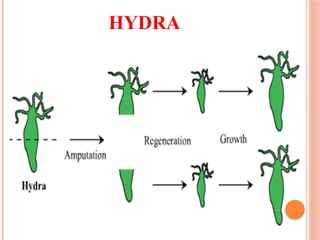
 A Hydra may be cut into two or more parts and each part
will reconstitute itself into a complete and new
individual of diminished size.
 The posterior end of a cut Hydra regenerates the mouth and
tentacles, the anterior part of the body regenerates the posterior
end with the foot and adhesive disc.
 Hydra may be cut into two or more parts and each part will
reconstitute itself into a complete and new individual of
diminished size.
 The posterior end of a cut Hydra regenerates the mouth and
tentacles, the anterior part of the body regenerates the posterior
end with the foot and adhesive disc.
 Even small sections of the body comprising as little as 1/200
parts of the original in individual, can regenerate a complete
animal.
 A type of repair involving a reorganization of the remaining part
of the body of an animal is known as morphallaxis or
morphallactic regeneration.
 If only smaller parts from the Hydra, the remodeling of the
remaining body is not so extensive, and with very small defects
the regeneration approaches the epimorphic type, even though a
HYDRA
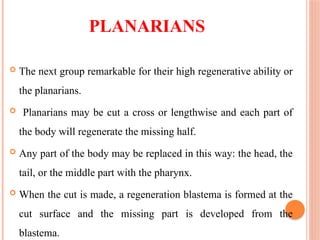
PLANARIANS
 The next group remarkable for their high regenerative ability or
the planarians.
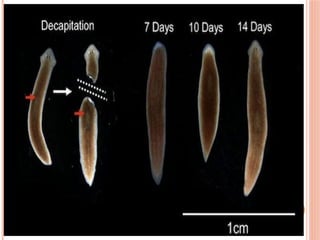
 Planarians may be cut a cross or lengthwise and each part of
the body will regenerate the missing half.
 Any part of the body may be replaced in this way: the head, the
tail, or the middle part with the pharynx.
 When the cut is made, a regeneration blastema is formed at the
cut surface and the missing part is developed from the
blastema.
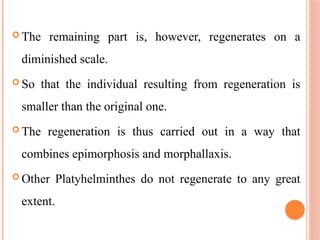
 The remaining part is, however, regenerates on a
diminished scale.
 So that the individual resulting from regeneration is
smaller than the original one.
 The regeneration is thus carried out in a way that
combines epimorphosis and morphallaxis.
 Other Platyhelminthes do not regenerate to any great
extent.
NEMERTEANS
 The nemertean has a high regenerative ability, and a complete
worm may be formed starting even from very small fragments.
 Many experiments have been carried out regeneration in the
annelids.
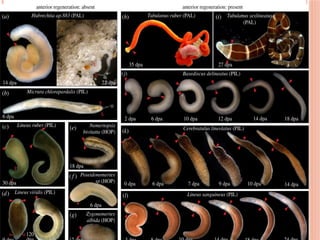
 Both Polycheate and oligocheates regenerate anterior and
posterior ends after an amputation.
 If an earthworm or other oligocheates is cut into halves, the
posterior half regenerates the anterior end with the mouth, and
the anterior end regenerates a new posterior end.
ANNELIDS
 In the earthworm Allobophora foetida this number is four or five.
 If five segments or less are cut off for the anterior end of the
worm.
 The regeneration is complete if more than five segments are
removed, only four or five segments well be recognized and the
worm will thus not attain the same overall number of segments as
it had before the operation.
 If the cut is carried out behind the genital segment.
 Only four or five anterior segments are recognized and the
genital organs are thus even renewed.
 On the other hand, there is no restriction in the regenerations of
posterior segments, and about as many are formed as have been
removed.
 The process of regeneration is an epimorphosis, a regeneration
but being formed and the new parts developing at the expense of
this bud.
 Hirudinea do not regenerate at all.
NEMATODS
 In nematodes, the regenerative ability is very low.
 This may be connected with the high degree of differentiation
of the cells of their bodies and the fixed limit to the total
number of cells.
 Only the closure of superficial wounds is still possible.
MOLLUSKS
 In mollusks, the regeneration is relatively poor.
 In gastropods, eyes stalks with eyes may be regenerated as well
as part of the head or of the foot.
 The whole head does not regenerate, and if the cerebral ganglia
are removed together with a part of head, these will not
regenerate.
 The arms of cephalopods may regenerates but not other parts of
their body.
 1.2: Arthropods
ARTHROPODS
 In arthropods, regeneration is limited to the renewal of lost
appendages, but this form of regeneration is fairly widespread.
 In most crustaceans the limbs may regenerate at any stage of
development, including the adult.
 In insects, limb regeneration occurs only in the larval stage and
the regenerated limb often does not reach the size of a normal
limb.
 The legs of crabs and some spiders are readily shed if seized by
any enemy.
 The legs break off at a preformed breaking point, across the
second leg joint.
 At this point there is a constriction which is a modified joint.
 The leg is broken off by the violent contraction of a muscle.
 This self-mutilation is known as autonomy.
 Autonomy is probably a special adaptation which helps the
animal to escape being caught by a predator.
 If the predator gets hold of one limb, he succeeds in capturing
only the limb but not the animal, the latter escaping at the expense
of the loss of the limb.
 After the amputation or loss of an appendage in arthropods, the
wound is covered by a chitinous plug.
 Underneath this, a regeneration bud is formed which latter
reproduces the limb by way of epimorphic regeneration.
 The new limb does not, however, become apparent until the next
molt.
 The regenerated limb is small at first and attains normal
proportion as a result of accelerated growth in the course of the
several molts.
ECHINODERM
 Among the echinoderms, starfishes, brittle stars and sea lilies
can regenerate arms and parts of disc.
 The arms appear to be lost rather often in natural conditions as
Individuals regenerating one or more arms are found quite
frequently.
 The holothuroidea are capable of ejecting through the anus part
of their internal organs the respiratory tree and the elementary
canal.
 These can be regenerated latter.
 In vertebrates regenerative power is most spectacular
in the urodele amphibians.
 In newts and salamanders and specially in their larva,
not only limbs can regenerate but also tails and
external gills and, furthermore, the upper and lower
Jaws.
 Parts of the eye can likewise regenerate, such as the
lens and the retina
 If most of the eye is removed, it can be regenerated
as long as small part is left, and the new eye
developed at the expense of the remaining fragment.
 In the anural amphibians, the faculty for regeneration
is restricted to the larval stage of their development.
 Frog and toad tadpoles are able to regenerate their
limbs and their tails.
 The legs of adult frogs and toads do not normally
regenerate at all.
FISHES
 In fishes, regeneration is very restricted.
 The fins can degenerate if cut off or damaged, but
the tail does not regenerate.
REPTILES
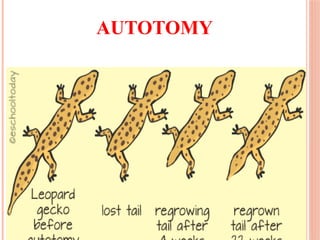
 The lizards are known to regenerate their tails. Such
regeneration follows autotomy.
 The tails are broken off at a preformed level near the base of the
tail.
 To release the mechanism of autotomy, the distal part of the tail
must be injured or Grabbed with such force as to cause the
animal discomfort.
 After the tail is shed, the regeneration bud is formed on the
wound surface, and this give rise to new tail.
 The latter, however, differs from the original tail; the
vertebral column is of a simplified structure.
 Scales covering the degenerated tail differ from the normal
ones.
 The legs and even the digits in these animals cannot
regenerate completely, though very rudimentary structures are
sometimes formed on the site of an amputation.
AUTOTOMY
BIRDS
In birds, parts of the beam can be
regenerated, but otherwise their regenerative
ability is rather poor.
MAMMALS
 In mammals, limbs do not regenerate spontaneously
even if amputated in a fetal stage.
 However, in infant opossums, which like other
marsupials, are rather incompletely differentiated at
birth.
 Amputated hind limbs were found to possess a
considerable ability for regeneration when stimulated
by implantation of fragment of brain tissue into limb.
 Otherwise, regeneration ability is limited to tissue regeneration,
but restoration of lost organs.
 Tissues regeneration is often equivalent to wound healing.
 Thus skin wounds may be covered by newly formed epidermis
and connective tissue.
 In large skin wounds, newly formed connective tissue differs
from the normal dermis.
 The skeletal tissue has a high regenerative ability.
 If parts of individual muscle are removed, the defects can be
repaired by a proliferation.
 Lesions in the tendons can be replaced by connective
tissue in the first place; the connective later acquires the
structure and mechanical property of the tendon.
 The tissues of some internal organs are able to
proliferate to a great extent .
 This is found to a striking degree in the case of the liver.
 The greater part of this organ may be removed, and the
remaining part then proliferates and restores the normal
mass of liver parenchyma.
 In other cases this explanation does not hold, it does not tell
us ,for intense , why the fishes regenerate to a lesser degree
than the amphibians , although the later are supposed to be
derived from the former in the force of evolution .
 With one and the same species of animals, the ability to
regenerate may be greater in the earlier stages of ontogenetic
cycle.
 Legs may be regenerated in tadpoles but not in adult frogs.
 Adult insects cannot regenerate legs, although the larvae or
nymphs are capable of regeneration.
 It may be recalled in this connection that parts of early embryos
are sometimes able to develop into whole animals.
 Whereas corresponding parts at a later stage are not even viable,
such as when the cleavage stage of an amphibian egg is
compared with an adult amphibian, or even with an embryo after
the end of gastrulation.
The skeletal tissue has a high regenerative
ability.
Large defects in bones, especially those of the
limbs, can be made good.
The tissues of some internal organs are able to
proliferate to a great extent.
 Thus to compensate for the loss of large parts of
the organ.
This is found to a striking degree in the case of
the liver.
CONCLUSION
It may be concluded that a renewal of the morphogenetic
process in regeneration occurs more easily if normal
morphogenesis is still under way.
If the morphogenetic processes of normal ontogenesis
have come to a complete standstill, it is more difficult or
even impossible to get them going again.
2 REGENERATIVE ABILITIES IN VARIOUS ANIMALS.pptx

2 REGENERATIVE ABILITIES IN VARIOUS ANIMALS.pptx

  • 1.
  • 2.
    CONTENTS  Regeneration ininvertebrates  Nematodes  Arthropods  Regeneration in vertebrates  Fishes  Amphibians  Reptiles  Birds  Mammals  Conclusion
  • 3.
    REGENERATION Regeneration is thesequence of morphogenetic events that restores the normal structure of an organ after its partial or total amputation.
  • 4.
    COELENTRATES  In thecoelenterates, the regenerative abilities are exceedingly high.  It was the regeneration of fresh water polyp, Hydra, first discovered by Tremble in 1740, that attracted the attraction of the scientists to this phenomenon.  A Hydra may be cut into two or more parts and each part will reconstitute itself into a complete and new individual of diminished size.
  • 5.
     The posteriorend of a cut Hydra regenerates the mouth and tentacles, the anterior part of the body regenerates the posterior end with the foot and adhesive disc.  Hydra may be cut into two or more parts and each part will reconstitute itself into a complete and new individual of diminished size.  The posterior end of a cut Hydra regenerates the mouth and tentacles, the anterior part of the body regenerates the posterior end with the foot and adhesive disc.
  • 6.
     Even smallsections of the body comprising as little as 1/200 parts of the original in individual, can regenerate a complete animal.  A type of repair involving a reorganization of the remaining part of the body of an animal is known as morphallaxis or morphallactic regeneration.  If only smaller parts from the Hydra, the remodeling of the remaining body is not so extensive, and with very small defects the regeneration approaches the epimorphic type, even though a
  • 7.
  • 8.
    PLANARIANS  The nextgroup remarkable for their high regenerative ability or the planarians.  Planarians may be cut a cross or lengthwise and each part of the body will regenerate the missing half.  Any part of the body may be replaced in this way: the head, the tail, or the middle part with the pharynx.  When the cut is made, a regeneration blastema is formed at the cut surface and the missing part is developed from the blastema.
  • 9.
     The remainingpart is, however, regenerates on a diminished scale.  So that the individual resulting from regeneration is smaller than the original one.  The regeneration is thus carried out in a way that combines epimorphosis and morphallaxis.  Other Platyhelminthes do not regenerate to any great extent.
  • 11.
    NEMERTEANS  The nemerteanhas a high regenerative ability, and a complete worm may be formed starting even from very small fragments.  Many experiments have been carried out regeneration in the annelids.  Both Polycheate and oligocheates regenerate anterior and posterior ends after an amputation.  If an earthworm or other oligocheates is cut into halves, the posterior half regenerates the anterior end with the mouth, and the anterior end regenerates a new posterior end.
  • 13.
    ANNELIDS  In theearthworm Allobophora foetida this number is four or five.  If five segments or less are cut off for the anterior end of the worm.  The regeneration is complete if more than five segments are removed, only four or five segments well be recognized and the worm will thus not attain the same overall number of segments as it had before the operation.  If the cut is carried out behind the genital segment.
  • 14.
     Only fouror five anterior segments are recognized and the genital organs are thus even renewed.  On the other hand, there is no restriction in the regenerations of posterior segments, and about as many are formed as have been removed.  The process of regeneration is an epimorphosis, a regeneration but being formed and the new parts developing at the expense of this bud.  Hirudinea do not regenerate at all.
  • 15.
    NEMATODS  In nematodes,the regenerative ability is very low.  This may be connected with the high degree of differentiation of the cells of their bodies and the fixed limit to the total number of cells.  Only the closure of superficial wounds is still possible.
  • 16.
    MOLLUSKS  In mollusks,the regeneration is relatively poor.  In gastropods, eyes stalks with eyes may be regenerated as well as part of the head or of the foot.  The whole head does not regenerate, and if the cerebral ganglia are removed together with a part of head, these will not regenerate.  The arms of cephalopods may regenerates but not other parts of their body.  1.2: Arthropods
  • 17.
    ARTHROPODS  In arthropods,regeneration is limited to the renewal of lost appendages, but this form of regeneration is fairly widespread.  In most crustaceans the limbs may regenerate at any stage of development, including the adult.  In insects, limb regeneration occurs only in the larval stage and the regenerated limb often does not reach the size of a normal limb.  The legs of crabs and some spiders are readily shed if seized by any enemy.
  • 18.
     The legsbreak off at a preformed breaking point, across the second leg joint.  At this point there is a constriction which is a modified joint.  The leg is broken off by the violent contraction of a muscle.  This self-mutilation is known as autonomy.  Autonomy is probably a special adaptation which helps the animal to escape being caught by a predator.  If the predator gets hold of one limb, he succeeds in capturing only the limb but not the animal, the latter escaping at the expense of the loss of the limb.
  • 19.
     After theamputation or loss of an appendage in arthropods, the wound is covered by a chitinous plug.  Underneath this, a regeneration bud is formed which latter reproduces the limb by way of epimorphic regeneration.  The new limb does not, however, become apparent until the next molt.  The regenerated limb is small at first and attains normal proportion as a result of accelerated growth in the course of the several molts.
  • 20.
    ECHINODERM  Among theechinoderms, starfishes, brittle stars and sea lilies can regenerate arms and parts of disc.  The arms appear to be lost rather often in natural conditions as Individuals regenerating one or more arms are found quite frequently.  The holothuroidea are capable of ejecting through the anus part of their internal organs the respiratory tree and the elementary canal.  These can be regenerated latter.
  • 21.
     In vertebratesregenerative power is most spectacular in the urodele amphibians.  In newts and salamanders and specially in their larva, not only limbs can regenerate but also tails and external gills and, furthermore, the upper and lower Jaws.  Parts of the eye can likewise regenerate, such as the lens and the retina
  • 22.
     If mostof the eye is removed, it can be regenerated as long as small part is left, and the new eye developed at the expense of the remaining fragment.  In the anural amphibians, the faculty for regeneration is restricted to the larval stage of their development.  Frog and toad tadpoles are able to regenerate their limbs and their tails.  The legs of adult frogs and toads do not normally regenerate at all.
  • 23.
    FISHES  In fishes,regeneration is very restricted.  The fins can degenerate if cut off or damaged, but the tail does not regenerate.
  • 24.
    REPTILES  The lizardsare known to regenerate their tails. Such regeneration follows autotomy.  The tails are broken off at a preformed level near the base of the tail.  To release the mechanism of autotomy, the distal part of the tail must be injured or Grabbed with such force as to cause the animal discomfort.  After the tail is shed, the regeneration bud is formed on the wound surface, and this give rise to new tail.
  • 25.
     The latter,however, differs from the original tail; the vertebral column is of a simplified structure.  Scales covering the degenerated tail differ from the normal ones.  The legs and even the digits in these animals cannot regenerate completely, though very rudimentary structures are sometimes formed on the site of an amputation.
  • 26.
  • 27.
    BIRDS In birds, partsof the beam can be regenerated, but otherwise their regenerative ability is rather poor.
  • 28.
    MAMMALS  In mammals,limbs do not regenerate spontaneously even if amputated in a fetal stage.  However, in infant opossums, which like other marsupials, are rather incompletely differentiated at birth.  Amputated hind limbs were found to possess a considerable ability for regeneration when stimulated by implantation of fragment of brain tissue into limb.
  • 29.
     Otherwise, regenerationability is limited to tissue regeneration, but restoration of lost organs.  Tissues regeneration is often equivalent to wound healing.  Thus skin wounds may be covered by newly formed epidermis and connective tissue.  In large skin wounds, newly formed connective tissue differs from the normal dermis.  The skeletal tissue has a high regenerative ability.  If parts of individual muscle are removed, the defects can be repaired by a proliferation.
  • 30.
     Lesions inthe tendons can be replaced by connective tissue in the first place; the connective later acquires the structure and mechanical property of the tendon.  The tissues of some internal organs are able to proliferate to a great extent .  This is found to a striking degree in the case of the liver.  The greater part of this organ may be removed, and the remaining part then proliferates and restores the normal mass of liver parenchyma.
  • 31.
     In othercases this explanation does not hold, it does not tell us ,for intense , why the fishes regenerate to a lesser degree than the amphibians , although the later are supposed to be derived from the former in the force of evolution .  With one and the same species of animals, the ability to regenerate may be greater in the earlier stages of ontogenetic cycle.  Legs may be regenerated in tadpoles but not in adult frogs.
  • 32.
     Adult insectscannot regenerate legs, although the larvae or nymphs are capable of regeneration.  It may be recalled in this connection that parts of early embryos are sometimes able to develop into whole animals.  Whereas corresponding parts at a later stage are not even viable, such as when the cleavage stage of an amphibian egg is compared with an adult amphibian, or even with an embryo after the end of gastrulation.
  • 33.
    The skeletal tissuehas a high regenerative ability. Large defects in bones, especially those of the limbs, can be made good. The tissues of some internal organs are able to proliferate to a great extent.  Thus to compensate for the loss of large parts of the organ. This is found to a striking degree in the case of the liver.
  • 34.
    CONCLUSION It may beconcluded that a renewal of the morphogenetic process in regeneration occurs more easily if normal morphogenesis is still under way. If the morphogenetic processes of normal ontogenesis have come to a complete standstill, it is more difficult or even impossible to get them going again.