Regeneration
Amar joseph
MSc Zoology
Regeneration
 The process of renewal, restoration, and
growth that makes genomes, cells, organisms,
and ecosystems resilient to natural fluctuations or
events that cause disturbance or damage.
• If the tail of a house lizard is cut, the missing part
develops again from the remaining part of the tail.
• In some cases, regeneration is so advanced that an
entire multicellular body is reconstructed from a small
fragment of tissue.
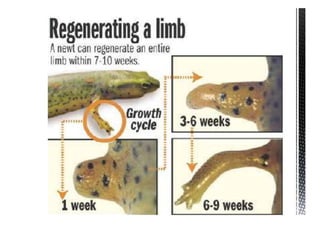
Regeneration of a Limb of a Newt
• The mechanism of regeneration in salamander involves the following
stages-
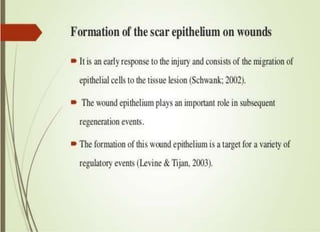
• Wound healing: The epidermal cells from the edges of the wound
migrate and
• spread over the exposed surface. This is known as wound healing.
• Blastema formation: A few days later, undifferentiated cells
accumulate inside the
• epidermis, resulting in a bulge. This is known as regeneration bud
or blastema.
• Redifferentiation and morphogenesis: The blastema develops
rudiments of the lost
• organ, like the digits which grow into new digits.
• Growth: The regenerated limb increases and attains the size of a
normal limb.
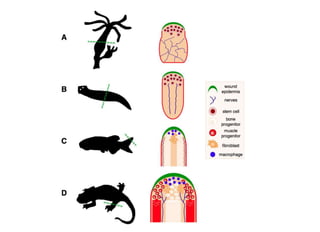
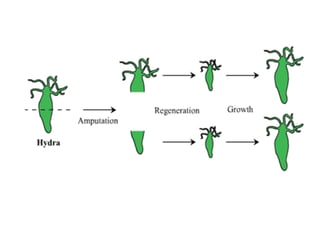
• In planarians and in Hydra, there are undifferentiated cells called
neoblasts whichmultiply and then migrate from the deeper parts of
the body to the cut surface.
Growth Factors
• Wound healing is due to accelerated mitosis. This is mediated by proteins called growth
• factors which act locally.
EGF
• Epidermal growth factor stimulates the epithelium to undergo mitosis. EGF is also
• produced in the salivary glands, which is why an animal's licking heals a wound.
FGF
• Fibroblast growth factor stimulates the endothelial cells of the blood vessels to divide and
• Heal the injured blood vessels.
Platelets
• Derived growth factor which stimulates the mitosis of fibroblasts at the site of injury to
fill
• In the damaged areas under the blood clot.
Polarity in Regeneration
• The body segments of Hydra or planarians exhibit distinct polarity during regeneration.
• Their anterior end always regenerates into head and posterior into the tail.
Regeneration
Regeneration
Regeneration
Regeneration
Regeneration
Regeneration

Regeneration

  • 1.
  • 2.
    Regeneration  The processof renewal, restoration, and growth that makes genomes, cells, organisms, and ecosystems resilient to natural fluctuations or events that cause disturbance or damage. • If the tail of a house lizard is cut, the missing part develops again from the remaining part of the tail. • In some cases, regeneration is so advanced that an entire multicellular body is reconstructed from a small fragment of tissue.
  • 7.
    Regeneration of aLimb of a Newt • The mechanism of regeneration in salamander involves the following stages- • Wound healing: The epidermal cells from the edges of the wound migrate and • spread over the exposed surface. This is known as wound healing. • Blastema formation: A few days later, undifferentiated cells accumulate inside the • epidermis, resulting in a bulge. This is known as regeneration bud or blastema. • Redifferentiation and morphogenesis: The blastema develops rudiments of the lost • organ, like the digits which grow into new digits. • Growth: The regenerated limb increases and attains the size of a normal limb. • In planarians and in Hydra, there are undifferentiated cells called neoblasts whichmultiply and then migrate from the deeper parts of the body to the cut surface.
  • 17.
    Growth Factors • Woundhealing is due to accelerated mitosis. This is mediated by proteins called growth • factors which act locally. EGF • Epidermal growth factor stimulates the epithelium to undergo mitosis. EGF is also • produced in the salivary glands, which is why an animal's licking heals a wound. FGF • Fibroblast growth factor stimulates the endothelial cells of the blood vessels to divide and • Heal the injured blood vessels. Platelets • Derived growth factor which stimulates the mitosis of fibroblasts at the site of injury to fill • In the damaged areas under the blood clot. Polarity in Regeneration • The body segments of Hydra or planarians exhibit distinct polarity during regeneration. • Their anterior end always regenerates into head and posterior into the tail.