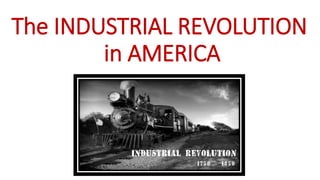
The INDUSTRIAL REVOLUTION
in AMERICA
1. Capital – money for investments
2. Factory system – a system that brings manufacturing steps together in one
place
3. Free enterprise – the freedom of private business to compete for profits, with
little government regulation
4. Technology – the use of scientific discoveries for practical uses; tools used for
production
5. Patent – a document that gives an inventor legal rights to his or her invention
6. Interchangeable parts – pieces that can be made in large quantities to replace
identical pieces
7. Commerce - the activity of buying and selling, especially on a large scale
8. Textiles – items made of cloth
9. Mass production – the making of large numbers of identical goods
10. Trade union – an organization of workers with the same skills
11. Strike – the refusal of workers to do their job until employers meet their
demands
12. Entrepreneur - a person who takes a financial risk to organize and operate a
business
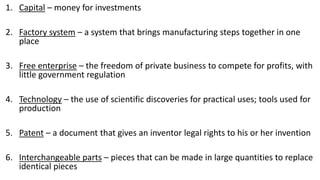
13. Canal – an artificial waterway
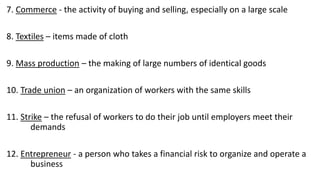
14. Steam engine - an engine that uses the condensation of steam to
generate power
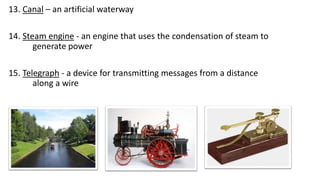
15. Telegraph - a device for transmitting messages from a distance
along a wire
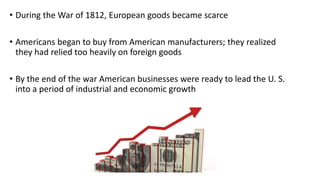
• During the War of 1812, European goods became scarce
• Americans began to buy from American manufacturers; they realized
they had relied too heavily on foreign goods
• By the end of the war American businesses were ready to lead the U. S.
into a period of industrial and economic growth
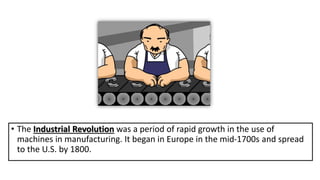
• The Industrial Revolution was a period of rapid growth in the use of
machines in manufacturing. It began in Europe in the mid-1700s and spread
to the U.S. by 1800.
IMPORTANT ADVANCES
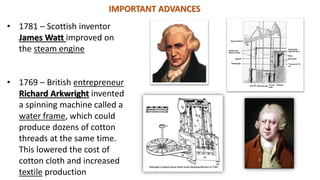
• 1781 – Scottish inventor
James Watt improved on
the steam engine
• 1769 – British entrepreneur
Richard Arkwright invented
a spinning machine called a
water frame, which could
produce dozens of cotton
threads at the same time.
This lowered the cost of
cotton cloth and increased
textile production
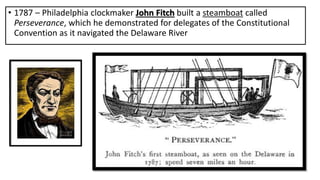
• 1787 – Philadelphia clockmaker John Fitch built a steamboat called
Perseverance, which he demonstrated for delegates of the Constitutional
Convention as it navigated the Delaware River
• To keep their technology secret, Britain had passed laws to keep their
machinery and their mechanics from leaving the country.
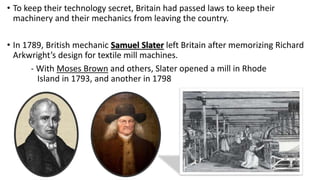
• In 1789, British mechanic Samuel Slater left Britain after memorizing Richard
Arkwright’s design for textile mill machines.
- With Moses Brown and others, Slater opened a mill in Rhode
Island in 1793, and another in 1798
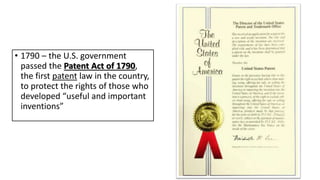
• 1790 – the U.S. government
passed the Patent Act of 1790,
the first patent law in the country,
to protect the rights of those who
developed “useful and important
inventions”
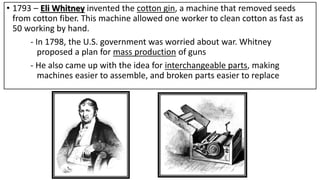
• 1793 – Eli Whitney invented the cotton gin, a machine that removed seeds
from cotton fiber. This machine allowed one worker to clean cotton as fast as
50 working by hand.
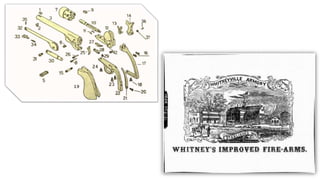
- In 1798, the U.S. government was worried about war. Whitney
proposed a plan for mass production of guns
- He also came up with the idea for interchangeable parts, making
machines easier to assemble, and broken parts easier to replace
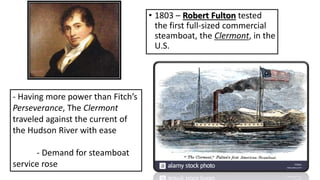
• 1803 – Robert Fulton tested
the first full-sized commercial
steamboat, the Clermont, in the
U.S.
- Having more power than Fitch’s
Perseverance, The Clermont
traveled against the current of
the Hudson River with ease
- Demand for steamboat
service rose
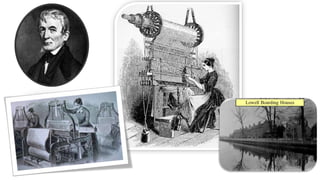
• 1814 – New England entrepreneur Francis Cabot Lowell opened his first textile
mill in Massachusetts
- He developed the Lowell System, a production method that included a loom
that could spin thread and weave cloth at the same time
- The machines were operated by young girls who had left family farms to work
in the factory
- These “Mill Girls” lived in boardinghouses near the mill, and worked up to 14
hours a day.
- In 1822, Lowell opened a larger mill in a town that would later be named
Lowell, Massachusetts
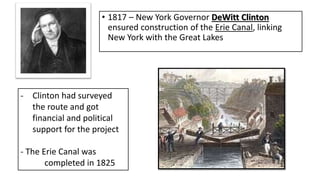
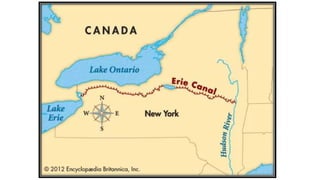
• 1817 – New York Governor DeWitt Clinton
ensured construction of the Erie Canal, linking
New York with the Great Lakes
- Clinton had surveyed
the route and got
financial and political
support for the project
- The Erie Canal was
completed in 1825
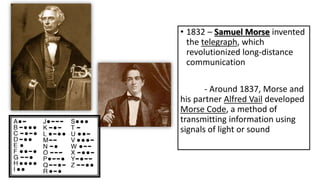
• 1832 – Samuel Morse invented
the telegraph, which
revolutionized long-distance
communication
- Around 1837, Morse and
his partner Alfred Vail developed
Morse Code, a method of
transmitting information using
signals of light or sound
EFFECTS OF THE INDUSTRIAL REVOLUTION IN THE U.S.
The presence of factories expanded, leading to the growth of towns and cities
In heavily populated cities, with no sewers to carry factory and animal waste
away, disease spread quickly. In 1793, a yellow fever epidemic in Philadelphia
killed thousands of people
City life grew to include libraries, museums, and shops not found in rural
communities
Canals united the Eastern and Midwestern parts of the U.S.
Communicating long distances quickly became possible
The expansion of industrialization in the North and concentration on
agriculture in the South caused the two regions to develop significant economic
and cultural differences
Soc studies #23 industrial revolution

Soc studies #23 industrial revolution

  • 1.
  • 2.
    1. Capital –money for investments 2. Factory system – a system that brings manufacturing steps together in one place 3. Free enterprise – the freedom of private business to compete for profits, with little government regulation 4. Technology – the use of scientific discoveries for practical uses; tools used for production 5. Patent – a document that gives an inventor legal rights to his or her invention 6. Interchangeable parts – pieces that can be made in large quantities to replace identical pieces
  • 3.
    7. Commerce -the activity of buying and selling, especially on a large scale 8. Textiles – items made of cloth 9. Mass production – the making of large numbers of identical goods 10. Trade union – an organization of workers with the same skills 11. Strike – the refusal of workers to do their job until employers meet their demands 12. Entrepreneur - a person who takes a financial risk to organize and operate a business
  • 4.
    13. Canal –an artificial waterway 14. Steam engine - an engine that uses the condensation of steam to generate power 15. Telegraph - a device for transmitting messages from a distance along a wire
  • 6.
    • During theWar of 1812, European goods became scarce • Americans began to buy from American manufacturers; they realized they had relied too heavily on foreign goods • By the end of the war American businesses were ready to lead the U. S. into a period of industrial and economic growth
  • 7.
    • The IndustrialRevolution was a period of rapid growth in the use of machines in manufacturing. It began in Europe in the mid-1700s and spread to the U.S. by 1800.
  • 8.
    IMPORTANT ADVANCES • 1781– Scottish inventor James Watt improved on the steam engine • 1769 – British entrepreneur Richard Arkwright invented a spinning machine called a water frame, which could produce dozens of cotton threads at the same time. This lowered the cost of cotton cloth and increased textile production
  • 9.
    • 1787 –Philadelphia clockmaker John Fitch built a steamboat called Perseverance, which he demonstrated for delegates of the Constitutional Convention as it navigated the Delaware River
  • 10.
    • To keeptheir technology secret, Britain had passed laws to keep their machinery and their mechanics from leaving the country. • In 1789, British mechanic Samuel Slater left Britain after memorizing Richard Arkwright’s design for textile mill machines. - With Moses Brown and others, Slater opened a mill in Rhode Island in 1793, and another in 1798
  • 11.
    • 1790 –the U.S. government passed the Patent Act of 1790, the first patent law in the country, to protect the rights of those who developed “useful and important inventions”
  • 13.
    • 1793 –Eli Whitney invented the cotton gin, a machine that removed seeds from cotton fiber. This machine allowed one worker to clean cotton as fast as 50 working by hand. - In 1798, the U.S. government was worried about war. Whitney proposed a plan for mass production of guns - He also came up with the idea for interchangeable parts, making machines easier to assemble, and broken parts easier to replace
  • 15.
    • 1803 –Robert Fulton tested the first full-sized commercial steamboat, the Clermont, in the U.S. - Having more power than Fitch’s Perseverance, The Clermont traveled against the current of the Hudson River with ease - Demand for steamboat service rose
  • 16.
    • 1814 –New England entrepreneur Francis Cabot Lowell opened his first textile mill in Massachusetts - He developed the Lowell System, a production method that included a loom that could spin thread and weave cloth at the same time - The machines were operated by young girls who had left family farms to work in the factory - These “Mill Girls” lived in boardinghouses near the mill, and worked up to 14 hours a day. - In 1822, Lowell opened a larger mill in a town that would later be named Lowell, Massachusetts
  • 19.
    • 1817 –New York Governor DeWitt Clinton ensured construction of the Erie Canal, linking New York with the Great Lakes - Clinton had surveyed the route and got financial and political support for the project - The Erie Canal was completed in 1825
  • 21.
    • 1832 –Samuel Morse invented the telegraph, which revolutionized long-distance communication - Around 1837, Morse and his partner Alfred Vail developed Morse Code, a method of transmitting information using signals of light or sound
  • 22.
    EFFECTS OF THEINDUSTRIAL REVOLUTION IN THE U.S. The presence of factories expanded, leading to the growth of towns and cities In heavily populated cities, with no sewers to carry factory and animal waste away, disease spread quickly. In 1793, a yellow fever epidemic in Philadelphia killed thousands of people City life grew to include libraries, museums, and shops not found in rural communities Canals united the Eastern and Midwestern parts of the U.S. Communicating long distances quickly became possible The expansion of industrialization in the North and concentration on agriculture in the South caused the two regions to develop significant economic and cultural differences