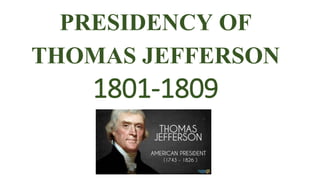
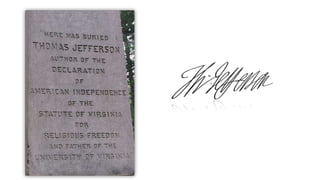
PRESIDENCY OF
THOMAS JEFFERSON
1801-1809
1. Incumbent – currently in office
2. Judicial review – the right of the Supreme Court to determine if a law violates
the Constitution
3. Customs duties – taxes on foreign imported goods
4. Frontiersman - a man living in the region between settled and unsettled
country
5. Embargo – an order that prohibits trade with another country
6. Impressment – the practice of forcing people to serve in the army or navy
• The election of 1800 was full of contention (heated disagreement)
• The Federalist candidates were John Adams (incumbent) and Charles Pinckney
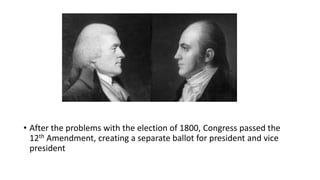
• The Democratic-Republican candidates were Thomas Jefferson and Aaron Burr
• The election ended in a tie, with Jefferson and Burr each receiving 73 electoral
votes
• After days of voting in the House of Representatives, Thomas Jefferson
became the third president of the U. S., with Aaron Burr as his vice president
• After the problems with the election of 1800, Congress passed the
12th Amendment, creating a separate ballot for president and vice
president
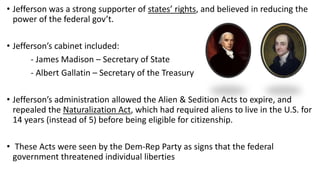
• Jefferson was a strong supporter of states’ rights, and believed in reducing the
power of the federal gov’t.
• Jefferson’s cabinet included:
- James Madison – Secretary of State
- Albert Gallatin – Secretary of the Treasury
• Jefferson’s administration allowed the Alien & Sedition Acts to expire, and
repealed the Naturalization Act, which had required aliens to live in the U.S. for
14 years (instead of 5) before being eligible for citizenship.
• These Acts were seen by the Dem-Rep Party as signs that the federal
government threatened individual liberties
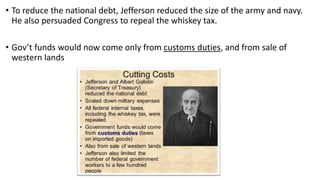
• To reduce the national debt, Jefferson reduced the size of the army and navy.
He also persuaded Congress to repeal the whiskey tax.
• Gov’t funds would now come only from customs duties, and from sale of
western lands
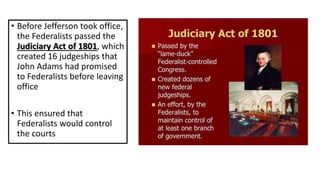
• Before Jefferson took office,
the Federalists passed the
Judiciary Act of 1801, which
created 16 judgeships that
John Adams had promised
to Federalists before leaving
office
• This ensured that
Federalists would control
the courts
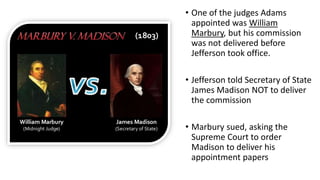
• One of the judges Adams
appointed was William
Marbury, but his commission
was not delivered before
Jefferson took office.
• Jefferson told Secretary of State
James Madison NOT to deliver
the commission
• Marbury sued, asking the
Supreme Court to order
Madison to deliver his
appointment papers
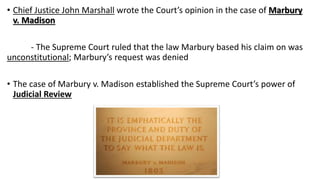
• Chief Justice John Marshall wrote the Court’s opinion in the case of Marbury
v. Madison
- The Supreme Court ruled that the law Marbury based his claim on was
unconstitutional; Marbury’s request was denied
• The case of Marbury v. Madison established the Supreme Court’s power of
Judicial Review
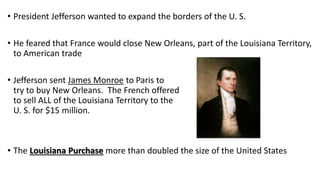
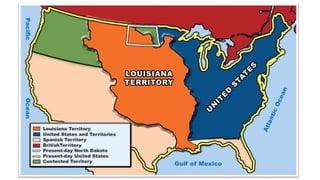
• President Jefferson wanted to expand the borders of the U. S.
• He feared that France would close New Orleans, part of the Louisiana Territory,
to American trade
• Jefferson sent James Monroe to Paris to
try to buy New Orleans. The French offered
to sell ALL of the Louisiana Territory to the
U. S. for $15 million.
• The Louisiana Purchase more than doubled the size of the United States
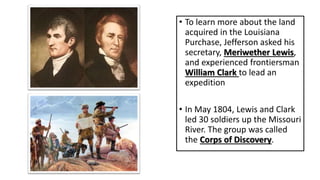
• To learn more about the land
acquired in the Louisiana
Purchase, Jefferson asked his
secretary, Meriwether Lewis,
and experienced frontiersman
William Clark to lead an
expedition
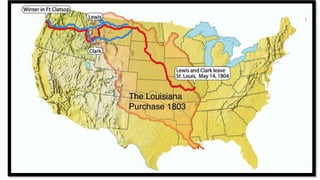
• In May 1804, Lewis and Clark
led 30 soldiers up the Missouri
River. The group was called
the Corps of Discovery.
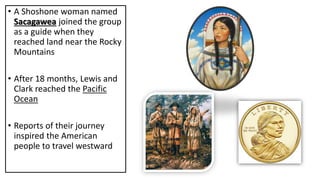
• A Shoshone woman named
Sacagawea joined the group
as a guide when they
reached land near the Rocky
Mountains
• After 18 months, Lewis and
Clark reached the Pacific
Ocean
• Reports of their journey
inspired the American
people to travel westward
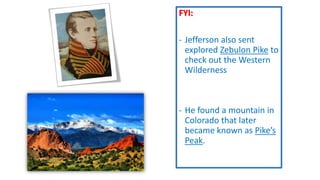
FYI:
- Jefferson also sent
explored Zebulon Pike to
check out the Western
Wilderness
- He found a mountain in
Colorado that later
became known as Pike’s
Peak.
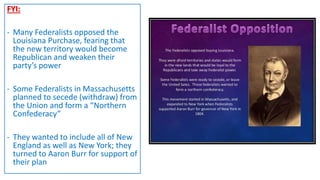
FYI:
- Many Federalists opposed the
Louisiana Purchase, fearing that
the new territory would become
Republican and weaken their
party’s power
- Some Federalists in Massachusetts
planned to secede (withdraw) from
the Union and form a “Northern
Confederacy”
- They wanted to include all of New
England as well as New York; they
turned to Aaron Burr for support of
their plan
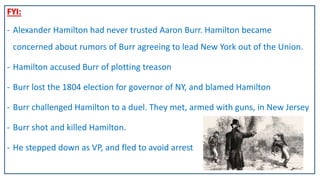
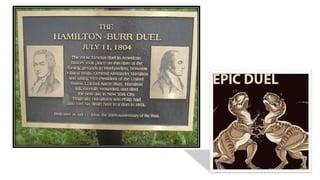
FYI:
- Alexander Hamilton had never trusted Aaron Burr. Hamilton became
concerned about rumors of Burr agreeing to lead New York out of the Union.
- Hamilton accused Burr of plotting treason
- Burr lost the 1804 election for governor of NY, and blamed Hamilton
- Burr challenged Hamilton to a duel. They met, armed with guns, in New Jersey
- Burr shot and killed Hamilton.
- He stepped down as VP, and fled to avoid arrest
• Great Britain and France were still at war; each country wanted to stop the
other from trading with the U.S.
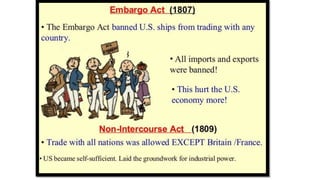
• In 1808, Jefferson urged Congress to pass the Embargo Act. This law banned
trade with all foreign countries
• The Embargo Act was the U.S. response to Britain’s practice of impressment of
U.S. citizens after they stopped and searched American ships
• Under the Embargo Act, American ships could not sail to foreign ports, and
American ports were closed to British and French ships
• By passing the Act, Congress hoped to punish Britain and France and protect
American merchant ships from capture
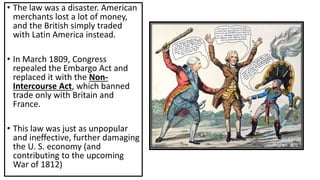
• The law was a disaster. American
merchants lost a lot of money,
and the British simply traded
with Latin America instead.
• In March 1809, Congress
repealed the Embargo Act and
replaced it with the Non-
Intercourse Act, which banned
trade only with Britain and
France.
• This law was just as unpopular
and ineffective, further damaging
the U. S. economy (and
contributing to the upcoming
War of 1812)
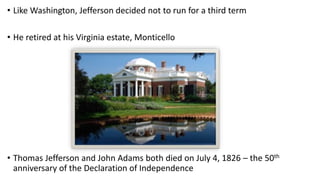
• Like Washington, Jefferson decided not to run for a third term
• He retired at his Virginia estate, Monticello
• Thomas Jefferson and John Adams both died on July 4, 1826 – the 50th
anniversary of the Declaration of Independence
Soc studies #21 thomas jefferson

Soc studies #21 thomas jefferson

  • 1.
  • 2.
    1. Incumbent –currently in office 2. Judicial review – the right of the Supreme Court to determine if a law violates the Constitution 3. Customs duties – taxes on foreign imported goods 4. Frontiersman - a man living in the region between settled and unsettled country 5. Embargo – an order that prohibits trade with another country 6. Impressment – the practice of forcing people to serve in the army or navy
  • 3.
    • The electionof 1800 was full of contention (heated disagreement) • The Federalist candidates were John Adams (incumbent) and Charles Pinckney • The Democratic-Republican candidates were Thomas Jefferson and Aaron Burr • The election ended in a tie, with Jefferson and Burr each receiving 73 electoral votes • After days of voting in the House of Representatives, Thomas Jefferson became the third president of the U. S., with Aaron Burr as his vice president
  • 4.
    • After theproblems with the election of 1800, Congress passed the 12th Amendment, creating a separate ballot for president and vice president
  • 6.
    • Jefferson wasa strong supporter of states’ rights, and believed in reducing the power of the federal gov’t. • Jefferson’s cabinet included: - James Madison – Secretary of State - Albert Gallatin – Secretary of the Treasury • Jefferson’s administration allowed the Alien & Sedition Acts to expire, and repealed the Naturalization Act, which had required aliens to live in the U.S. for 14 years (instead of 5) before being eligible for citizenship. • These Acts were seen by the Dem-Rep Party as signs that the federal government threatened individual liberties
  • 7.
    • To reducethe national debt, Jefferson reduced the size of the army and navy. He also persuaded Congress to repeal the whiskey tax. • Gov’t funds would now come only from customs duties, and from sale of western lands
  • 8.
    • Before Jeffersontook office, the Federalists passed the Judiciary Act of 1801, which created 16 judgeships that John Adams had promised to Federalists before leaving office • This ensured that Federalists would control the courts
  • 9.
    • One ofthe judges Adams appointed was William Marbury, but his commission was not delivered before Jefferson took office. • Jefferson told Secretary of State James Madison NOT to deliver the commission • Marbury sued, asking the Supreme Court to order Madison to deliver his appointment papers
  • 10.
    • Chief JusticeJohn Marshall wrote the Court’s opinion in the case of Marbury v. Madison - The Supreme Court ruled that the law Marbury based his claim on was unconstitutional; Marbury’s request was denied • The case of Marbury v. Madison established the Supreme Court’s power of Judicial Review
  • 12.
    • President Jeffersonwanted to expand the borders of the U. S. • He feared that France would close New Orleans, part of the Louisiana Territory, to American trade • Jefferson sent James Monroe to Paris to try to buy New Orleans. The French offered to sell ALL of the Louisiana Territory to the U. S. for $15 million. • The Louisiana Purchase more than doubled the size of the United States
  • 14.
    • To learnmore about the land acquired in the Louisiana Purchase, Jefferson asked his secretary, Meriwether Lewis, and experienced frontiersman William Clark to lead an expedition • In May 1804, Lewis and Clark led 30 soldiers up the Missouri River. The group was called the Corps of Discovery.
  • 15.
    • A Shoshonewoman named Sacagawea joined the group as a guide when they reached land near the Rocky Mountains • After 18 months, Lewis and Clark reached the Pacific Ocean • Reports of their journey inspired the American people to travel westward
  • 17.
    FYI: - Jefferson alsosent explored Zebulon Pike to check out the Western Wilderness - He found a mountain in Colorado that later became known as Pike’s Peak.
  • 18.
    FYI: - Many Federalistsopposed the Louisiana Purchase, fearing that the new territory would become Republican and weaken their party’s power - Some Federalists in Massachusetts planned to secede (withdraw) from the Union and form a “Northern Confederacy” - They wanted to include all of New England as well as New York; they turned to Aaron Burr for support of their plan
  • 19.
    FYI: - Alexander Hamiltonhad never trusted Aaron Burr. Hamilton became concerned about rumors of Burr agreeing to lead New York out of the Union. - Hamilton accused Burr of plotting treason - Burr lost the 1804 election for governor of NY, and blamed Hamilton - Burr challenged Hamilton to a duel. They met, armed with guns, in New Jersey - Burr shot and killed Hamilton. - He stepped down as VP, and fled to avoid arrest
  • 21.
    • Great Britainand France were still at war; each country wanted to stop the other from trading with the U.S. • In 1808, Jefferson urged Congress to pass the Embargo Act. This law banned trade with all foreign countries • The Embargo Act was the U.S. response to Britain’s practice of impressment of U.S. citizens after they stopped and searched American ships • Under the Embargo Act, American ships could not sail to foreign ports, and American ports were closed to British and French ships • By passing the Act, Congress hoped to punish Britain and France and protect American merchant ships from capture
  • 22.
    • The lawwas a disaster. American merchants lost a lot of money, and the British simply traded with Latin America instead. • In March 1809, Congress repealed the Embargo Act and replaced it with the Non- Intercourse Act, which banned trade only with Britain and France. • This law was just as unpopular and ineffective, further damaging the U. S. economy (and contributing to the upcoming War of 1812)
  • 24.
    • Like Washington,Jefferson decided not to run for a third term • He retired at his Virginia estate, Monticello • Thomas Jefferson and John Adams both died on July 4, 1826 – the 50th anniversary of the Declaration of Independence