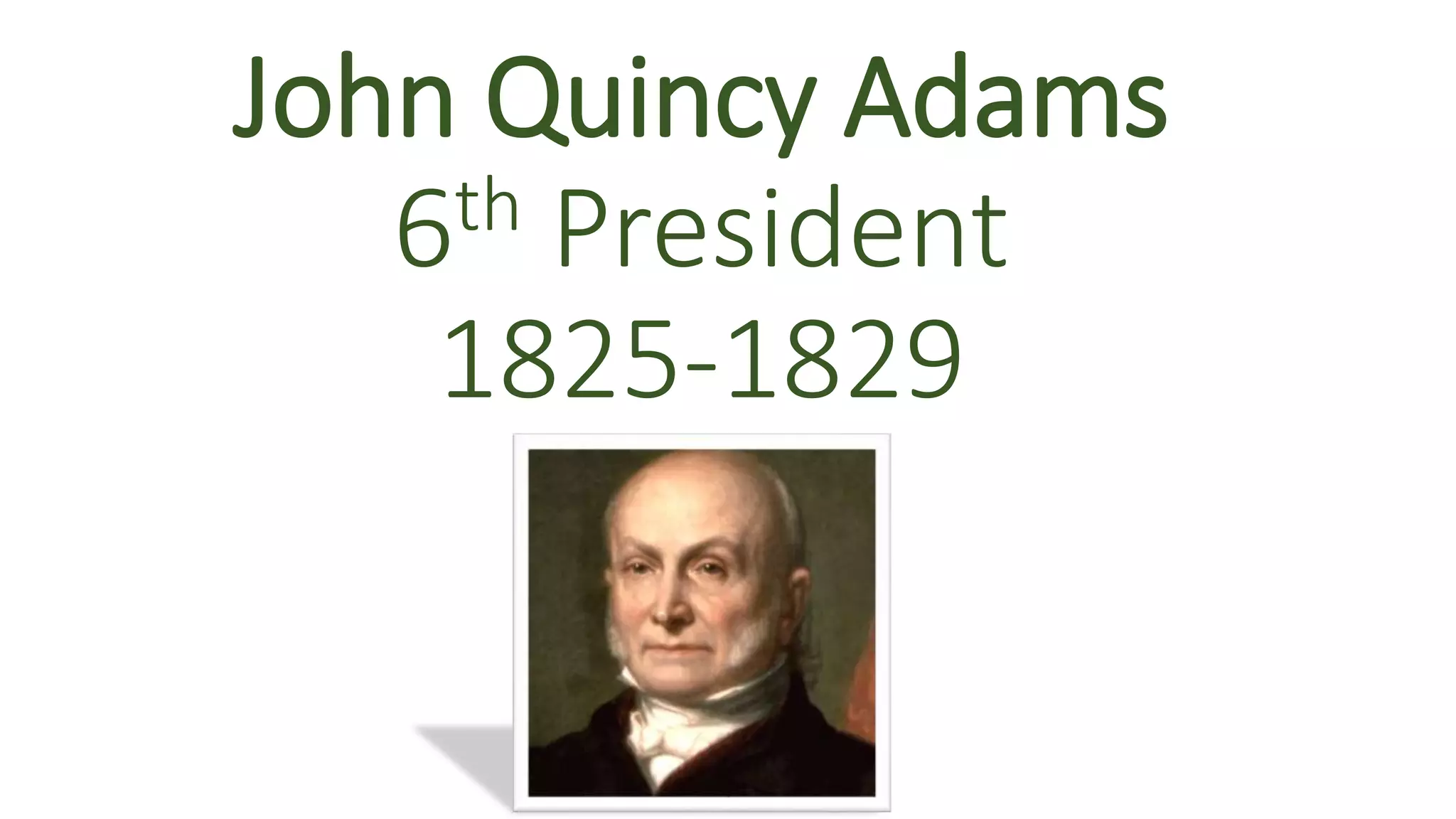
John Quincy Adams
6th President
1825-1829
• From 1816 to 1824 only one political party existed in the U.S.
• During the election of 1824, these “Jeffersonian Republicans” had four
candidates for the presidency
• The party nominated William H. Crawford
• The other three were “favorite son” candidates.
- this referred to a candidate who received backing from his home
state rather than from the national party
• The favorite son candidates were:
- Andrew Jackson from Tennessee
- Henry Clay from Kentucky
- John Quincy Adams from Massachusetts
• Though Jackson received the largest number of popular votes, no candidate
received a majority (more than half) of the electoral votes
• According to the 12th Amendment, when this occurs, the election is decided
by the House of Representatives
• The House elected John Quincy Adams
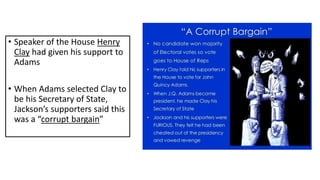
• Speaker of the House Henry
Clay had given his support to
Adams
• When Adams selected Clay to
be his Secretary of State,
Jackson’s supporters said this
was a “corrupt bargain”
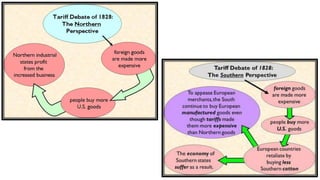
• In 1828, Congress passed a high tariff on manufactured goods from Europe
• Northern manufacturers welcomed the tariff because it made goods from
Europe more expensive, so Americans would be more likely to buy American
made items
• In the South, the tariff was hated; they argued that the tariff would keep
Europe from buying their goods, and would drive prices up.
• They called it the Tariff of Abominations
• The “corrupt bargain”,
the rise in sectionalism
between the North and
South, passing the Tariff
of Abominations, and
lack of support from
Congress caused Adams’
presidency to starkly
contrast Monroe’s
• John Quincy Adams
would serve only one
term as president

Soc studies #25 john quincy adams

  • 1.
    John Quincy Adams 6thPresident 1825-1829
  • 2.
    • From 1816to 1824 only one political party existed in the U.S. • During the election of 1824, these “Jeffersonian Republicans” had four candidates for the presidency • The party nominated William H. Crawford • The other three were “favorite son” candidates. - this referred to a candidate who received backing from his home state rather than from the national party
  • 3.
    • The favoriteson candidates were: - Andrew Jackson from Tennessee - Henry Clay from Kentucky - John Quincy Adams from Massachusetts • Though Jackson received the largest number of popular votes, no candidate received a majority (more than half) of the electoral votes • According to the 12th Amendment, when this occurs, the election is decided by the House of Representatives • The House elected John Quincy Adams
  • 4.
    • Speaker ofthe House Henry Clay had given his support to Adams • When Adams selected Clay to be his Secretary of State, Jackson’s supporters said this was a “corrupt bargain”
  • 5.
    • In 1828,Congress passed a high tariff on manufactured goods from Europe • Northern manufacturers welcomed the tariff because it made goods from Europe more expensive, so Americans would be more likely to buy American made items • In the South, the tariff was hated; they argued that the tariff would keep Europe from buying their goods, and would drive prices up. • They called it the Tariff of Abominations
  • 7.
    • The “corruptbargain”, the rise in sectionalism between the North and South, passing the Tariff of Abominations, and lack of support from Congress caused Adams’ presidency to starkly contrast Monroe’s • John Quincy Adams would serve only one term as president